
Snitchnotes Team
Why Do Stars Twinkle but Planets Do Not?
Why Do Stars Twinkle but Planets Do Not?
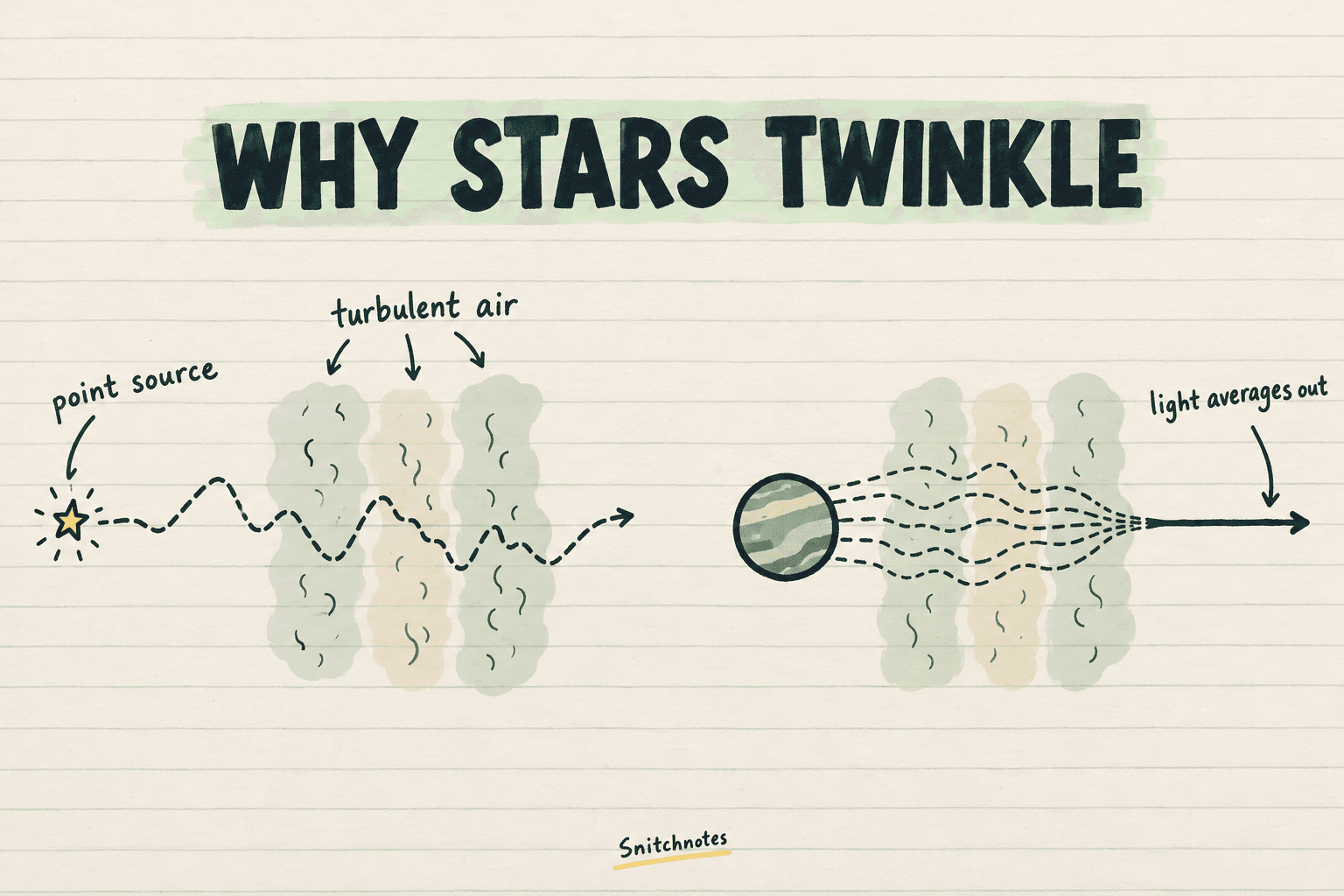
Stars twinkle because their light passes through moving pockets of Earth's atmosphere that bend it in constantly changing ways. To our eyes, a distant star is almost a single point, so those small changes can make it appear to brighten, dim, shift, or change color. Planets are much closer and appear as tiny disks; light from different parts of each disk is disturbed differently, and the fluctuations mostly average out.
The scientific name for the changing brightness is atmospheric scintillation. It matters beyond a pretty night sky: the same turbulent air blurs telescope images, which is why observatories seek calm sites, use adaptive optics, or place telescopes above the atmosphere. It also gives you a useful—though imperfect—clue for telling a bright planet from a star.
How atmospheric scintillation makes stars twinkle
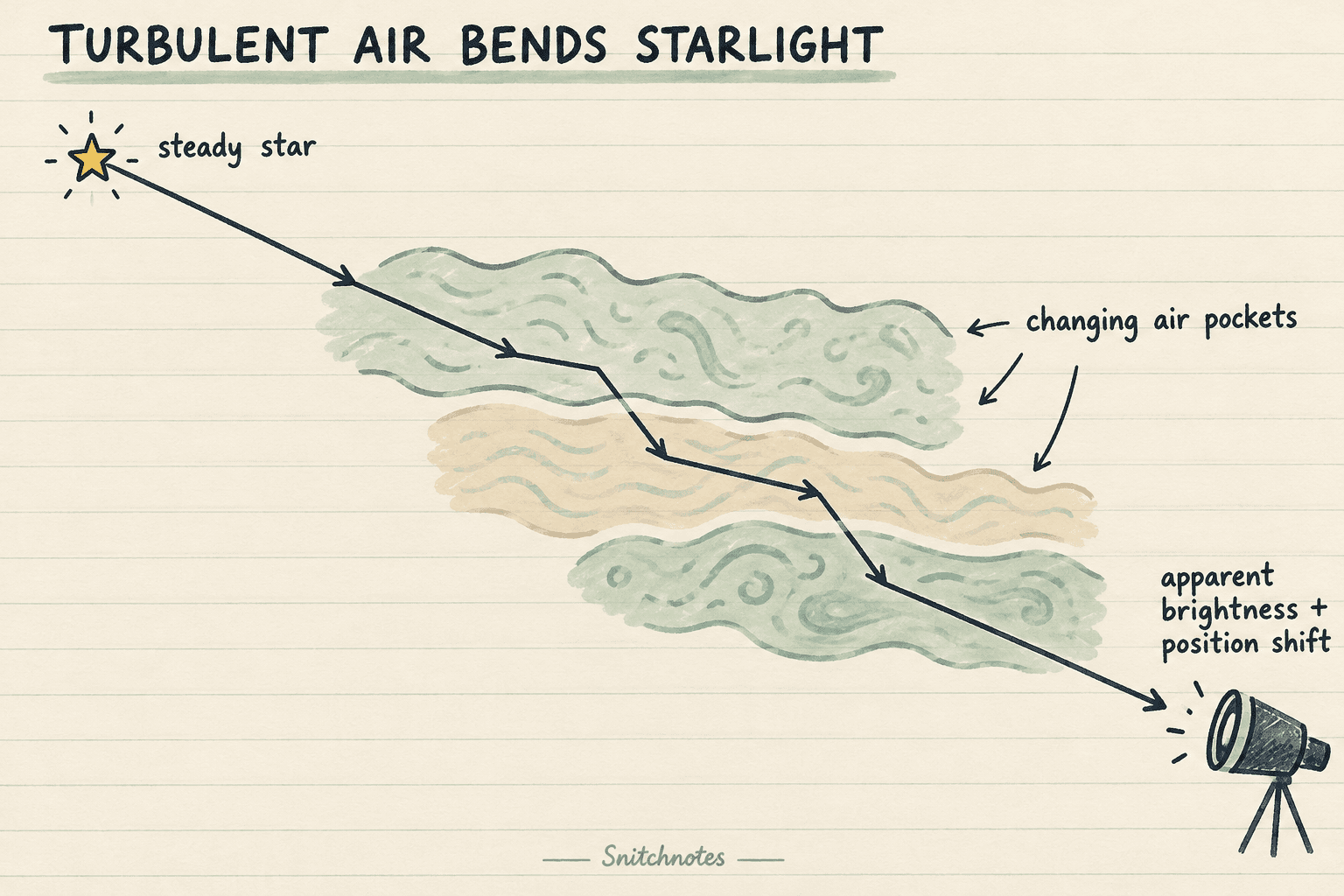
A star does not usually pulse rapidly just because it looks twinkly from your backyard. The apparent flicker is produced much closer to home. Earth's atmosphere contains shifting regions with different temperatures and densities. Those differences create small variations in refractive index, so each region bends incoming light by a slightly different amount.
Think of the atmosphere as a stack of weak, wobbly lenses. As turbulent air moves across your line of sight, the path of the starlight keeps changing. Sometimes a little more light reaches your pupil; sometimes a little less does. The star's apparent position also wanders, and different wavelengths can be redirected differently enough for a bright star near the horizon to flash colors.
Stars near the horizon usually twinkle more because their light takes a longer slanted path through the atmosphere than light from a star high overhead. That longer route crosses more turbulent air. NASA's StarChild explanation points to this extra atmosphere as the reason horizon stars often flicker most dramatically.
Why planets usually look steadier
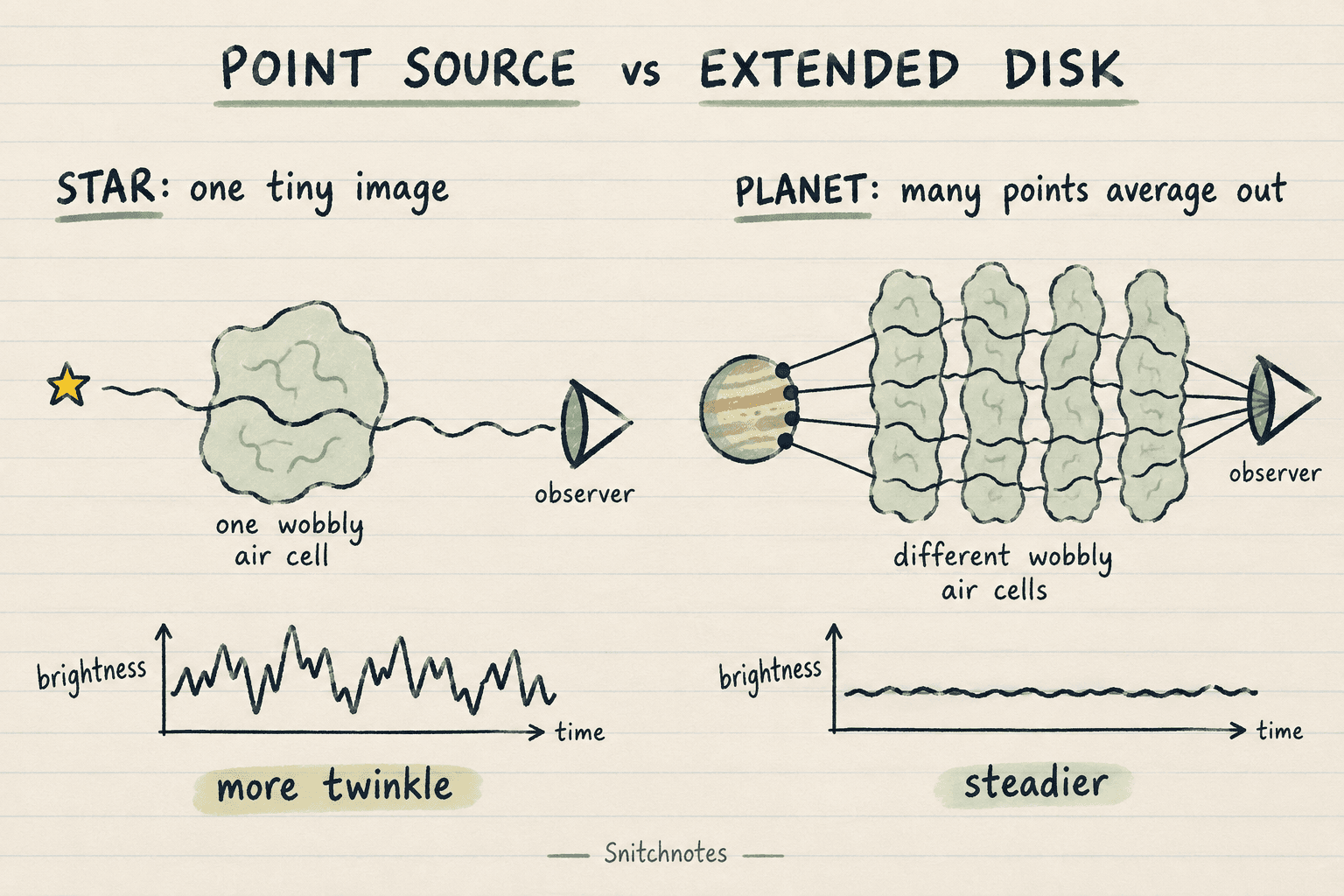
The key is apparent angular size, not whether an object is physically a star or a planet. Stars are enormous, but they are so far away that ordinary observing systems see almost all of them as unresolved points. Planets in our solar system are far smaller, yet they are close enough to present tiny disks in the sky.
Imagine dividing a planet's disk into many points. Light from each point travels through a somewhat different set of atmospheric cells. At one instant, turbulence may focus light from one part of the disk and defocus light from another. When your eye combines all those contributions, increases and decreases tend to cancel. The planet can still be blurred or shifted by poor atmospheric seeing, but its total light usually appears steadier.
A crowd offers a useful analogy. If one person raises and lowers a flashlight, the change is obvious. If hundreds of people each vary their lights independently, the total glow changes much less because their fluctuations do not all peak together. A star behaves more like the single light; a resolved planetary disk behaves more like the crowd.
The boundary: planets can twinkle too
“Planets do not twinkle” is a good beginner's rule, not a law. A planet can scintillate when it is low on the horizon, when atmospheric turbulence is strong, or when its apparent disk is especially small. The effect is generally weaker than it is for a nearby-looking point star under the same conditions. Extended objects such as the Moon and large nebulae also average over many light paths, so they do not wink like point sources.
Twinkling is also different from slow, real changes in a star's brightness. Variable stars can brighten and fade because of physical processes at the star, but those changes follow timescales and patterns astronomers can measure. The rapid, irregular shimmer you see second by second is normally the atmosphere acting on the light after it has crossed space.
How astronomers reduce the twinkle
For a casual observer, twinkling is charming. For an astronomer trying to resolve fine detail, it is noise. European Southern Observatory telescopes use adaptive optics: computers measure atmospheric distortion using a nearby reference star or an artificial laser guide star, then rapidly reshape a deformable mirror to compensate. The corrected image can approach the sharpness of an observation made from space.
Observatory location helps too. High, dry sites reduce the amount of atmosphere above a telescope and are chosen for stable air, dark skies, and clear weather. Space telescopes avoid atmospheric seeing altogether. The atmosphere that keeps us alive is wonderful at many jobs; behaving like perfectly still optical glass is not one of them.
How to identify a planet by eye
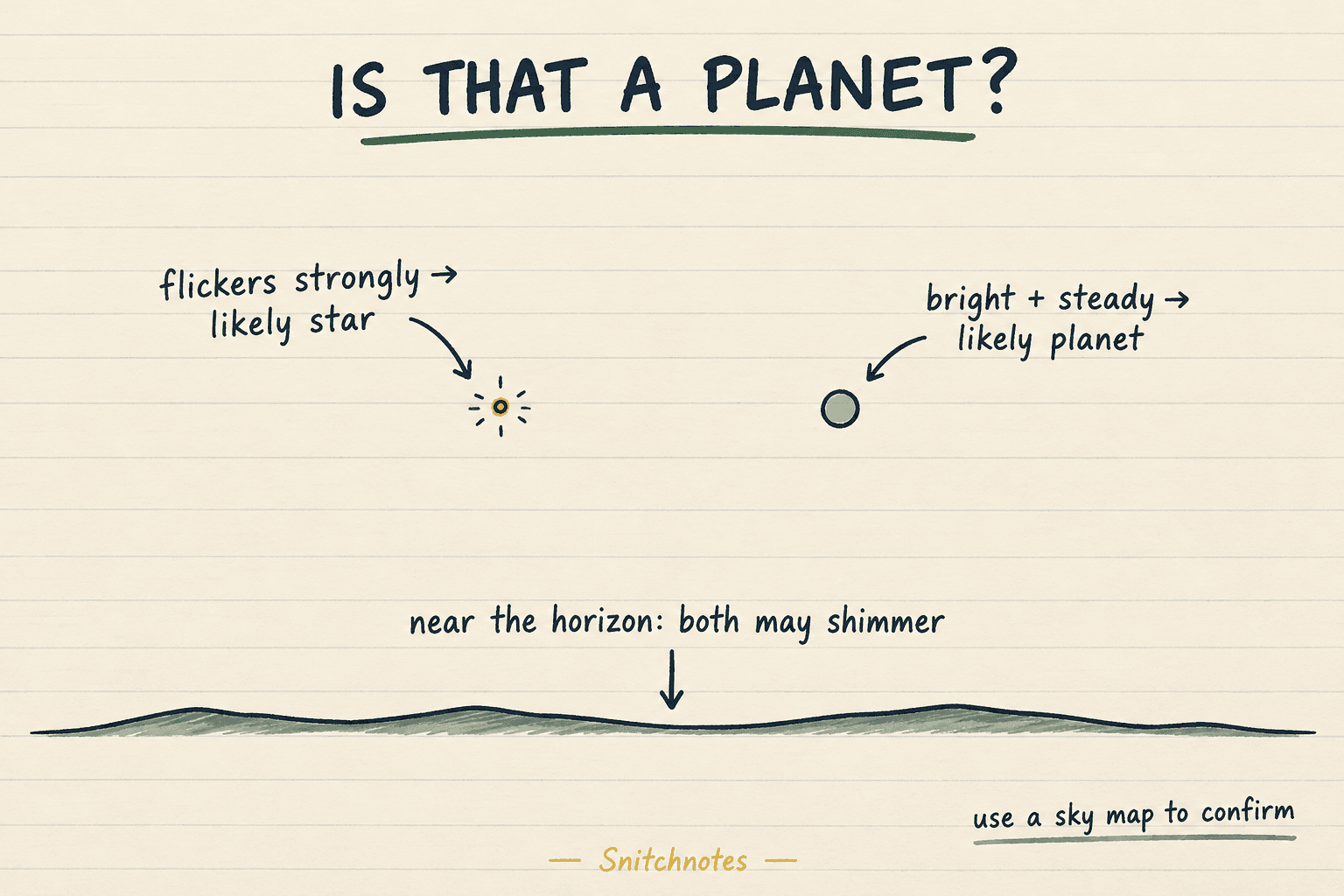
- Compare the bright object with nearby stars. Strong, rapid flickering suggests a star; a steadier glow suggests a planet.
- Check its height. Near the horizon, both stars and planets pass through more air and may shimmer, so the twinkle test becomes less reliable.
- Confirm with a current sky map or astronomy app. Position and date settle the question better than appearance alone.
For example, suppose two bright objects are visible after sunset. One flashes noticeably and sits low in the west; the other is higher and shines with a calm, cream-colored light. The second object is the better planet candidate, but the first object's low altitude makes the comparison uncertain. A sky map provides the final check.
Check your understanding
Why does a physically huge star act like a point source?
Because it is extremely far away. Apparent angular size depends on both actual size and distance, and most stars subtend such tiny angles that their disks cannot be resolved in ordinary viewing.
Would stars twinkle for an astronaut observing from space?
Not from atmospheric scintillation if no atmosphere lies between the astronaut and the star. The star's light would appear steadier because the moving refractive layers responsible for the familiar twinkle are absent.
If a diagram like this makes the idea click, Snitchnotes can turn your own lecture slides, PDFs, and notes into organized study notes, flashcards, and practice questions for the concepts you need to remember.
Related concepts
- Refraction: the change in a light ray's direction when it travels through regions with different refractive indices.
- Astronomical seeing: the blurring and motion of celestial images caused mainly by turbulence in Earth's atmosphere.
- Angular size: how large an object appears across the sky, measured as an angle rather than a physical diameter.
- How to check units using dimensional analysis: another practical way to test whether a physics explanation or equation is internally consistent.
Sources
NASA Goddard Space Flight Center StarChild: Why Do Stars Twinkle?
NASA Goddard Space Flight Center Imagine the Universe!: The Night Sky
University of California, Riverside Physics FAQ: Why Do Stars Twinkle Whereas Planets Do Not?
European Southern Observatory: Adaptive Optics
University of Virginia ASTR 3130 Lecture Notes: Telescopes, Resolution, Seeing and Plate Scale
Zamień wykłady w materiały gotowe na egzamin.
Notatki, quizy, podcasty, fiszki i czat — z jednego uploadu.
Stwórz pierwszą notatkę za darmo