
Snitchnotes Team
How to Study From a Formula Sheet Without Memorizing Blindly
How to Study From a Formula Sheet Without Memorizing Blindly
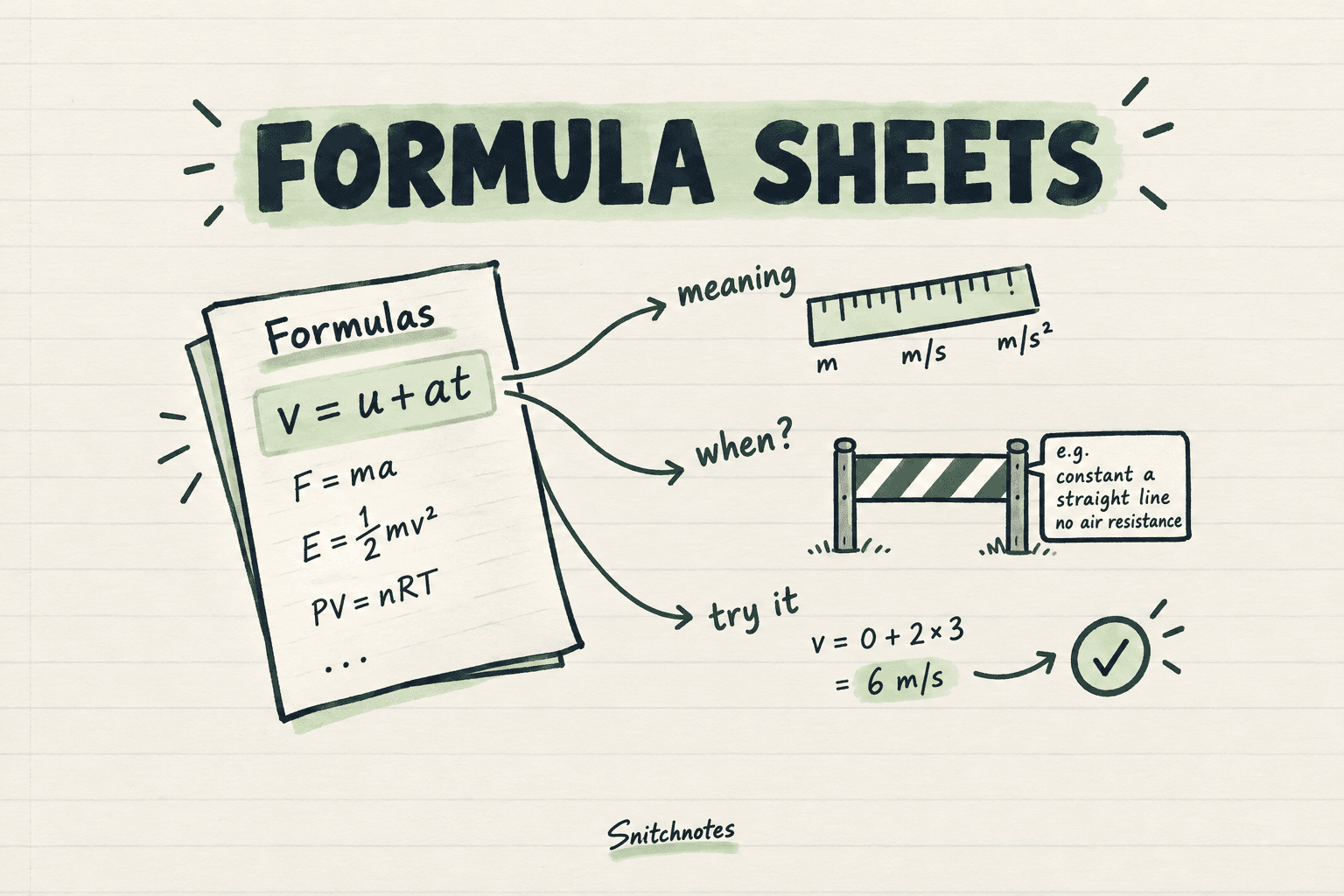
To study from a formula sheet, do not treat it as a list of symbols to recite. For every formula, learn what each quantity means, the units, the conditions under which the relationship is valid, and the clues that make it useful. Then practise choosing and applying the formula in mixed problems. The sheet should become a map for decisions, not a menu from which you guess an equation.
This matters because many exams provide equations but still test whether you can recognize the right model, rearrange it, and judge whether an answer makes sense. North Carolina State University's Disability Resources Office makes the distinction clearly: a formula sheet supports courses assessing application rather than memorization, while students are still expected to recognize relevant equations and understand their proper use.
First diagnose why the formula sheet is not helping
When a formula sheet feels useless, the problem is usually not the number of equations. It is missing connections. You may recognize a formula without knowing when to use it, know the variables without their units, or copy a worked solution without understanding why that relationship fit the problem. Circle the point where you get stuck: choosing, rearranging, substituting, calculating, or interpreting. That diagnosis tells you what to practise.
A crowded sheet can also hide structure. The University of Toronto Scarborough Learning Strategies team recommends grouping related formulas because the grouping makes equations faster to find and encourages reflection on how concepts connect. Organize by idea or problem type—such as constant acceleration, energy, or probability distributions—rather than by the order in which equations appeared in lectures.
Turn each formula into a four-part note
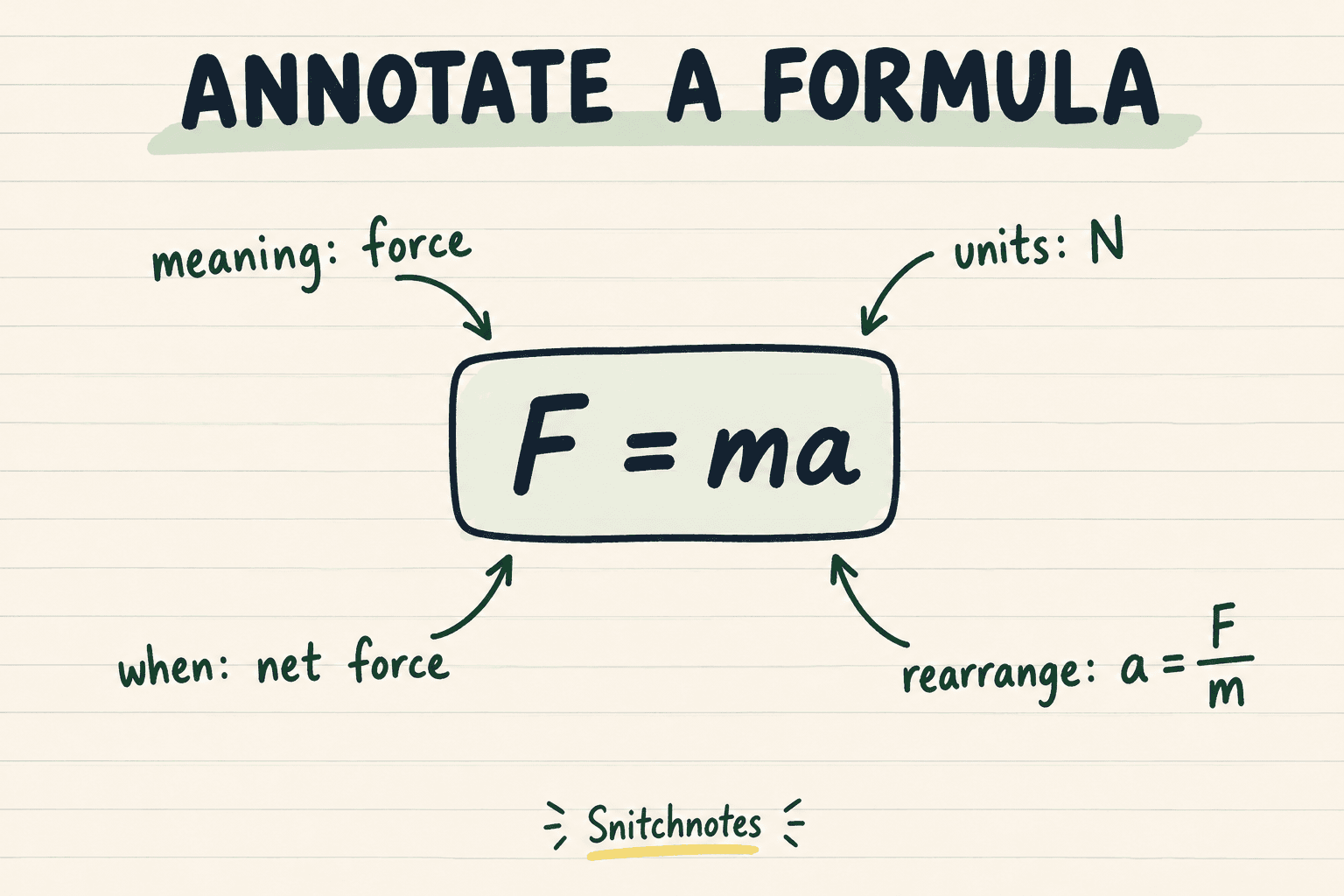
Take one formula at a time and add four annotations: meaning, units, conditions, and rearrangements. For F = ma, write that F means net force, m is mass, and a is acceleration; in SI units these are newtons, kilograms, and metres per second squared. Note that the relationship describes the net external force, not one force chosen from a diagram. Then practise rearranging it as a = F/m and m = F/a.
The conditions line is often the most valuable. For a constant-acceleration equation, write “constant acceleration.” For a normal-distribution formula, record the assumptions your course requires. For an approximation, note the range in which it is acceptable. A correct equation used outside its conditions can produce a polished but meaningless answer.
Use one worked example, then remove the support
If a formula is new, begin with a worked example and explain each step to yourself: what is being asked, which information is relevant, why the formula fits, and how the units behave. The Massachusetts Institute of Technology Teaching + Learning Lab describes worked examples as step-by-step models that are especially useful during initial skill acquisition, provided learners actively explain the procedure instead of merely watching it.
Then fade the support. Cover the formula and try to reconstruct its meaning. Cover the solution and solve a similar problem. Finally, change the surface details—a ramp becomes a lift, or a dice problem becomes a quality-control problem—while keeping the underlying structure. If you can only solve the original numbers, you have remembered the example rather than learned the method.
Choose formulas by structure, not keywords
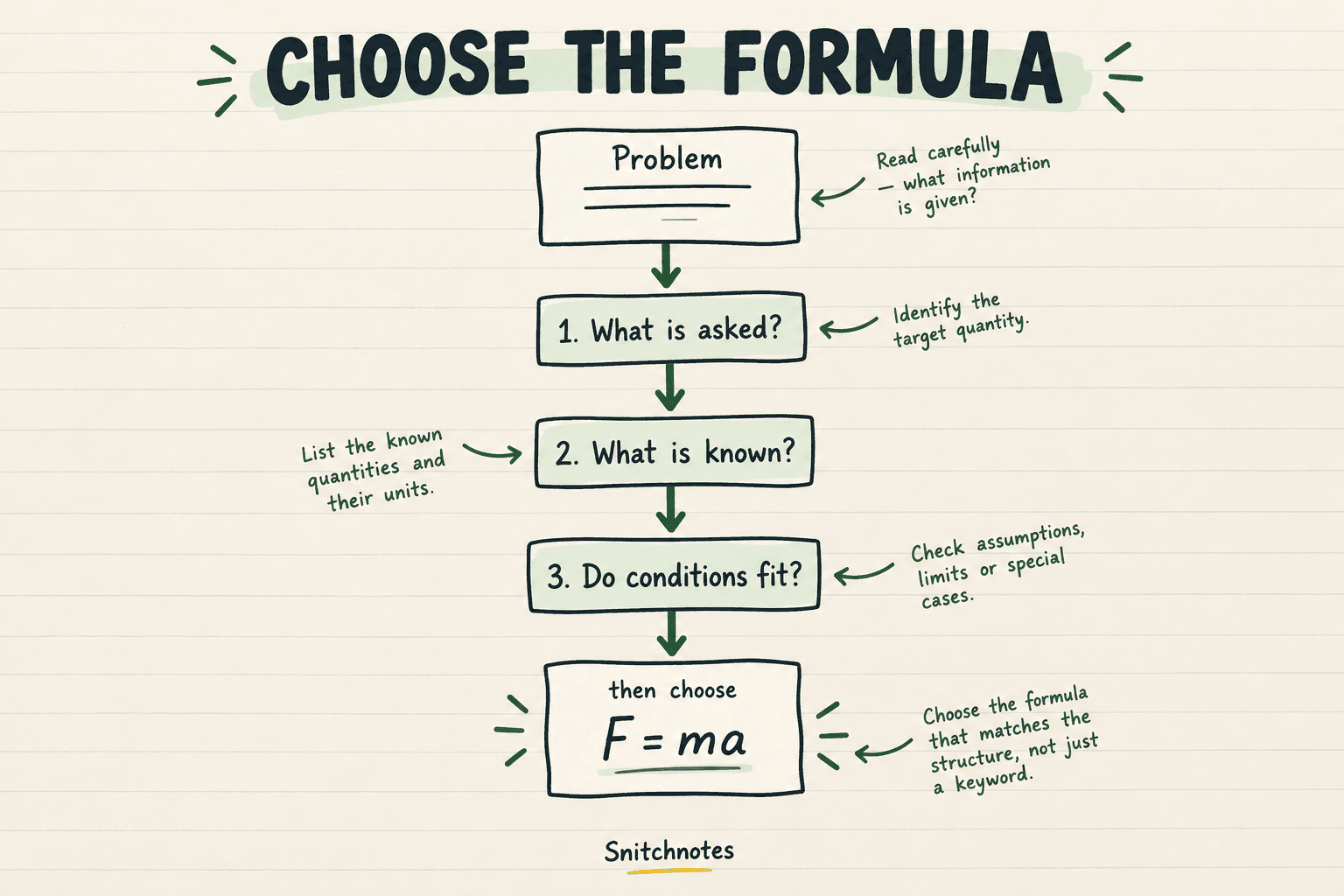
Before touching the sheet, write three things: the target quantity, the known quantities with units, and the conditions described by the problem. Only then scan the relevant formula group. This prevents keyword matching, where seeing “speed” sends you to the first equation containing v even though the problem is really about energy or momentum.
For example, suppose a 2-kilogram cart starts from rest and accelerates at 3 metres per second squared for 4 seconds. The target is final velocity; the known values are initial velocity, acceleration, and time; and acceleration is constant. That structure supports v = u + at, giving v = 0 + (3 × 4) = 12 metres per second. A quick unit check confirms that acceleration multiplied by time produces velocity.
Practice in a recall-apply-check loop
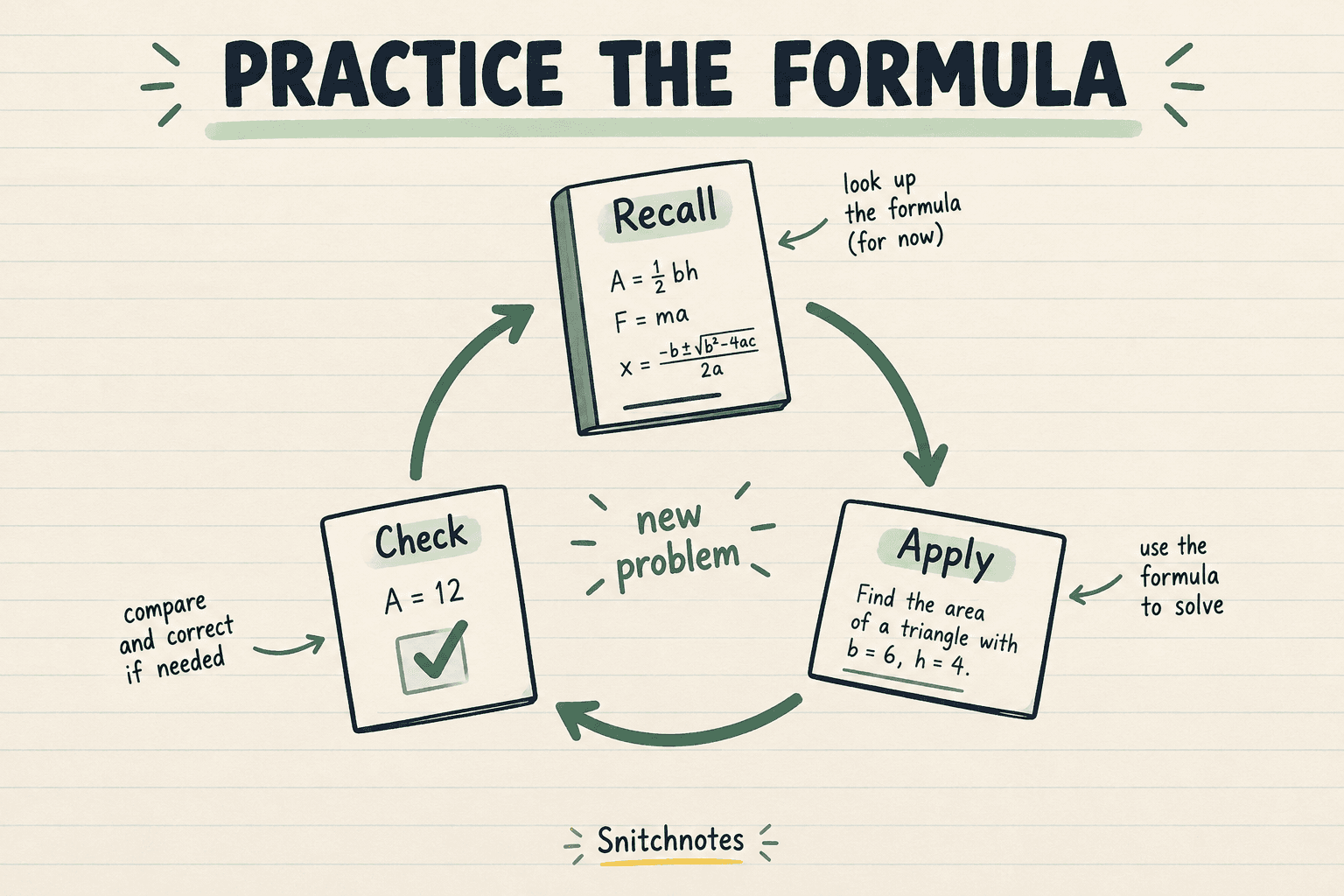
Use a three-stage loop. First, recall the formula or locate it from the correct group. Second, apply it to a fresh problem without following a model line by line. Third, check the answer against units, sign, scale, and the official solution. Turn every mistake into a precise note such as “forgot constant-acceleration condition” or “converted minutes after substituting.”
Retrieval practice strengthens learning by requiring you to pull knowledge out rather than only reread it, according to RetrievalPractice.org. But recalling a formula is not enough for a problem-solving exam. Pair recall with varied application. Mix several formulas from the same topic so that choosing the relationship becomes part of the question instead of being announced by the worksheet heading.
Common mistakes and useful boundaries
- Copying every equation: include what the exam permits, then use grouping and annotations to expose relationships.
- Memorizing symbols without definitions: the same letter can represent different quantities in different topics.
- Skipping units until the end: units can reveal a wrong formula or conversion before arithmetic compounds the error.
- Practising only one problem type at a time: blocked sets build fluency, but mixed sets test whether you can choose.
Do not assume that every exam allows a personal formula sheet. Check the course rules for permitted content, format, approval, and calculator use. If a formula sheet is part of an accommodation, follow the institution's process and deadlines rather than negotiating it informally on exam day.
Check your understanding
You know every equation on the sheet but freeze on mixed problems. What should you practise?
Practise the choice before the calculation: identify the target, known quantities, units, and conditions, then select the formula. Use mixed problems so the method is not revealed by the section title.
What four notes should sit beside a formula?
Record what the variables mean, their units, the conditions or assumptions, and useful rearrangements. Add one small example if the formula is still unfamiliar.
If your formulas are scattered across lectures, slides, and PDFs, Snitchnotes can organize that material into study notes, flashcards, and quizzes so you can practise the recall-apply-check loop on your own course content.
Related concepts
- Problem-solving exams: learn methods without memorizing complete solutions.
- Physics derivations: connect equations to assumptions and physical meaning.
- Dimensional analysis: use units to test relationships and conversions.
- Interleaved practice: mix problem types so choosing a method becomes part of practice.
Sources
University of Toronto Scarborough Learning Strategies: Formula Sheets
Massachusetts Institute of Technology Teaching + Learning Lab: Worked Examples
Zamień wykłady w materiały gotowe na egzamin.
Notatki, quizy, podcasty, fiszki i czat — z jednego uploadu.
Stwórz pierwszą notatkę za darmo