
Snitchnotes Team
How to Study the Complement System Without Rote Memorization
How to Study the Complement System Without Rote Memorization
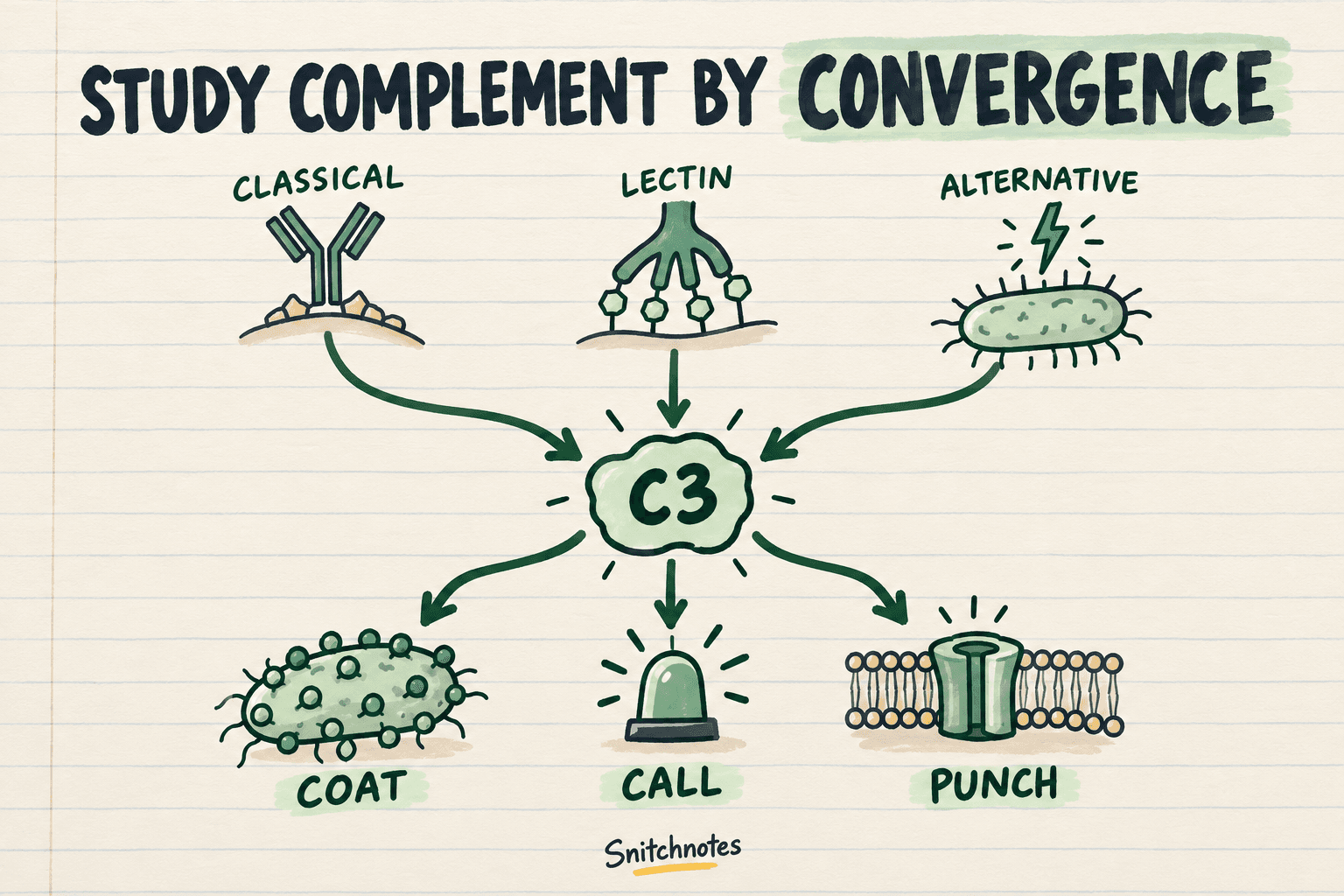
The easiest way to study the complement system is to stop treating the classical, lectin, and alternative pathways as three separate protein lists. Learn one shared shape instead: different triggers build C3 convertases, every pathway converges on C3, and the cascade produces three memorable effects—coat microbes, call inflammatory help, and punch holes in susceptible membranes. Once that spine is secure, add the pathway-specific names.
This convergence-first method reduces the number of disconnected facts you must hold at once. It also helps you reconstruct an answer when an exam question starts from a trigger, a missing protein, or a clinical outcome rather than asking you to recite the cascade in order.
Why the usual memorization approach breaks down
A long arrow chain looks learnable while it is in front of you. The trouble appears when the page closes: C1, C2, C3, C4, factors B and D, and the convertases compete as isolated labels. Their numbers are not a reliable description of activation order, so memorizing them as a countdown creates extra confusion.
Complement is better understood as a decision tree with a shared trunk. Ask three questions in the same order every time: What starts this pathway? What C3 convertase does it build? What happens after C3 is cleaved? That structure gives every protein a job and a location.
Build one map in three layers
Layer 1: learn the triggers
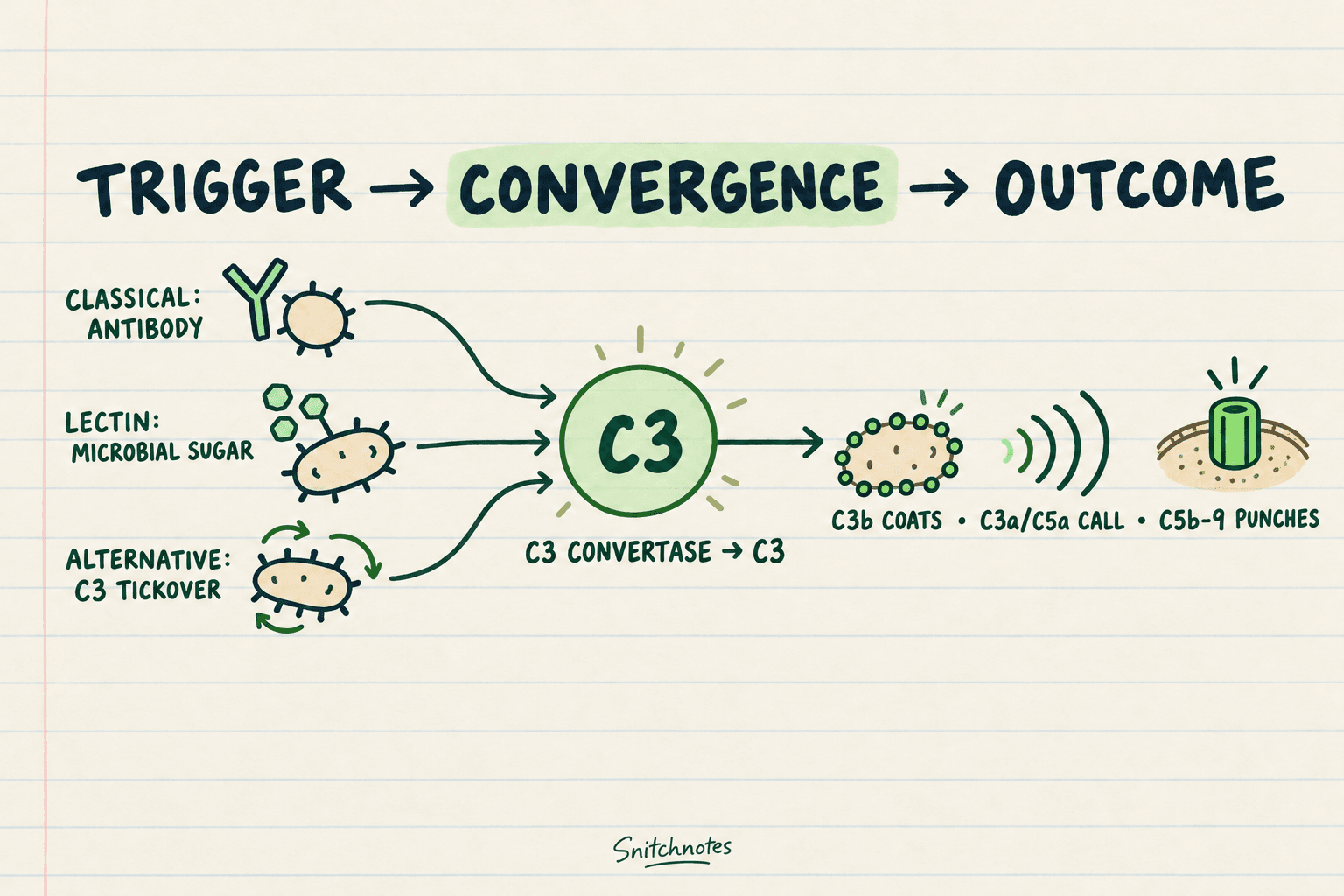
Use one short cue for each start. Classical: antibodies bound to a target commonly allow C1q to engage and begin the cascade. Lectin: mannose-binding lectin or ficolins recognize microbial carbohydrate patterns. Alternative: low-level C3 activation is continually sampled, and the pathway is stabilized and amplified on a surface that lacks adequate host protection.
Layer 2: attach the convertases
Classical and lectin take different routes to the same C3 convertase, C4b2a. The alternative pathway builds C3bBb. Do not memorize those complexes as floating passwords. Write each directly between its trigger and C3, because their shared job is what matters: cleaving C3 into C3a and C3b.
Layer 3: learn the shared outcomes
Use the cue coat, call, punch. C3b coats a microbial surface and promotes phagocytosis; this is opsonization. C3a and especially C5a help drive inflammation, while C5a recruits and activates leukocytes. C5b begins assembly of the terminal C5b–9 membrane attack complex, which can form a pore in susceptible membranes.
The cue is deliberately functional. If you remember that C3b coats, you can connect it to opsonization and to formation of C5 convertase. If you remember that C5b starts the punch, you can rebuild the terminal sequence toward C5b–9 rather than recalling nine numbers without a purpose.
Follow one encapsulated bacterium
Imagine an encapsulated bacterium in blood with IgG or IgM already bound to its surface. C1q recognizes the bound antibody and starts the classical pathway. Activation of C4 and C2 produces C4b2a, the classical C3 convertase. That enzyme cleaves many C3 molecules, depositing C3b on the bacterium.
Now narrate the consequences instead of continuing as a bare list. The capsule makes direct engulfment difficult, but a coat of C3b gives phagocytes a better handle through complement receptors. Additional C3b helps create C5 convertase; C5a strengthens the inflammatory recruitment signal, and C5b can initiate the terminal pathway. For an encapsulated organism, opsonization may be the most important part of the story, even though all three outcomes belong on your map.
Erase the labels and rebuild the case in four moves: antibody-bound bacterium, C4b2a, C3 cleavage, then coat–call–punch. Next, change only the trigger. Replace antibody recognition with microbial sugar recognition for lectin, or with alternative-pathway tickover and surface amplification. The shared trunk stays put.
Turn the map into retrieval practice
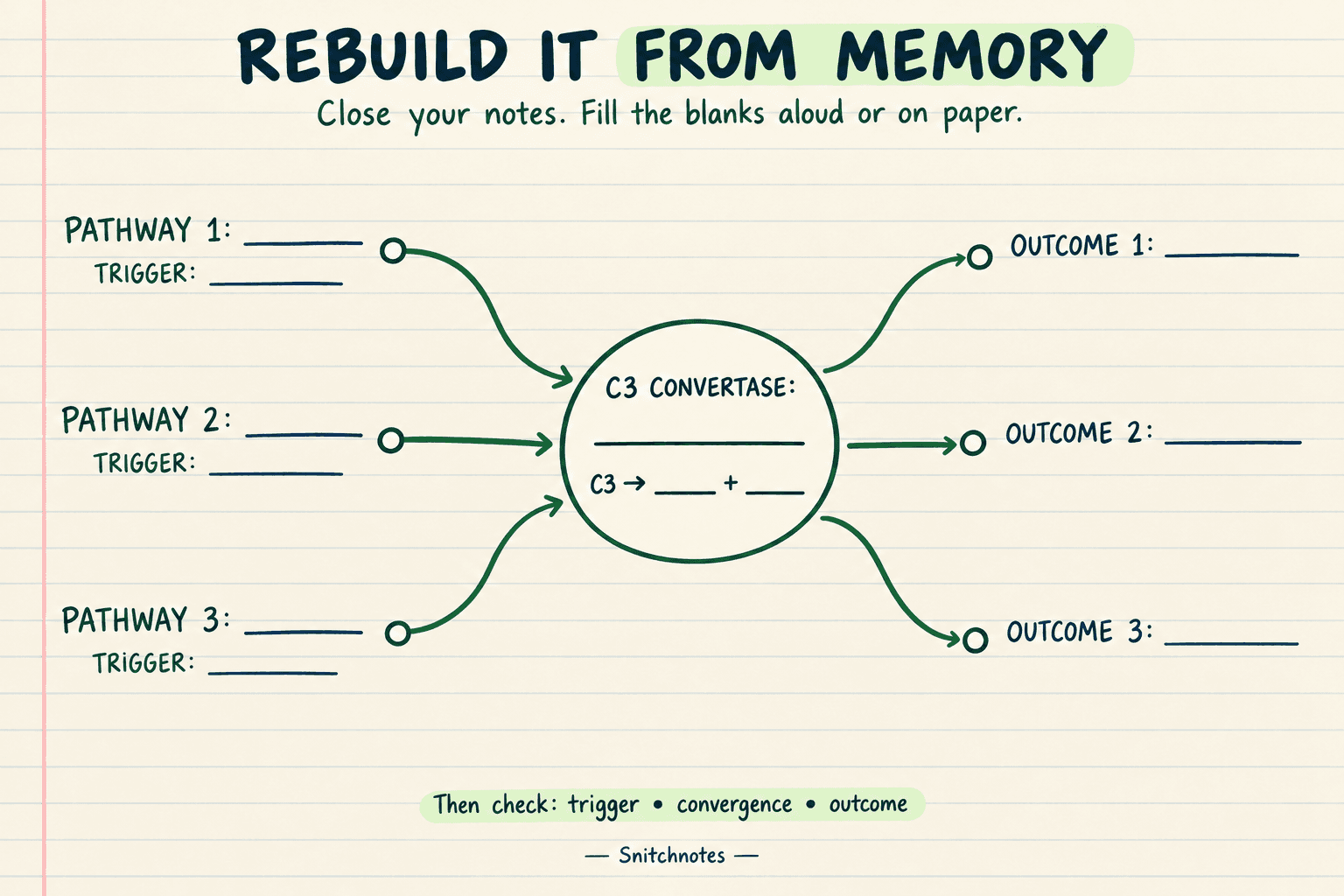
Looking at a completed diagram can create familiarity without recall. Research on the testing effect shows that trying to retrieve studied material can improve delayed retention more than repeated restudy. Use the blank template as a test: close your notes, fill it aloud or on paper, check immediately, and correct only what you missed.
- Name the three pathways and one trigger for each.
- Write C4b2a for classical and lectin, and C3bBb for alternative.
- Split C3 into C3a and C3b, then explain coat, call, and punch in full sentences.
- Repeat after a delay, mixing the order so you can start from a trigger, convertase, or outcome.
A useful boundary: coat–call–punch is a study scaffold, not the complete biology of complement. The system also amplifies signals, clears immune complexes and dying cells, interacts with adaptive immunity, and is tightly regulated to limit host damage. The membrane attack complex is not equally effective against every organism; a thick cell wall can make direct lysis less important than opsonization.
Check your understanding
Which two pathways share the same C3 convertase?
The classical and lectin pathways both form C4b2a. The alternative pathway forms C3bBb.
Why is C3 the best convergence point for your map?
All three activation pathways generate a C3 convertase that cleaves C3. From there, C3b supports opsonization and C5 convertase formation, while downstream cleavage products connect the cascade to inflammation and the terminal membrane attack pathway.
Does the classical pathway always require antibody?
Antigen-bound IgM or IgG is the standard teaching trigger, but it is not the only possible activator. Molecules such as C-reactive protein can also engage the classical pathway, so treat antibody as the common exam model rather than an absolute rule.
If your immunology slides still feel like disconnected protein names, Snitchnotes can turn your lectures, PDFs, and notes into clearer study notes, flashcards, quizzes, and audio for retrieval practice.
Related concepts
- Opsonization: coating a target so phagocytes can recognize and ingest it more efficiently.
- Innate–adaptive connection: antibodies can direct the classical complement pathway toward a specific antigen.
- How to study immunology for med school exams: build mechanisms and retrieve them instead of rereading lists.
- The sodium–potassium pump step by step: another example of learning a biological process as a reconstructable sequence.
Sources
Merle and colleagues, Frontiers in Immunology: Complement System Part II—Role in Immunity
Zamień wykłady w materiały gotowe na egzamin.
Notatki, quizy, podcasty, fiszki i czat — z jednego uploadu.
Stwórz pierwszą notatkę za darmo