
Snitchnotes Team
Dramatic Irony vs Situational Irony: Differences and Examples
Dramatic Irony vs Situational Irony: Differences and Examples
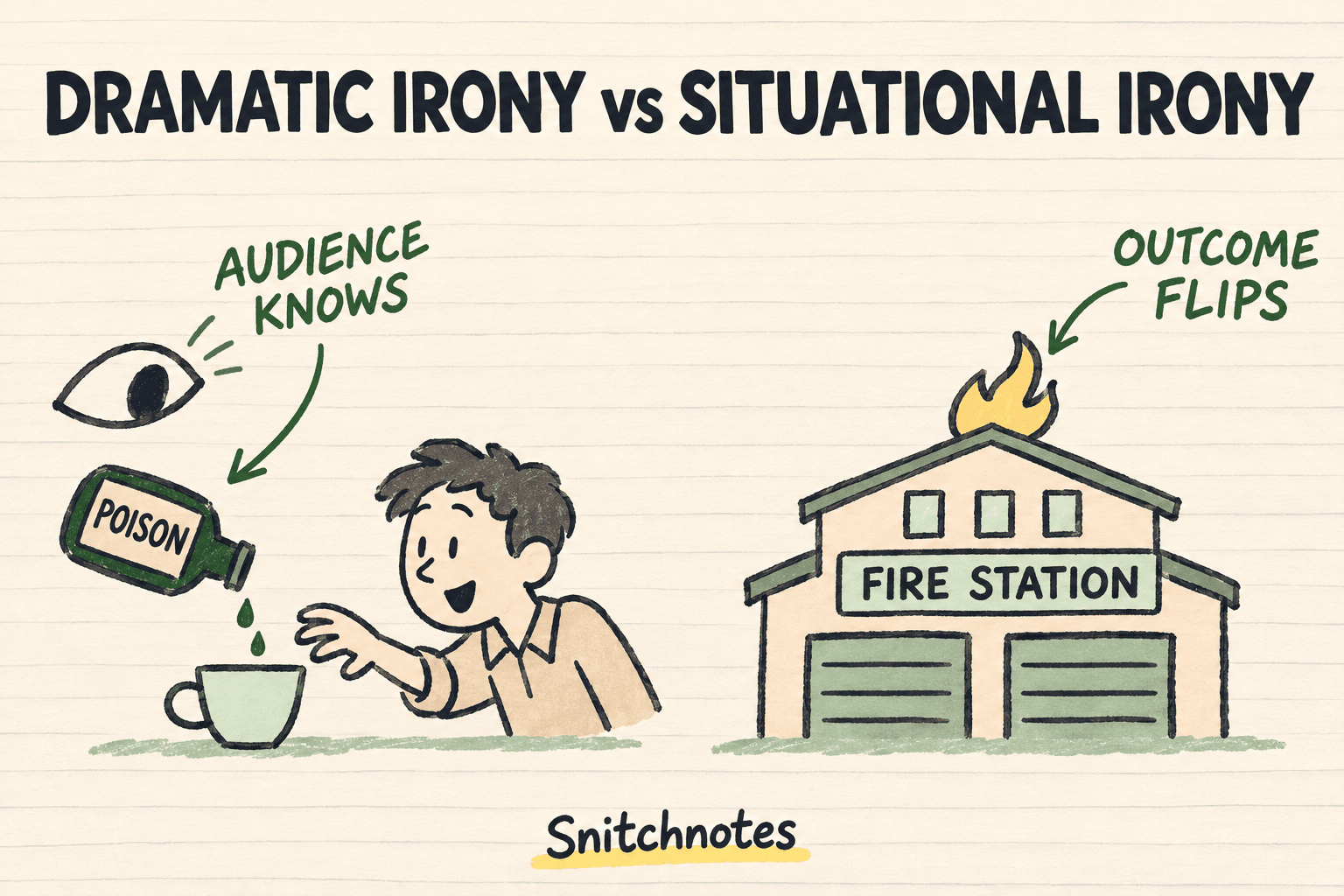
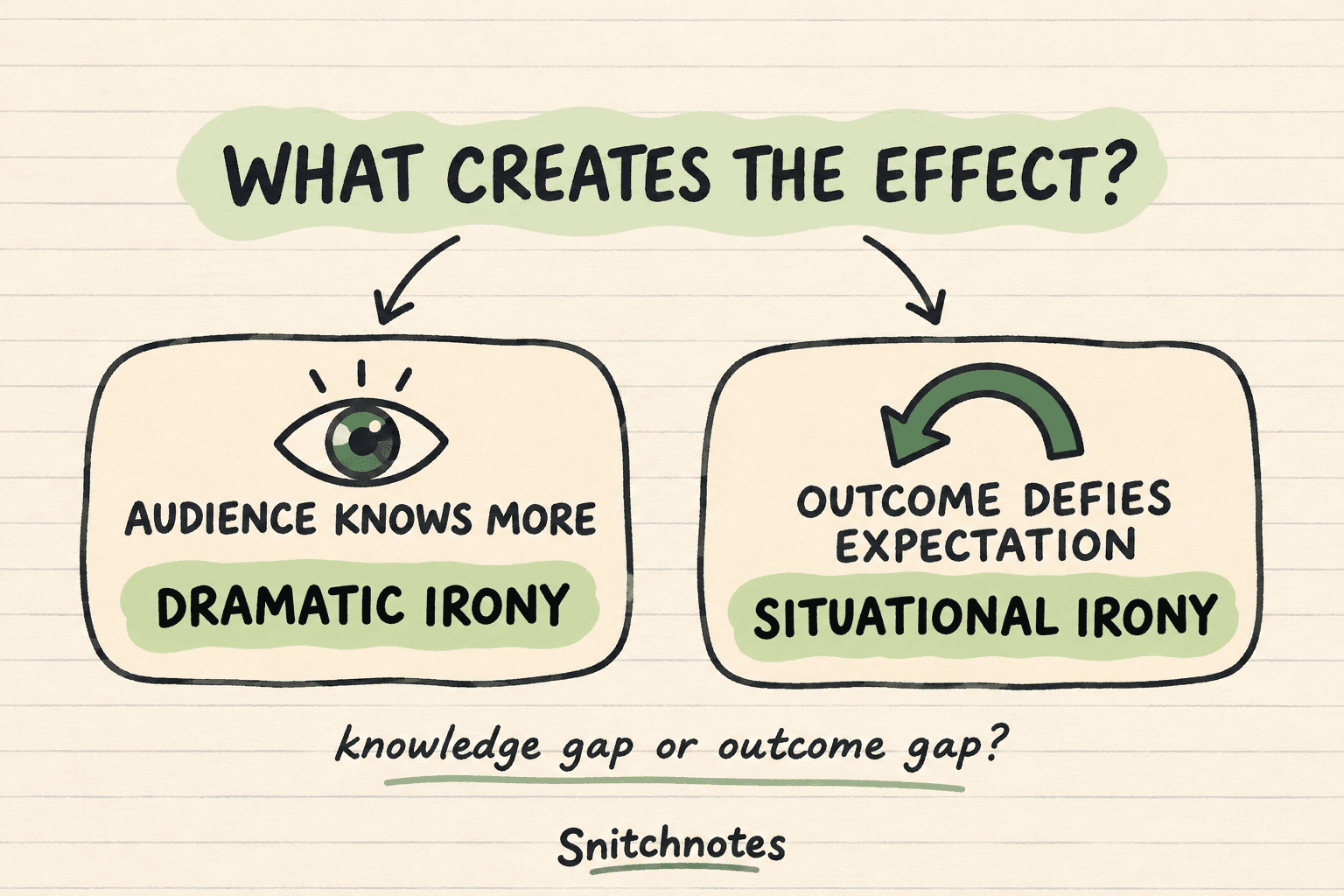
Dramatic irony happens when the audience or reader knows important information that a character does not. Situational irony happens when the actual outcome sharply conflicts with a reasonable expectation created by the situation. The simplest distinction is therefore knowledge versus outcome: dramatic irony asks who knows what, while situational irony asks what was expected and what actually happened.
This article is for students who need to label irony in a poem, story, play, film, or exam passage. You will compare the two forms, apply one quick classification test, and work through examples that look similar at first.
Dramatic irony vs situational irony at a glance
The Oregon State Guide to Literary Terms defines dramatic irony through a character's lack of important plot information. The reader's fuller view makes an innocent line, decision, or action carry a second meaning. That gap can produce suspense, dread, comedy, or sympathy because we understand consequences the character cannot yet see.
Situational irony does not require the audience to possess a secret. Instead, a plan, role, or pattern creates a reasonable expectation, and the result meaningfully turns against it. Oregon State describes this form through intentions that are foiled or actions that produce the opposite result. A surprising event can be ironic, but surprise by itself is not enough; the outcome must clash with what the situation led us to expect.
- Dramatic irony: audience knowledge is greater than character knowledge.
- Situational irony: the actual result conflicts with a justified expectation.
- Dramatic irony often builds tension before a revelation; situational irony often lands when the outcome becomes clear.
- A scene can contain both, but each label must be supported by a different contrast.
Why the difference matters
Correct classification helps you explain an author's technique rather than merely spotting something odd. If the audience knows a villain has forged a letter while the hero trusts it, the effect comes from privileged knowledge. If a plan designed to prevent a disaster causes that disaster, the effect comes from a reversed outcome. Naming the right contrast lets you connect the device to suspense, humor, character judgment, or theme.
EBSCO's overview notes that dramatic irony works in both comedy and tragedy. Hidden motives and mistaken identities can make an audience laugh, while foreknowledge in tragedy can make an ordinary promise or confident decision feel painful. Situational irony can also be comic or tragic; its defining feature is not mood but incongruity between expectation and result.
The fastest test: knowledge gap or outcome gap?
First ask, "Would the effect disappear if the audience did not know the secret?" If yes, the passage probably uses dramatic irony. Identify the exact fact the audience knows and the character lacks. Do not write only that the reader knows more; state what the reader knows and how it changes the meaning of the character's words or action.
If there is no essential secret, ask, "What outcome did the situation reasonably lead us to expect, and what happened instead?" If the contrast is sharp and meaningful, the example is probably situational irony. The expectation should come from the role, goal, or causal setup—not merely from your personal guess.
Worked comparison: the poison cup and the burning fire station
Imagine a play in which the audience sees poison poured into a silver cup. A hero enters, calls the cup a welcome gift, and lifts it to drink. This is dramatic irony because the audience knows the cup is dangerous while the hero believes it is safe. The hero does not need to drink it for the device to work; the knowledge gap already makes the action tense.
Now imagine a fire station catching fire because its alarm system was never tested. This is situational irony because a place organized to prevent and fight fires suffers the very disaster it is meant to handle. No hidden information is required. The contrast lies between the station's protective role and the outcome.
The examples can overlap if the writing adds another contrast. Suppose the audience sees the fire alarm disconnected while the chief praises the building's safety. The praise creates dramatic irony because we know what the chief does not; the station later burning can create situational irony because the outcome reverses the station's expected function. One scene, two separate reasons.
Four irony examples, classified
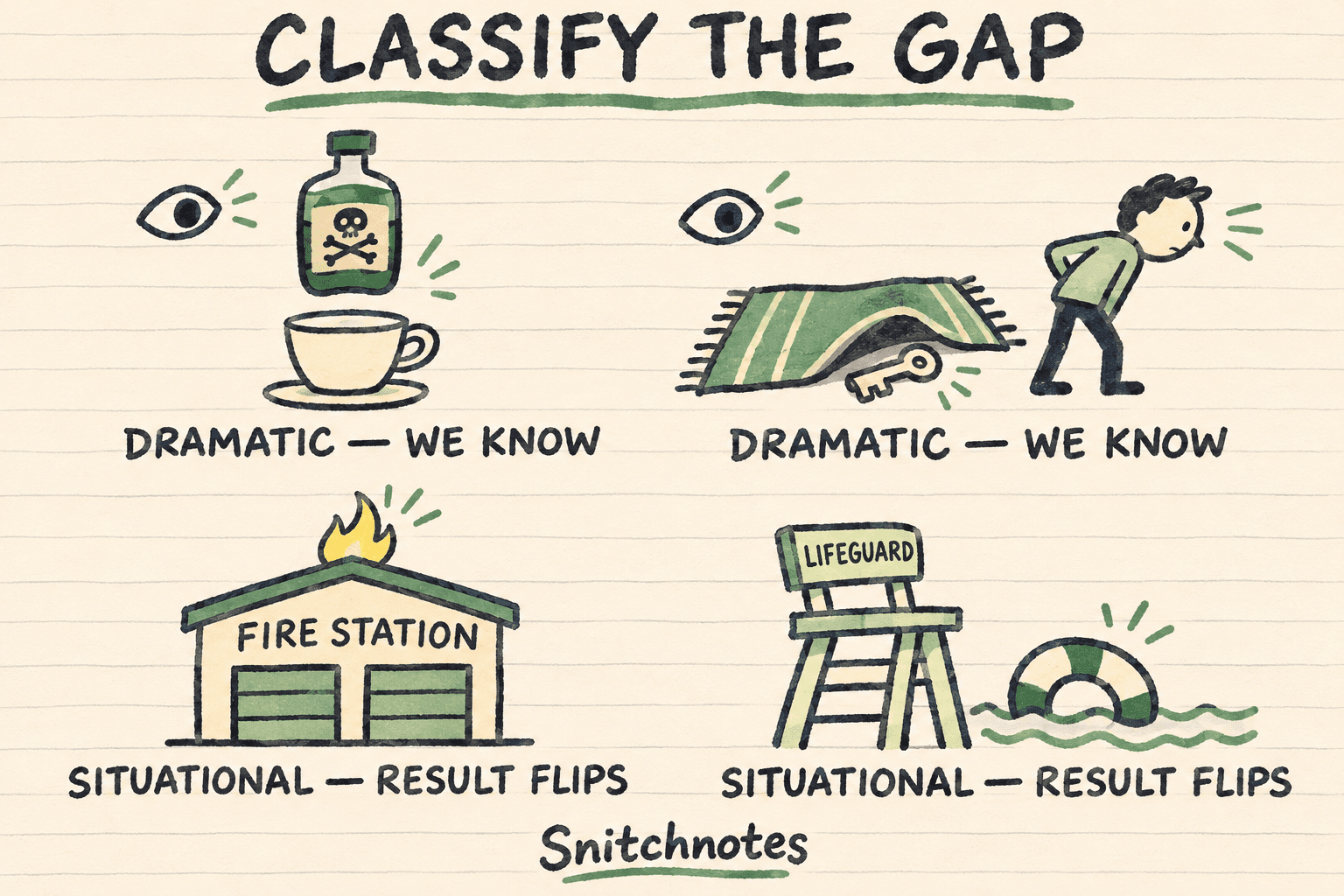
- A reader sees poison added to a cup before an unsuspecting guest drinks: dramatic irony, because the effect depends on the reader's knowledge.
- A detective searches a room while the reader can see the missing key under a rug: dramatic irony, because the detective lacks information available to the reader.
- A fire station burns after ignoring its own inspection schedule: situational irony, because the outcome contradicts the institution's purpose.
- A lifeguard who refuses a safety drill later needs another swimmer to rescue them: situational irony, because the rescuer becomes the person who needs rescue.
A boundary case: Oedipus and overlapping irony
Sophocles' Oedipus the King is a classic example of dramatic irony. As EBSCO explains, the audience understands crucial facts about Oedipus's identity and King Laius's death before Oedipus does. His vow to find and punish the guilty person therefore carries a meaning he cannot hear: he is directing the investigation toward himself.
The story also contains reversed efforts and outcomes, so a teacher may discuss situational irony in its larger pattern. That does not make the labels interchangeable. In a close-reading answer, classify the exact moment in front of you. If your evidence is the audience's superior knowledge, call it dramatic. If your evidence is an attempted escape or solution producing the opposite result, call it situational.
Common mistakes when identifying irony
Not every coincidence, disappointment, or strange event is ironic. Rain on a picnic is bad luck unless the setup creates a meaningful contradiction—for example, a weather forecaster's carefully planned outdoor lesson being cancelled by an unpredicted storm. Even then, explain the expectation rather than relying on the event's awkwardness.
Also avoid confusing these forms with verbal irony. Verbal irony involves a contrast between what someone says and what they mean or what the situation warrants. A character saying "Lovely weather" during a downpour may be verbally ironic. It becomes dramatic only if the audience holds crucial knowledge the character lacks, and situational only if the unfolding result reverses a justified expectation.
Check your understanding
The audience knows a disguised visitor is the missing prince, but the queen does not. Which type is it?
Dramatic irony. The effect depends on a knowledge gap between the audience and the queen.
A thief steals a car to escape, but the car belongs to an undercover police officer. Which type is it?
Situational irony, if the focus is the escape plan producing capture. If the audience knew the owner was an officer before the thief did, the scene could also use dramatic irony.
What evidence should a strong exam answer include?
Name both sides of the contrast. For dramatic irony, state what the audience knows and the character does not. For situational irony, state the reasonable expectation and the conflicting outcome.
Related concepts
- Verbal irony: a gap between a speaker's words and intended meaning.
- Tragic irony: dramatic irony that contributes to an unavoidable or devastating outcome.
- Denotation vs connotation: how literal meaning differs from associated meaning.
- How to scan poetry meter step by step: another method for classifying a literary pattern from evidence.
Sources
Oregon State University, Oregon State Guide to Literary Terms: What is Irony?
Zamień wykłady w materiały gotowe na egzamin.
Notatki, quizy, podcasty, fiszki i czat — z jednego uploadu.
Stwórz pierwszą notatkę za darmo