
Snitchnotes Team
How to Analyze a Poem When You Do Not Understand It
How to Analyze a Poem When You Do Not Understand It
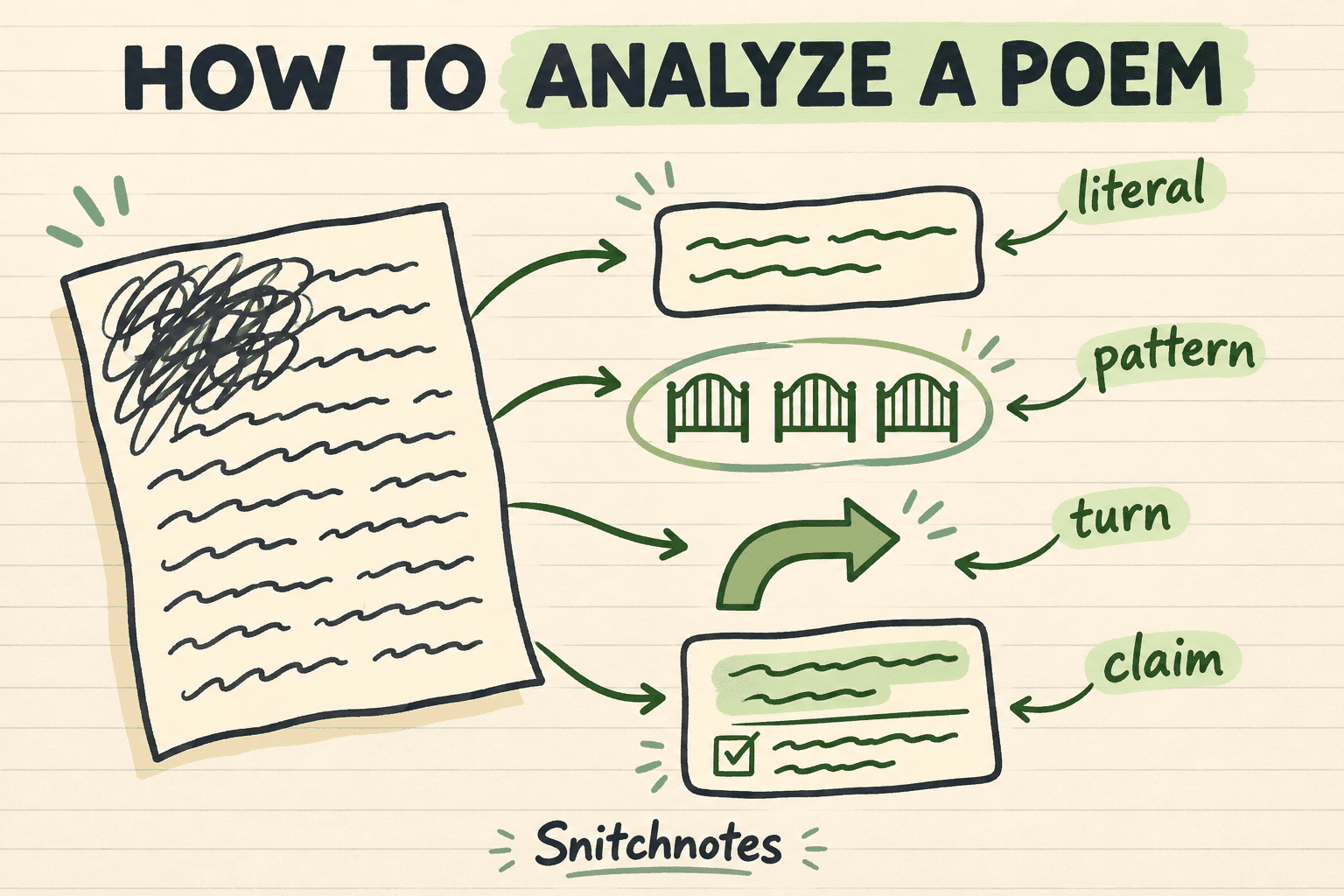
If you do not understand a poem, do not begin by guessing its hidden message. Start with what you can prove: paraphrase the literal situation, mark repeated words or images, notice a shift or tension, and turn those observations into a claim supported by exact phrases. The goal is not to discover one secret answer. It is to build a reading another person can follow and test against the poem.
This troubleshooting method is for students staring at a poem that feels dense, strange, or stubbornly blank. Confusion is not evidence that you are bad at poetry; it is a signal to make the task smaller. Close reading works by moving from visible details to questions and then to an arguable interpretation, not by leaping straight to theme.
Why a poem can feel impossible at first
Poems compress meaning. A sentence may run across several lines, a familiar object may work as a metaphor, and the speaker may sound certain in one line but doubtful in the next. If you try to solve diction, imagery, sound, form, context, and theme at once, the page becomes a pile of possible meanings with no clear first move.
The useful question is not “What does the whole poem mean?” but “What do I notice, and what problem does that detail create?” Purdue University’s Online Writing Lab treats poetry analysis as a text-based argument: a specific thesis should grow from particular elements and the relationships among them. The University of York similarly advises readers to stay with the actual words, observe their effects, and shape selected details into an argument rather than listing every device they spot.
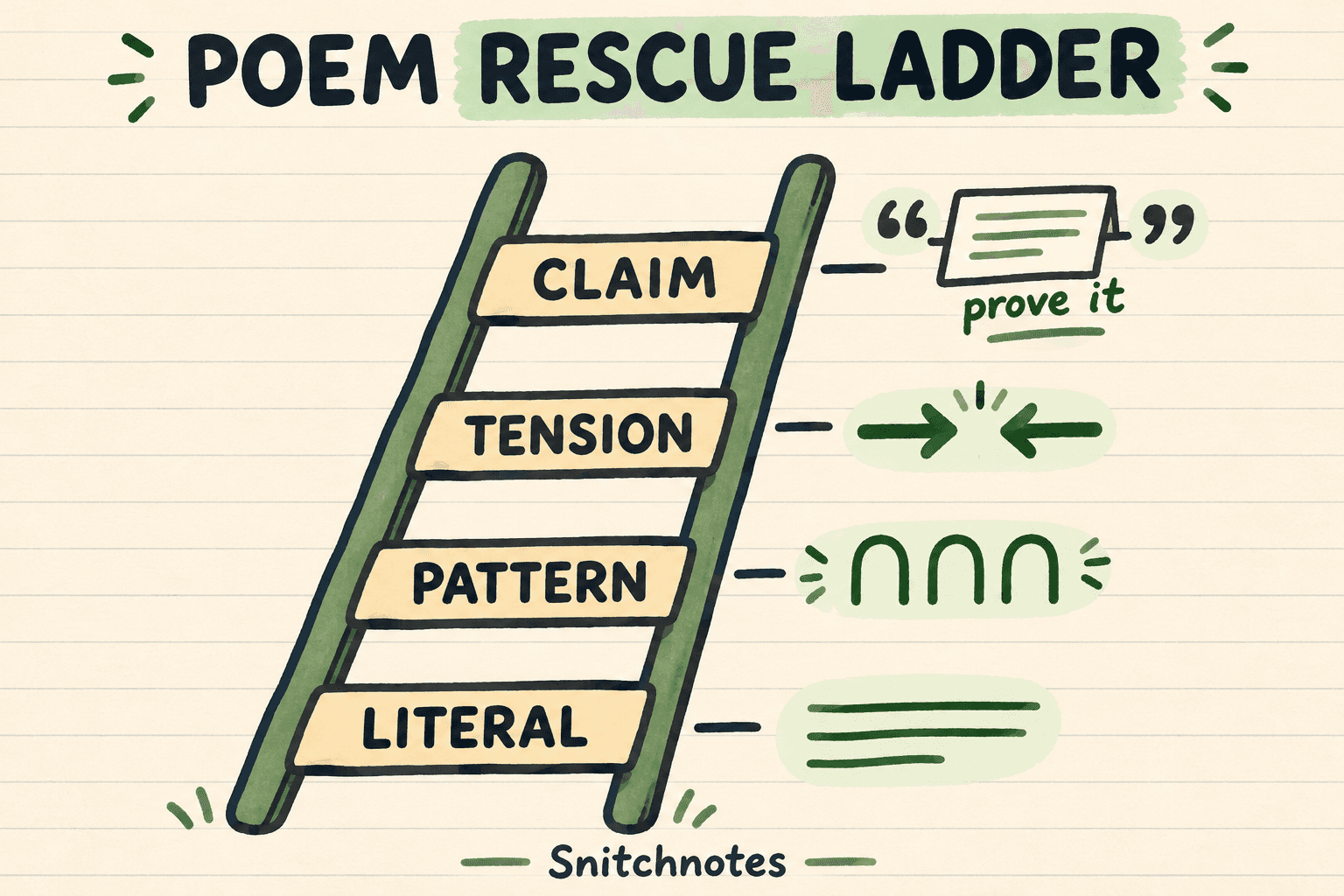
Use the four-step poem rescue ladder
- Literal: say what happens in ordinary language. Read the poem aloud, follow complete sentences rather than stopping automatically at each line break, and identify who speaks, what they describe, and what changes. Look up only words whose meanings block the sentence. A rough paraphrase is scaffolding, not your final interpretation.
- Pattern: circle what repeats or belongs together. Track repeated words, images, sounds, sentence shapes, oppositions, or spaces. Three doors, gates, and walls may form a threshold pattern even when the exact noun changes. Repetition matters because it gives separate details a shared direction.
- Tension: find what does not fit neatly. Look for a contrast, contradiction, unanswered question, surprising comparison, or turn signaled by words such as “but,” “yet,” or “then.” A turn does not always solve the poem. It may change the speaker’s attitude, reverse an expectation, or make the central problem harder.
- Claim: explain how the pattern and tension work together. Use a sentence frame: “Through [pattern or choice], the poem presents [subject] as [arguable idea], especially when [turn or tension].” Then attach two short quotations. A strong claim is specific enough to disagree with and narrow enough to prove.
Harvard lecturer Jeffrey R. Wilson recommends reading more than once, identifying a contradiction or gray area, collecting evidence, and letting analysis produce the thesis. That sequence matters. If you write the thesis before examining the evidence, you are likely to force every detail into your first guess.
Worked example: the locked garden poem
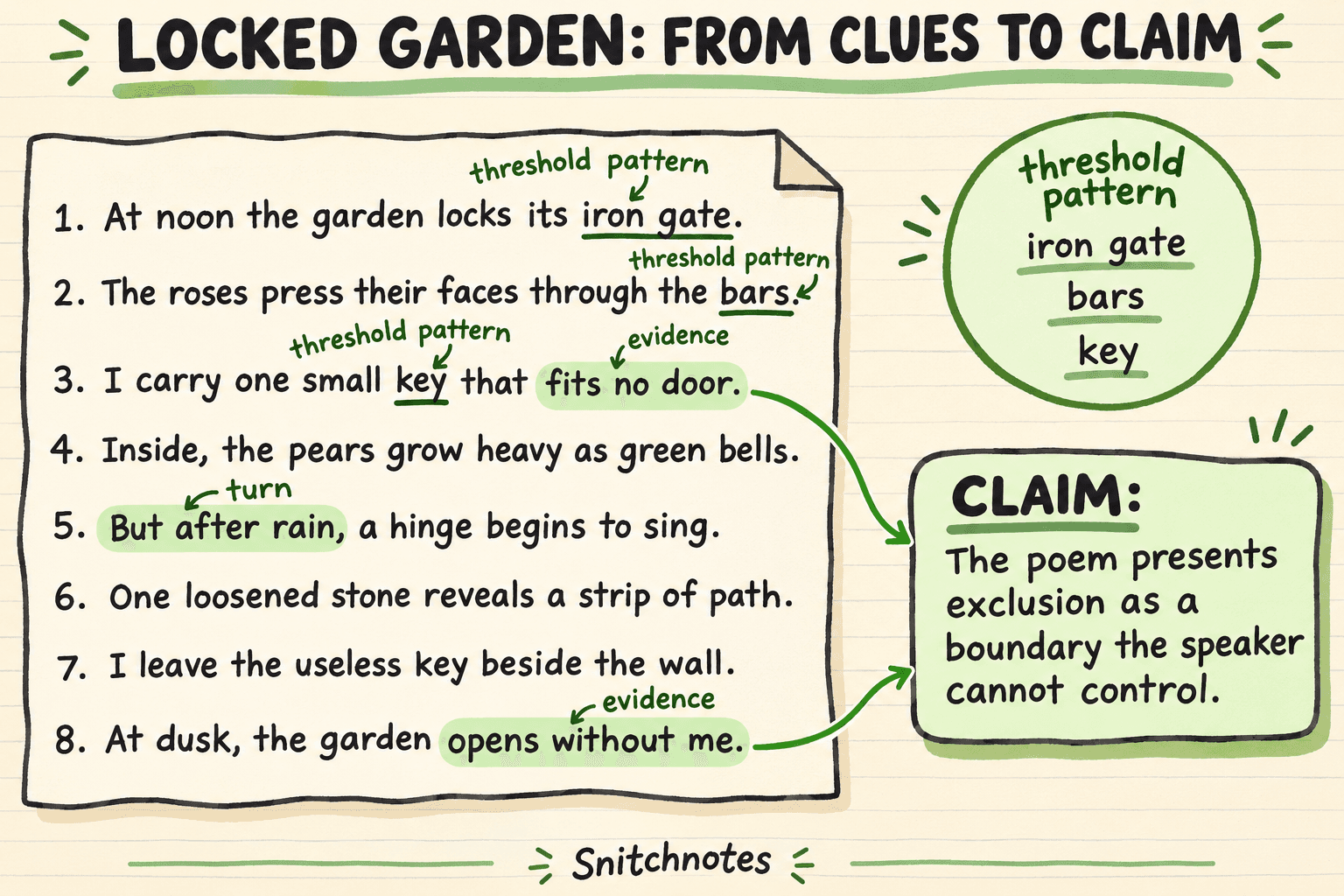
Consider this original eight-line poem:
At noon the garden locks its iron gate.
The roses press their faces through the bars.
I carry one small key that fits no door.
Inside, the pears grow heavy as green bells.
But after rain, a hinge begins to sing.
One loosened stone reveals a strip of path.
I leave the useless key beside the wall.
At dusk, the garden opens without me.
1. Paraphrase the literal situation
A speaker stands outside a locked garden. The key does not work. After rain, part of the boundary loosens and a path appears, but the final opening happens without the speaker controlling it. This paraphrase does not explain what the garden symbolizes; it simply secures the sequence of events.
2. Group the repeated threshold images
“Iron gate,” “bars,” “key,” “door,” “hinge,” “path,” and “wall” all concern entry or separation. The poem repeatedly places the speaker near a boundary. Even the roses press through bars, so the inside and outside are close enough to see each other but not freely connected.
3. Mark the turn and the tension
Line 5 begins with “But,” shifting from fixed closure to movement: rain makes the hinge sing, and a stone reveals a path. Yet the speaker’s key remains useless. The tension is that access becomes possible, but not through the tool the speaker expected to use or through an act of mastery.
4. Draft a claim and test it
A defensible claim is: “The poem presents exclusion as a boundary the speaker cannot control; the key ‘fits no door,’ while the garden finally ‘opens without me.’” The first phrase establishes failed agency, and the second complicates the apparent opening. Another reader could argue that the poem is about patience rather than exclusion, but that reading would still need to explain the same threshold pattern and final phrase.
Common mistakes when a poem is confusing
- Hunting for devices without effects: naming metaphor, alliteration, or enjambment is not analysis until you explain what the choice makes the reader notice or expect.
- Treating the speaker as the poet: unless context proves otherwise, discuss the voice inside the poem as the speaker rather than assuming it is a factual confession by the author.
- Stopping at summary: paraphrase tells you what happens; analysis explains why a wording, pattern, or structural shift changes how that situation can be understood.
- Forcing certainty: a good interpretation can acknowledge ambiguity. “The ending complicates the speaker’s control” is often stronger than “The garden definitely represents society.”
Context can matter, especially when a poem uses historical references, an unfamiliar form, or an older meaning of a word. But research should answer a question raised by the text, not replace reading the text. First establish the words and patterns on the page; then use reliable context to refine, challenge, or limit your interpretation.
Check your understanding
What should you do before deciding the theme?
Paraphrase the literal situation and collect observable details. Theme becomes useful after you can show which repeated choices and tensions create it.
How do you know whether a claim is analytical?
It explains a relationship among textual choices, makes an arguable point, and can be supported with exact evidence. “The poem mentions a gate” is an observation; “the threshold pattern makes exclusion feel visible but unstable” is a claim.
What if two interpretations seem possible?
Test both against the whole poem. Prefer the reading that explains more important details with fewer exceptions, or write a claim that preserves the tension between them. Poetry analysis rewards evidence and reasoning, not absolute certainty.
If your own course poems still feel tangled, Snitchnotes can turn your uploaded readings, lecture slides, and notes into organized study notes, flashcards, and quizzes so you can practice moving from evidence to interpretation.
Related concepts
- Analyze an unreliable narrator with a claim-evidence table: use a similar evidence-first method when a narrator’s version of events may be unstable.
- Find evidence for a literature essay without rereading everything: collect targeted passages after you have a focused question.
- Fix a literature essay that summarizes instead of analyzes: turn plot or paraphrase into claims about how language creates meaning.
Sources
Purdue Online Writing Lab: Writing About Poetry
Purdue Online Writing Lab: Poetry—Close Reading
University of York, Department of English and Related Literature: Close Reading
Jeffrey R. Wilson, Harvard University: Aphorisms on the Close Reading Process
Zamień wykłady w materiały gotowe na egzamin.
Notatki, quizy, podcasty, fiszki i czat — z jednego uploadu.
Stwórz pierwszą notatkę za darmo