
Snitchnotes Team
What to Do After Your Mock Exam Score Drops
What to Do After Your Mock Exam Score Drops
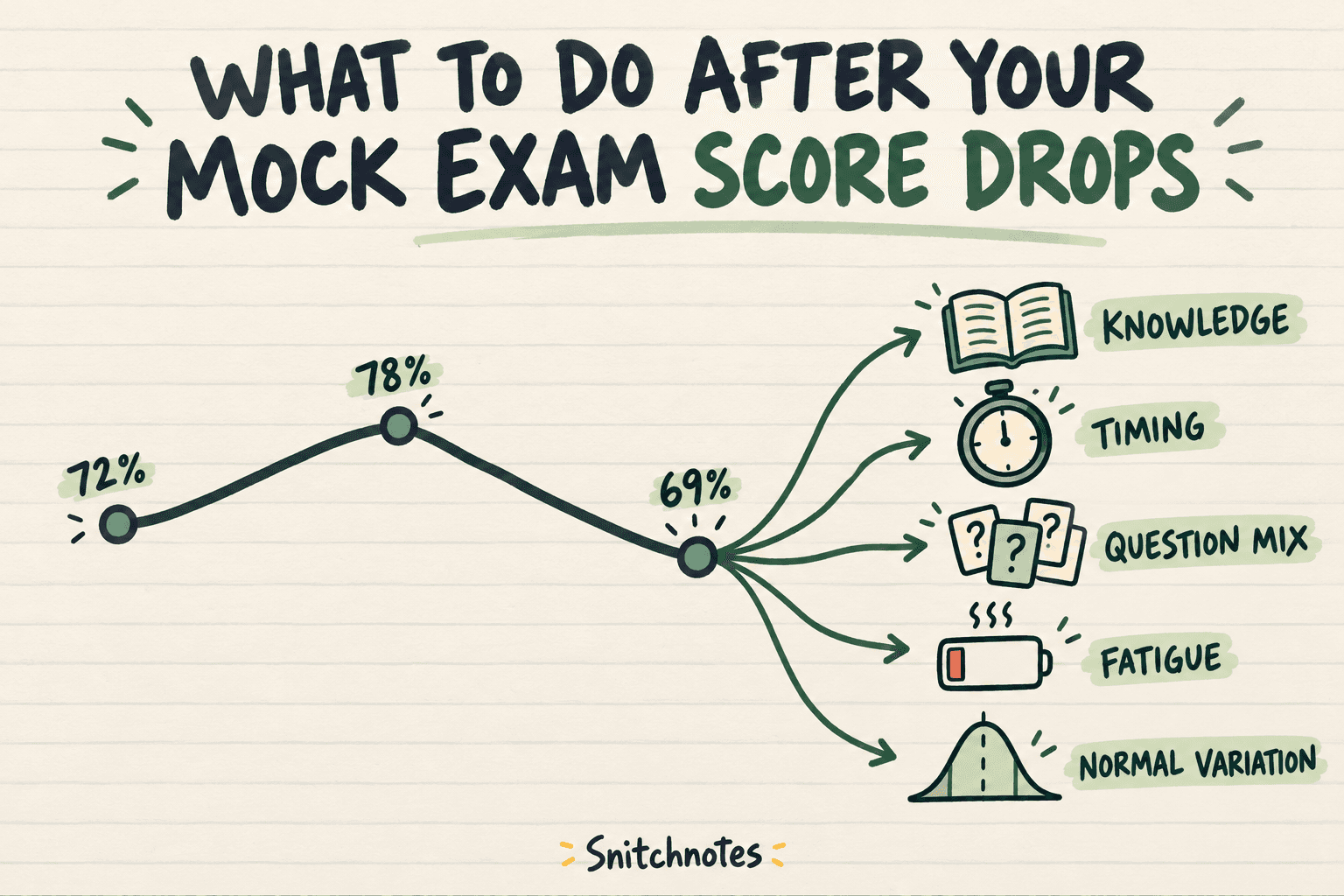
If your mock exam score dropped, do not immediately rewrite your entire study plan. First check whether the two tests were genuinely comparable. Then review every lost mark and sort it into five possible causes: a knowledge gap, a timing problem, a different question mix, fatigue or test conditions, and normal score variation. Fix the largest repeatable cause, then take another comparable mock after targeted practice.
This matters because one lower score can feel like proof that you are getting worse when it may be telling a much narrower story. Official test reports sometimes include score ranges precisely because performance can vary across different administrations even under similar conditions. A mock is useful evidence, but it is still one sample of your performance—not a character reference.
Start with a 30-minute debrief
Before studying anything new, preserve the evidence. Write down the total score, section scores, time used, number of unanswered questions, sleep the night before, interruptions, and anything unusual about the paper. Do this while the experience is fresh. A vague feeling such as “I panicked” becomes more useful when translated into “I spent 11 minutes on two algebra questions and guessed the final six.”
Next, review the paper without changing answers first. Mark each missed item with one primary reason: did not know, knew but could not retrieve, misread, calculation or process slip, ran out of time, or guessed between plausible options. If two reasons apply, choose the one that would have prevented the error earliest. That keeps the diagnosis actionable instead of turning every mistake into a general complaint about concentration.
Step 1: check whether the mocks were comparable
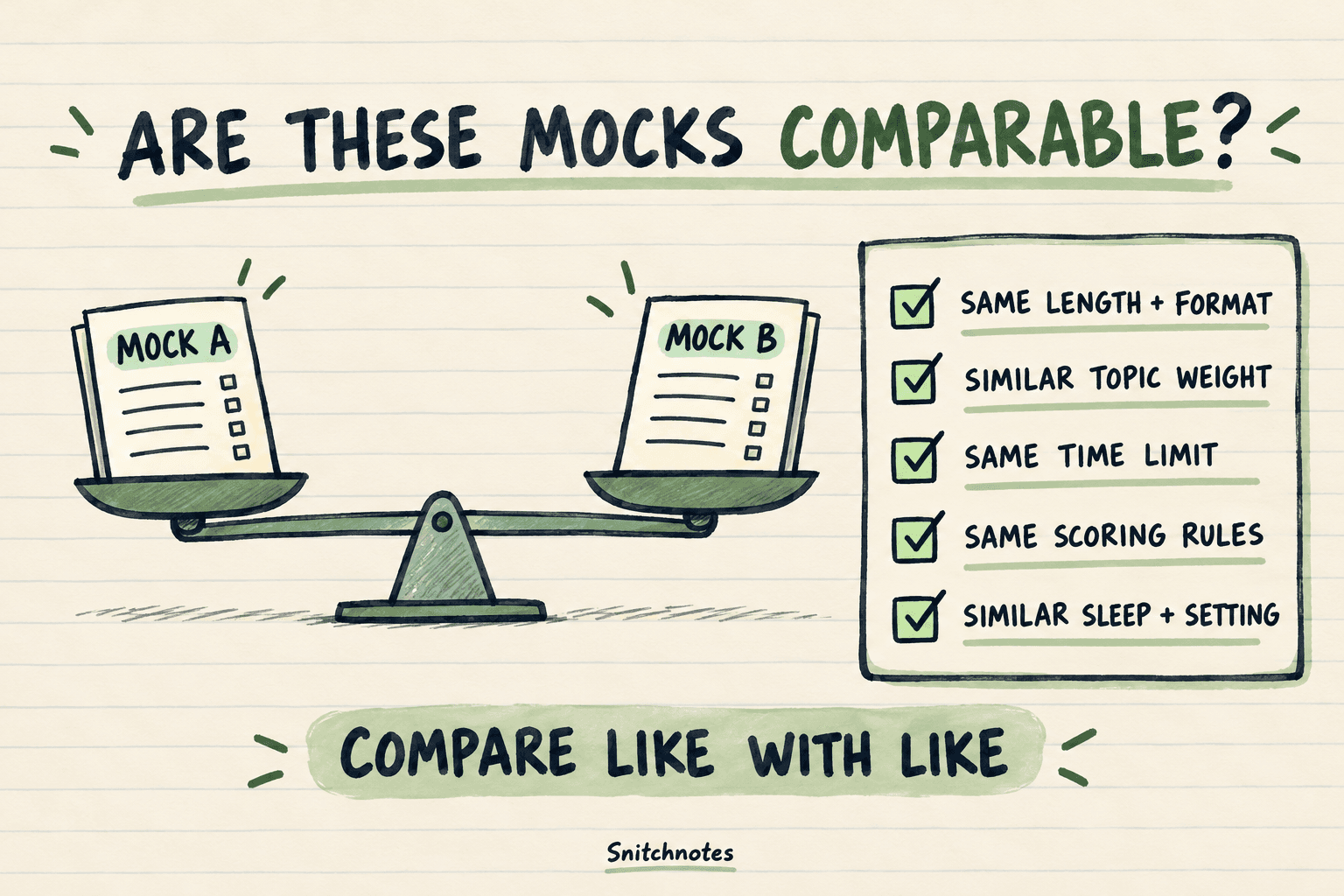
A percentage from one mock is not automatically comparable with the same percentage from another. Check whether both papers had the same length and format, similar topic weighting, the same time limit, and the same scoring or penalty rules. Also compare your conditions: a quiet morning after normal sleep is not equivalent to a late-night attempt after classes and work.
If the papers were different, compare like with like. Look at algebra against algebra, essay planning against essay planning, or the first timed hour against the first timed hour. A harder paper can produce a lower raw score even while a specific skill improves. The College Board, for example, explains that an SAT score range represents how a score would likely vary across another administration under identical conditions. The exact range depends on the exam, so use your own test provider’s guidance when it exists.
Step 2: diagnose the cause of the drop
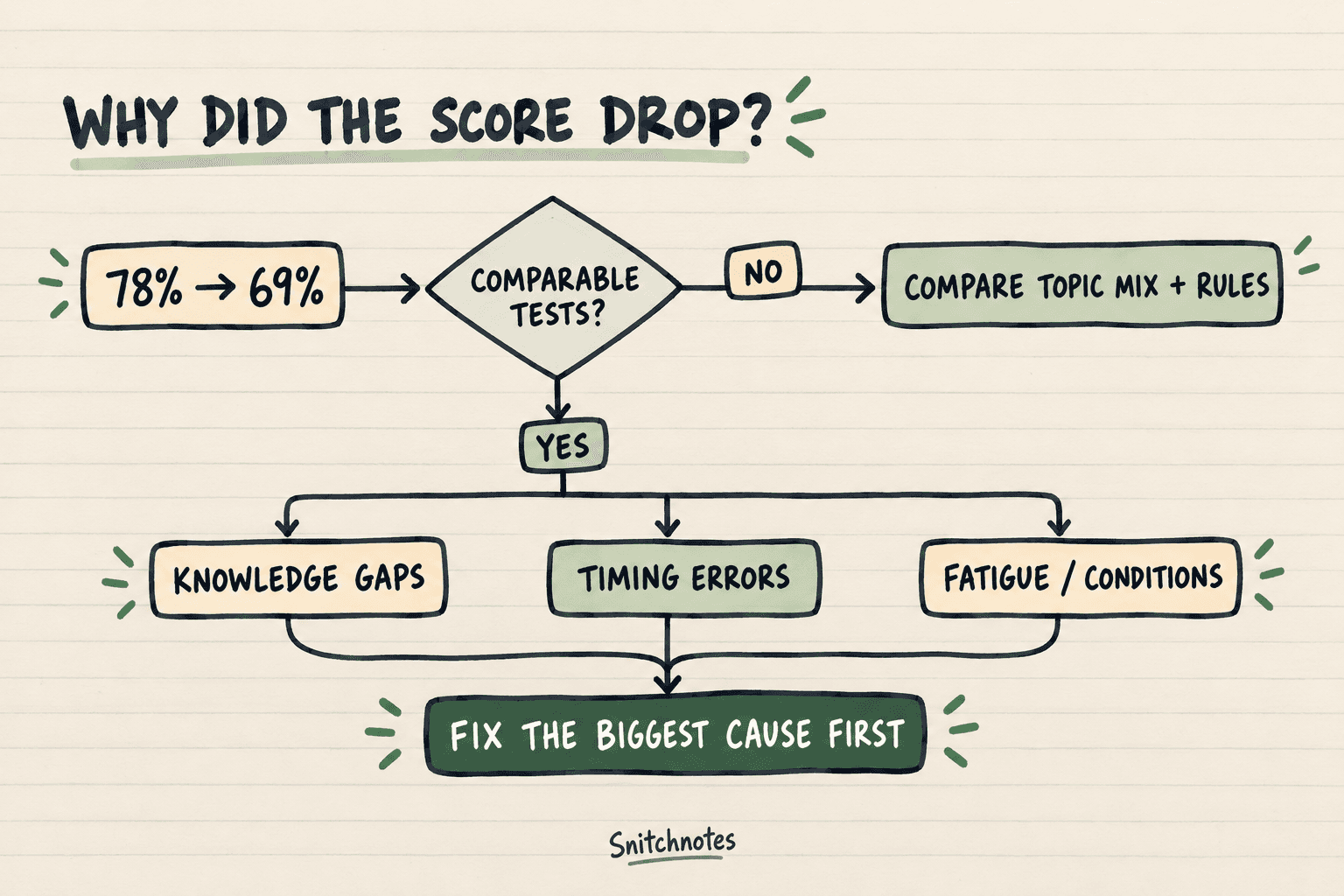
Knowledge gaps form a pattern: several misses cluster around the same concept and remain difficult without a time limit. Timing errors look different: you can solve the question afterward, but your pacing, order, or time allocation failed during the mock. Question mix belongs upstream—one paper may simply contain more of your weaker topics. Fatigue or conditions are plausible when errors rise late in the paper, reading becomes sloppy, or the attempt happened under unusually poor sleep or distraction.
Normal variation is the remaining possibility, not an excuse. Test scores are imperfect measurements influenced by the particular questions and occasion. Educational Testing Service describes reliability as score consistency across occasions, test editions, or raters; no realistic mock removes all measurement error. The practical response is to look for repeated patterns across comparable attempts rather than treating a single point estimate as perfectly precise.
Jordan’s 72%, 78%, and 69%: a worked diagnosis
Jordan scores 72% on Mock A, 78% on Mock B, and 69% on Mock C. At first glance, the nine-point fall looks alarming. But Mock C contains 14 algebra questions compared with eight on Mock B, Jordan takes it after a six-hour shift, and the paper uses a strict 90-minute limit that Jordan did not apply to Mock B. Those scores are not three identical measurements.
The review shows that Jordan misses seven algebra questions. Four are correct when retried untimed, which points to rushed execution; three still fail, which reveals a genuine knowledge gap in rearranging equations. Jordan also leaves five questions unanswered in the final 12 minutes. The useful diagnosis is not “I have forgotten everything.” It is “algebra is overrepresented in this paper, three concepts need repair, and my pacing collapses near the end.”
Build a one-week response plan
- Day 1: Finish the error review and choose one dominant cause. Jordan chooses rushed algebra plus three specific equation gaps.
- Days 2–3: Relearn only the missing steps, then retrieve them from memory with short practice sets and corrective feedback.
- Day 4: Mix the repaired topic with other question types so the right method must be selected, not merely repeated.
- Day 5: Complete a timed section and use checkpoints, such as reaching question 15 by minute 30.
- Day 6: Review the error log, stop heavy work at a sensible hour, and prepare comparable test conditions.
- Day 7: Take a comparable mock, then judge whether the targeted errors and pacing improved—not only whether the total score rose.
Retrieval practice is useful here because producing an answer from memory gives you a stronger test of access than rereading the solution. Research on learning also distinguishes temporary performance during practice from durable learning. A difficult session can feel worse while still producing useful learning, so your plan should track error types and later recall as well as today’s percentage.
What not to conclude from one lower score
Do not conclude that all prior improvement was fake, that you need to double your study hours, or that the lowest score is your “real” level. Equally, do not dismiss every fall as bad luck. One score is enough to trigger a review, but usually not enough to establish a trend. If two or three comparable attempts show the same weakness, that repeated evidence deserves a larger change in method or support from a teacher or tutor.
Sleep and fatigue deserve special care. A meta-analysis by Julian Lim and David Dinges found that short-term sleep deprivation impairs several areas of cognitive performance, especially attention and working memory. That does not mean every weak mock can be blamed on sleep. It means testing conditions belong in your evidence log, and the fairest retest should reproduce the conditions you expect on exam day.
Check your understanding
Why should you compare the mock papers before comparing scores?
Different topic weights, formats, time limits, scoring rules, and conditions can change the result. A lower total may reflect a harder or less favorable sample rather than broad regression.
What separates a knowledge gap from a timing error?
A knowledge gap remains difficult when the question is retried calmly without a time limit. A timing error is more likely when you can solve it afterward but could not allocate time, retrieve the method, or execute it accurately during the mock.
What should your next mock test?
It should test whether your chosen intervention changed the repeated pattern under comparable conditions. Look at the relevant error category and pacing checkpoints alongside the total score.
If your error review is scattered across papers and screenshots, Snitchnotes can turn your own lectures, PDFs, and notes into clearer study notes, flashcards, quizzes, and audio for the targeted week ahead.
Related concepts
- How to learn from exam mistakes: turn individual errors into specific corrections.
- How to build a practice-test error log: track patterns across multiple attempts.
- Test reliability: how consistently an assessment measures performance across occasions or forms.
Sources
College Board: What Do My SAT Suite Scores Mean?
Educational Testing Service: Test Reliability—Basic Concepts
Soderstrom and Bjork: Learning Versus Performance—An Integrative Review
Lim and Dinges: A Meta-Analysis of the Impact of Short-Term Sleep Deprivation on Cognitive Variables
Karpicke and Roediger: The Critical Importance of Retrieval for Learning
講義をテスト対策バッチリの教材に。
ノート、クイズ、ポッドキャスト、フラッシュカード、チャット — アップロード1回で全部。
最初のノートを無料で試す