
Snitchnotes Team
How to Study When Worked Solutions Skip Steps
How to Study When Worked Solutions Skip Steps
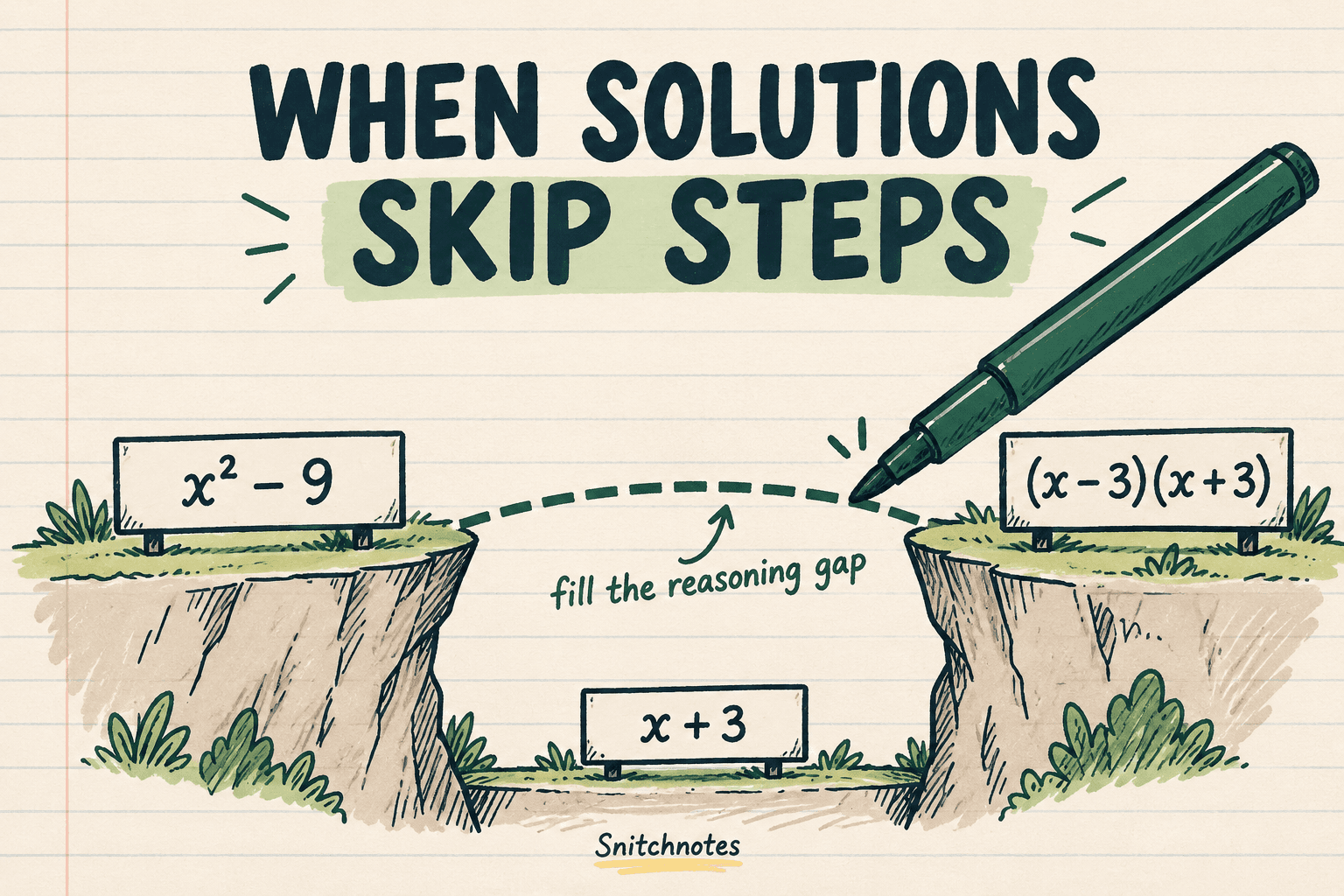
When a worked solution skips steps, stop at the first transition you cannot explain. Reconstruct the missing line by naming the rule, showing why it applies, and checking that the new line really follows. Then close the solution and reproduce the reasoning yourself. The goal is not to make every solution longer; it is to make every important jump understandable.
This method works for compressed algebra, calculus, statistics, physics, chemistry, and other step-based subjects. It turns a frustrating answer key into an active study exercise instead of a sequence you copy and promptly forget.
Why skipped steps cause trouble
Experts compress familiar operations. They may combine two algebra moves, invoke a theorem without naming it, substitute a value mentally, or leave a condition unstated. That compression can be efficient for an experienced reader, but a learner sees only line A and line D. Copying line D creates the feeling of progress without supplying the reasoning that connects them.
The University of North Carolina Learning Center advises students in technical courses to work problems and explain both the steps and why they work. Massachusetts Institute of Technology guidance similarly recommends self-explaining worked examples with questions such as which principle is being applied and why. Your task, then, is not merely to reveal the hidden calculation. It is to recover the reason for it.
Step 1: Find the first unexplained transition
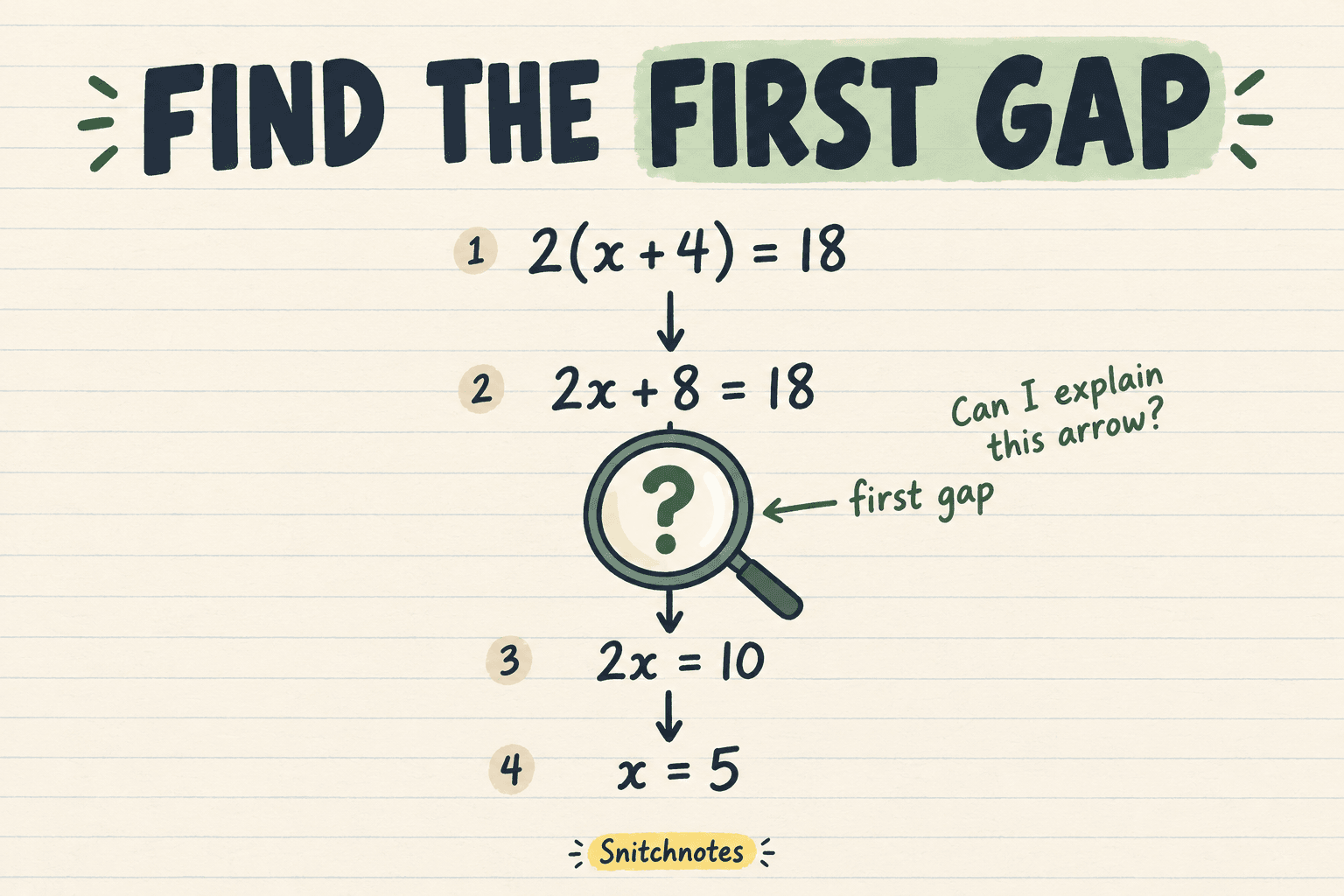
Cover everything below the current line and move downward one arrow at a time. For each transition, ask: What changed? What stayed the same? Could I justify this move aloud without looking ahead? Mark the first arrow where the answer becomes vague. Do not begin with the final answer, because the earliest missing idea often explains several later lines.
Write a question beside that arrow. Useful questions include “Was something factored?”, “Was the same operation applied to both sides?”, “Which definition was used?”, “What quantity was substituted?”, and “Does this theorem require a condition?” A precise question makes the gap small enough to investigate.
Step 2: Classify the missing move
Most jumps belong to a manageable category: algebraic manipulation, substitution, a definition, a known identity, a theorem, a unit conversion, or a hidden assumption. Compare the symbols before and after the arrow. New numbers often signal substitution; a changed form with the same value often signals an identity or algebraic rewrite; a new conclusion word such as “therefore” may signal a theorem.
Use your lecture notes, formula sheet, textbook index, or a nearby complete example to identify the candidate rule. Give yourself a short attempt before looking it up. UNC suggests spending roughly 10–15 minutes struggling productively with a practice problem before consulting resources, then using those resources to fill the gaps.
Step 3: Use rule, evidence, reconstruction
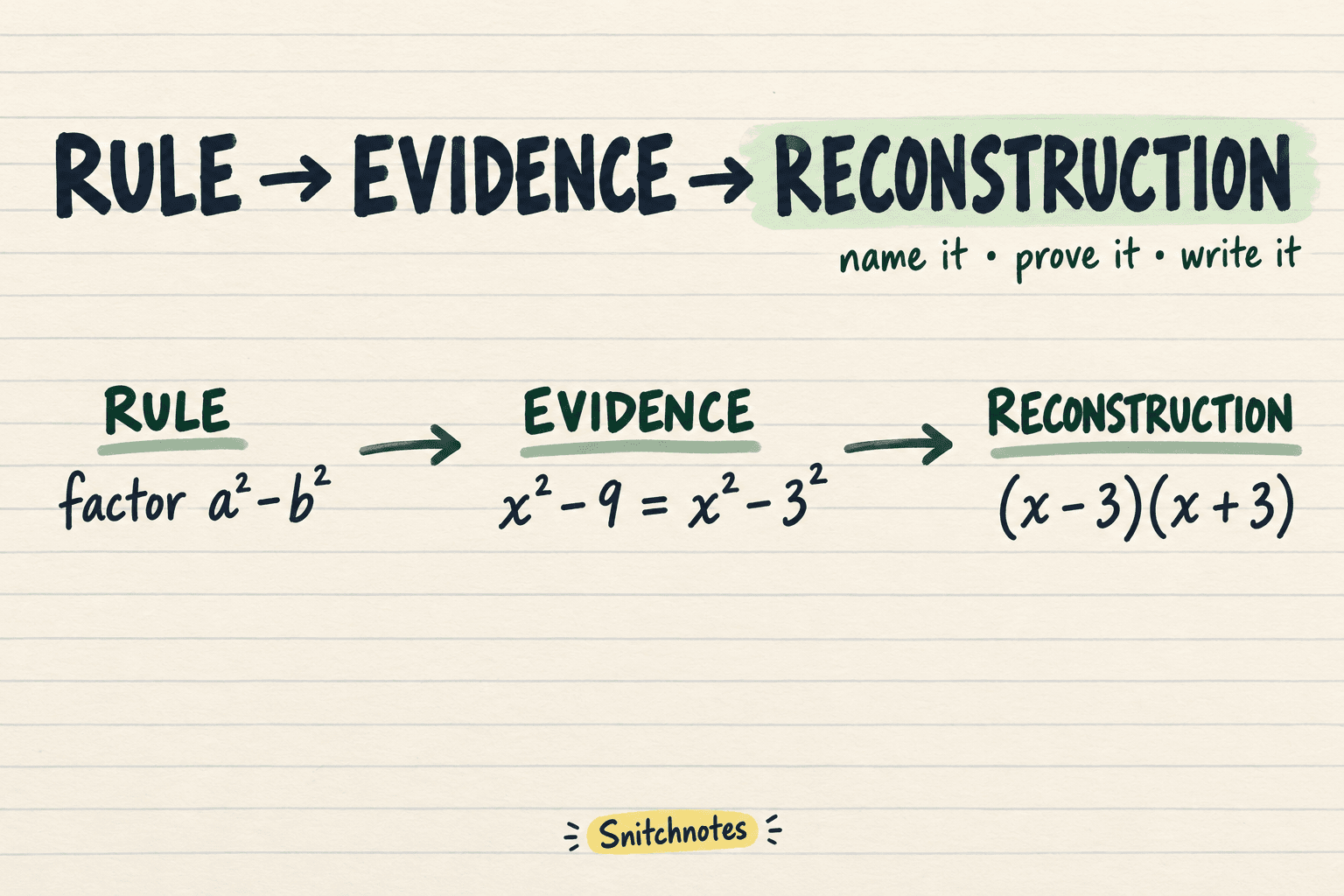
Annotate the gap with three items. Rule names the operation or principle. Evidence identifies the feature that makes the rule relevant here. Reconstruction writes one or more intermediate lines. This prevents a common mistake: finding a familiar formula and applying it simply because it looks nearby.
For example, the rule may be the difference-of-squares identity. The evidence is that x² − 9 can be written as x² − 3². The reconstruction is (x − 3)(x + 3). If one intermediate line still contains a mysterious jump, split it again. A useful reconstruction is as detailed as you need, not as detailed as somebody else needs.
A 25-minute calculus example
Nina has 25 minutes before class and finds a solution that jumps from lim x→3 of (x² − 9)/(x − 3) to lim x→3 of (x + 3), then to 6. She can copy that in seconds, but the first arrow is doing nearly all the conceptual work.
- Rule: factor a difference of squares, so x² − 9 = (x − 3)(x + 3).
- Evidence: the numerator is x² − 3², and the denominator contains the matching factor x − 3.
- Reconstruction: for x ≠ 3, cancel the common factor to obtain x + 3.
- Check: the limit concerns values near 3, so simplifying for x ≠ 3 is valid; substituting 3 into x + 3 gives 6.
Nina then closes the worked solution, rewrites the four links from memory, and tries the related limit as x approaches 5 of (x² − 25)/(x − 5). Changing the number checks whether she learned the structure rather than memorized one page.
Step 4: Verify, hide, and vary
First verify the repaired transition locally. Reverse the algebra, substitute a safe test value, check units in a science problem, or compare the result with a definition. Next hide the solution and reproduce the path. Finally, alter one feature: a number, sign, variable, diagram, or condition. If the method survives the variation, you probably understand the rule rather than its surface appearance.
Self-explanation matters here. Harvard’s ABLConnect summarizes research showing that explaining worked examples can improve problem-solving learning and reveal areas of confusion. MIT also notes an important boundary: worked examples are especially useful during initial learning, while more knowledgeable learners benefit increasingly from solving problems themselves.
Complete, faded, and skipped solutions are different
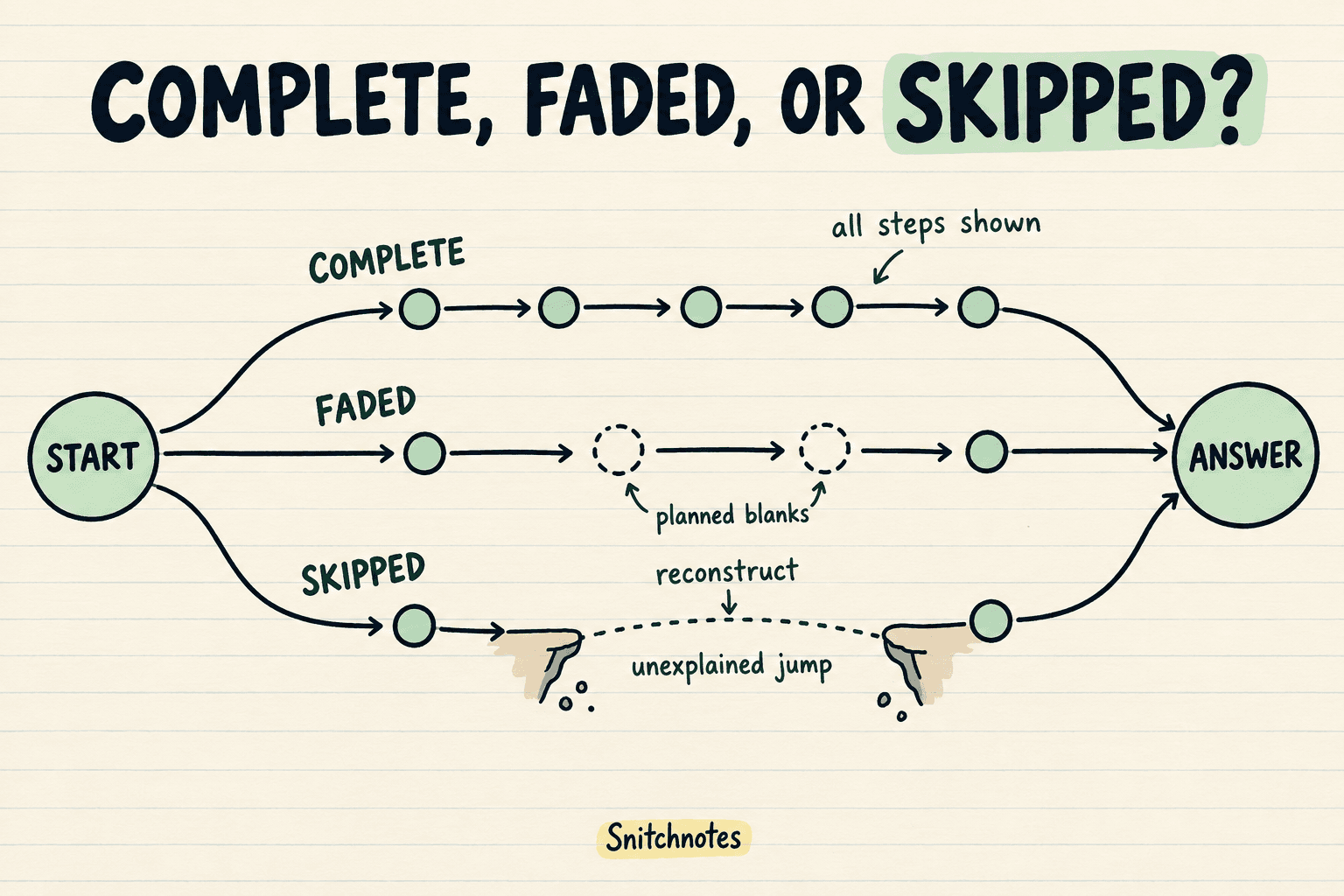
A complete example intentionally shows the path. A faded example intentionally removes selected steps so you can supply them; the omission is the exercise. A skipped solution compresses reasoning without necessarily telling you what vanished. Treat the first as a model, the second as guided practice, and the third as a troubleshooting task.
Do not assume every gap is your fault. A solution may contain a typo, use notation that was never defined, or rely on a condition that is false. If you cannot justify a jump after a focused attempt and checking course resources, take the two surrounding lines to an instructor, tutor, or classmate and ask which rule connects them. That question is much easier to answer than “I do not understand any of this.”
Check your understanding
Where should you start when several steps seem confusing?
Start with the earliest arrow you cannot justify. Repairing it may make later steps obvious, while starting from the answer can hide the original source of confusion.
What are the three parts of a useful annotation?
Name the rule, identify evidence that the rule applies in this problem, and write the missing intermediate line or lines.
How do you know you understood rather than copied?
Hide the solution, reproduce the reasoning, and solve a nearby variation. If you can explain each transition and handle the changed feature, the method is becoming transferable.
Related concepts
- Self-explanation: stating why a step follows and how it connects to what you already know.
- Productive struggle: making a bounded attempt before consulting help, then using feedback to repair understanding.
- How to study with faded worked examples
- Worked example study method for math and science exams
Sources
University of North Carolina Learning Center: Study Smarter Not Harder
University of North Carolina Learning Center: Math and Physics Learning Strategies
MIT Open Learning: Learning Through Step-by-Step Solutions to Solved Problems
講義をテスト対策バッチリの教材に。
ノート、クイズ、ポッドキャスト、フラッシュカード、チャット — アップロード1回で全部。
最初のノートを無料で試す