
Snitchnotes Team
Odds vs Probability: Differences and Conversion Examples
Odds vs Probability: Differences and Conversion Examples
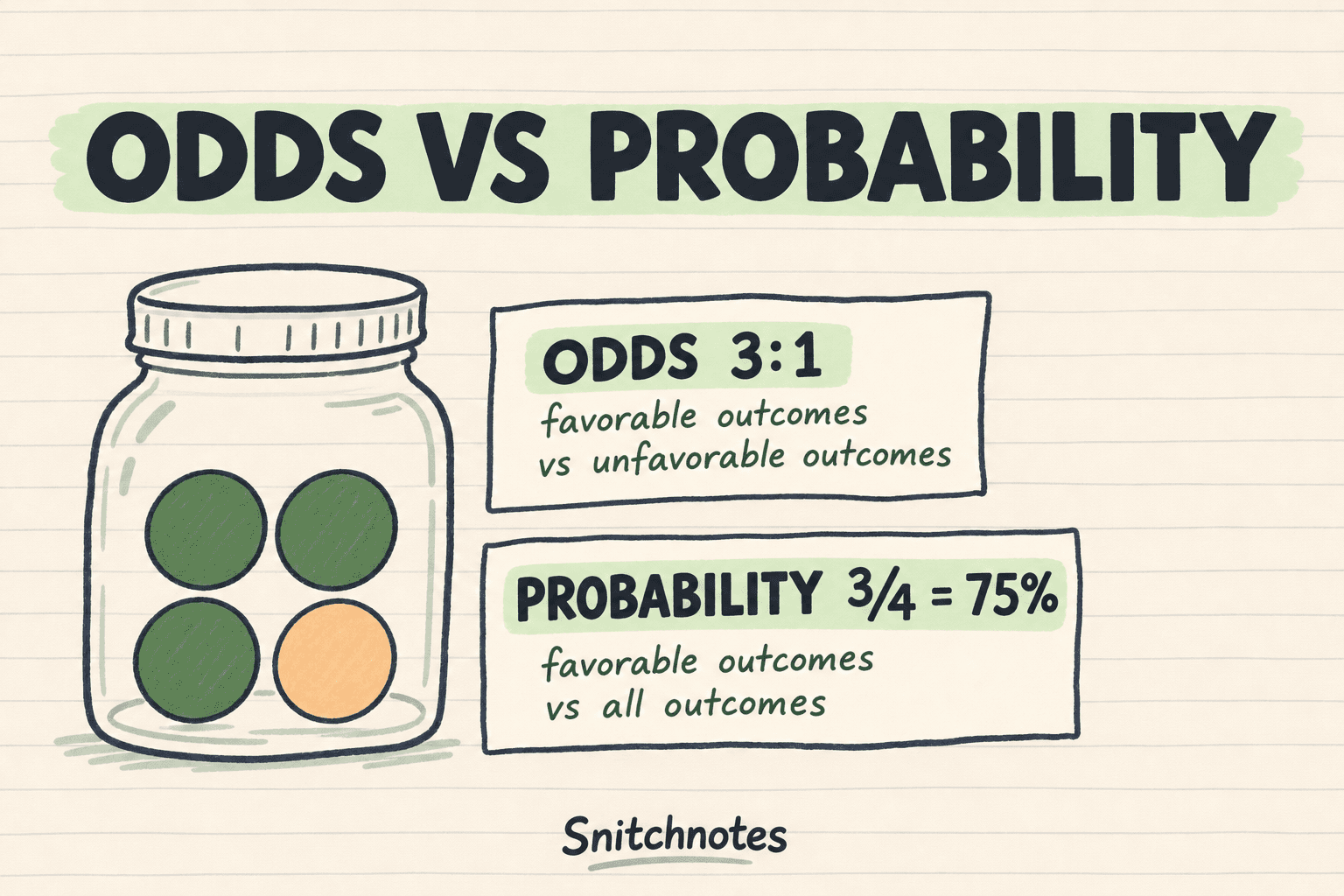
Probability compares favorable outcomes with all possible outcomes. Odds in favor compare favorable outcomes with unfavorable outcomes. That change of denominator is the whole difference: three favorable outcomes out of four have probability 3/4, or 75%, but odds in favor of 3:1.
The two forms describe the same chance, so you can convert between them. The trap is reading a ratio without asking what its two sides represent. This guide gives you that reference check, the formulas, and worked conversions you can reuse in statistics, risk, and everyday forecasts.
Odds vs probability: the core difference
Imagine a bag holding three green tokens and one orange token. Let drawing green be the favorable event. Its probability is favorable divided by total: 3/(3+1) = 3/4 = 0.75 = 75%. Its odds in favor are favorable divided by unfavorable: 3/1, usually written 3:1.
Probability is normally written as a fraction, decimal, or percentage and ranges from 0 to 1, inclusive. Odds are a ratio. Odds of 3:1 say that there are three favorable chances for every one unfavorable chance; they do not say that three of every one outcomes succeed. The University of Illinois statistics course uses this same success-versus-failure framing.
A quick comparison
- Probability = favorable / total. For the tokens: 3/4.
- Odds in favor = favorable / unfavorable. For the tokens: 3/1, or 3:1.
- Odds against reverse the order. For drawing green, the odds against are 1:3.
How to convert between odds and probability
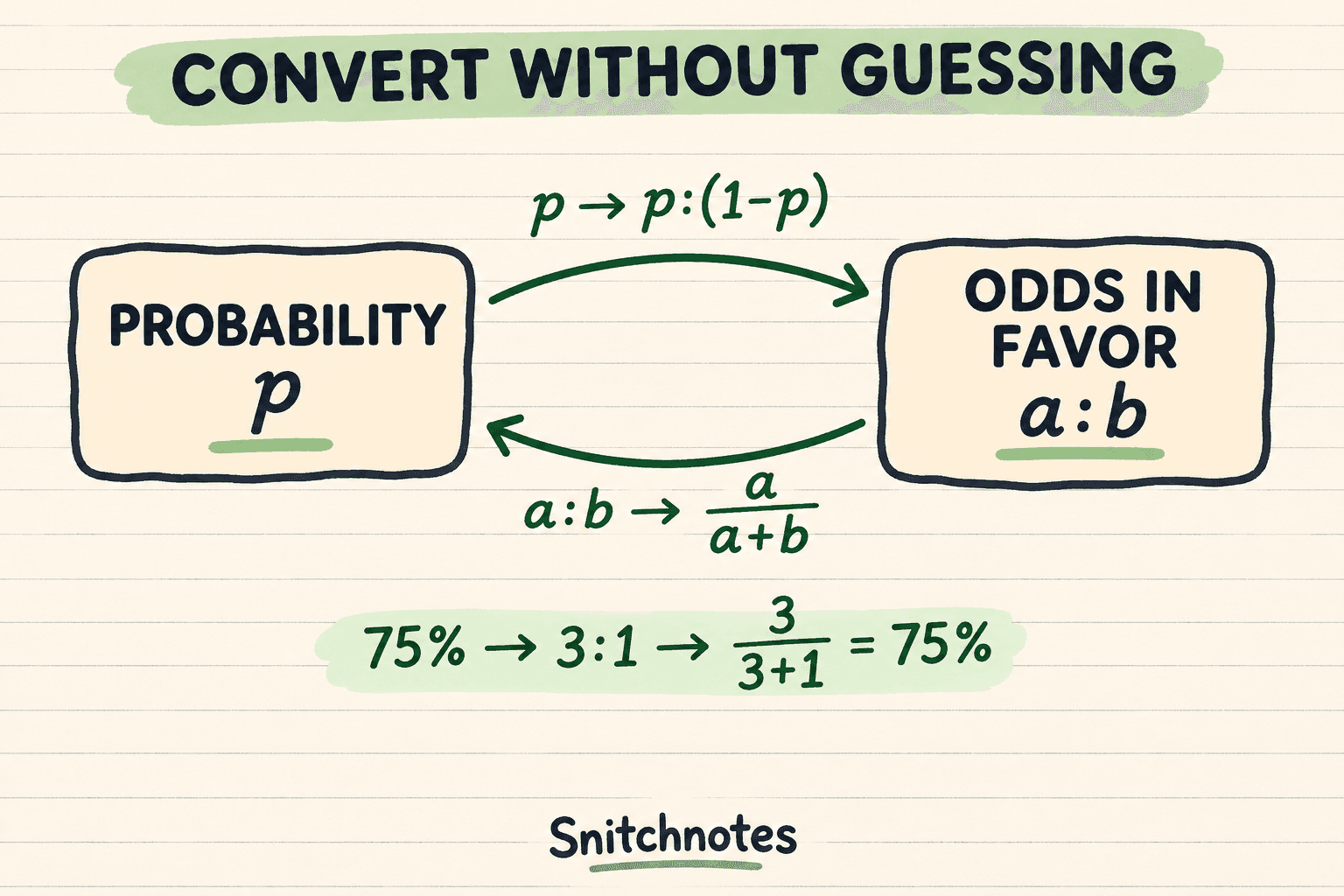
If the odds in favor are a:b, imagine a favorable outcomes and b unfavorable outcomes. The total is a+b, so probability = a/(a+b). For odds of 3:1, probability = 3/(3+1) = 3/4 = 75%. MIT OpenCourseWare presents the same conversion in its probability and statistics material.
If probability is p, the probability of the event not happening is 1−p. Therefore odds in favor are p:(1−p). At p = 0.75, that is 0.75:0.25. Divide both sides by 0.25 to simplify the ratio to 3:1.
When p is written as a percentage, you can first compare the percentage with its complement. A 60% probability gives 60:40, which simplifies to 3:2. A 10% probability gives 10:90, which simplifies to 1:9. Keeping the event first prevents you from accidentally calculating odds against.
Worked conversions: rain and a card draw
Convert a 20% rain probability to odds
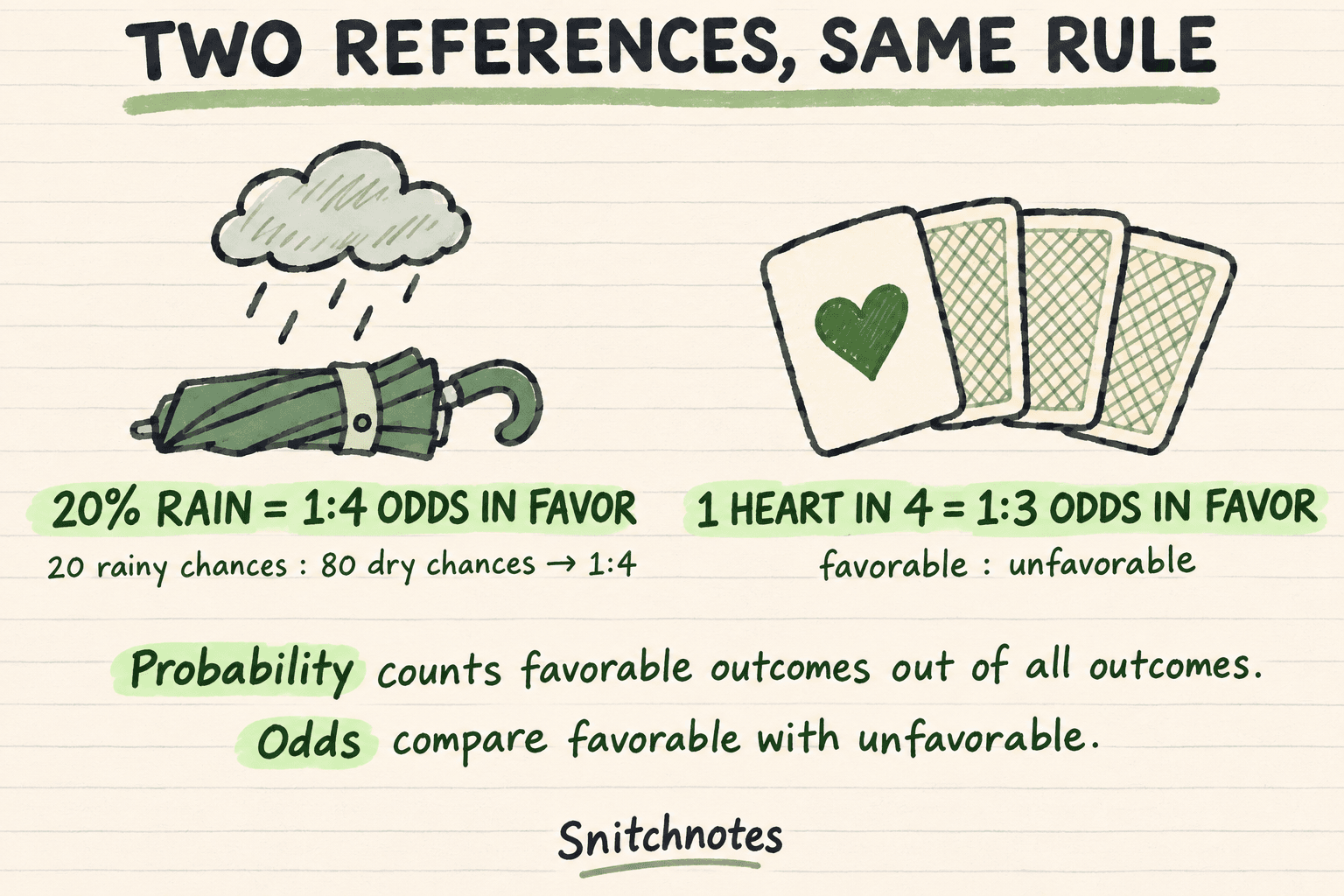
Let rain be the event. Its probability is 20%, while no rain has probability 80%. The odds in favor of rain are therefore 20:80 = 1:4. This means one rainy chance for every four dry chances in the ratio, not one rainy outcome out of four total outcomes. The equivalent probability remains 1/(1+4) = 1/5 = 20%.
The National Weather Service defines a precipitation probability for a particular point over a specified time period. Converting 20% to 1:4 changes only the representation, not the forecast's location, time window, or event definition. Those details still matter.
Convert a one-in-four card chance to odds
Suppose one card in a set of four has a heart and the other three do not. The probability of drawing the heart is 1/4 = 25%. The odds in favor are one favorable card to three unfavorable cards, or 1:3. The phrase “one in four” names a probability; “one to three” names the matching odds in favor.
Why the distinction matters
Odds and probability can sound similar at low values but separate sharply as an event becomes common. A probability of 50% corresponds to even odds of 1:1. A probability of 80% corresponds to odds of 4:1, not 4:5 or 80:100 after simplification. Mixing the reference groups can make a result look smaller or larger than it is.
Also keep odds separate from an odds ratio. Odds describe one event relative to its non-event. An odds ratio compares the odds in one group with the odds in another group, as UCLA and the National Center for Biotechnology Information explain. An odds ratio of 2 does not, by itself, mean a 200% probability or tell you either group's probability.
Common misconception: one in four is not odds of one to four
“One in four” means one favorable outcome among four total outcomes, so the probability is 1/4. The other three outcomes are unfavorable, making the odds in favor 1:3. By contrast, odds of 1:4 contain five ratio parts in total and convert to probability 1/(1+4) = 1/5.
Language around betting may quote odds in different conventions, including odds against, so never rely on word order alone. Label the event, label the non-event, and ask whether the denominator is total outcomes or unfavorable outcomes. That ten-second check is more reliable than memorizing isolated examples.
Check your understanding
What probability matches odds in favor of 2:3?
Add the ratio parts to get five total parts, then divide the two favorable parts by five: 2/(2+3) = 2/5 = 40%.
What odds in favor match a 30% probability?
Compare the event with its 70% complement: 30:70. Divide both sides by 10 to get odds of 3:7 in favor.
If odds against an event are 4:1, what are the odds in favor?
Reverse the ratio: odds in favor are 1:4. The corresponding probability is 1/(1+4) = 20%.
Related concepts
- Conditional probability: choose the correct denominator when the sample space changes.
- Permutation vs combination: decide whether order changes the count.
- Sampling error vs sampling bias: distinguish random variation from systematic distortion.
Sources
University of Illinois: Odds and Probability
MIT OpenCourseWare: Bayesian Updating—Odds
National Weather Service: What Does Probability of Precipitation Mean?
UCLA Statistical Consulting: How Do I Interpret Odds Ratios in Logistic Regression?
講義をテスト対策バッチリの教材に。
ノート、クイズ、ポッドキャスト、フラッシュカード、チャット — アップロード1回で全部。
最初のノートを無料で試す