
Snitchnotes Team
Classical vs Operant Conditioning: Key Differences
Classical vs Operant Conditioning: Key Differences
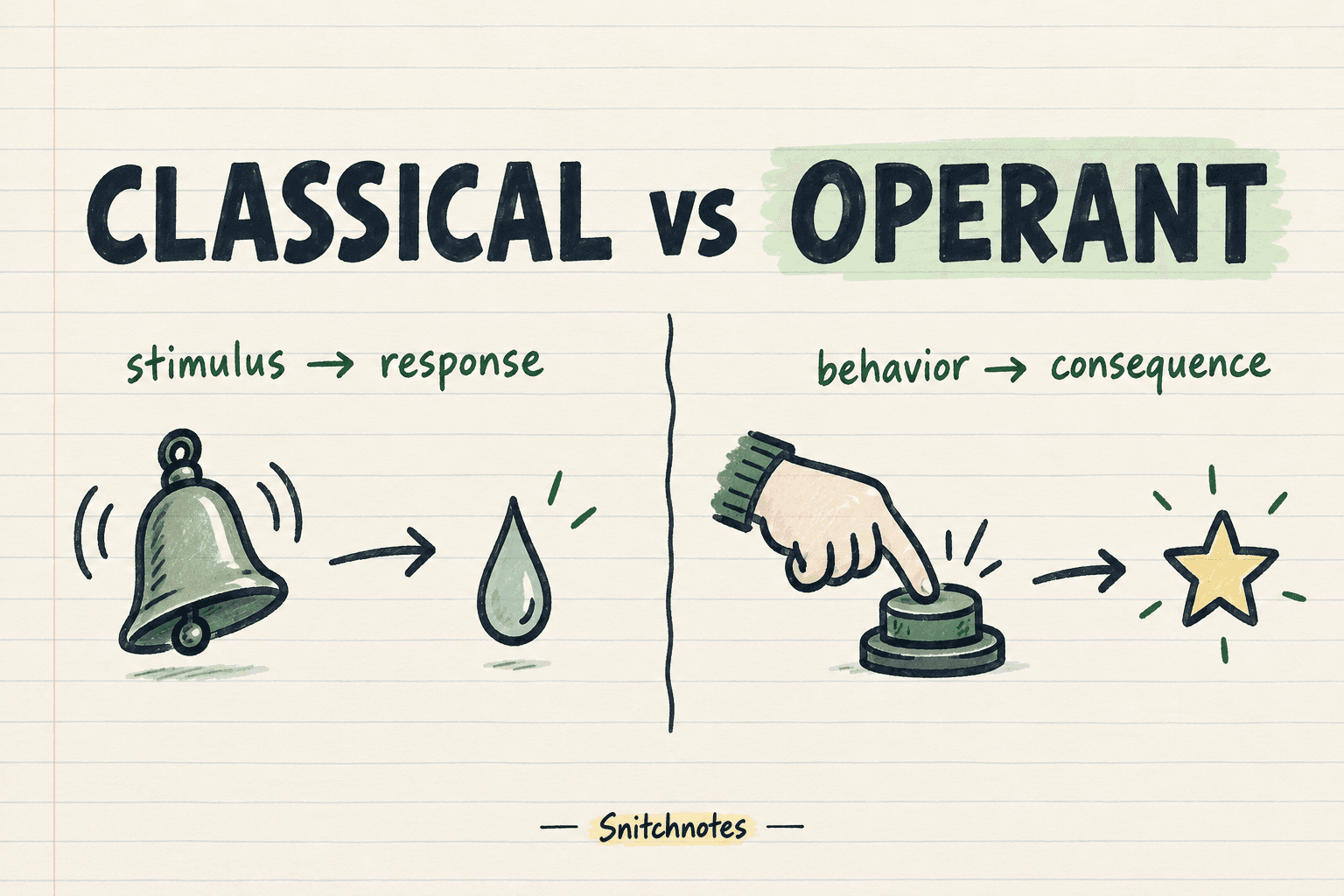
Classical conditioning is learning that one stimulus predicts another, so a stimulus comes to trigger a response. Operant conditioning is learning that a behavior produces a consequence, so that behavior becomes more or less likely. The quickest test is simple: if the learner is connecting two events that happen around them, think classical; if the learner's action changes because of what follows it, think operant.
Both are forms of associative learning, and both can operate in the same situation. The difference matters because exam questions often disguise the mechanism inside a short story. Naming the bell, reward, or punishment is not enough; you need to identify the relationship being learned.
The fastest way to tell them apart
In classical conditioning, the key sequence is stimulus, then response. A previously neutral cue is paired with something that already produces a response. After learning, the cue itself can elicit that response. Ivan Pavlov's familiar example pairs a tone with food until the tone predicts food and elicits salivation. The animal does not need to decide that salivating is useful.
In operant conditioning, the key sequence is behavior, then consequence. A behavior is followed by reinforcement, which increases it, or punishment, which decreases it. A student who contributes more often after receiving specific praise is learning from the consequence of speaking up. The behavior operates on the environment and changes what happens next.
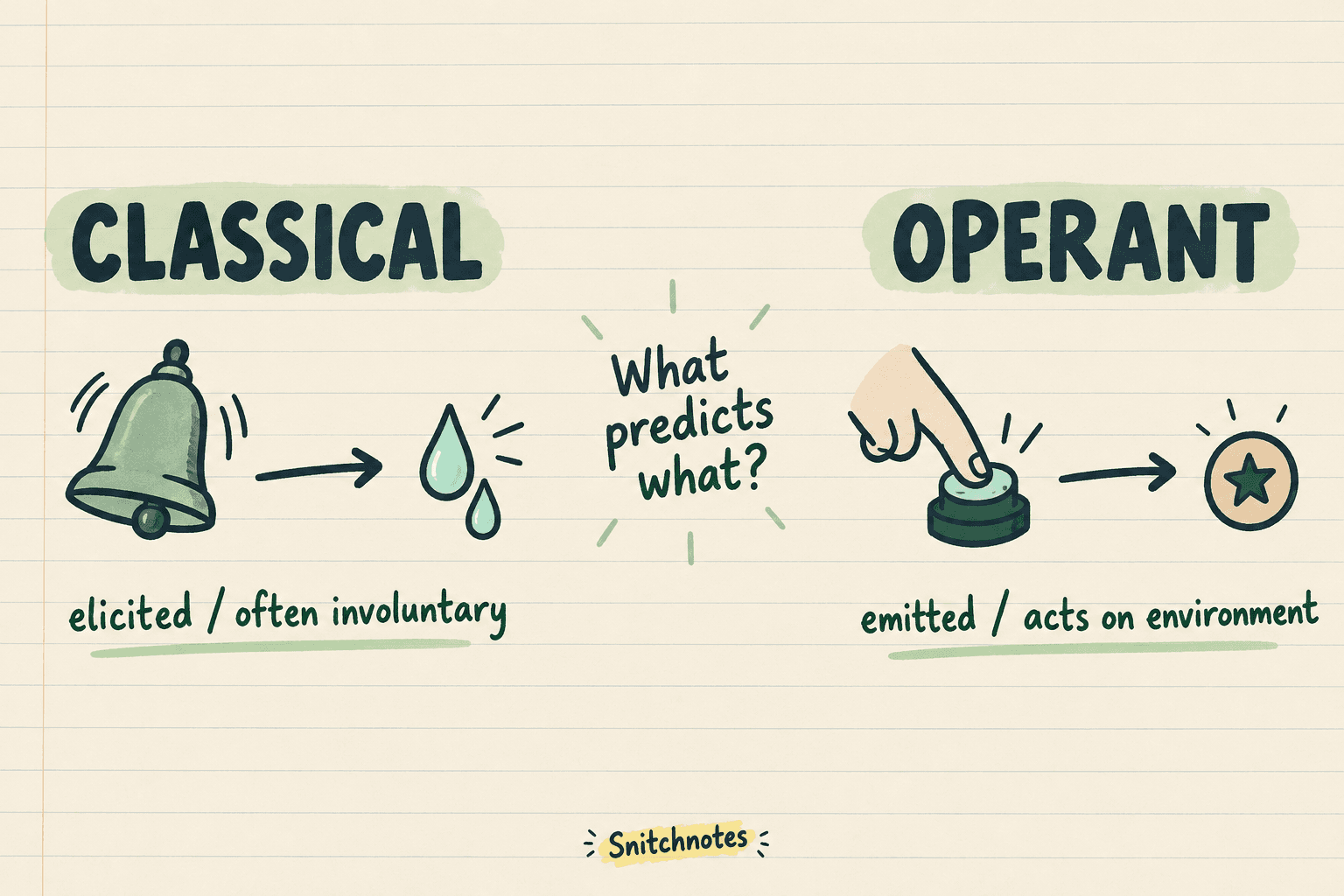
A good classification question is: what predicts what? If a cue predicts another stimulus or an elicited reaction, the mechanism is classical. If a behavior predicts a consequence, it is operant. Words such as reward, fear, or automatic can provide hints, but the learned relationship is the stronger evidence.
Classical vs operant conditioning at a glance
- What is associated: classical conditioning links two stimuli; operant conditioning links a behavior and its consequence.
- Order: in classical conditioning, the predictive cue comes before the response; in operant conditioning, the consequence follows the behavior.
- Typical response: classical conditioning often involves reflexive or emotional responses; operant conditioning commonly shapes actions.
- What changes: classical conditioning changes what a cue means; operant conditioning changes how likely a behavior is.
The word often matters in that third point. Classical conditioning is not limited to simple reflexes, and operant behavior is not necessarily carefully planned. Habits can be emitted with little reflection. Use involuntary versus voluntary as a clue, not as the definition.
Four exam-style examples
1. A notification sound makes you tense
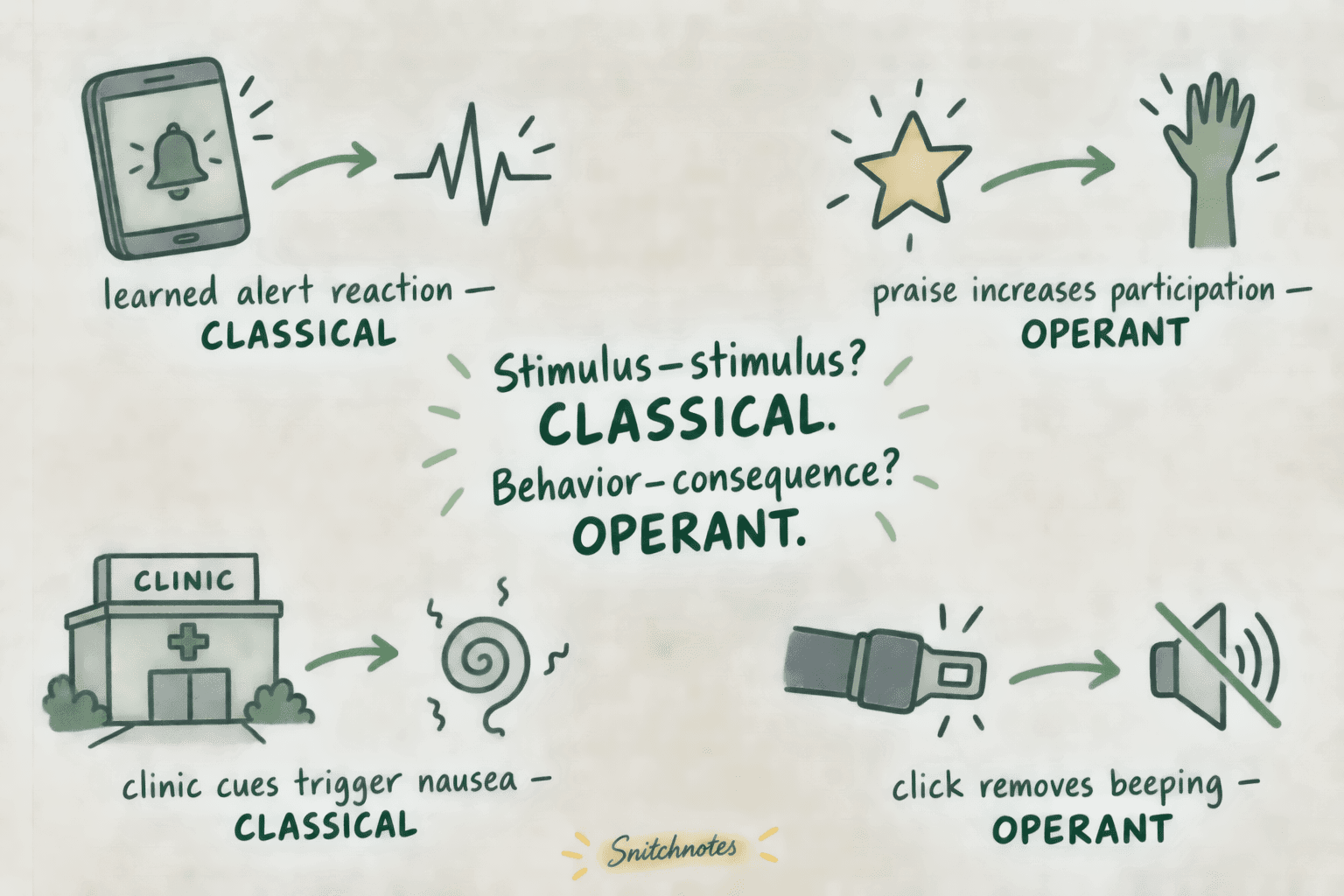
Suppose stressful messages repeatedly arrive with the same sound. Eventually the sound alone makes your shoulders tighten. This is classical conditioning: the notification cue has become associated with stressful messages and now elicits a learned alert reaction.
2. Praise increases class participation
A teacher gives specific praise after a student answers. The student begins answering more often. This is operant conditioning because the consequence follows the behavior and increases its future frequency. More precisely, it is positive reinforcement: something is added and the behavior increases.
3. A clinic waiting room triggers nausea
A patient receives medication that causes nausea during repeated clinic visits. Later, the clinic's smell or waiting room triggers nausea before treatment starts. This is classical conditioning because clinic cues have been paired with the nausea-producing treatment. The response is attached to a predictive stimulus.
4. Buckling a seat belt stops the beeping
A driver buckles the seat belt and an irritating alarm stops. Buckling happens faster on later trips. This is operant conditioning: the behavior removes an unpleasant consequence and therefore increases. It is negative reinforcement, not punishment.
Do not confuse negative reinforcement with punishment
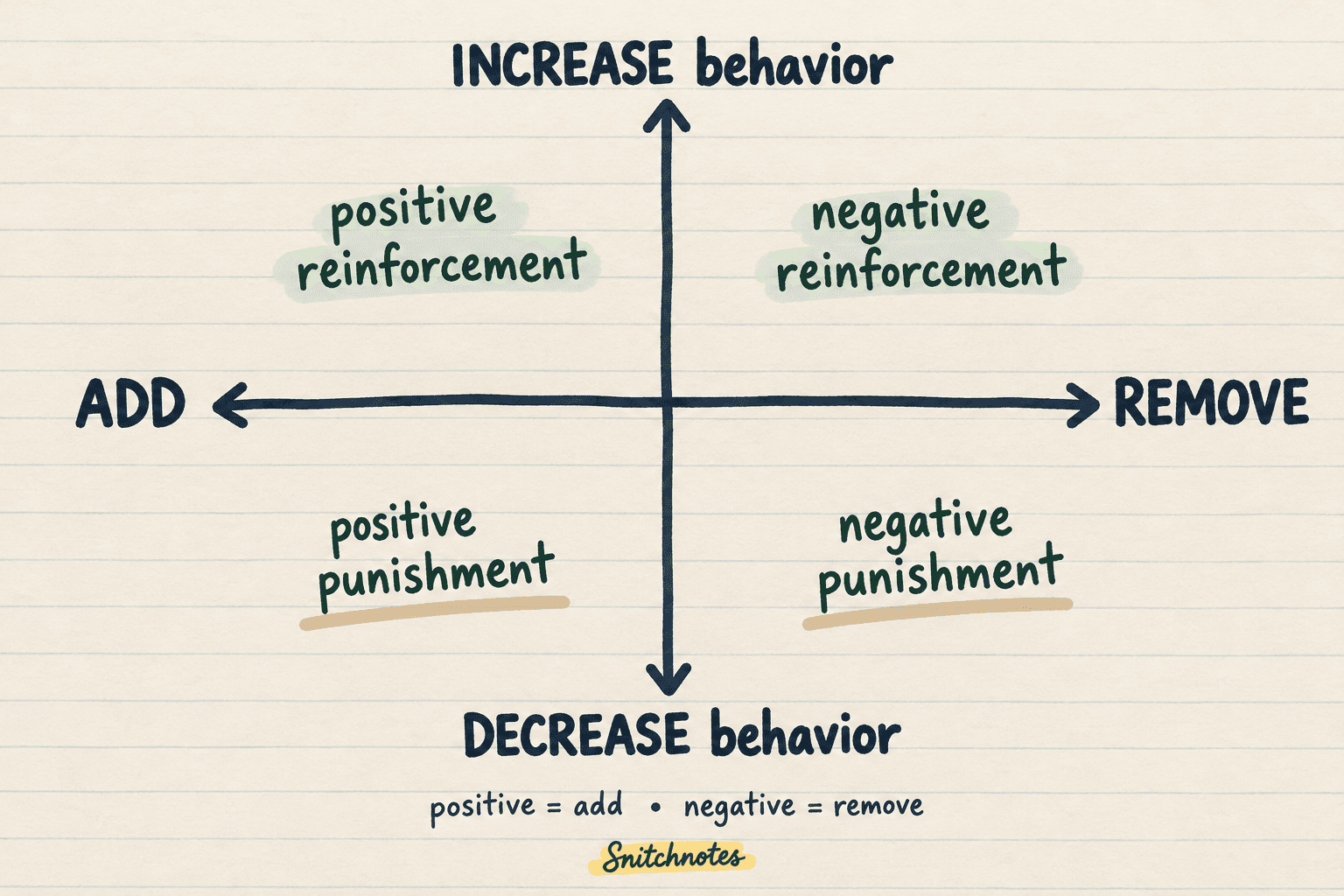
In learning theory, positive and negative do not mean good and bad. Positive means something is added; negative means something is removed. Reinforcement increases a behavior; punishment decreases it. Combine those two axes and the four terms become much easier to classify.
- Positive reinforcement: add a desirable consequence to increase behavior, such as praise after participation.
- Negative reinforcement: remove an unpleasant condition to increase behavior, such as silencing an alarm by buckling up.
- Positive punishment: add a consequence to decrease behavior, such as an extra task after breaking a rule.
- Negative punishment: remove something valued to decrease behavior, such as losing game time after ignoring a deadline.
Also remember the boundary: a consequence counts as reinforcement or punishment only by its effect on later behavior. A teacher may intend a comment as praise, but if participation falls, that comment did not function as reinforcement for that student in that context.
Can both happen at once?
Yes. Imagine a dog hears a click before receiving food, then learns that sitting makes the click and food appear. The click can become a conditioned stimulus through classical conditioning because it predicts food. Sitting is shaped through operant conditioning because that behavior produces the click-and-food consequence. One situation can contain both processes; classify the specific relationship the question asks about.
This is why calling classical conditioning passive and operant conditioning active can mislead. The labels describe learning arrangements, not two kinds of creature or two completely separate brain systems. Focus on stimulus–stimulus versus behavior–consequence.
Check your understanding
A song that played during a frightening event now produces anxiety. Which type is it?
Classical conditioning. The song is a cue associated with the frightening event, and it now elicits anxiety.
A student studies earlier because doing so prevents a last-minute panic. Which type is it?
Operant conditioning, specifically negative reinforcement. Studying earlier is a behavior that increases because it removes or prevents an unpleasant condition.
What single question should you ask first?
Ask what predicts what. Two linked stimuli point toward classical conditioning; a behavior linked to its consequence points toward operant conditioning.
If your psychology examples are scattered across lectures, slides, and notes, Snitchnotes can turn that material into organized study notes, flashcards, and quizzes so you can practice classifying new scenarios.
Related concepts
- Extinction: a learned response weakens when the relevant pairing or consequence no longer occurs.
- Stimulus generalization: similar cues produce a learned response after conditioning.
- Shaping: successive approximations toward a target behavior are reinforced.
- Mediator vs moderator variables: another commonly confused psychology comparison.
Sources
OpenStax Psychology 2e: Classical Conditioning
OpenStax Psychology 2e: Operant Conditioning
University of Minnesota: Learning by Association—Classical Conditioning
American Psychological Association Dictionary of Psychology: Operant Conditioning
講義をテスト対策バッチリの教材に。
ノート、クイズ、ポッドキャスト、フラッシュカード、チャット — アップロード1回で全部。
最初のノートを無料で試す