
Snitchnotes Team
Civil Rights vs Civil Liberties: Key Differences and Examples
Civil Rights vs Civil Liberties: Key Differences and Examples
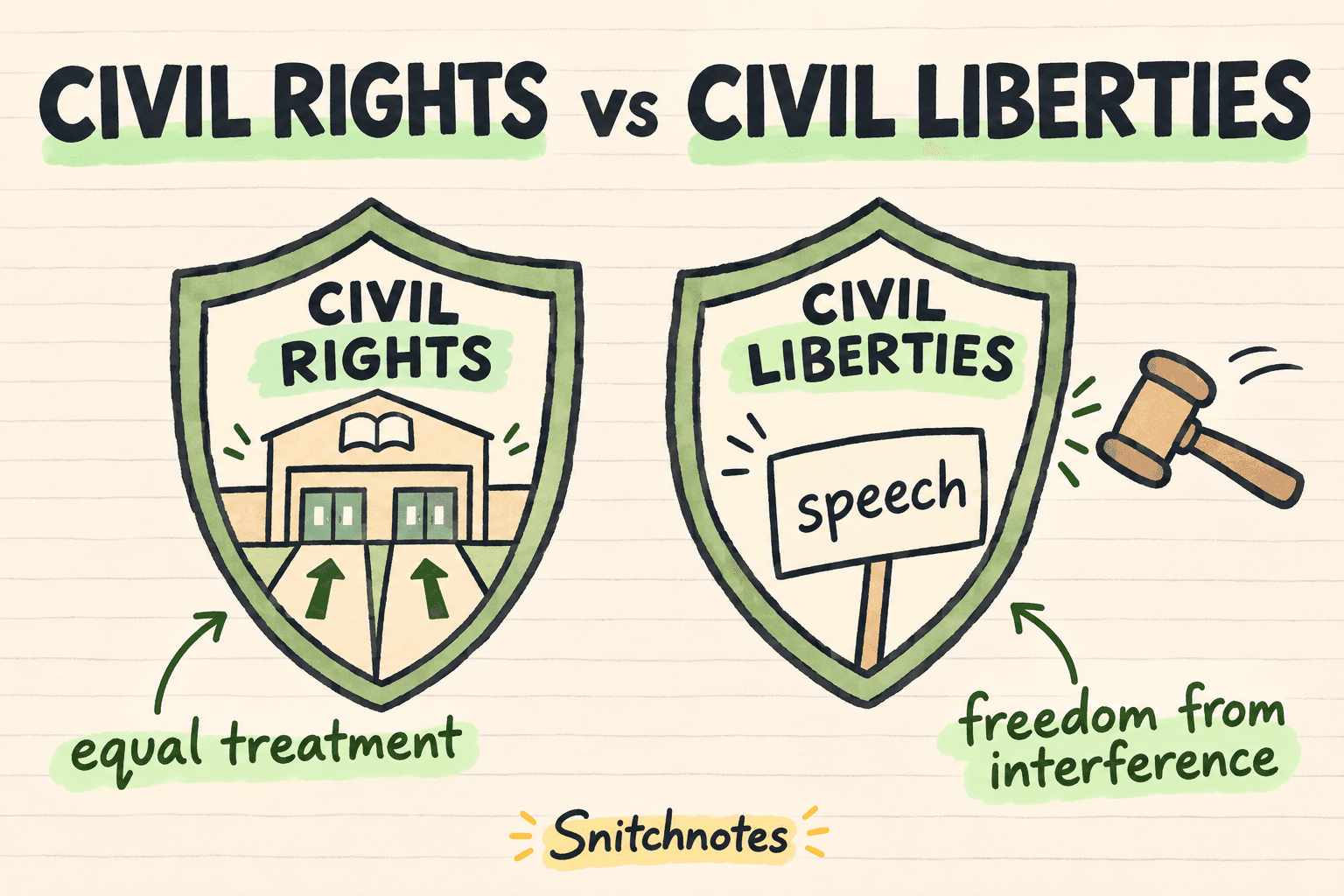
Civil liberties protect individual freedoms from government interference. Civil rights protect people from unequal treatment and discrimination. A city stopping peaceful speech raises a civil-liberties question; a public school applying different enrollment rules by race raises a civil-rights question.
That is the quickest useful distinction, but the categories can overlap. The same dispute may involve both a protected freedom and equal treatment, and the exact legal answer depends on who acted, which law applies, and the facts. This comparison gives you a reliable first classification without pretending every case fits one box.
Civil rights vs civil liberties: the core difference
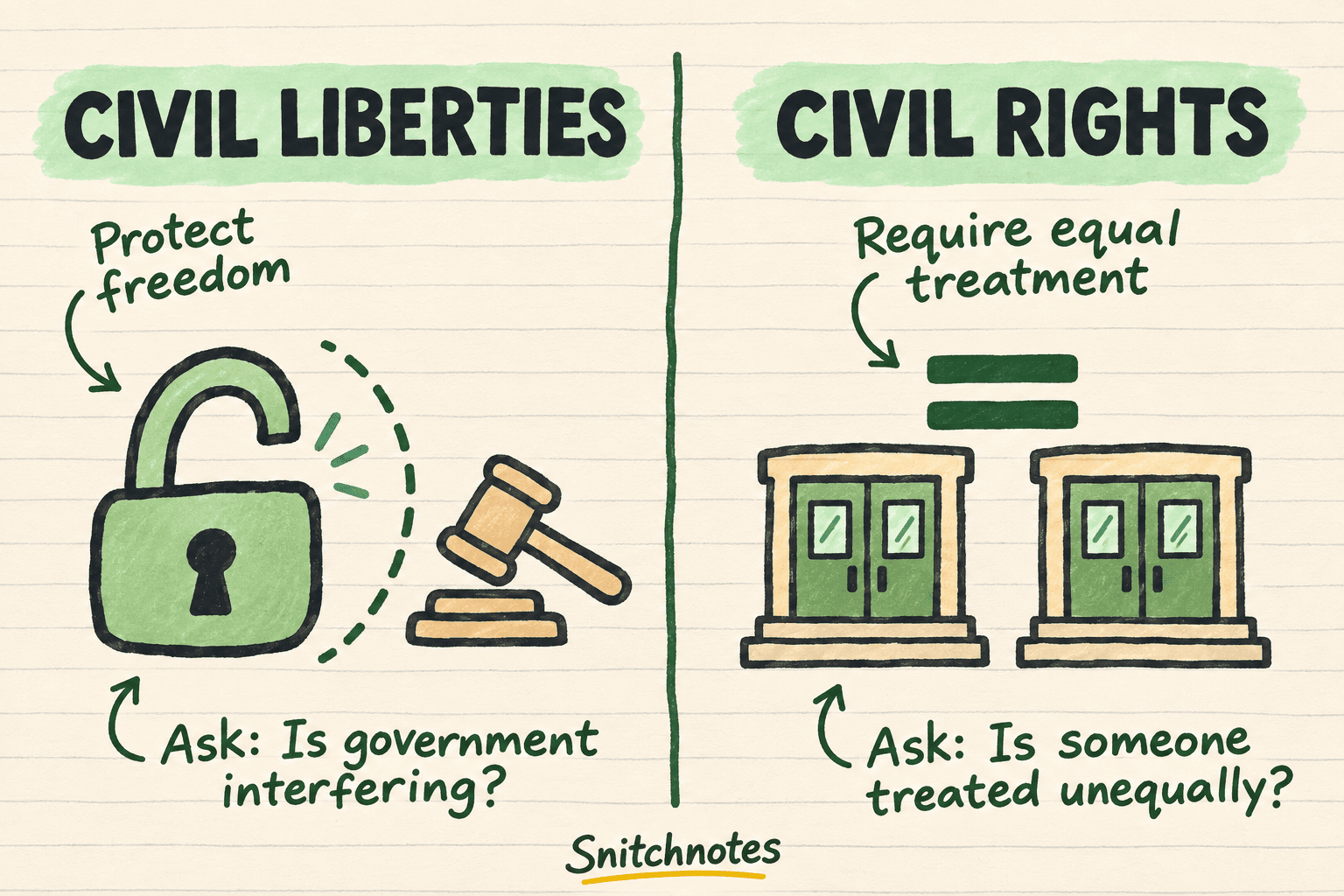
Civil liberties are freedoms the government generally may not invade without sufficient constitutional justification. The Bill of Rights includes familiar examples: freedom of religion, speech, press, peaceful assembly, and petition in the First Amendment, plus protections involving searches, criminal procedure, and punishment in later amendments. Think of civil liberties as restraints on government power.
Civil rights focus on equal legal status, equal protection, and protection against discrimination. The Fourteenth Amendment says states may not deny any person equal protection of the laws. Federal statutes add more specific protections in areas such as education, employment, housing, public accommodations, and voting. Think of civil rights as rules requiring people and institutions to treat protected groups fairly where the law applies.
A compact memory aid is negative restraint versus equal treatment. A civil liberty often tells government, “Do not interfere with this freedom.” A civil right often says, “Do not distribute an opportunity, benefit, or protection unequally.” The words are sometimes used more broadly in law and history, so this is a study distinction, not a claim that the categories have sealed borders.
How to classify a case in three questions
Start with the action, not the label. A familiar topic such as religion or voting can produce different claims depending on what happened. Use these three questions in order:
- Who acted? Constitutional civil-liberties claims usually require government action. A federal, state, city, public school, police department, or other government body is an immediate clue.
- What is the complaint? If the complaint is that government restricted speech, worship, privacy, assembly, or due process, begin with civil liberties. If it is unequal access or discrimination, begin with civil rights.
- What legal source protects the person? Look for a constitutional amendment, a federal or state civil-rights statute, or both. The source tells you who is covered, which conduct is prohibited, and what exceptions or tests apply.
This method also prevents a common mistake: assuming every unfair act is automatically unconstitutional. Private conduct may fall outside a constitutional rule yet still be covered by a statute. Conversely, conduct can feel discriminatory without meeting the elements of a particular civil-rights claim.
Four examples: protest, school, religion, and voting
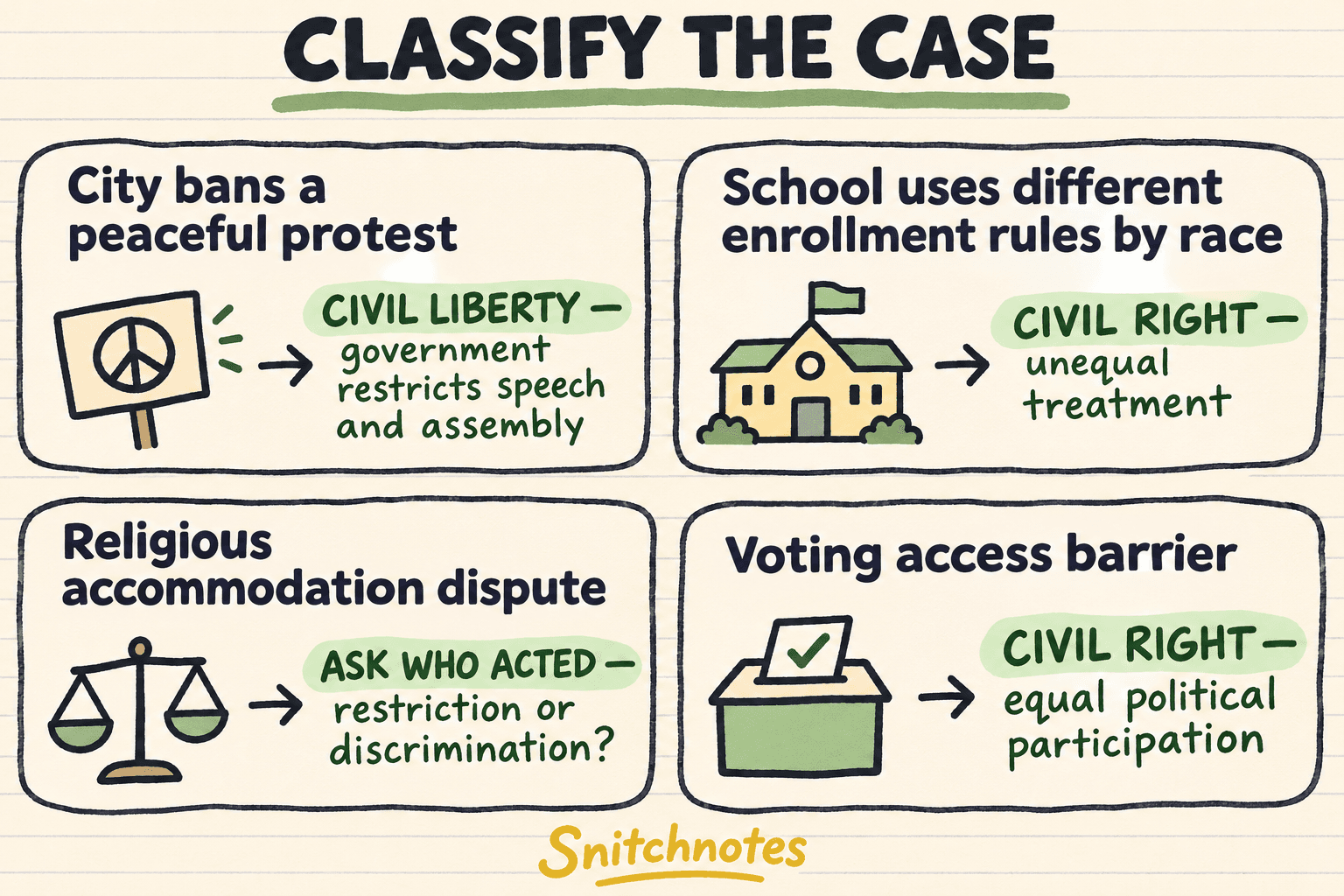
1. A city bans a peaceful protest
This is primarily a civil-liberties issue because a government actor is restricting speech and peaceful assembly. The First Amendment expressly protects speech, assembly, and petition. That does not mean every restriction is invalid; governments can enforce some content-neutral rules about time, place, and manner. The useful classification comes before the detailed legal test.
2. A public school uses different enrollment rules by race
This is primarily a civil-rights issue because students are receiving unequal treatment based on race. The Fourteenth Amendment's Equal Protection Clause applies to states, and federal civil-rights laws also prohibit specified forms of discrimination in education. The Department of Justice identifies race, color, national origin, sex, religion, disability, and other protected grounds across the laws its Educational Opportunities Section enforces.
3. A religious accommodation dispute
Ask who acted and what the person wants. If a city blocks religious exercise, the claim may center on the First Amendment's Free Exercise Clause, a civil liberty. If a school or employer treats someone differently because of religion or fails to follow an applicable accommodation rule, civil-rights statutes may be central. Religion is a good example of one subject producing both kinds of protection.
4. A barrier to voting access
Voting is commonly classified as a civil right because the dispute concerns equal political participation. The Fifteenth Amendment bars denial or abridgment of voting rights on account of race, color, or previous condition of servitude, and later amendments protect against other specified exclusions. The Voting Rights Act of 1965 also prohibits certain discriminatory voting practices. Constitutional liberty and equal-protection arguments can overlap in real litigation.
Where the categories overlap and boundaries matter
Civil rights and civil liberties are not opposites. Both limit abuses of power and protect individual participation in public life. Freedom of religion can be a liberty when government interferes with worship and a civil-rights concern when a covered institution discriminates because of religion. A voting rule may implicate equal treatment, political participation, speech, and association at the same time.
Neither label supplies the final outcome. Rights can have legal boundaries, and courts apply different standards depending on the protected interest, government level, classification, setting, and statute. For an exam answer, name the category, identify the government or private actor, point to the likely legal source, and then analyze the rule.
Why the distinction matters
The distinction helps you choose the right question. In a civil-liberties problem, ask what freedom government burdened and whether the restriction is constitutionally justified. In a civil-rights problem, ask who was treated differently, on what basis, in which setting, and which equality or anti-discrimination rule applies.
It also makes historical change easier to see. The Bill of Rights began as a set of restraints on federal power, while the Reconstruction Amendments transformed citizenship, equality, and enforcement after the Civil War. Later civil-rights laws addressed discrimination in specific parts of life. The categories tell related stories about freedom, equality, and who can enforce them.
Check your understanding
Police search a student's bag without a valid legal basis. Which category comes first?
Civil liberties. The complaint is about government intrusion and the Fourth Amendment protection against unreasonable searches and seizures.
A federally funded program rejects applicants because of national origin. Which category comes first?
Civil rights. The complaint concerns discriminatory treatment, and a statute may prohibit national-origin discrimination in the program.
Why might one case involve both categories?
Because one action can both burden a protected freedom and treat people unequally. Classify each claim separately, identify its legal source, and avoid assuming one label cancels the other.
Related concepts
- Judicial review: how courts evaluate whether government action conflicts with the Constitution.
- Original vs appellate jurisdiction: where a court first hears a case and where decisions are reviewed.
- Civil law vs criminal law: the parties, purposes, proof standards, and outcomes in two legal systems.
Sources
National Archives: The Bill of Rights — A Transcription
National Archives: The Constitution — Amendments 11–27
U.S. Department of Justice: Types of Educational Opportunities Discrimination
U.S. Department of Justice: Statutes Enforced by the Voting Section
講義をテスト対策バッチリの教材に。
ノート、クイズ、ポッドキャスト、フラッシュカード、チャット — アップロード1回で全部。
最初のノートを無料で試す