
Snitchnotes Team
Why Do Lithium-Ion Batteries Lose Capacity Over Time?
Why Do Lithium-Ion Batteries Lose Capacity Over Time?
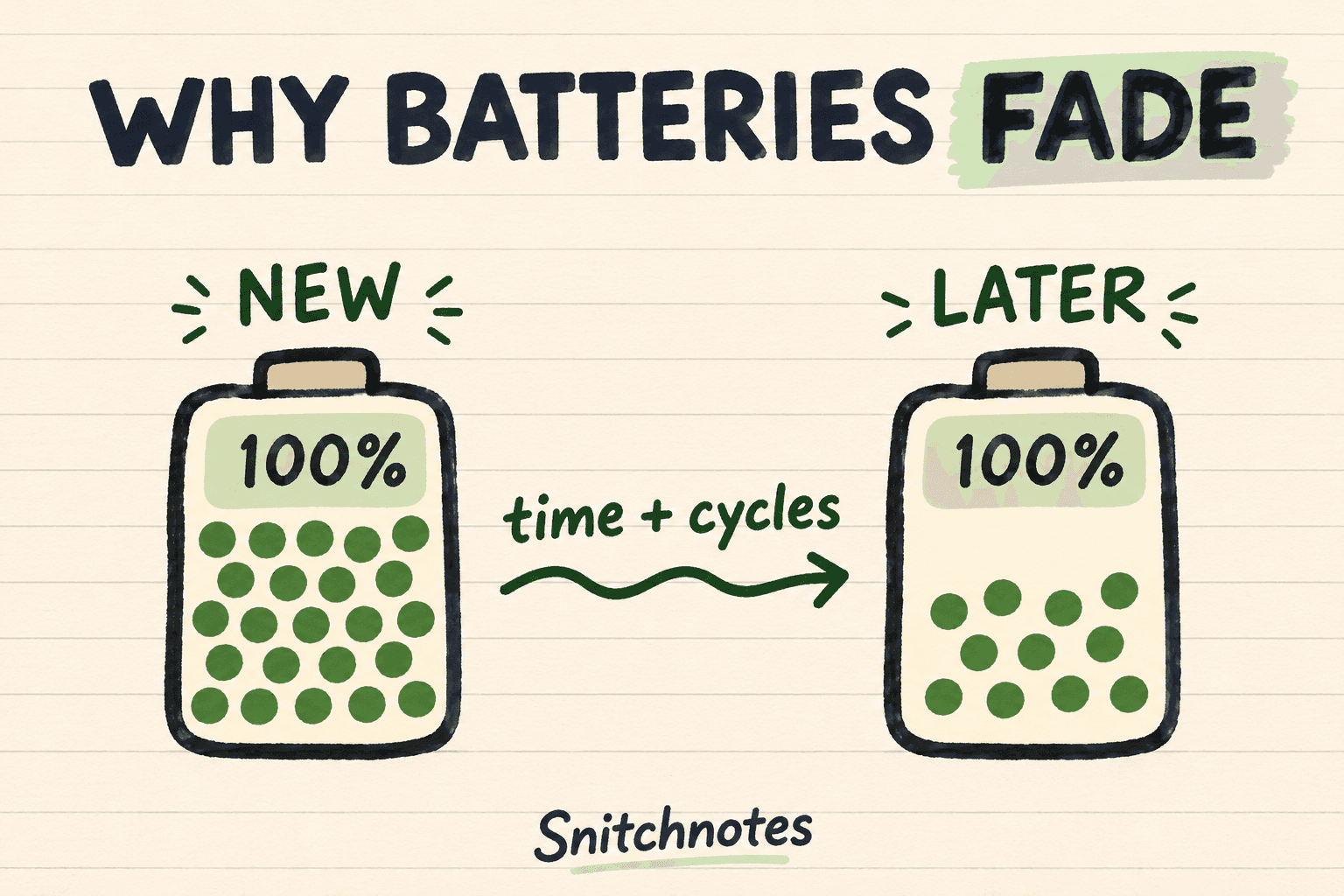
Lithium-ion batteries lose capacity because their useful chemistry slowly changes. Side reactions trap some lithium, protective layers thicken, electrode particles crack or become disconnected, and internal resistance rises. Fewer lithium ions and active sites remain available for the reversible journey that stores and releases energy, so a full charge holds less energy than it did when the battery was new.
That is why a phone can display 100% and still run down sooner. The display describes how full the battery is relative to its current usable capacity, not necessarily its original capacity. A battery that has fallen from 100 normalized energy units to 82 can still be filled to its new 100% mark; that full mark now represents only 82 of the original units.
How a lithium-ion battery stores energy
A typical lithium-ion cell has a negative electrode, a positive electrode, an electrolyte that carries lithium ions, and a separator that keeps the electrodes from touching. During charging, an external power source moves lithium ions toward the negative electrode while electrons travel through the outer circuit. During discharge, the process reverses and the electrons power the device.
Capacity measures how much charge the cell can move through this reversible process under specified conditions. Aging reduces that amount in two broad ways: it can remove lithium from the usable inventory, or it can remove electrode material and pathways from active service. It can also increase impedance, making useful energy and peak power harder to deliver before the device reaches its voltage limit.
Calendar aging and cycle aging
A battery ages even when it is sitting unused. This is calendar aging: time-dependent reactions continue at electrode surfaces, and their rate depends strongly on conditions such as temperature and state of charge. Cycle aging is the additional wear associated with charging and discharging. The two are not sealed compartments; the same mechanisms can interact, and previous damage can change what happens during the next cycle.
A 2024 Scientific Data study illustrates the distinction. It describes solid-electrolyte interphase growth as a process that continues over time, while lithium plating is associated with charging and depends on state of charge, temperature, charge rate, and cell age. Real batteries experience a mixture, so cycle count alone cannot tell you the whole story.
The main mechanism: the protective layer keeps growing
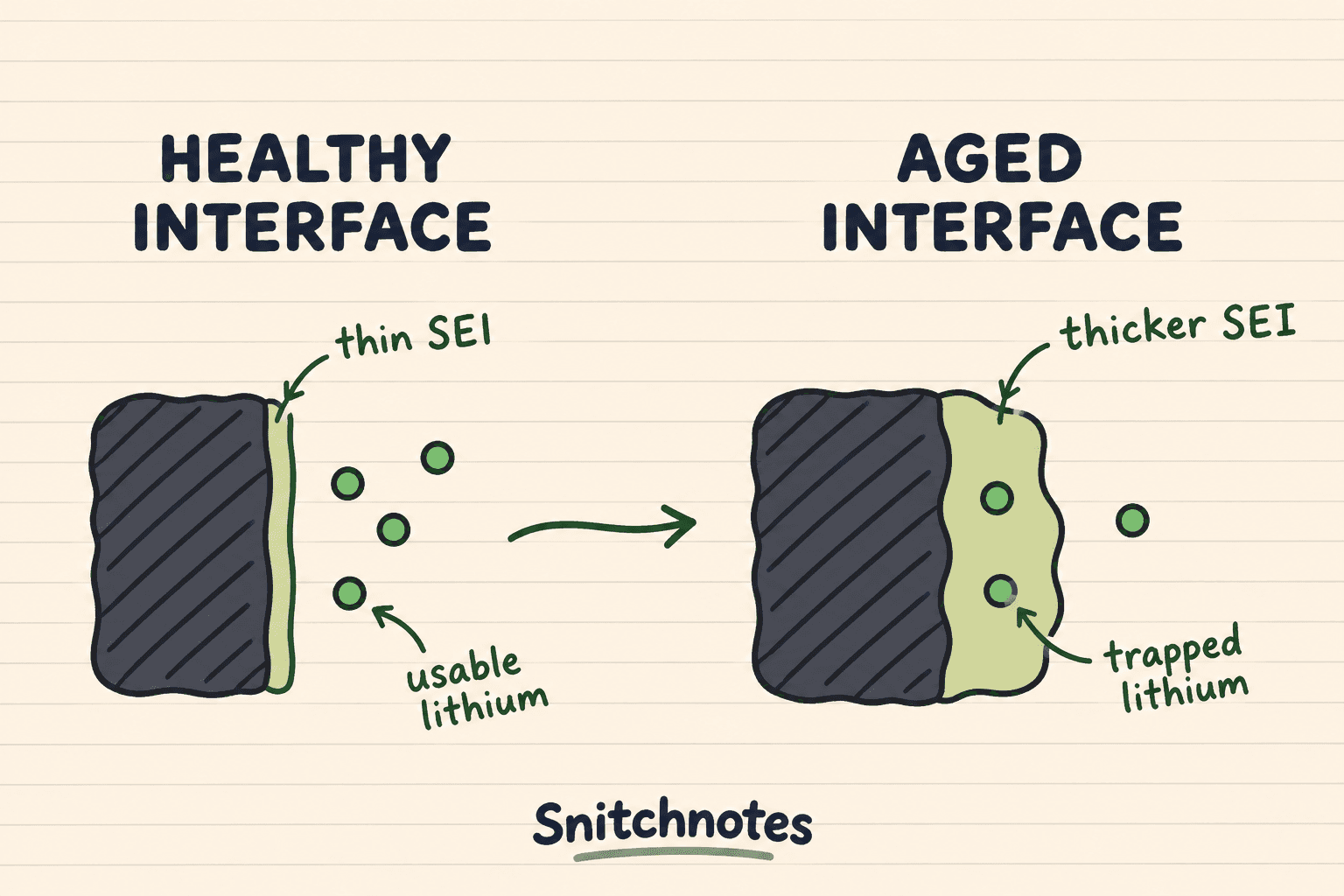
At the negative electrode, electrolyte molecules react and form a thin layer called the solid-electrolyte interphase, or SEI. A stable SEI is useful: it lets lithium ions pass while limiting further electrolyte breakdown. The catch is that it does not become perfectly inert. Slow side reactions keep adding material to the layer during storage and cycling.
SEI growth consumes cyclable lithium and electrolyte solvent. It can also lengthen the path ions must cross, contributing to higher resistance. A 2025 Nature Communications model treats SEI growth as a common mechanism and shows how it couples with electrolyte dry-out, lithium plating, loss of active material, and particle cracking. Fresh surfaces exposed by cracks can grow fresh SEI, so one kind of damage can feed another.
Other ways usable capacity is lost
- Lithium plating: During charging, especially when transport into the negative electrode is too slow, lithium can deposit on its surface instead of being stored inside it. Some plated lithium becomes electrically isolated or reacts to form more SEI, removing it from useful circulation. Cold temperature, high charge rate, and high state of charge can increase this risk.
- Particle cracking and lost contact: Electrode materials expand and contract as lithium enters and leaves. Repeated stress can crack particles or disconnect active material from the conducting network, leaving less surface available to store lithium.
- Positive-electrode and electrolyte degradation: At high cell voltage, unwanted reactions at the positive electrode can oxidize electrolyte and alter electrode surfaces. Different cell chemistries age at different rates, but the general result is less active material, more resistance, or both.
A phone battery from 100 units to 82
Imagine a new phone battery whose full usable capacity is 100 energy units. After many hot days, long periods near full charge, and repeated cycles, side reactions and electrode wear leave it with 82 usable units. Plug it in overnight and the phone may still show 100% in the morning. Nothing contradictory happened: 100% state of charge now means all 82 remaining units are filled.
Apple makes the same distinction in its battery-health guidance: maximum capacity compares the battery with when it was new, while the ordinary charge indicator tracks the present charge level. The example's 82% health number is a teaching value, not a prediction for every phone. Battery management software estimates these values, and estimates can be recalibrated as the system gathers more data.
What speeds up battery aging?
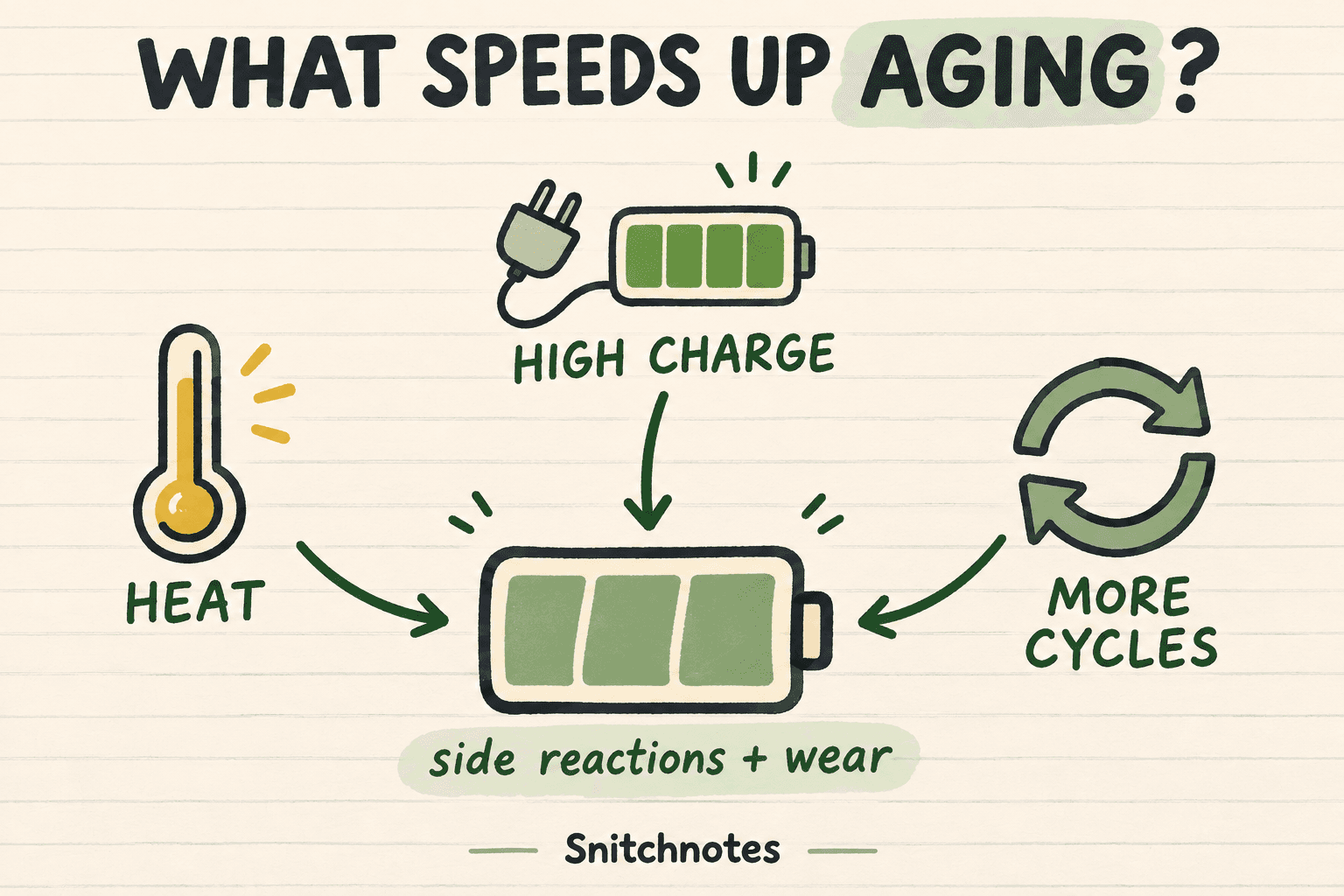
Heat generally accelerates the chemical side reactions behind calendar and cycle aging. Spending long periods at a high state of charge can also increase stress because electrode potentials favor additional reactions. Charging quickly in the cold creates a different problem: lithium has more difficulty moving into the negative electrode, which can favor plating. Cycling adds repeated chemical and mechanical change, although shallow and deep cycles do not impose identical stress.
These are tendencies, not a universal countdown. Cell chemistry, electrode design, temperature control, charge protocol, depth of discharge, and battery-management software all matter. National Renewable Energy Laboratory research therefore uses operating data such as temperature, state of charge, voltage, and impedance to model battery life rather than relying on one magic cycle number.
What can you actually do?
- Avoid unnecessary heat, especially leaving a charging device in direct sun or a hot car.
- Use optimized or adaptive charging features when they fit your routine; they can reduce time spent sitting at full charge.
- Do not fast-charge a very cold device unless its manufacturer says the battery is within its charging temperature range. Let it warm naturally rather than heating it directly.
You do not need to micromanage every percentage point. Batteries are consumable components, and some capacity loss is unavoidable. The practical goal is to avoid repeated extremes while letting the device's battery-management system do its job.
Misconceptions and boundaries
Capacity loss is not the same as a battery simply being empty. State of charge asks how full today's usable container is; state of health asks how that container compares with its earlier capacity and performance. Nor is all degradation caused by cycling. A battery stored for months can age through calendar reactions, particularly under unfavorable temperature and charge conditions.
Finally, there is no single mechanism or care rule that predicts every lithium-ion cell. A phone pouch cell, an electric-vehicle pack, and a grid-storage cell may use different materials and controls. If you are learning this from dense lecture slides, Snitchnotes can turn the material into a mechanism map, flashcards, and a quiz that separates causes from effects.
Check your understanding
How can an aged phone show 100% charge but store less energy?
The charge percentage is relative to the battery's current usable capacity. If aging reduces that capacity to 82% of its original value, filling the remaining capacity still produces a 100% charge reading.
Why does SEI growth reduce capacity?
Continued SEI-forming reactions consume lithium and electrolyte that would otherwise participate in reversible storage. A thicker layer can also increase resistance to ion movement.
Why can cold fast charging be harmful even though heat also accelerates aging?
They involve different limits. Heat speeds many side reactions, while cold slows lithium transport into the negative electrode. If charging pushes lithium toward that electrode faster than it can enter, lithium plating becomes more likely.
Related concepts
- Why metal feels colder than wood: learn how heat transfer differs from temperature itself.
- How GPS uses relativity for accuracy: see how tiny physical effects become important in engineered systems.
- Electrochemical potential and redox reactions: the deeper foundation for why ions and electrons move through a cell.
Sources
Scientific Data: Comprehensive battery aging dataset and mechanisms
Trasforma le tue lezioni in materiale pronto per l'esame.
Appunti, quiz, podcast, flashcard e chat — da un solo upload.
Prova il primo appunto gratis