
Snitchnotes Team
Why Is the Ampersand Called an Ampersand?
Why Is the Ampersand Called an Ampersand?
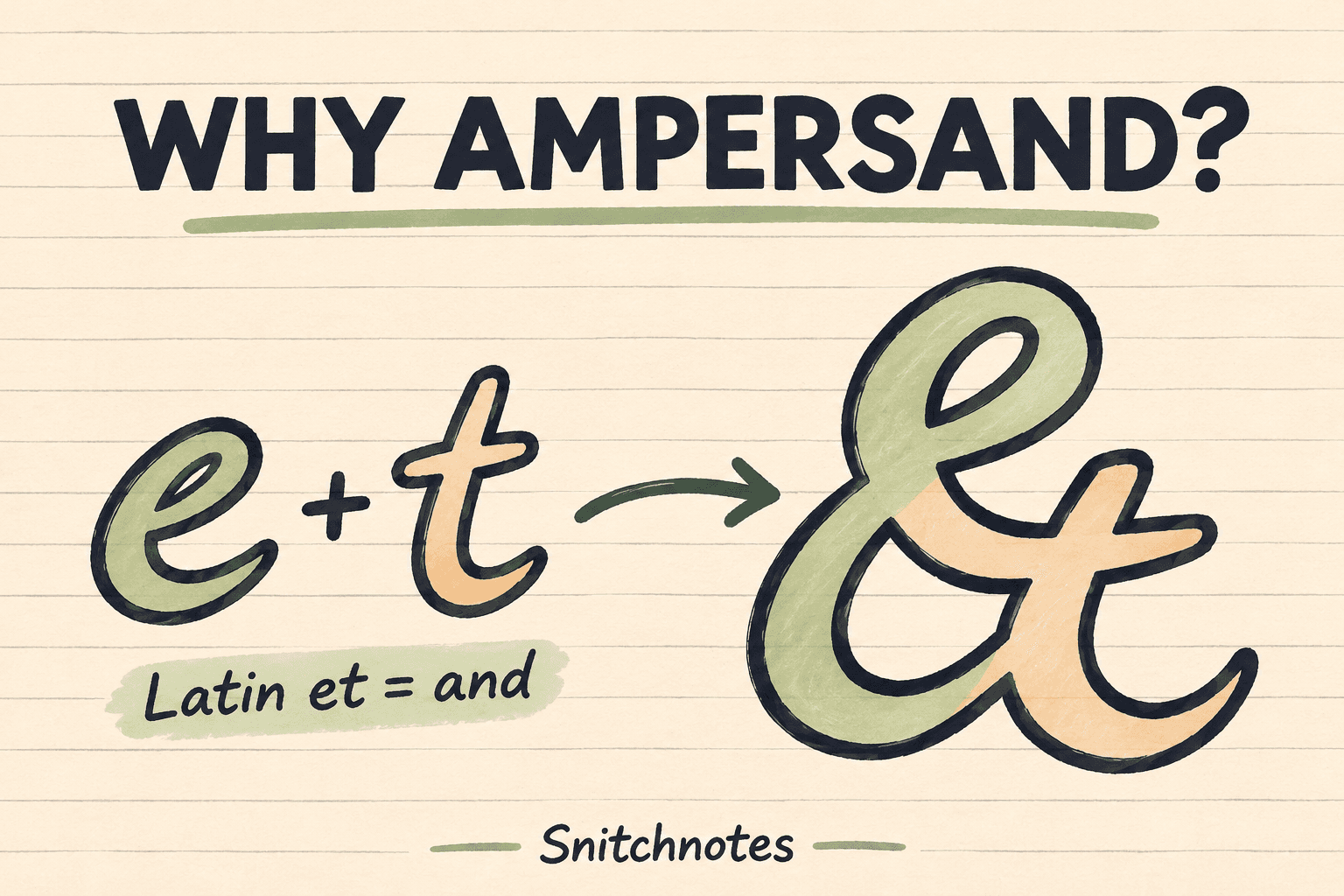
The ampersand is called an ampersand because its name grew from the spoken phrase “and per se and.” In older alphabet recitations, the symbol & could follow Z and was read as “and, by itself, and.” Said repeatedly, those words blurred together until English speakers heard and wrote ampersand. The symbol has a different but connected origin: it began as a ligature, or joined form, of the Latin letters e and t in et, the Latin word for “and.”
So there are two histories to keep apart: one explains the mark's shape, and the other explains its name. This distinction matters because the familiar story that & was simply “the 27th letter” is only a shortcut. It was often taught beside the alphabet, but it was still a symbol standing for a whole word.
The short answer: one symbol, two origin stories
The written mark is ancient. The Smithsonian Institution Archives traces forms of the cursive Latin ligature to around the first century CE. The name is much younger: Merriam-Webster dates the first known English use of ampersand to 1795, and the Oxford English Dictionary identifies and per se and as its source phrase. A mark that already meant “and” acquired a name by being recited aloud in English classrooms.
That is why the answer can sound circular. Ampersand comes from a phrase containing two ands because the phrase named a character that itself meant and. Once you separate the object from the sentence used to identify it, the loop disappears.
How Latin et became &
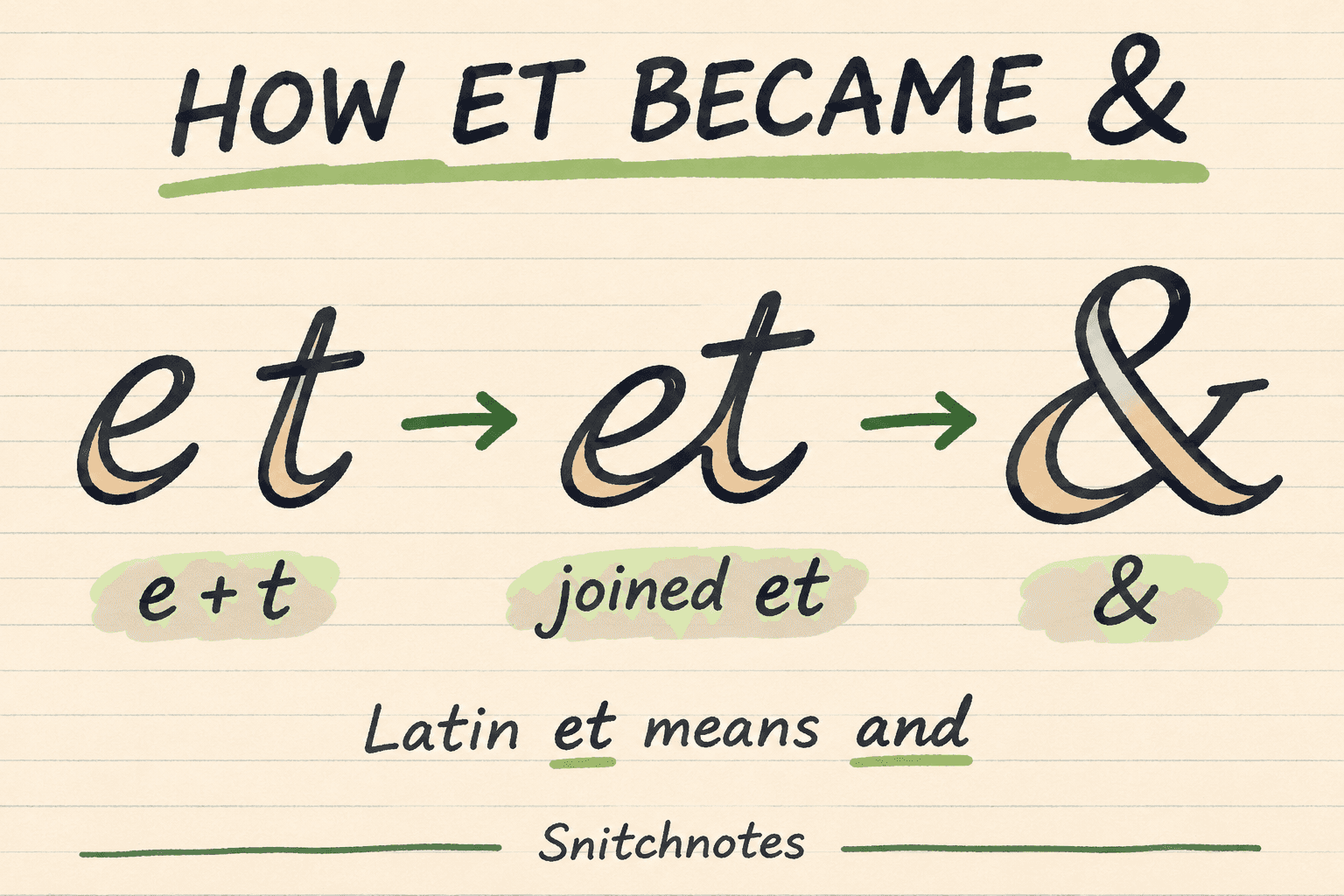
Latin writers used et for “and.” When scribes wrote the e and t together, the letters formed a ligature: two characters joined into one written shape. Over centuries and across handwriting and type styles, the joined strokes became more compact and stylized. In some ampersands you can still spot a rounded e flowing into a rising or crossing t; in others, the ancestry is harder to see.
The diagram is a teaching simplification, not one mandatory stroke-by-stroke evolutionary path. Historical letterforms varied. The stable point is the relationship: the Unicode Standard lists AMPERSAND at U+0026 and notes that it was originally derived from a ligature of e and t. The mark is therefore a tiny fossil of Latin handwriting sitting on a modern keyboard.
Why schoolchildren said “and per se and”
Per se is Latin for “by itself.” Older recitation conventions used it when a character could also be a complete word. Saying “I per se I,” for example, distinguished the letter I standing alone as the word I. When & appeared after Z in some alphabet lists, “& per se and” meant, roughly, “the character & by itself stands for the word and.” Because the symbol was pronounced and, the full spoken sequence became “and per se and.”
Johns Hopkins University Press summarizes the schoolroom ending as “X, Y, Z, and per se and.” This was practical labeling, not a secret new letter name. But children and teachers repeating a five-syllable phrase created perfect conditions for sounds to run together.
Mina's final alphabet recitation
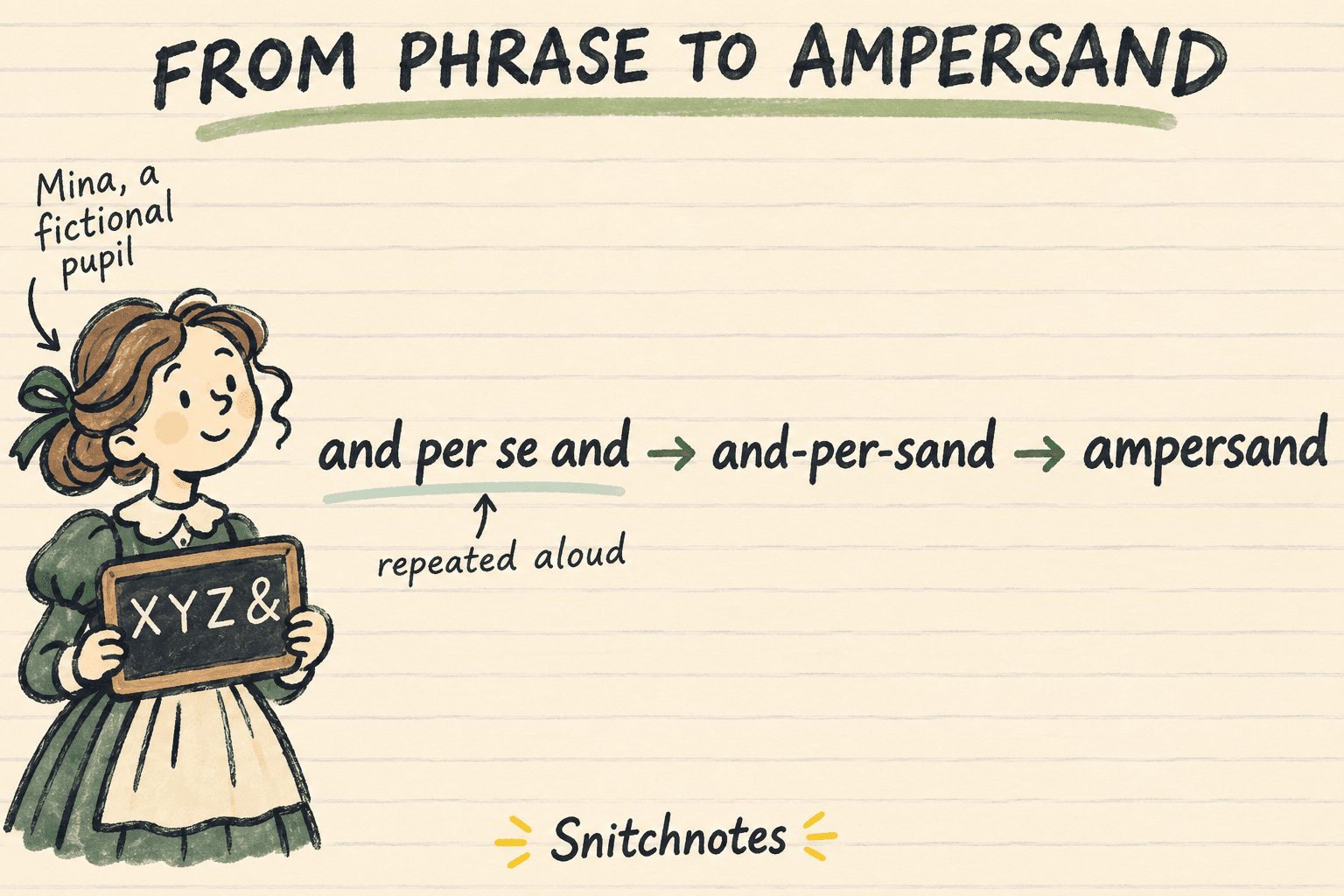
Imagine Mina, a fictional nineteenth-century pupil, reaching the end of her lesson: “X, Y, Z, and per se and.” She is not a historical person, but her recitation models the documented convention. On the page, the symbol remains &. In speech, however, the boundaries between and, per, se, and and begin to soften.
Say the phrase at ordinary speed: and-per-se-and. The final sound of one word leans into the next, unstressed syllables shrink, and the repeated phrase can be heard as something like and-per-sand. The established English form ampersand is the result of that spoken compression. It is a useful example of reanalysis: listeners treat a familiar sequence of sounds as a new single word.
Mina's slate captures the whole story in one frame. The written side moves from e plus t to &, while the spoken side moves from and per se and to ampersand. One history belongs to handwriting; the other belongs to pronunciation.
Was the ampersand really the 27th letter?
It is fair to say that & was sometimes treated as a 27th item in alphabet recitations, especially in the nineteenth century. It is misleading to say English officially had a permanent 27-letter alphabet and later expelled one member. The ampersand represented the word and, not a separate speech sound, and it was not used to spell ordinary words as an alphabetic letter would be. “Quasi-letter” is the more careful description.
A related boundary matters too: the ampersand is not the same sign as the Tironian et, ⁊, another historical shorthand for and. Unicode assigns that sign its own character. Similar jobs do not make the marks identical.
Why ampersands look so different
Type designers have unusual freedom with ampersands because the mark is already a compressed word rather than one ordinary letter. A roman typeface may show a looping symbol, while an italic face may reveal the original et more clearly. Both can be legitimate descendants of the same ligature. If an ampersand looks mysterious, try tracing an e and then looking for the t's crossbar or upright stroke.
Check your understanding
What do the symbol and the name each come from?
The symbol comes from a ligature of e and t in Latin et, meaning “and.” The English name comes from the spoken phrase and per se and.
What did per se mean in the recitation?
It meant “by itself.” The phrase identified & as a character that, standing alone, represented the word and.
Why is “27th letter” only partly accurate?
The ampersand often followed Z in lessons, but it represented a complete word rather than a separate sound used to spell English words. It behaved more like an alphabet companion than a normal letter.
If a lecture leaves you with symbols, terms, and histories that refuse to connect, Snitchnotes can turn your slides, PDFs, and notes into clearer study notes, flashcards, quizzes, and audio for review.
Related concepts
- Ligature: a single written or printed form made by joining two or more letters.
- Reanalysis: when speakers reinterpret the structure or boundaries of a word or phrase.
- Why languages lose grammatical gender: another look at how repeated use reshapes language over time.
- Denotation vs connotation: how a word's direct meaning differs from the associations it carries.
Sources
Merriam-Webster: How the & Came by Its Name
Oxford English Dictionary: ampersand, n.
Unicode Standard Names List: U+0026 AMPERSAND
Trasforma le tue lezioni in materiale pronto per l'esame.
Appunti, quiz, podcast, flashcard e chat — da un solo upload.
Prova il primo appunto gratis