
Snitchnotes Team
How to Memorize the Cranial Nerves by Function
How to Memorize the Cranial Nerves by Function
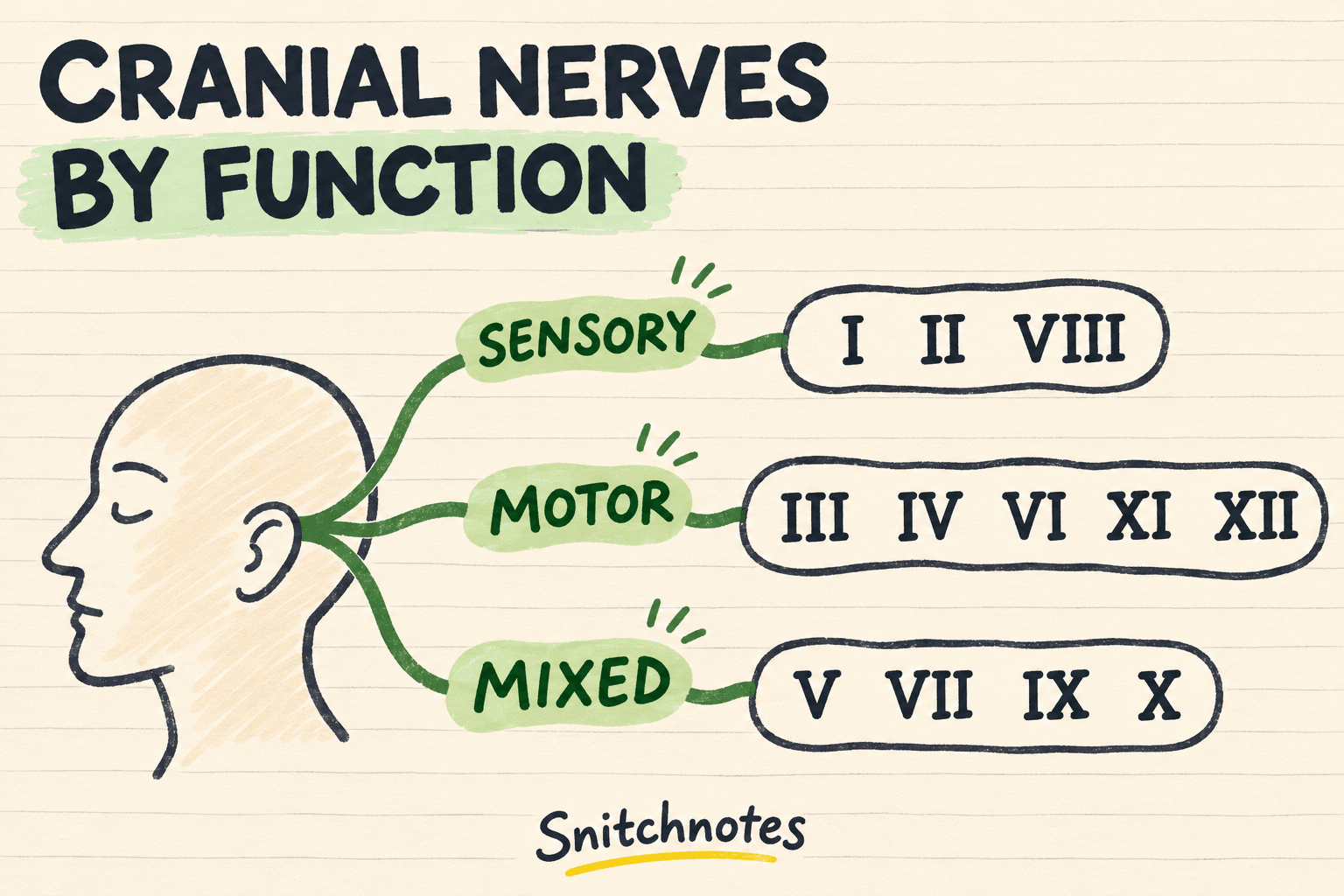
To memorize the cranial nerves, group them by function first: sensory nerves I, II, and VIII; motor nerves III, IV, VI, XI, and XII; and mixed nerves V, VII, IX, and X. Then attach each nerve to an action you can picture, such as smelling coffee, following a pen, clenching the jaw, smiling, hearing a whisper, swallowing, shrugging, or moving the tongue. Retrieve the map from those actions instead of repeating one long list.
This method is for anatomy, nursing, medicine, and health-science students who can recite the nerve names but still confuse what they do. You will build one function map, walk through it with Noor, and practise it with a six-minute cover-test-recall routine.
Why a function map works better than one long mnemonic
A name mnemonic can preserve the order from olfactory to hypoglossal, but order is only one exam cue. A question may begin with diplopia, facial numbness, hoarseness, or a weak shoulder shrug. If your memory has only a name chain, you must search the whole chain before finding the useful nerve. A function map gives you several smaller routes into the same knowledge.
OpenStax explicitly organizes the cranial nerve examination by functional group and notes that memorizing names alone does not explain what the nerves do. The National Library of Medicine's StatPearls review similarly groups III, IV, and VI for eye movement. That is the basic memory principle here: chunk nerves that participate in the same kind of job, then add a concrete testable action.
Learn the three functional groups
Begin with the pure sensory group. Cranial nerve I, the olfactory nerve, carries smell. II, the optic nerve, carries vision. VIII, the vestibulocochlear nerve, carries hearing and balance information. The compact pattern is I-II-VIII: smell, sight, hearing and balance.
Next, learn the motor group as two clusters. III oculomotor, IV trochlear, and VI abducens control eye movements; III also contributes to eyelid elevation and pupil constriction. XI accessory helps turn the head and shrug the shoulders. XII hypoglossal moves the tongue. Think eyes, shoulder, tongue rather than five disconnected definitions.
The mixed group combines incoming sensory information with outgoing motor or autonomic functions. V trigeminal carries facial sensation and powers chewing. VII facial controls facial expression and carries taste from the anterior two-thirds of the tongue. IX glossopharyngeal contributes to pharyngeal sensation, swallowing, and taste from the posterior third. X vagus contributes to voice and swallowing and carries extensive parasympathetic output to thoracic and abdominal organs.
Build a function map from real actions
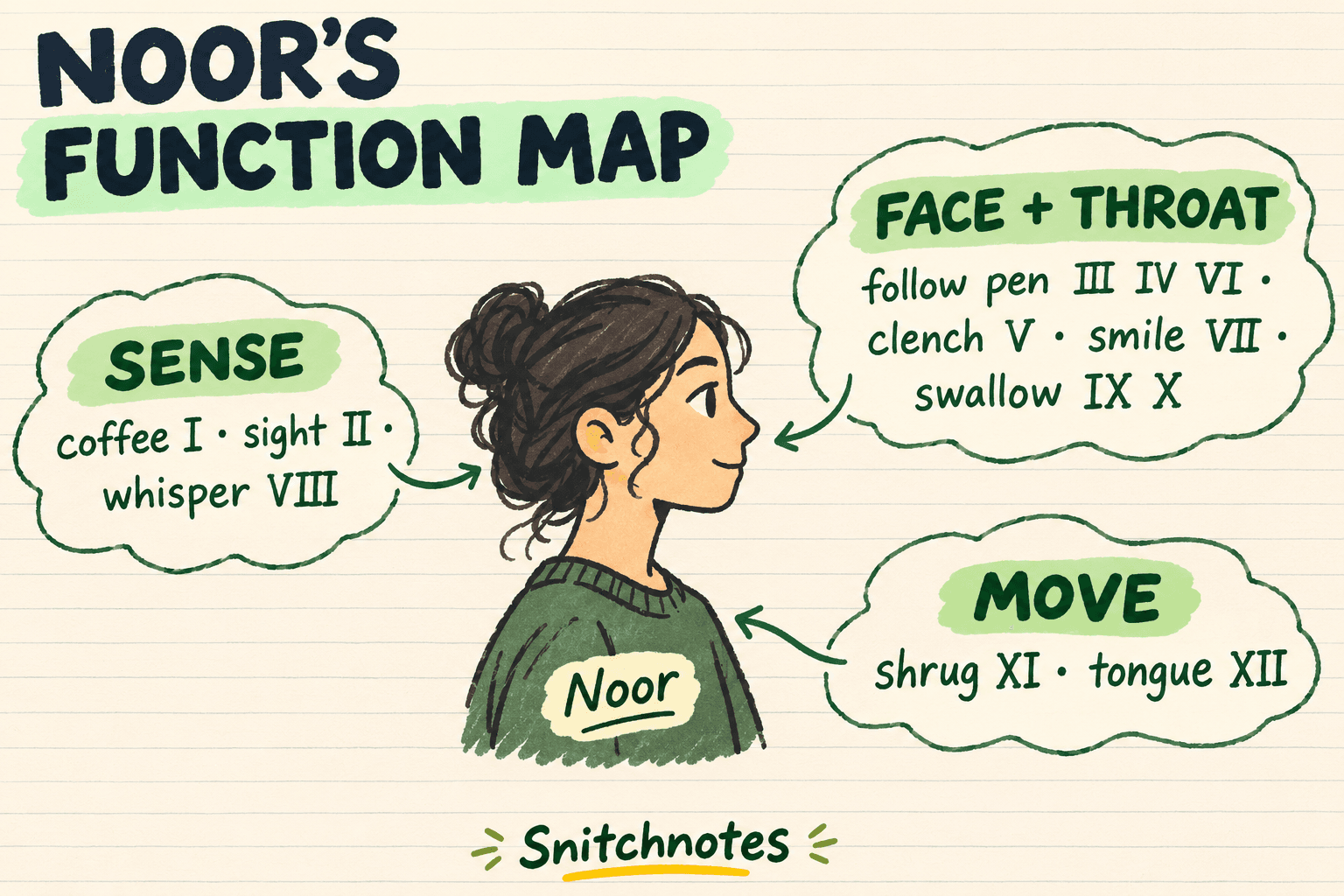
Picture Noor during a short bedside check. She smells coffee: I. She sees a pen and follows it with her eyes: II brings in the visual information, while III, IV, and VI move the eyes. She clenches her jaw: V. She smiles: VII. She hears a whisper: VIII. She swallows: IX and X. She shrugs against resistance: XI. Finally, she sticks out and moves her tongue: XII.
Run the scene in the same order until every action produces a number and every number produces an action. Then reverse it. If you see VII, picture Noor smiling; if you see a smile, retrieve facial nerve VII. Bidirectional practice matters because anatomy questions can give you either the nerve or the function.
Keep the map compact. Write three headings: sensory, motor, mixed. Under each number, add one anchor action before adding fine detail. For X, start with voice and swallow; add visceral parasympathetic functions after that anchor is stable. For V, start with face and chew; then attach its three sensory divisions when your course reaches them.
Use a six-minute cover-test-recall drill
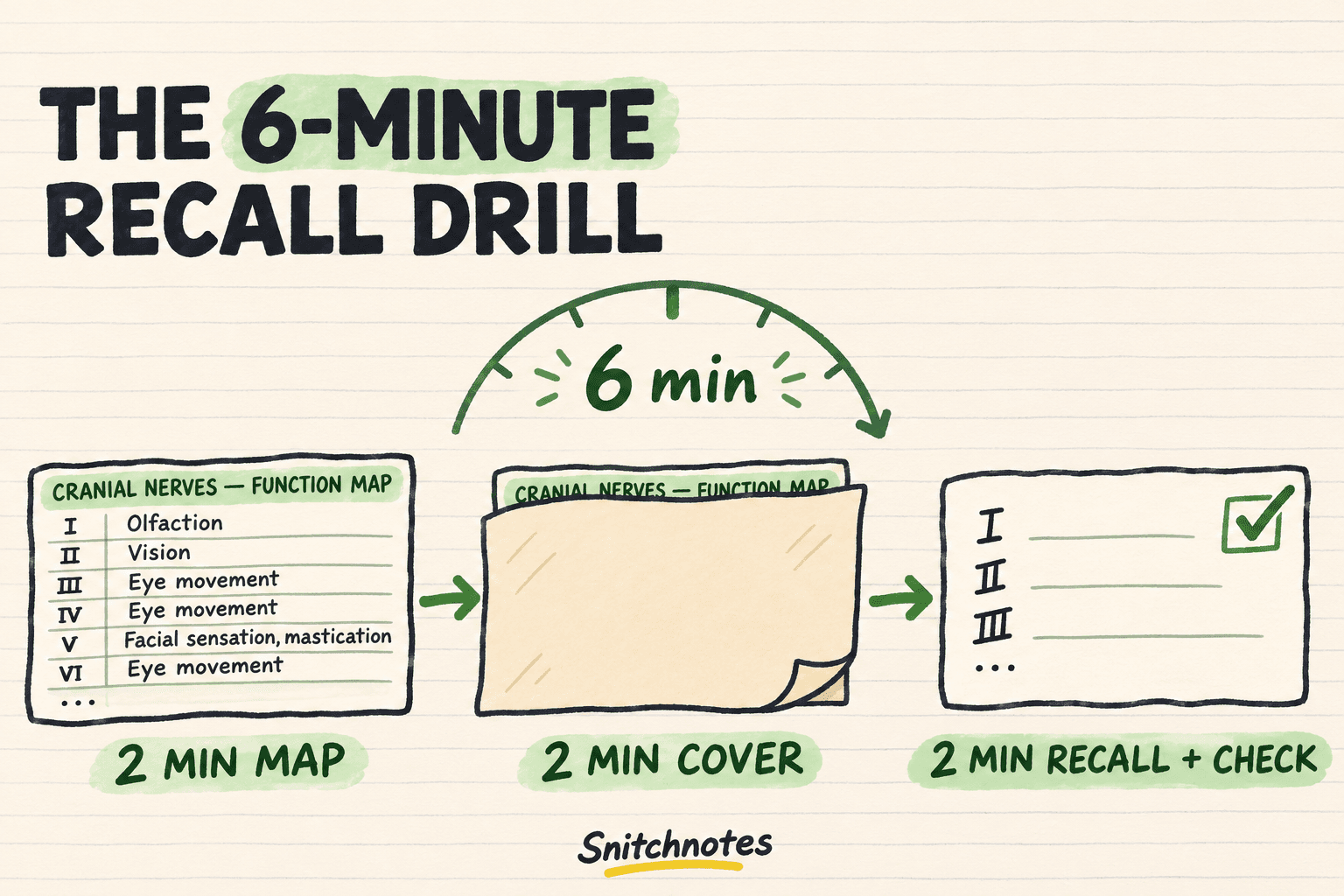
- Map for two minutes. Read the three groups and trace Noor's actions from smell to tongue movement.
- Cover for two minutes. Hide the labels and rebuild sensory, motor, and mixed groups on blank paper.
- Recall and check for two minutes. Say the action for each numeral, compare with the map, and circle only the links you missed.
Do not spend the final two minutes rereading everything. Correct the exact weak link, such as confusing IX with X or leaving IV out of the eye-movement trio. Then repeat the drill later with the groups and actions in a different order. John Dunlosky and colleagues rated practice testing and distributed practice as high-utility learning techniques; the drill combines both when you retrieve repeatedly across separate sessions.
The boundary: this map is a memory scaffold, not a full exam
The sensory, motor, and mixed labels are useful top-level categories, but they compress real anatomy. Several nerves carry parasympathetic fibers, taste travels in more than one nerve, and one action may involve several nerves. Following a pen, for example, depends on visual input through II and coordinated movement through III, IV, and VI.
A classroom action is also not a diagnosis. Merck Manual's clinical guide combines observations, targeted tests, and context when assessing cranial nerves. Use this function map to organize what you learn, then follow your course's exact examination sequence and safety guidance. Never practise invasive or uncomfortable tests on another person just to make a flashcard memorable.
Check your understanding
Which cranial nerves form the pure sensory group?
I olfactory for smell, II optic for vision, and VIII vestibulocochlear for hearing and balance.
Which nerves would Noor retrieve while following a pen?
II carries vision, while III, IV, and VI control the extraocular muscles that move the eyes.
How should you study a missed link?
Name the exact confusion, correct it from a trusted source, hide the answer, and retrieve it again later in both directions. The goal is not to admire a complete chart; it is to rebuild the chart without looking.
If you want to apply the same hide-retrieve-check loop to your own lecture slides, Snitchnotes can turn your materials into study notes, quizzes, and flashcards without replacing the anatomy sources your course requires.
Related concepts
- How to Memorize Muscle Origins and Insertions: connect structures to movements instead of learning isolated columns.
- How to Study the Complement System Without Rote Memorization: organize another dense biology sequence by function and checkpoints.
- Retrieval practice: produce an answer before checking the source.
- Chunking: group related facts so each cue opens a smaller, meaningful set.
Sources
OpenStax, Anatomy and Physiology 2e: The Cranial Nerve Exam
National Library of Medicine, StatPearls: Cranial Nerve Testing
Merck Manual Professional Edition: How to Assess the Cranial Nerves
Dunlosky et al. (2013), Improving Students' Learning With Effective Learning Techniques
Trasforma le tue lezioni in materiale pronto per l'esame.
Appunti, quiz, podcast, flashcard e chat — da un solo upload.
Prova il primo appunto gratis