

Snitchnotes Team
Why Do Airplane Windows Have Rounded Corners?
Why Do Airplane Windows Have Rounded Corners?
Airplane windows have rounded corners because curves spread structural stress more smoothly through the fuselage. A sharp corner makes stress crowd into a small area, creating a better starting point for a fatigue crack. That matters because a pressurized cabin is loaded and unloaded on every flight.
So the familiar oval or rounded-rectangle window is not mainly a style choice. It is one part of a larger safety system designed to manage repeated pressure loads, slow crack initiation and growth, and make damage easier to tolerate and inspect.
The physics: sharp corners concentrate stress
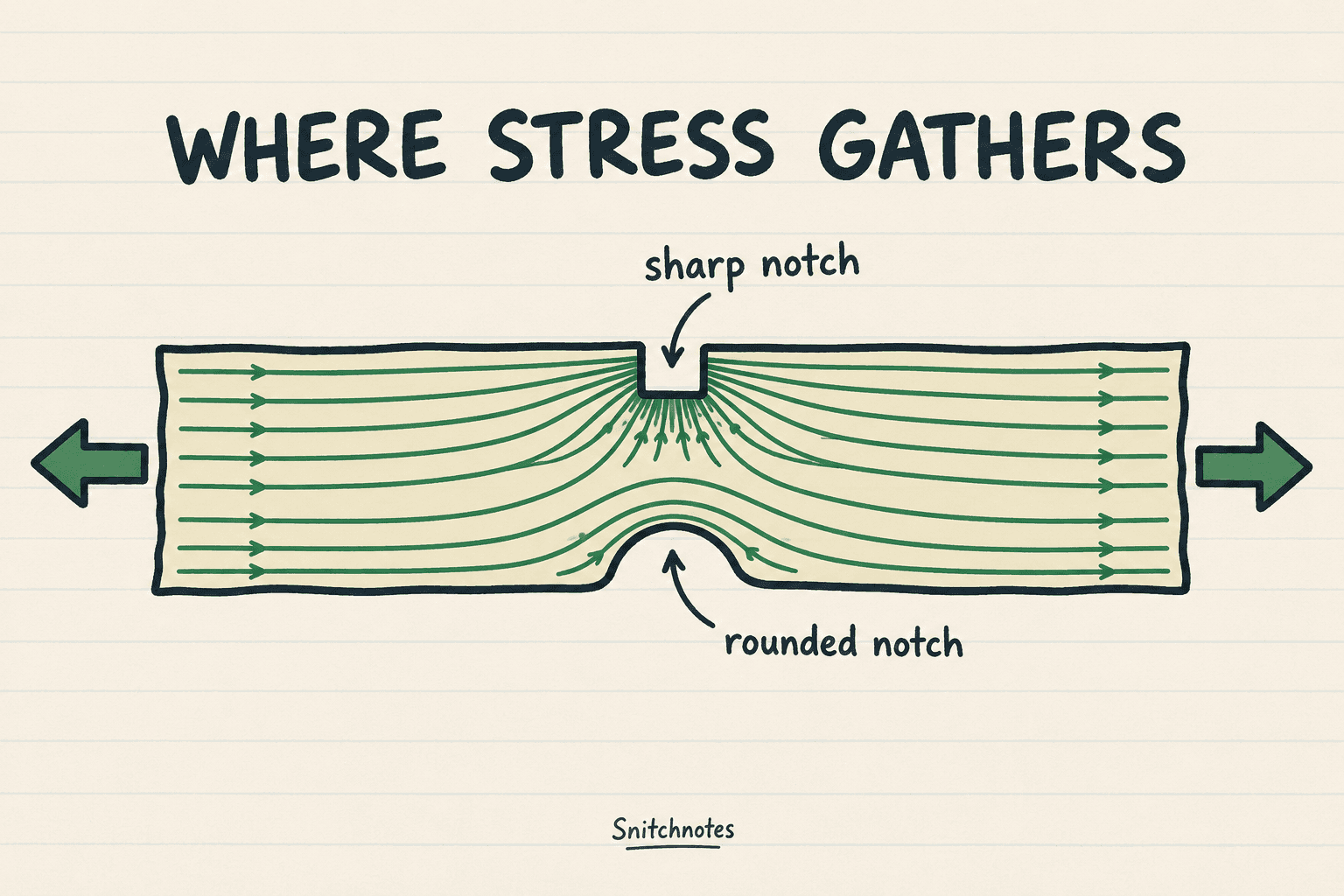
Imagine pulling a sheet of card that has a cutout in it. The load must flow around the missing material. If the cutout turns through a tight, sharp corner, those load paths bunch together near the corner. Engineers call this local increase a stress concentration. The average stress across the whole sheet may be modest while the stress beside the corner is much higher.
Give the same opening a generous radius and the load changes direction gradually. The stress does not vanish, because any opening interrupts the structure, but its peak is reduced and spread over a broader region. This is why engineers round not only aircraft windows but also many cutouts, hatches, and internal corners in machines.
Cabin pressure makes the load repeat
At cruising altitude, the air inside a passenger cabin is kept at a higher pressure than the thin air outside. That pressure difference pushes outward on the fuselage skin. A window interrupts the skin, so its frame and the material around it must carry the load around the opening.
After landing, the pressure difference returns toward zero. The next flight applies a similar cycle again. Federal Aviation Administration guidance on fatigue therefore tells designers to evaluate stress-concentration features such as holes, joints, changes in section, and sharp corners, and to include repeated cabin-pressure loads when considering fatigue.

Nora’s one-frame window lesson
Nora notices the rounded window beside seat 18A and sketches two cutouts on her boarding pass: one square, one rounded. She draws the same outward arrows around both. At the square corner, the arrows have to turn abruptly and crowd together; around the curve, they fan smoothly. Her tiny drawing captures the essential answer: same cabin pressure, different local peak stress.
A rounded corner does not remove the load. It gives the load a gentler route around the opening.
The paper comparison is an analogy, not an aircraft strength test. Real fuselages use metal or composite structures, reinforced frames, fasteners, seals, and multiple window panes. Still, the geometry lesson holds: a smaller corner radius usually creates a more severe stress concentration than a larger, smoother radius in the same basic structure.
How a tiny crack can grow
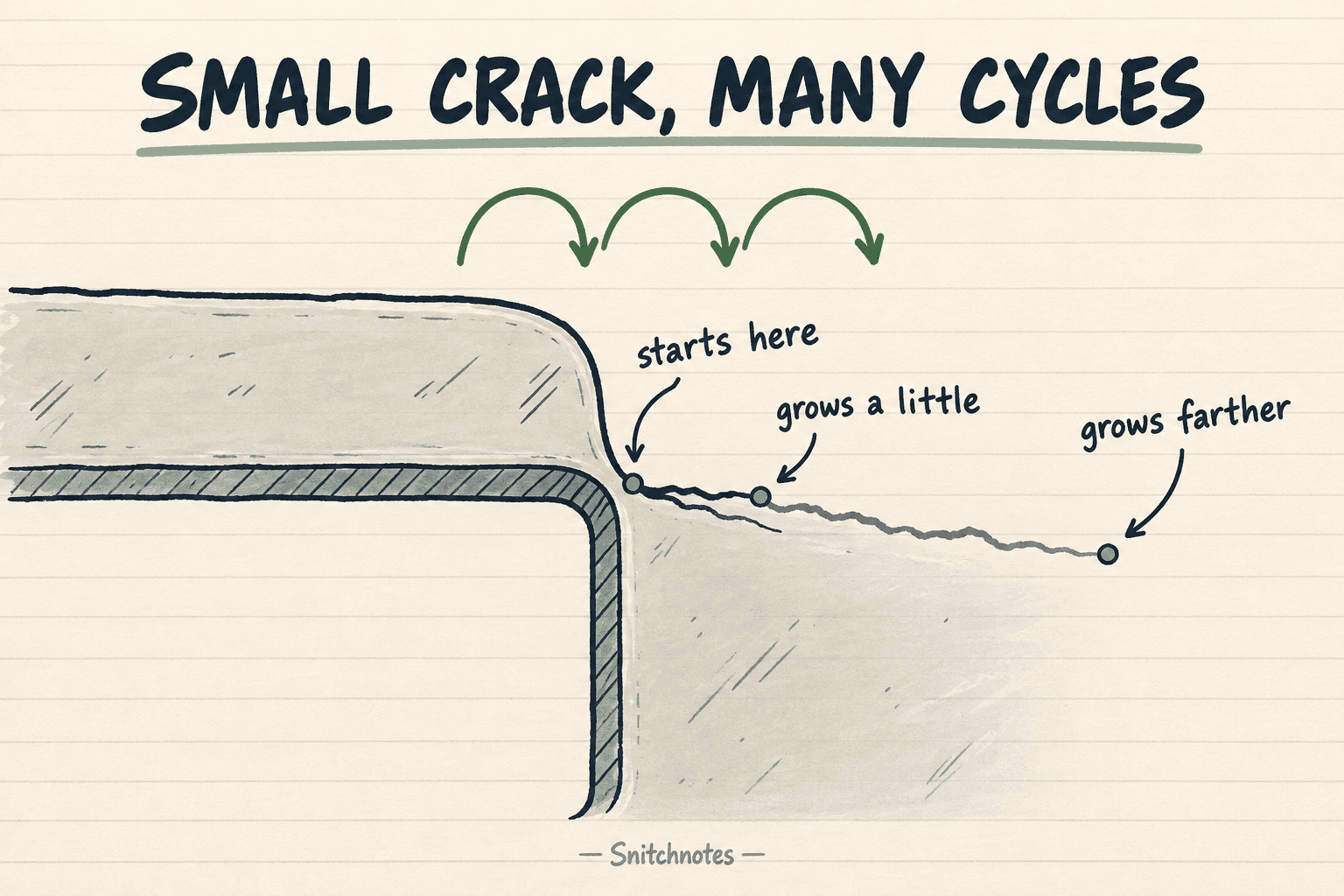
Fatigue is damage caused by repeated loading. A component can experience loads below the level that would break it in one event, yet a small flaw can initiate or extend a little at a time. NASA research on aircraft structures documents fatigue cracks growing from the boundaries of holes under repeated loading.
A sharp corner is troublesome because it raises the local stress right where a crack could begin. Once a crack exists, the crack tip becomes another powerful stress concentration. Continued cycles can extend it until it is detected, arrested by the structure, or becomes critical. Rounded corners lower one important risk at the beginning of that chain.
What the de Havilland Comet taught aviation
The early de Havilland Comet made this lesson painfully visible. After fatal in-flight breakups in 1954, investigators recovered wreckage and performed full-scale pressure cycling. The Federal Aviation Administration’s case history says the Comet’s relatively squarish windows created stress concentrations higher than anticipated, fatiguing material around window corners.
The history is often shortened to “square windows caused the crashes,” but that is too neat. The investigation involved the complete pressurized structure, manufacturing details, testing assumptions, escape-hatch and antenna-window openings, and fatigue behavior. On the test fuselage, failure appeared after 1,230 previous pressurized flights plus 1,830 simulated tank cycles. Wreckage from Flight 781 pointed to fatigue near squarish Automatic Direction Finder windows on top of the fuselage. The durable lesson was broader: treat cutouts and repeated pressurization as a fatigue system.
Rounded does not mean invulnerable
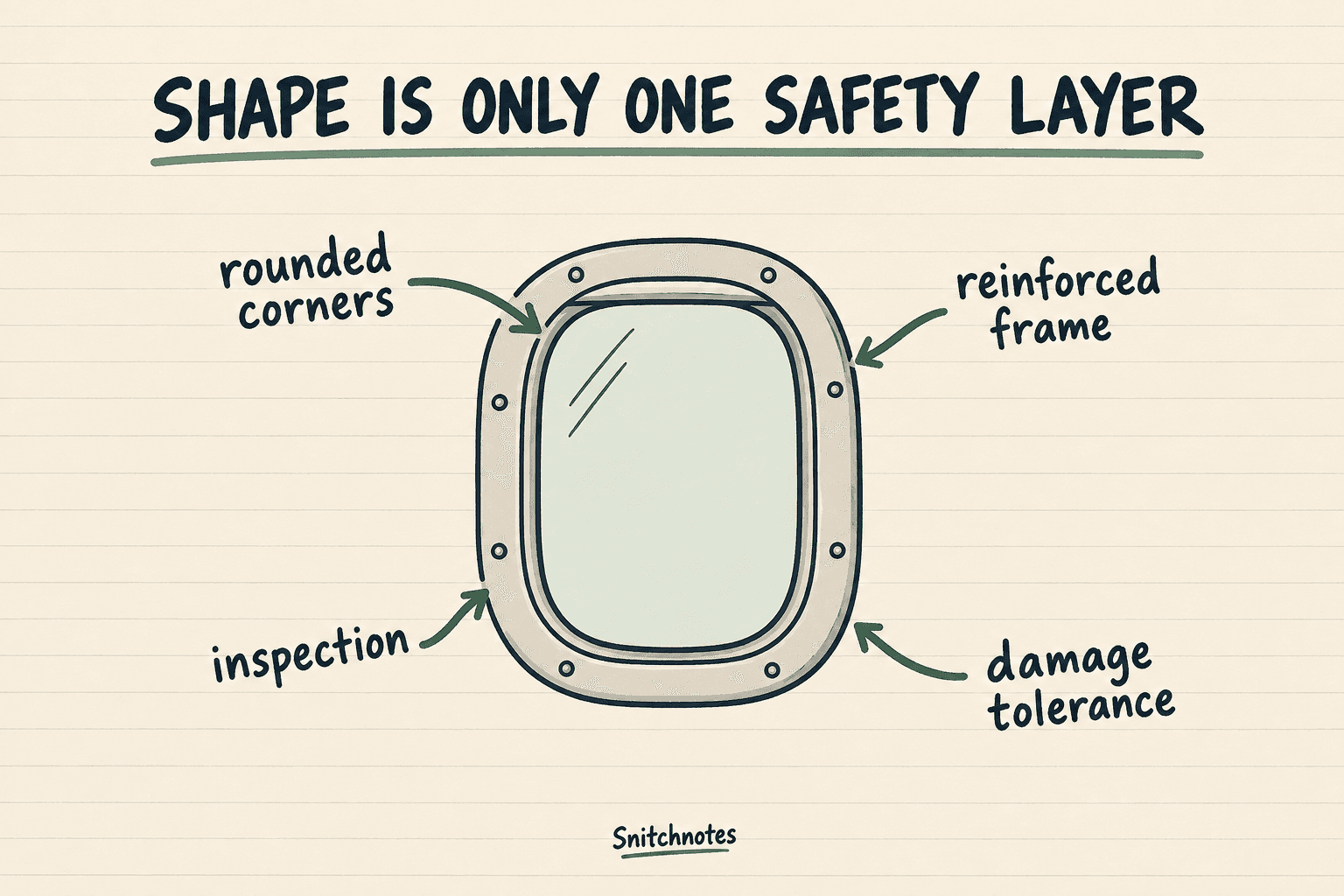
A rounded opening can still carry high stresses, and a circular hole can still develop a fatigue crack. Window safety also depends on the size and radius of the opening, the surrounding frame, materials, fasteners or bonding, manufacturing quality, expected pressure cycles, inspection, and damage-tolerant design. Rounded corners reduce a known stress raiser; they do not make inspection unnecessary.
Check your understanding
Why is a sharp corner risky in a pressurized fuselage?
It forces structural load paths to turn abruptly, producing a high local stress concentration where a fatigue crack is more likely to start.
Why do repeated flights matter?
The cabin-pressure difference loads the fuselage during flight and relaxes after landing. Repetition can initiate and grow fatigue damage even when one ordinary cycle does not break the structure.
Do rounded windows eliminate fatigue?
No. They reduce one source of peak stress. Safe design also requires suitable materials, framing, manufacturing, damage tolerance, testing, and inspection.
Related concepts
- Stress concentration: a local rise in stress caused by a hole, notch, sharp corner, or other geometric change.
- Fatigue: progressive damage produced by repeated or fluctuating loads.
- Why Roman concrete lasts so long
- Dimensional analysis in chemistry: step-by-step method
Sources
Federal Aviation Administration: De Havilland DH-106 Comet 1 lessons learned
The National Archives: Report on Comet Accident Investigation
Transforme tes cours en fiches prêtes pour les exams.
Notes, quiz, podcasts, flashcards et chat — en un seul upload.
Essaie ta première note gratuitement