
Snitchnotes Team
How to Study for a Class With No Practice Questions
How to Study for a Class With No Practice Questions
If your class has no practice questions, build a small question bank from the course's own learning objectives, slides, readings, examples, and assignment feedback. Answer those questions from memory, check each answer against a trusted source, repair mistakes, and retest later. The goal is not to guess the exact exam. It is to practise retrieving and using the knowledge the course says matters.
This method works for a lecture-heavy class, a new course with no past papers, or an instructor who provides only notes. You need a study target, a few reliable source materials, and a loop that tells you whether your homemade questions are accurate.
Why the missing question bank matters
Without prompts, it is easy to mistake recognition for mastery. A paragraph can look familiar while the idea disappears the moment the book closes. In two experiments with prose passages, Henry Roediger and Jeffrey Karpicke found that taking free-recall tests improved retention on delayed tests more than repeated study, even though repeated study increased learners' confidence.
That does not make every self-written question good. A vague prompt, a wrong answer key, or twenty questions about tiny details can create busywork. The troubleshooting task is therefore twofold: make questions that match the course, then calibrate them against reliable material.
Step 1: Define what the course can assess
Start with the syllabus, learning objectives, lecture headings, repeated examples, assignment criteria, and anything the instructor explicitly emphasizes. These are better anchors than choosing random sentences from the textbook. Carnegie Mellon University's Eberly Center recommends aligning assessments, objectives, and instructional activities; your study questions should follow the same logic.
Make a one-page target list. Write one line per examinable idea, such as “explain how natural selection changes allele frequencies” or “apply opportunity cost to a choice.” If no objectives are provided, turn each major lecture heading into an outcome: “After this section, I should be able to…”
Step 2: Turn each source into questions
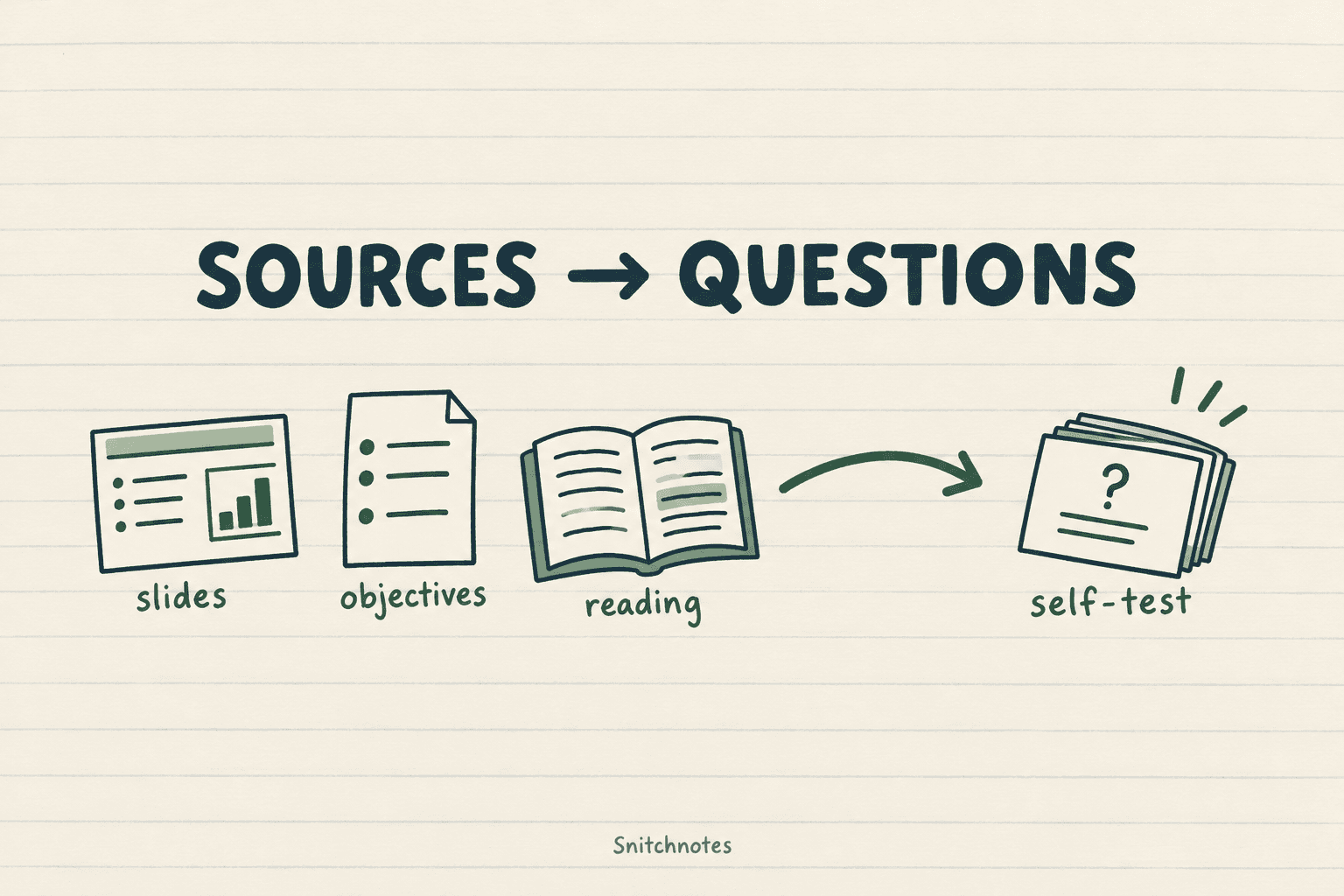
Use the source only to write the prompt, then close it before answering. A slide title can become a “why” question, a labelled diagram can become a blank redraw, a worked example can become a new case with changed values, and a paragraph can become a compare-or-predict prompt. Aim for two or three useful questions per major idea, not a card for every sentence.
Mix brief recall with explanation and application. In a study using science texts, Jeffrey Karpicke and Janell Blunt found that retrieval practice supported comprehension and inference, not merely verbatim recall. Your bank should therefore ask what a term means and what happens when the situation changes.
Six reusable question stems
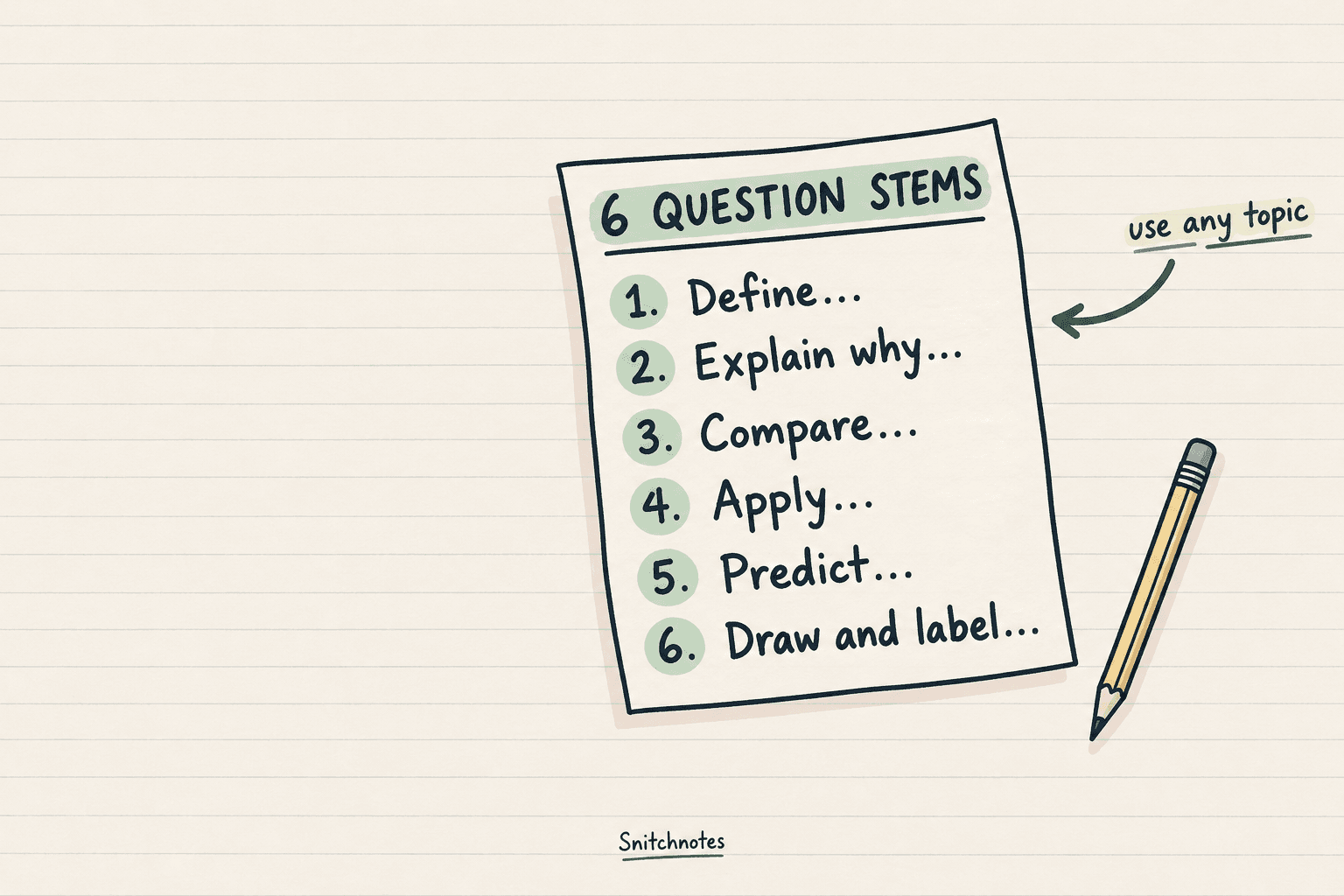
- Define: What does this term mean, and what is one non-example?
- Explain why: Why does this process produce that outcome?
- Compare: How are these two ideas alike, and where do they differ?
- Apply: Which concept explains this new case, and how?
- Predict: What changes if one condition is removed or increased?
- Draw and label: Can you reconstruct the process, graph, or structure from memory?
Keep each prompt answerable from the assigned material. “Explain everything about photosynthesis” is too broad to diagnose a gap. “Why does closing the stomata reduce carbon dioxide uptake?” gives you a specific claim to retrieve and check.
Step 3: Make a short answer key
For every question, write a compact key from the textbook, lecture notes, official formula sheet, marking rubric, or instructor feedback. Include the essential points, not a polished essay. For calculations, save the setup and units as well as the final number. For diagrams, list the required labels and relationships.
If two sources disagree or a definition remains unclear, flag the card instead of inventing certainty. Ask the instructor, teaching assistant, or a knowledgeable classmate which interpretation fits the course. A questionable card belongs in a “verify” pile, not in your repeated practice set.
Step 4: Calibrate, do not just generate
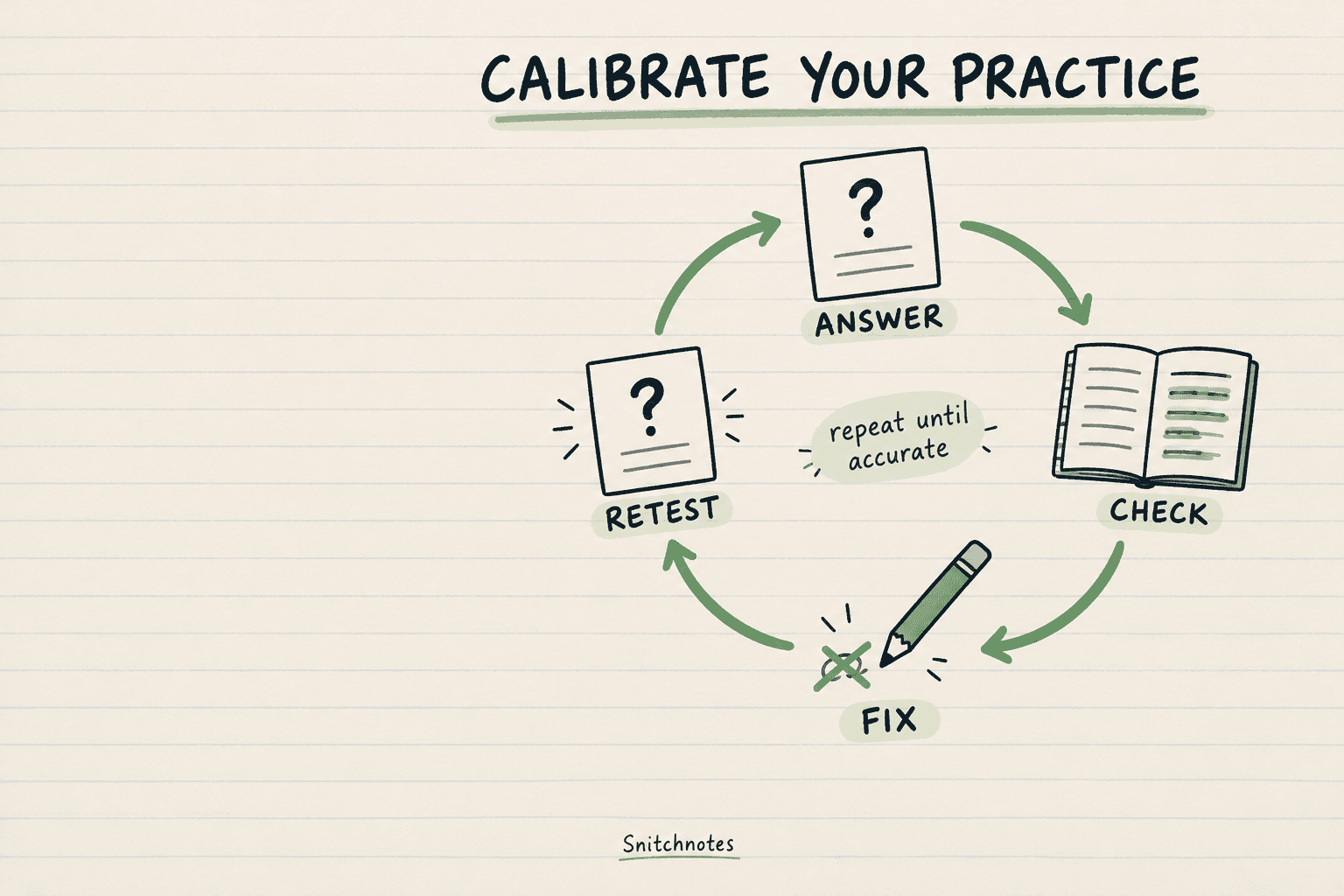
- Answer without notes. Say it aloud, write it, solve it, or draw it.
- Check against the answer key and mark the exact missing or incorrect part.
- Fix the explanation in your own words without changing the underlying fact.
- Retest the question later and occasionally vary the example or wording.
Do not score only “right” or “wrong.” Use three marks: accurate, partly accurate, and unsupported guess. That middle category catches answers that sound plausible but omit a mechanism, condition, unit, or exception. Spend the next round on partial answers and guesses rather than restarting the whole bank.
A useful example
Suppose an economics lecture has a slide titled “Price ceilings” with a supply-and-demand graph but no practice set. Your target might be “explain how a binding price ceiling affects quantity supplied and quantity demanded.” From that target, create three questions: define a binding price ceiling, draw and label the graph, and predict what happens to the shortage if the ceiling is lowered further.
Answer with the slide closed. Then check the graph, the direction of each change, and the condition that the ceiling must sit below equilibrium to bind. If you drew demand shifting instead of movement along the curve, record that specific error and redraw the graph tomorrow with different prices. One slide has now produced definition, diagram, and application practice.
The important boundary: you cannot predict everything
Self-made questions can reveal whether you can retrieve and apply the taught material, but they cannot guarantee the instructor's wording, difficulty, or topic weighting. Use the syllabus, assessment rubric, sample assignments, and instructor guidance to estimate emphasis. If the exam format is unknown, ask whether it uses essays, calculations, short answers, diagrams, or multiple choice.
Also avoid writing only the questions you already enjoy answering. After an assignment or quiz, compare your bank with the feedback: Did you miss definitions, transfer questions, exceptions, or multi-step problems? Add the missing type. A good homemade bank changes as evidence arrives.
Check your understanding
What should you use before choosing question wording?
First identify the course target from objectives, headings, examples, rubrics, and instructor emphasis. The wording should test that target rather than a random detail.
Why should every homemade question have an answer key?
The key lets you distinguish accurate retrieval from a fluent-sounding guess. It also makes errors specific enough to repair.
What should happen after a partly correct answer?
Identify the missing condition, step, unit, or mechanism, correct it from a trusted source, and retest later with the same idea in slightly different wording or context.
If turning a long slide deck or reading into a balanced question set is the bottleneck, Snitchnotes can help convert your own class materials into quizzes and flashcards for this answer-check-fix-retest loop.
Related concepts
- How to Study When Practice Questions Make You Feel Stupid: a troubleshooting method for questions that already exist but feel too difficult.
- How to Use Learning Objectives to Study for Exams: turn course outcomes into a focused revision plan.
- Retrieval practice: recalling information without looking at the source, then checking accuracy.
- Transfer practice: applying the same principle to a new example rather than repeating the original wording.
Sources
Dunlosky et al. (2013), Improving Students' Learning With Effective Learning Techniques
Carnegie Mellon University Eberly Center: Align Assessments, Objectives, Instructional Strategies
Transforme tes cours en fiches prêtes pour les exams.
Notes, quiz, podcasts, flashcards et chat — en un seul upload.
Essaie ta première note gratuitement