
Snitchnotes Team
How to Read a Balance of Payments Table Without Reversing the Signs
How to Read a Balance of Payments Table Without Reversing the Signs
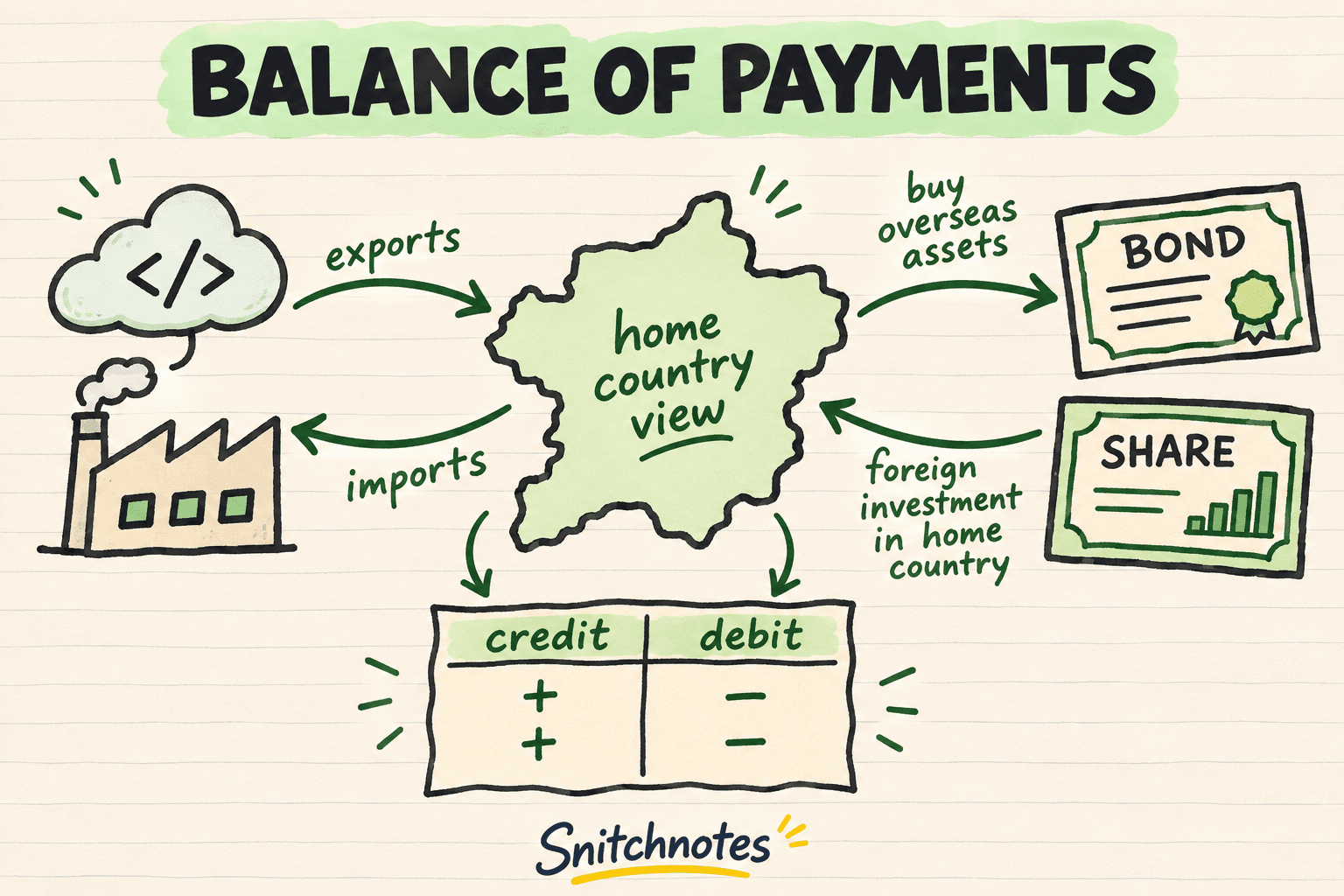
To read a balance of payments table without reversing the signs, use the same order every time: choose the reporting country, classify the transaction, identify whether it is a credit or debit, and then apply the table's financial-account convention. Exports are current-account credits; imports are current-account debits. In the financial account, acquisition of a foreign asset raises assets, while foreign acquisition of a home-country asset raises liabilities.
This order matters because the balance of payments records transactions between a country's residents and nonresidents over a period. It is not simply a list of money entering and leaving a bank account. One transaction can involve a good moving one way and a financial claim moving the other, so following the cash arrow alone is an easy way to flip a sign.
Why balance of payments signs feel backward
The table combines two accounting languages. Current- and capital-account items are commonly shown as credits and debits: a credit is positive and a debit is negative. The financial account in the International Monetary Fund's BPM6 presentation is organized around net acquisition of financial assets and net incurrence of liabilities. Its balance is assets minus liabilities, so a larger liability is subtracted when you calculate the financial-account balance.
That distinction explains a classic trap. If a foreign investor buys a bond issued by the home country, the home country's liabilities increase. A detailed table may show +20 in the net-incurrence-of-liabilities column, but its contribution to financial assets minus liabilities is −20. Both statements are correct; they refer to a raw column and a calculated balance, respectively.
First classify what changed
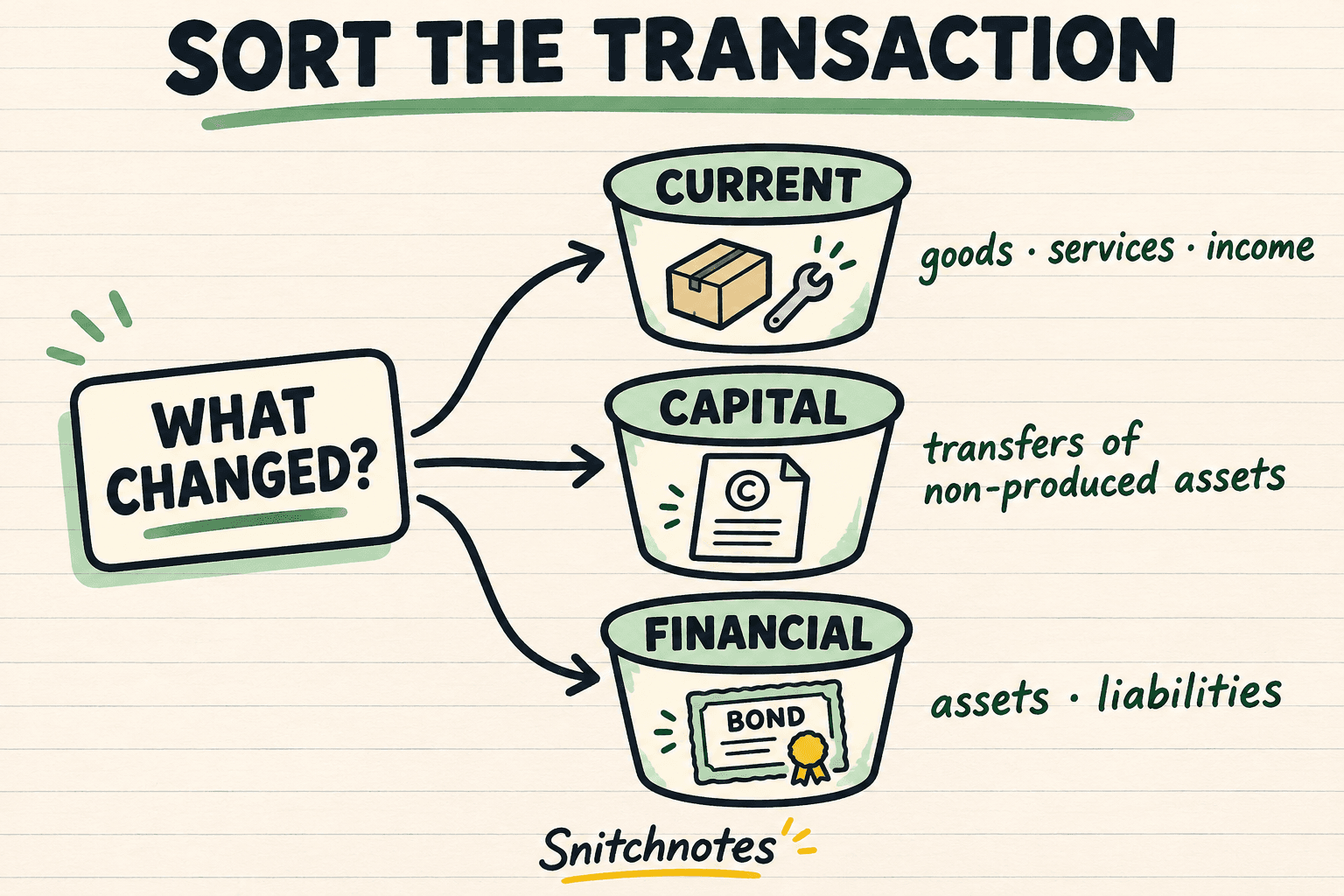
The current account covers goods, services, primary income such as wages and investment income, and secondary income such as many current transfers. Selling software support abroad is a service export; importing machinery is a goods import. The capital account is much smaller in most examples and covers capital transfers plus acquisitions or disposals of non-produced, nonfinancial assets such as certain licenses, leases, or rights.
The financial account records transactions in financial assets and liabilities: direct investment, portfolio securities, financial derivatives, reserve assets, and other investment such as loans and deposits. Despite its everyday name, buying shares or bonds does not go in the capital account under this framework. It goes in the financial account.
A four-step troubleshooting method
- Write the perspective at the top: home country. Ask who is resident and who is nonresident; nationality and currency are not reliable substitutes for residence.
- Name what changed before choosing a sign: a good, service, income flow, transfer, non-produced asset, foreign financial asset, or home-country liability.
- For current and capital items, mark credits positive and debits negative. Exports and income received are usually credits; imports and income paid are usually debits.
- For financial items, read the column headings. Under BPM6, calculate the balance as net acquisition of financial assets minus net incurrence of liabilities. Then check the accounting identity rather than relying on the direction of cash.
Worked example: four transactions, one perspective
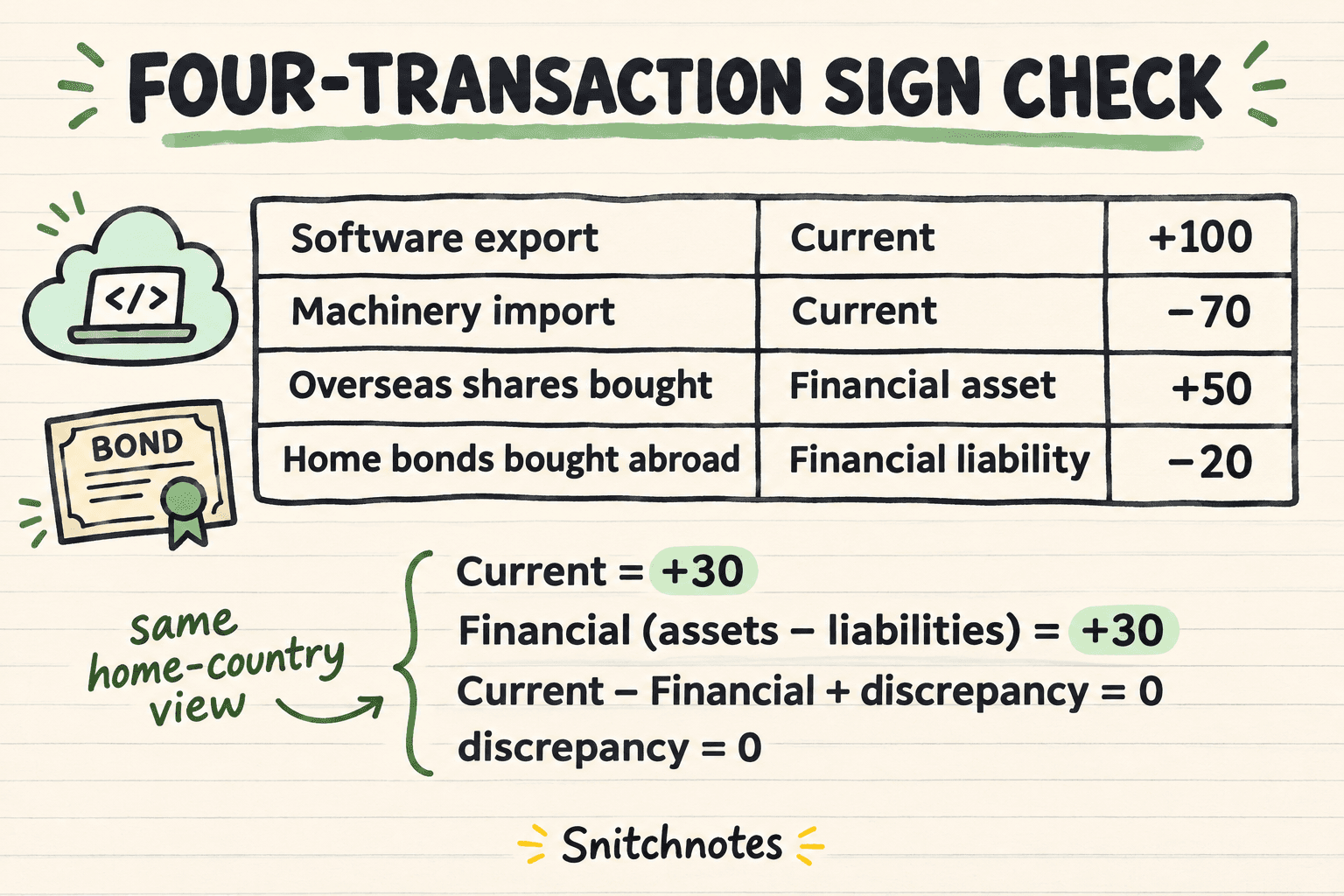
Suppose the home country exports $100 million of software and imports $70 million of machinery. The software export is a current-account credit of +100; the machinery import is a current-account debit of −70. The current-account balance is therefore +30 million. Assume there are no capital-account transactions.
Now suppose foreign investors buy $20 million of bonds issued by the home country. The home country's financial liabilities increase by +20. Home-country residents also buy $50 million of overseas shares, so acquisition of foreign financial assets increases by +50. The financial-account balance is assets minus liabilities: +50 − 20 = +30 million.
The simplified identity is current account + capital account − financial account + net errors and omissions = 0. Here it is +30 + 0 − 30 + 0 = 0. The statistical discrepancy is zero because the example was built with perfectly matching records. In real data, separately collected records do not line up exactly, so net errors and omissions closes the accounting gap; it is not a mystery transaction to classify.
Common sign mistakes and their fixes
- Mistake: treating every inflow as positive in the final balance. Fix: distinguish a positive liability entry from its subtraction in assets minus liabilities.
- Mistake: putting investment in the capital account. Fix: bonds, shares, loans, and deposits belong in the financial account; the capital account is narrower.
- Mistake: changing perspectives halfway through. Fix: rewrite every sentence from the reporting country's view before assigning a sign.
- Mistake: forcing every published table into one layout. Fix: inspect whether the table shows credits and debits, signed balances, or separate asset and liability columns.
A useful boundary is that some textbooks use an older presentation in which financial inflows are labeled credits and outflows debits. The underlying economics has not changed, but the displayed financial-account sign may differ from BPM6's assets-minus-liabilities balance. State the convention, then stay consistent.
Check your understanding
A resident receives interest from a foreign bond. Where does it go?
It is primary income received from abroad, so it is a current-account credit. The bond itself is a financial asset, but the interest earned on it is income in the current account.
A foreign bank lends $40 million to a home-country company. What changes?
The home country's financial liabilities increase by $40 million. In a BPM6-style table, net incurrence of liabilities rises by +40; in the assets-minus-liabilities balance, that liability contributes −40.
Why might net errors and omissions be nonzero?
Trade, income, and financial transactions are measured from different records and can differ in timing, valuation, or coverage. The discrepancy makes the published accounts add up; it does not tell you which individual record is wrong.
Related concepts
- How banks create money when lending: connect loans with bank assets, liabilities, and deposits.
- How to study comparative advantage and opportunity-cost tables: practice keeping one perspective and unit consistent.
- Asymmetric information in economics: see why incomplete records and unequal knowledge affect decisions.
Sources
International Monetary Fund: BPM6 Compilation Guide
U.S. Bureau of Economic Analysis: U.S. International Economic Accounts—Concepts and Methods
Reserve Bank of Australia: The Balance of Payments
Office for National Statistics: Balance of Payments methodology
Transforme tes cours en fiches prêtes pour les exams.
Notes, quiz, podcasts, flashcards et chat — en un seul upload.
Essaie ta première note gratuitement