
Snitchnotes Team
How Did Eratosthenes Measure Earth's Circumference?
How Did Eratosthenes Measure Earth's Circumference?
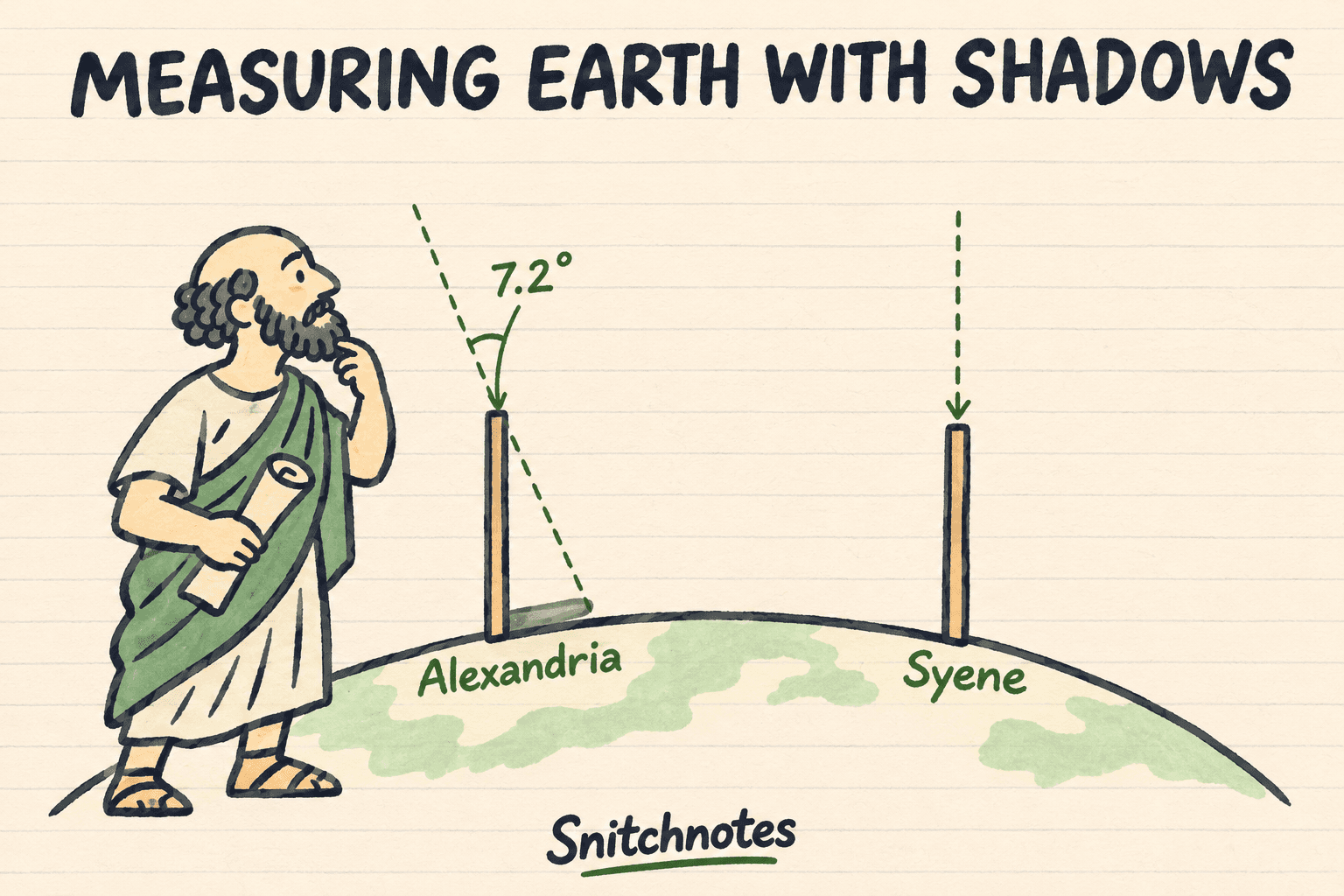
Eratosthenes estimated Earth's circumference by comparing the Sun at two Egyptian cities. At noon near the summer solstice, the Sun was reported to shine straight down at Syene, while a vertical object in Alexandria cast a shadow corresponding to an angle of about 7.2 degrees. Because 7.2 degrees is one-fiftieth of a full circle, he multiplied the roughly 5,000-stadia distance between the cities by 50. The result was about 250,000 stadia for the distance around Earth.
The clever part was not difficult arithmetic. It was recognizing that a local shadow could reveal the angle of a planet-sized arc. With ordinary observations, a known distance, and geometry, Eratosthenes made the whole Earth measurable without traveling around it.
Two cities, two noon shadows
The familiar account begins in the third century BCE. Eratosthenes, a scholar who later led the Library of Alexandria, knew of an unusual solstice observation at Syene, near modern Aswan. At local noon, sunlight reached the bottom of a well and upright objects cast little or no shadow. That meant the Sun was almost directly overhead.
In Alexandria, farther north, the same noon Sun was not directly overhead. A vertical gnomon, essentially a measuring stick, cast a short shadow. The ratio of the shadow's length to the gnomon's height gave an angle of about 7.2 degrees between the Sun's rays and the local vertical. Two sticks had supplied the missing fraction of a circle.
Why the shadow angle matched an angle inside Earth
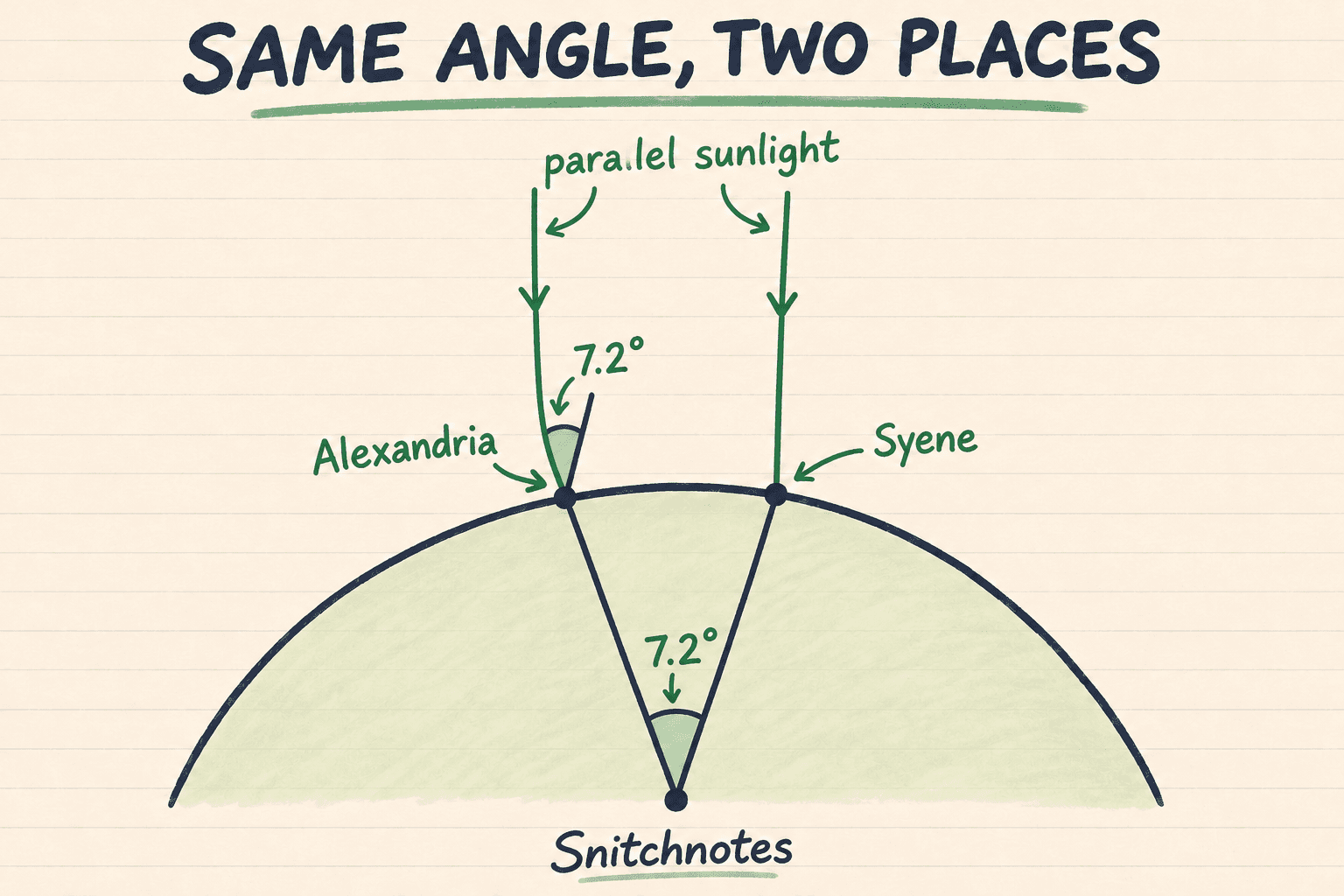
The geometry works because the Sun is extremely far away compared with the size of Earth, so its rays reach Alexandria and Syene almost parallel. At Syene, the ray lined up with the local vertical. At Alexandria, Earth's curved surface tilted the local vertical away from that same ray.
Extend both local verticals down toward Earth's center and they meet. The angle between them is the central angle separating the two cities. Basic geometry makes that central angle equal to the observed 7.2-degree angle at Alexandria. In other words, the shadow measured how much Earth's surface curved between the cities.
The calculation: multiply one arc by 50
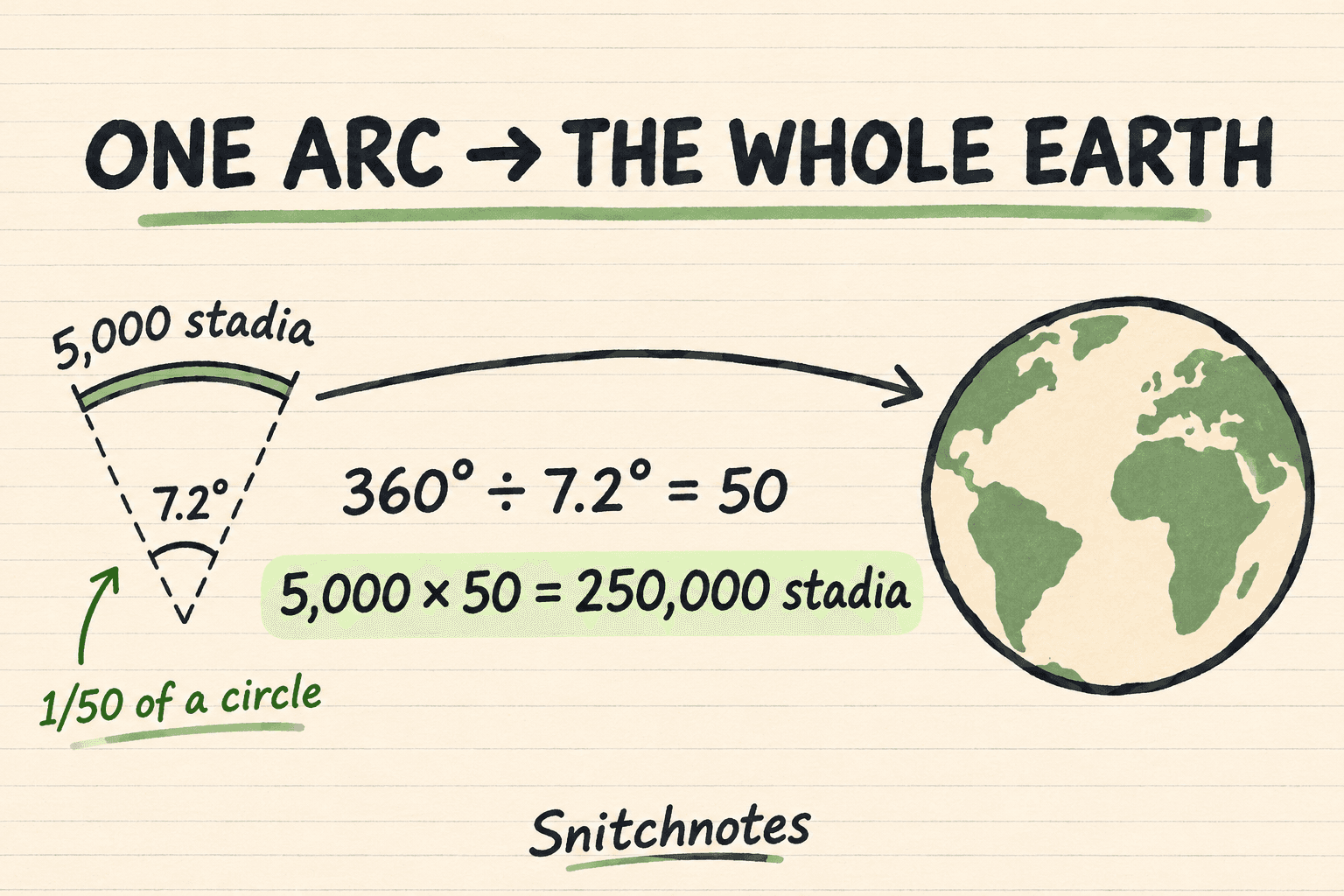
A complete circle contains 360 degrees. Dividing 360 by 7.2 gives 50, so the Alexandria-Syene arc represented one-fiftieth of Earth's full circumference. The distance used for that arc was about 5,000 stadia.
The rest is one multiplication: 5,000 stadia × 50 = 250,000 stadia. Some ancient reports give Eratosthenes' final value as 252,000 stadia, possibly because that number divides neatly into the 60-part conventions used in ancient geography. Either way, the method is the same: find the fraction of the circle, then scale the known arc distance to the whole circle.
Where did the 5,000-stadia distance come from?
This input was at least as important as the angle. The American Physical Society's historical account says professional distance measurers called bematists surveyed the route by calibrated pacing. Other retellings connect the figure to travel or geographic records. Eratosthenes' own book on measuring Earth has been lost, so later writers preserve a simplified version rather than his complete working notes.
That uncertainty is a useful lesson in measurement: elegant geometry cannot rescue a poor baseline. If the city distance is 2 percent too large, the circumference will also be 2 percent too large. The final result inherits the uncertainty of every input.
How accurate was Eratosthenes?
There is no single honest percentage to quote without a qualification. The ancient stadion was not one universally fixed modern length, and scholars disagree about which version Eratosthenes used. Depending on the conversion, 250,000 stadia can land remarkably close to the modern circumference or several thousand kilometers away. NASA gives Earth's modern equatorial circumference as about 40,070 kilometers.
The setup also used convenient approximations. Alexandria and Syene are not exactly on the same north-south meridian, and Syene is not precisely on the Tropic of Cancer. The Sun's overhead position and the route distance were not perfect either. Those limits affect the numerical accuracy, but they do not weaken the central idea. The method is geometrically sound and can be repeated today with synchronized shadow measurements.
A common misconception: he did not discover that Earth was round
Eratosthenes' experiment is sometimes told as proof that convinced people Earth was spherical. That skips the historical context. Greek thinkers had argued for a spherical Earth centuries earlier, and Aristotle had listed observational evidence such as Earth's round shadow during lunar eclipses. Eratosthenes tackled a different question: if Earth is spherical, how large is it?
Another misconception is that the well alone produced the answer. The zero-shadow observation supplied a reference, but the calculation also needed the Alexandria angle, the distance between the cities, parallel sunlight, and a spherical-Earth model. Remove any one of those pieces and there is no circumference estimate.
Check your understanding
Why did Eratosthenes multiply by 50?
The measured 7.2-degree angle is one-fiftieth of 360 degrees. If the 5,000-stadia city distance covers one-fiftieth of Earth, the full circumference is 50 times that distance.
What assumption connects the shadow to Earth's center?
Sunlight reaching the two cities is treated as parallel. That makes the Alexandria shadow angle equal to the central angle between the cities' local verticals.
Why is the exact modern conversion uncertain?
Ancient sources report the answer in stadia, but the stadion did not have one securely identified length in modern meters. Different plausible conversions produce different kilometer values.
If a history or science lecture leaves you with the result but not the reasoning, Snitchnotes can turn your slides, PDFs, and notes into clearer study notes, flashcards, quizzes, and audio for review.
Related concepts
- Gnomon: a vertical object whose shadow can reveal the Sun's angle.
- Central angle: an angle with its vertex at the center of a circle, used to connect arc length with circumference.
- Why Roman concrete lasts so long: another historical case in which evidence helps reconstruct an ancient technique.
- Dimensional analysis step by step: a method for keeping units and scale factors under control.
Sources
American Physical Society: Eratosthenes Measures Earth
NASA Science: Tropical Solstice Shadows
NASA Imagine the Universe: The Earth
MacTutor History of Mathematics: Eratosthenes and the Circumference of the Earth
Transforme tes cours en fiches prêtes pour les exams.
Notes, quiz, podcasts, flashcards et chat — en un seul upload.
Essaie ta première note gratuitement