
Snitchnotes Team
Stop Studying Harder and Start Studying Smarter: The 7-Day Brain Science Method That Actually Works
Ever feel like you’re “studying” for hours just to forget everything the next day? Yeah… join the club. And here’s the best part: it’s not your fault.
The problem isn’t your intelligence.
It’s that nobody ever actually taught you how to study better.
Most students rely on ineffective study habits—highlighting entire textbooks, rereading notes, or pretending Netflix in the background is “ambient noise.” These methods feel productive, but they don’t actually help you remember anything.
If you want real results, you need a system based on how the brain learns. This 7-day study plan uses active recall, spaced repetition, and AI study tools to rebuild your study habits from the ground up.
Let’s reset your brain for academic success.
The Neuroscience of Learning: Why Your Old Methods Are Failing You
Rereading your notes feels comforting. It gives your brain a fake sense of “I’ve seen this before, I must know it.” But recognition ≠ recall.
The Neuroscience:
- Highlighting and rereading are among the least effective learning techniques (Dunlosky et al., 2013)
- Passive studying creates illusion of competence
- Strong memory formation requires struggle, not comfort
- Your brain needs to actively retrieve information to create durable learning pathways
Passive studying = watching a workout video.
Active studying = actually doing the workout.
Time to retire the neon highlighters and build a new system.
Your 7-Day Study Plan to Fix Study Habits
Think of this as a full detox for your old habits. Every day builds on the last, so by Day 7 you’ll have a working weekly study routine that your future GPA will worship you for.
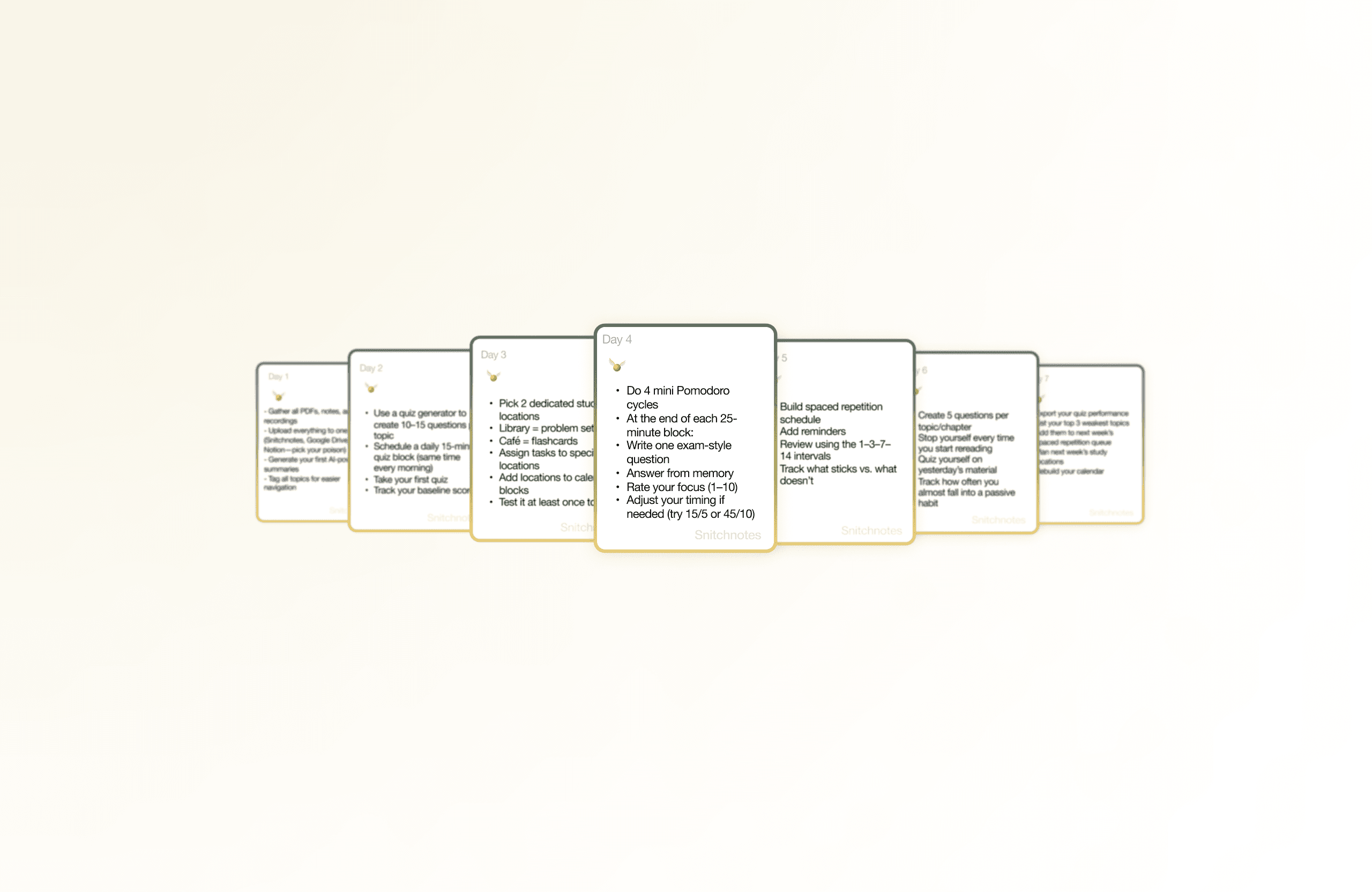
Days 1-2: Build Your Active Recall Routine Foundation
Day 1: Organize Your Digital Chaos with AI Study Tools
Right now, your study materials probably look like:
- PDFs in 12 different folders
- Lecture recordings labeled “audio_4829019.mp3”
- Notes scattered across Notion, OneNote, and 7 half-used notebooks
Time to consolidate.
Use an AI study tool like Snitchnotes to turn that chaos into clean, structured, searchable content.
Your tasks today:
- Gather all PDFs, notes, audio recordings
- Upload everything to one place (Snitchnotes, Google Drive, Notion—pick your poison)
- Generate your first AI-powered summaries
- Tag all topics for easier navigation
This is the foundation of your system.
Day 2: Replace Rereading with Daily Quizzing
From now on, reading is for learning new material, not reviewing it.
Your new rule:
If you’re reviewing, you’re quizzing.
Your tasks today:
- Use a quiz generator to create 10–15 questions per topic
- Schedule a daily 15-minute quiz block (same time every morning)
- Take your first quiz
- Track your baseline score
Congrats—you’ve officially dumped passive studying.
Days 3-4: Master Your Focus and Environment
Day 3: Study Smarter, Not Harder with Location Strategy
Context-dependent learning is real.
Where you study matters.
Your brain forms stronger memories in distinct environments.
Your tasks:
- Pick 2 dedicated study locations
- Library = problem sets
- Café = flashcards
- Assign tasks to specific locations
- Add locations to calendar blocks
- Test it at least once today
You’ll be shocked how much this helps your recall.
Day 4: Master the Mini Pomodoro for Peak Focus
Forget the old “50/10” method.
ADHD or not, most Gen Z brains thrive with the Mini Pomodoro:
25 minutes on → 5 minutes off
Batch similar tasks together so your brain stays in one mental mode.
Your tasks:
- Do 4 mini Pomodoro cycles
- At the end of each 25-minute block:
- Write one exam-style question
- Answer from memory
- Rate your focus (1–10)
- Adjust your timing if needed (try 15/5 or 45/10)
This builds consistency without burnout.
Days 5-6: Make Knowledge Stick with a Spaced Repetition Schedule
Day 5: Create Your Spaced Repetition Schedule
To beat the forgetting curve, follow the golden pattern:
1 → 3 → 7 → 14
Review on Day 1, Day 3, Day 7, Day 14.
Use Anki if you want automation, or schedule it manually in Google Calendar.
Your tasks:
- Build spaced repetition schedule
- Add reminders
- Review using the 1–3–7–14 intervals
- Track what sticks vs. what doesn’t
This is where long-term memory finally kicks in.
Day 6: Stop Passive Studying Cold Turkey
You’re six days into your reboot—you can’t slip now.
Every time you feel the urge to reread your notes?
Make yourself answer 5 original questions from memory instead.
Your tasks:
- Create 5 questions per topic/chapter
- Stop yourself every time you start rereading
- Quiz yourself on yesterday’s material
- Track how often you almost fall into a passive habit
This single day will change your entire academic life.
Day 7: Audit Your Study Routine Reset and Build Your Weekly Study Plan
Today is about building your forever system.
Your tasks:
- Export your quiz performance
- List your top 3 weakest topics
- Add them to next week’s spaced repetition queue
- Plan next week’s study locations
- Rebuild your calendar
You’re not just correcting habits—you’re building a long-term, sustainable system.
Why This System Actually Works
This 7-day study plan is built on the neuroscience of learning:
- Active Recall strengthens neural pathways by forcing your brain to retrieve information
- A Spaced Repetition Schedule leverages the spacing effect to move information into long-term memory
- The Mini Pomodoro and location strategy optimize your focus and prevent cognitive burnout
- AI Study Tools like a quiz generator or automatic notes organizer streamline the process
Research Citations:
- Active recall effectiveness: Roediger & Karpicke (2006)
- Spaced repetition benefits: Cepeda et al. (2006)
- Learning techniques ranking: Dunlosky et al. (2013)
Your Transformation Starts Now
It takes effort to fix study habits that have been ingrained for years. Your brain might resist at first. But stick with this system. By Day 7, you should see higher recall in your practice quizzes.
You're not just cramming for the next exam; you're building a sustainable weekly study plan that will serve you throughout your entire academic and professional career.
Important Note: Use AI to study, not to submit work you didn't create. Cite sources and follow your school's academic integrity policies. Avoid uploading restricted course materials to third-party tools without permission.
Frequently Asked Questions
What is active recall? Active recall is a study method where you actively retrieve information from memory rather than passively reviewing material. Instead of rereading notes, you test yourself by answering questions or explaining concepts without looking at your materials.
What's the best spaced repetition schedule? Start with the 1-3-7-14 pattern: review new material after 1 day, 3 days, 7 days, then 14 days. Tools like Anki can optimize these intervals based on your performance.
How do I stop passive studying? Replace every passive activity (rereading, highlighting) with an active one (self-testing, explaining concepts aloud). Set a rule: before reviewing material, create 5 questions about it first.
What if I miss a day in the plan? Don't restart. Jump back in where you left off. The key is building the habit, not perfect execution.
Transforme tes cours en fiches prêtes pour les exams.
Notes, quiz, podcasts, flashcards et chat — en un seul upload.
Essaie ta première note gratuitement