
Snitchnotes Team
Why Does English Have Silent Letters?
Why Does English Have Silent Letters?
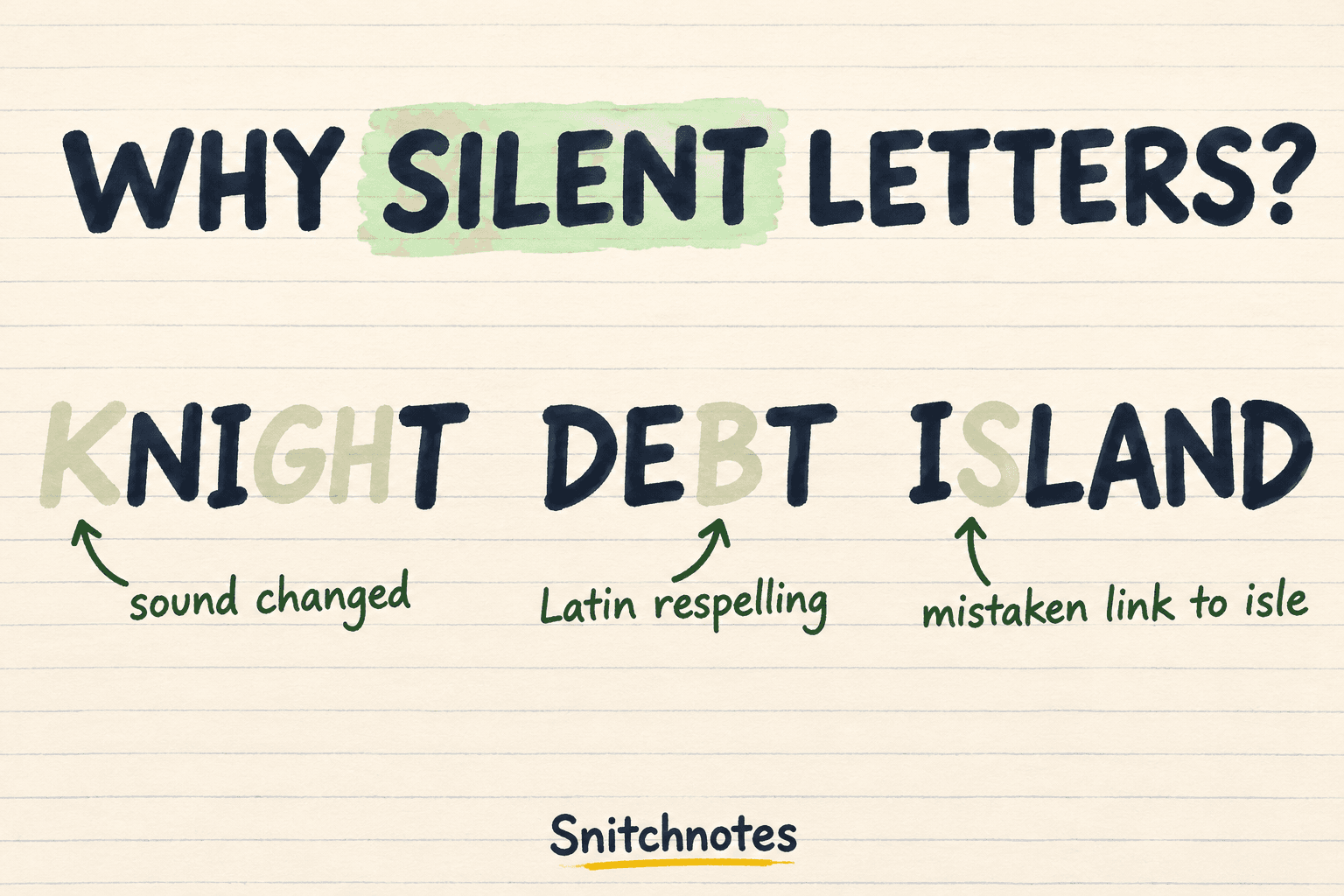
English has silent letters because spelling records history as well as sound. Some letters once represented sounds that later disappeared, as in knight. Some arrived with words borrowed from other languages. Others were added by scholars who wanted a spelling to display a Latin or Greek connection, as with the b in debt. The s in island came from a mistaken association with isle.
Meanwhile, written forms became increasingly standardized while pronunciation kept changing. The result is not one broken rule but a stack of historical layers. Knowing which layer you are looking at makes odd spellings easier to remember and prevents the tempting but false explanation that every silent letter used to be pronounced.
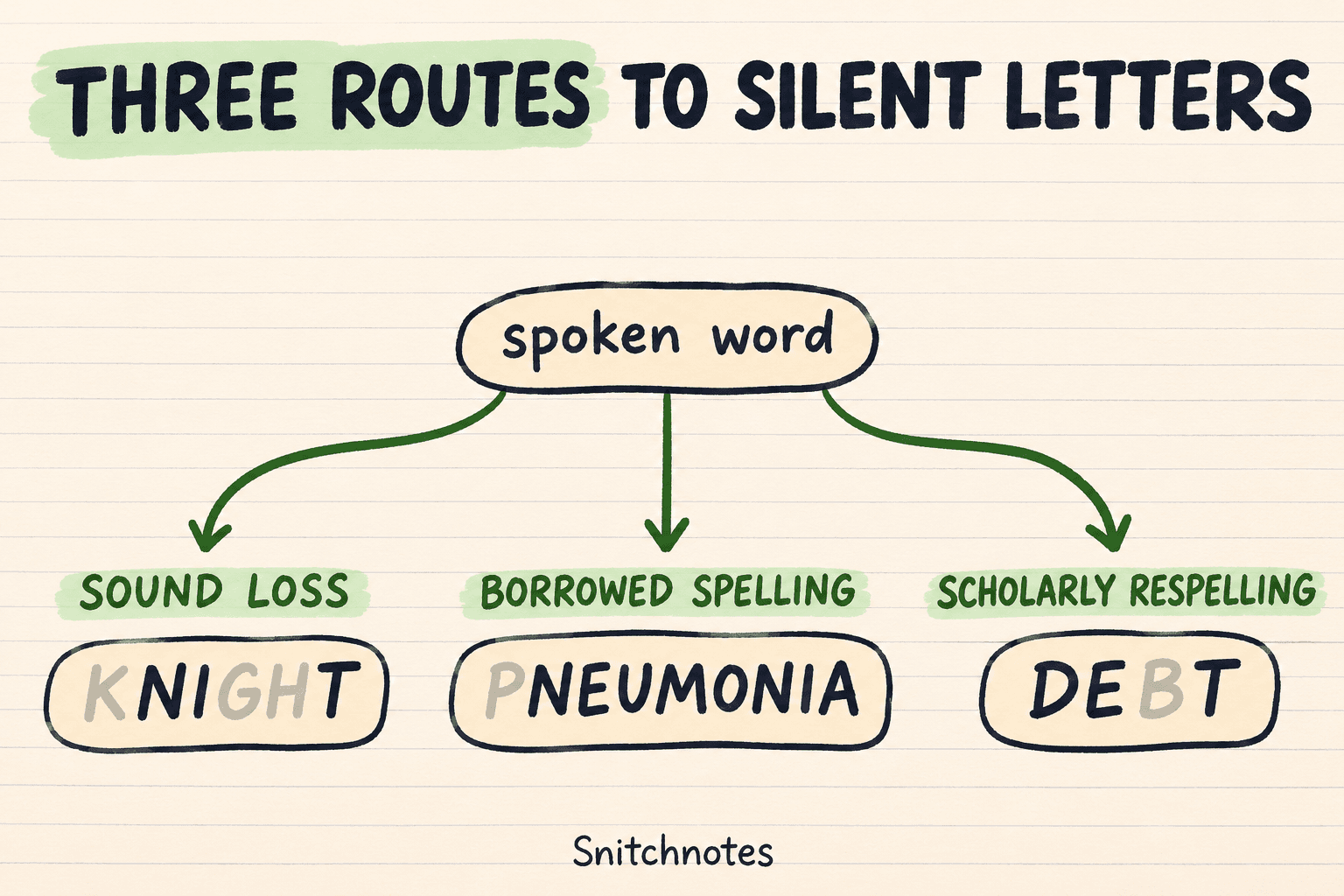
Three routes to silent letters
The first route is sound loss. Earlier English speakers pronounced consonants that many modern speakers do not. Initial clusters such as kn became simpler, and the sound written gh in words such as night and light disappeared or changed. Spelling often kept the older letters because familiar written forms are useful even when speech moves on.
The second route is borrowing. English has taken words from French, Latin, Greek, Norse, and many other languages. A borrowed word may keep letters from its source spelling even when English speakers do not give every letter a separate sound. Pneumonia, for example, entered English through New Latin from Greek, and its initial p is silent in standard English.
The third route is deliberate respelling. Medieval and Renaissance scholars sometimes changed a familiar spelling to make a classical ancestry visible. Debt had circulated in Middle English as dette or dete, through French. Writers inserted b to connect it with Latin debitum, but ordinary pronunciation did not gain a b sound. Receipt and indict show comparable learned additions.
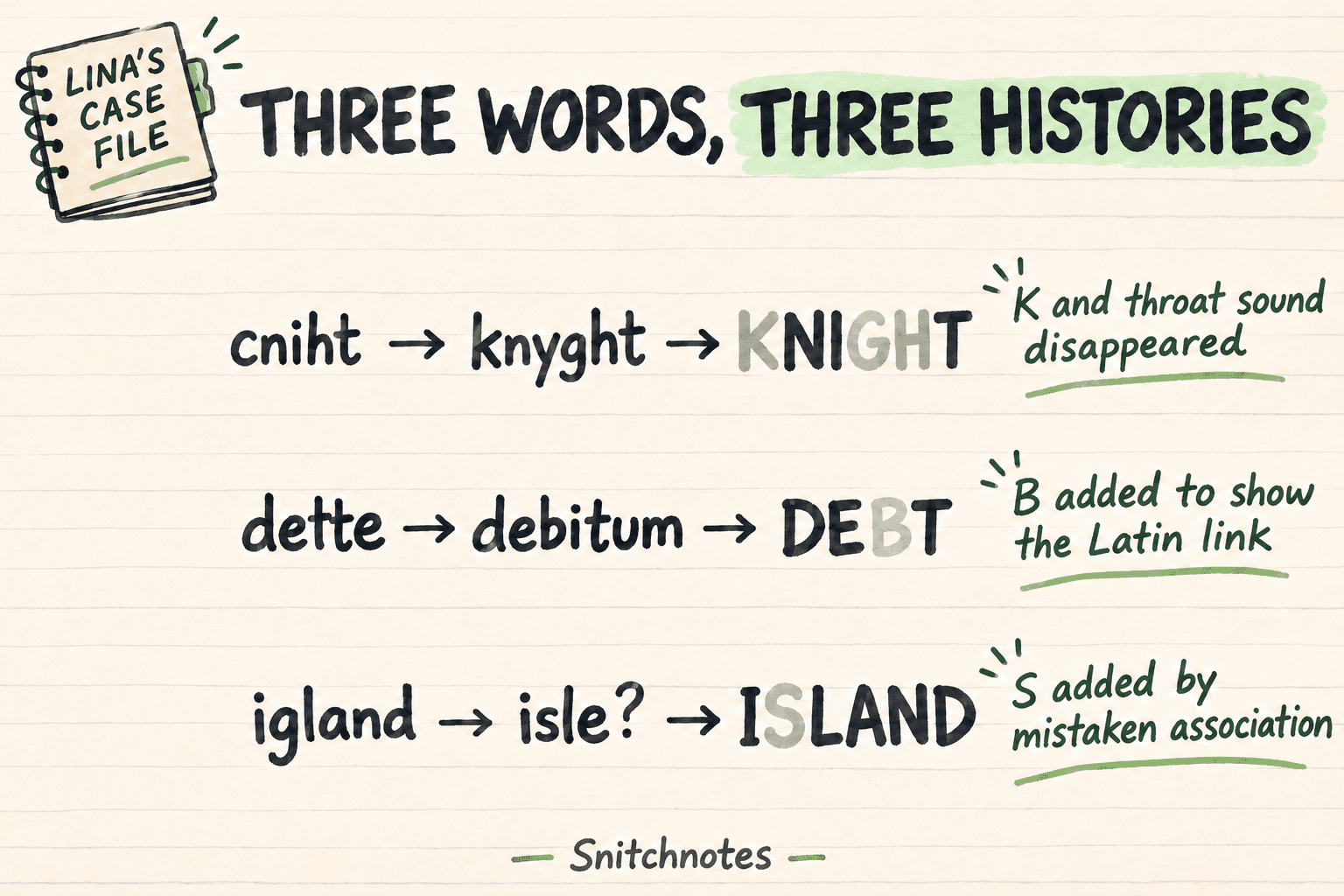
Lina's case file: knight, debt, and island
Lina puts three words on a detective board. All contain silent letters, but treating them as one mystery would hide the useful part: each spelling has a different witness statement. The quickest solution is to give every word a short biography.
Knight: the sounds changed
Knight descends from Old English cniht. The initial consonant cluster included an audible k, and the consonant later written gh represented a back-of-the-throat sound, comparable to the sound in Scots loch. Middle English spellings included knyght. Over centuries, standard pronunciations lost both the initial k and the gh sound, while the letters remained.
Debt: a letter was added
Debt took a French route into English and appeared as dette or dete. Its deeper ancestor is Latin debitum. Scholars restored a b to the written word to advertise that Latin relationship. The spelling changed, but English speakers did not start saying the b. This is why the letter is better understood as a learned label than as the fossil of a lost English sound.
Island: the connection was mistaken
Island goes back to Old English igland, a compound meaning island or literally island-land; its history did not contain an s. The similar-looking word isle came through French from Latin insula. Later spelling associated the two words and inserted s into island, even though their earlier histories were distinct. The new letter never represented a normal English s sound in the word.
Why spelling did not simply catch up
Changing every spelling whenever pronunciation shifts sounds tidy, but English has never had one pronunciation shared by every region and generation. A reform that matches one accent may mismatch another. Stable spellings also let readers recognize the same word across accents and connect related forms, even when the sound-letter match is imperfect.
Standardization was gradual, not a single moment when printing froze the language. Schools, government writing, dictionaries, and print all encouraged more consistent forms. At the same time, pronunciation continued to develop. Professor Suzanne Kemmer's Rice University overview notes that writing norms commonly lag behind sound change; silent letters are one visible result of that lag.
The important boundary: silent does not mean useless
A silent letter contributes no separate sound in a particular modern pronunciation, but it may still help identify a word or word family. The k in know distinguishes the written word from no. The spelling sign connects visually with signature, where the g is pronounced. These are present-day reading benefits, not proof that each letter was preserved for a clever purpose. Historical spelling is often useful without being systematically designed.
It is also misleading to blame all silent letters on careless speech or the Great Vowel Shift. Consonant loss, borrowing, learned respelling, analogy, and regional variation are separate processes. When you meet an odd spelling, ask two questions: was the sound lost, or was the letter never part of the English pronunciation? A historical dictionary can tell you which story fits.
Check your understanding
Which word shows sound loss: knight or debt?
Knight. Its k and the sound represented by gh were pronounced in earlier forms. Debt's b was inserted into the spelling later to display a Latin connection.
Why is the s in island different from the b in debt?
Both were added later, but for different reasons. Debt's b marks a real Latin ancestry through debitum. Island's s arose from a mistaken association with isle, whose earlier history was different.
Did every silent letter once represent a sound?
No. Some record lost sounds, but others entered through borrowing or were inserted by later writers. That is why a word-by-word history works better than one universal silent-letter rule.
Related concepts
- Why is the ampersand called an ampersand?
- Why do languages lose grammatical gender?
- Denotation vs connotation: differences and examples
Sources
Rice University, Suzanne Kemmer: Spelling and Standardization in English—Historical Overview
Oxford English Dictionary: Knight, N.—Meanings, Etymology and More
Convierte tus clases en material listo para el examen.
Apuntes, quizzes, podcasts, flashcards y chat — con una sola subida.
Prueba tu primer apunte gratis