
Snitchnotes Team
How to Solve Fermi Estimation Problems Step by Step
How to Solve Fermi Estimation Problems Step by Step
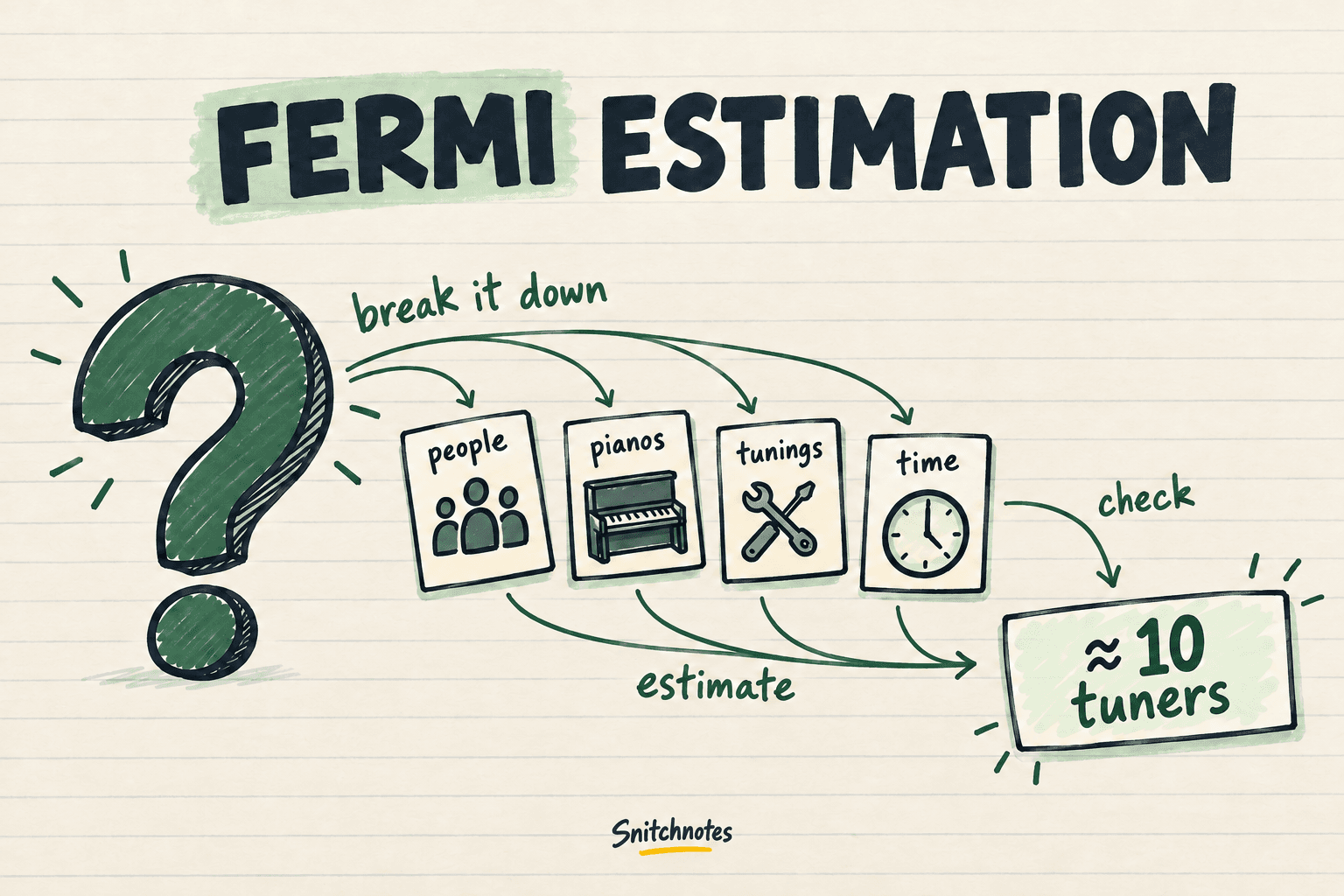
To solve a Fermi problem, rewrite the unknown quantity as a chain of smaller quantities you can estimate, state one reasonable assumption for each, calculate with rounded numbers, and then test whether the result has the right units and order of magnitude. The goal is not an exact answer. It is a transparent estimate that another person can inspect, challenge, and improve.
This method is useful when the question looks impossible because the needed data are missing: How many piano tuners does a city support? How many tennis balls fit in a bus? Fermi problems, named for physicist Enrico Fermi, turn that blank-page feeling into a sequence of manageable decisions.
Why Fermi estimation matters
A Fermi estimate gives you a fast scale check before you invest in precise data. If your estimate says a city needs 10 piano tuners, a later claim of 10,000 should trigger questions. University of California, Berkeley teaching materials describe the usual target as getting within an order of magnitude: close enough to distinguish roughly 10 from 100 or 1,000.
That makes the technique valuable in physics, engineering, policy, business, and ordinary fact-checking. It also exposes where uncertainty lives. A calculator can multiply your assumptions perfectly, but it cannot decide whether one household in 20 owning a piano is plausible.
The six-step Fermi problem method
- Define the target and its unit. Ask exactly what you need to estimate: tuners in a city, kilograms of paint, or liters of water per day.
- Build an assumption tree. Break the target into factors that connect what you know to what you need.
- Choose plausible round values. Prefer one significant digit or friendly numbers such as 2.5, 20, 500, or a power of ten.
- Write units beside every factor. Units reveal whether you should multiply or divide and should cancel until only the target unit remains.
- Calculate the central estimate. Keep the arithmetic simple enough that the reasoning remains visible.
- Stress-test the answer. Change the most uncertain assumptions, compute lower and upper bounds, and compare the result with any reality check you can find.
Worked example: estimating piano tuners
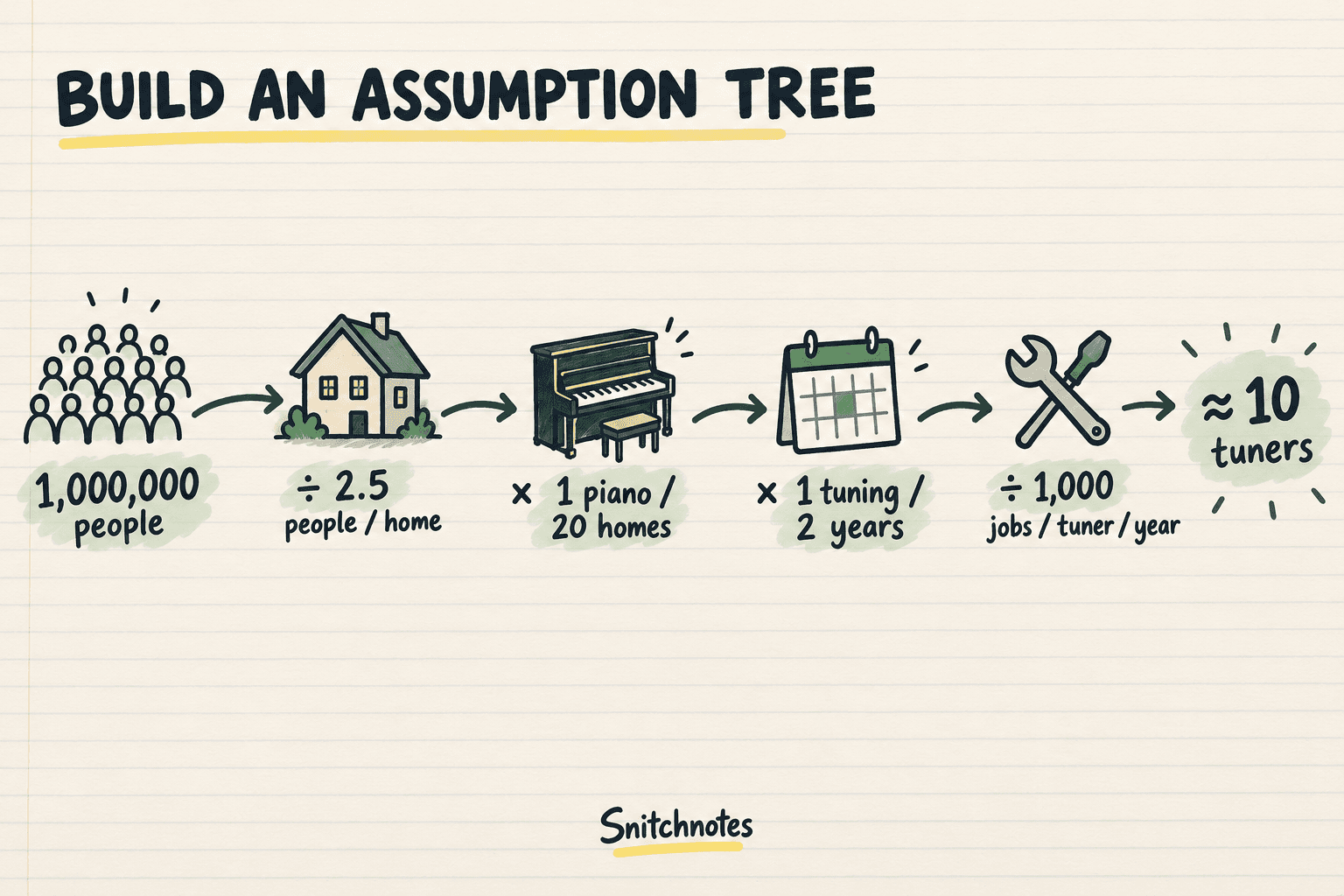
Suppose a city has 1,000,000 people. We want the number of full-time piano tuners its residents can support. Start with demand for tuning jobs, then divide by how many jobs one tuner can complete.
- Assume 2.5 people per household: 1,000,000 ÷ 2.5 = 400,000 households.
- Assume one household in 20 owns a piano: 400,000 ÷ 20 = 20,000 pianos.
- Assume each piano is tuned once every two years: 20,000 ÷ 2 = 10,000 tuning jobs per year.
- Assume one tuner completes four jobs per day, five days per week, for 50 weeks: 4 × 5 × 50 = 1,000 jobs per year.
The estimate is 10,000 jobs per year ÷ 1,000 jobs per tuner per year = about 10 tuners. Notice the unit cancellation: jobs per year divided by jobs per tuner per year leaves tuners. NASA presents a classic Chicago version of this same problem; the exact assumptions differ, but the reasoning pattern is identical.
Use powers of ten without losing the logic
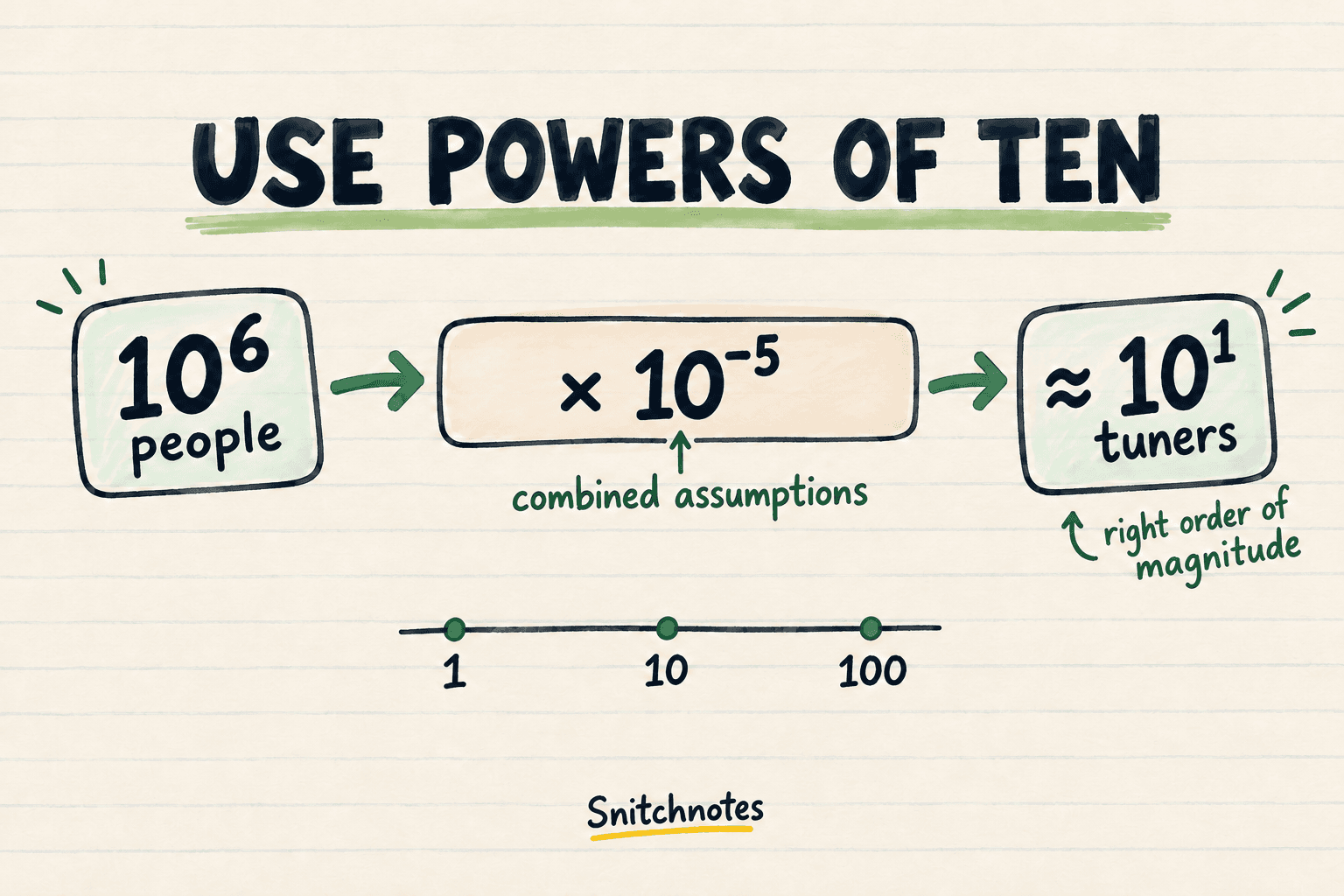
Powers of ten help when the factors are large, tiny, or numerous. The population is about 10⁶. After combining household size, piano ownership, tuning frequency, and tuner capacity, the overall conversion is roughly 10⁻⁵ tuners per person. Multiplying gives 10⁶ × 10⁻⁵ = 10¹, so the answer should be in the tens.
Do not replace every factor with a power of ten too early. First write the verbal model and units; then simplify the arithmetic. Otherwise you can obtain tidy exponents while quietly multiplying the wrong quantities.
Troubleshoot weak assumptions with bounds
A single estimate can hide false confidence. For a rough lower bound, try three people per household, one piano per 30 households, one tuning every three years, and 1,250 jobs per tuner per year. That gives about three tuners. For an upper bound, try two people per household, one piano per 10 households, one tuning every 1.5 years, and 750 jobs per tuner per year. That gives about 44.
The range is broad, but it is informative: the answer is plausibly a few to a few dozen, not hundreds or thousands. The biggest uncertainty is piano ownership, so better local data there would improve the estimate more than calculating household size to extra decimal places.
Common mistakes and boundaries
The most common mistake is treating an assumption as a hidden fact. Label every assumed value and explain why it is reasonable. Another mistake is fake precision: an answer such as 10.37 tuners suggests accuracy the inputs do not support. Report about 10, or a range such as 3–45.
Fermi estimation also has limits. It works best when a quantity can be decomposed into stable, roughly independent factors and when the required answer is a scale, not an exact count. It is a poor substitute for measurement when safety margins, legal thresholds, medical doses, or rare events make small errors consequential.
Check your understanding
Why do the units matter?
They test the structure of the estimate. If the final unit is jobs per year when the question asks for people, the assumption chain is incomplete or an operation is reversed.
Which assumption should you research first?
Research the assumption that is both uncertain and influential. In the piano example, ownership could vary several-fold and directly scales demand, so it matters more than a small refinement to working weeks.
What makes a Fermi answer defensible?
A defensible answer shows its assumptions, arithmetic, units, bounds, and limits. Someone should be able to replace one assumption and see exactly how the estimate changes.
If multi-step estimates keep turning into a wall of notes, Snitchnotes can turn your lectures, slides, and PDFs into clearer study notes, flashcards, quizzes, and audio for practice.
Related concepts
- Dimensional analysis in chemistry: use unit cancellation to structure multi-step calculations.
- Problem-solving exams without memorizing solutions: practice reasoning patterns instead of answer shapes.
- Sensitivity analysis: identify which uncertain input changes the output most.
Sources
National Oceanic and Atmospheric Administration: Lesson Plan—Fermi Challenge
NASA Glenn Research Center: Fermi's Piano Tuner Problem
University of California, Berkeley: Fermi Problems—Sense & Sensibility & Science
Convierte tus clases en material listo para el examen.
Apuntes, quizzes, podcasts, flashcards y chat — con una sola subida.
Prueba tu primer apunte gratis