
Snitchnotes Team
How Does GPS Use Relativity to Stay Accurate?
How Does GPS Use Relativity to Stay Accurate?
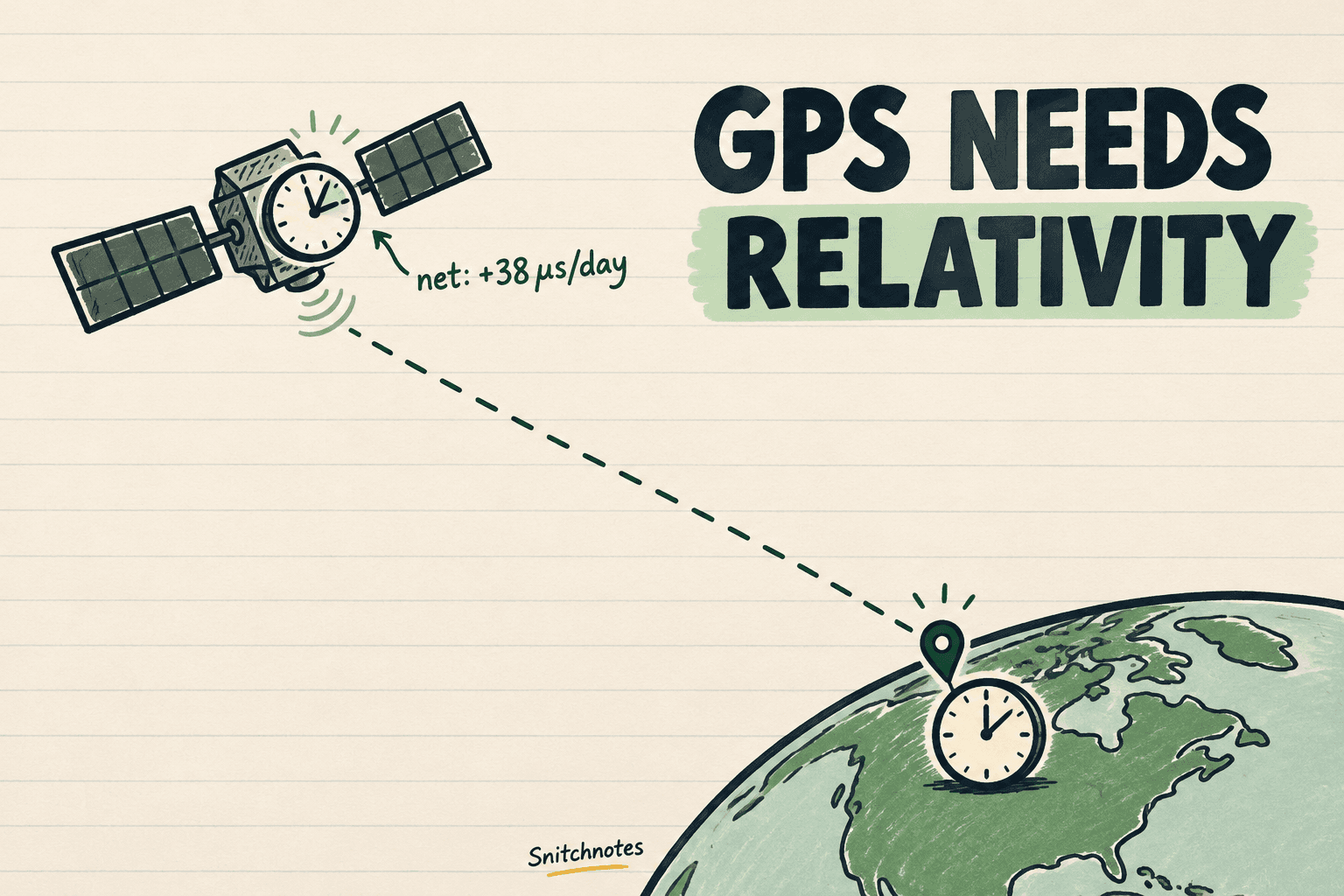
GPS uses relativity by correcting for two changes in satellite clock rates. A satellite’s speed makes its atomic clock run about 7 microseconds per day slower, while the weaker gravity high above Earth makes it run about 45 microseconds per day faster. The combined result is about 38 microseconds per day faster than clocks on Earth, so the system builds that difference into its timing and applies smaller clock corrections during operation.
That tiny number matters because GPS finds distance from a radio signal’s travel time. Light covers almost 300 meters in one microsecond. Without relativistic corrections, a clock error would quickly become a large ranging error rather than a harmless physics curiosity.
Why GPS is really a clock system
Each GPS satellite broadcasts a precisely timed signal plus information about its orbit. Your receiver compares when the signal was transmitted with when it arrived. Multiplying that travel time by the speed of light gives a distance-like measurement called a pseudorange. Measurements from at least four satellites let the receiver solve for three position coordinates and its own clock offset.
The receiver in a phone does not need its own atomic clock. The fourth unknown in the navigation equations corrects its much less accurate clock. Even so, the satellite clocks and the time scale behind them must remain extraordinarily consistent. GPS.gov reports that specialized GPS time-transfer equipment can stay within 30 nanoseconds of the U.S. Naval Observatory’s realization of Coordinated Universal Time 95 percent of the time.
Special relativity slows the satellite clock
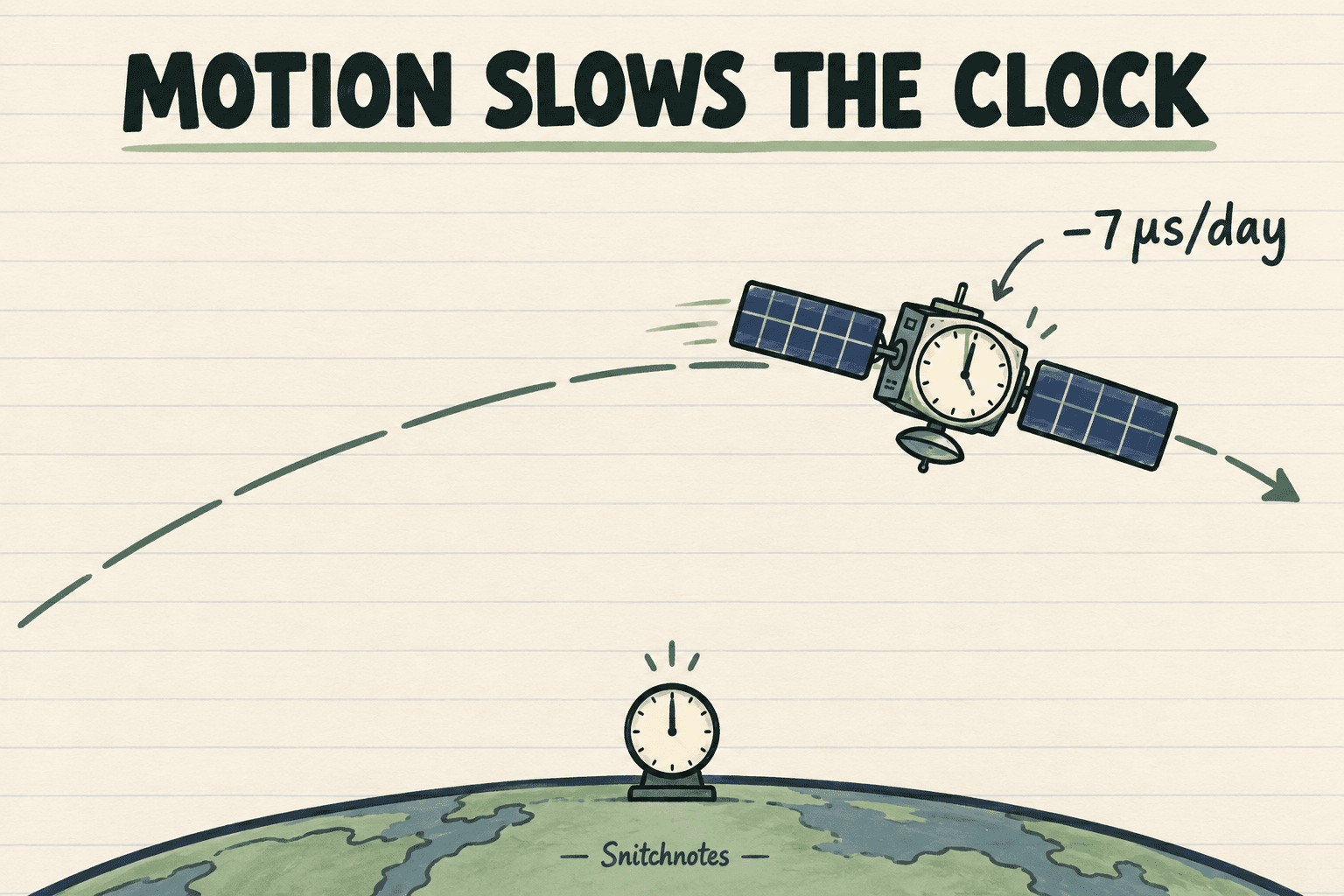
Special relativity says that a moving clock ticks more slowly than a clock at rest in the chosen reference frame. GPS satellites race around Earth, so from an Earth-centered comparison their onboard atomic clocks lose about 7 microseconds per day relative to clocks on the ground. This is velocity time dilation: more speed means slightly less elapsed time on the moving clock.
The effect is far too small to notice on a wristwatch. GPS, however, converts fractions of a second into distances by multiplying by the speed of light. At that scale, a few microseconds are enormous.
General relativity speeds the satellite clock
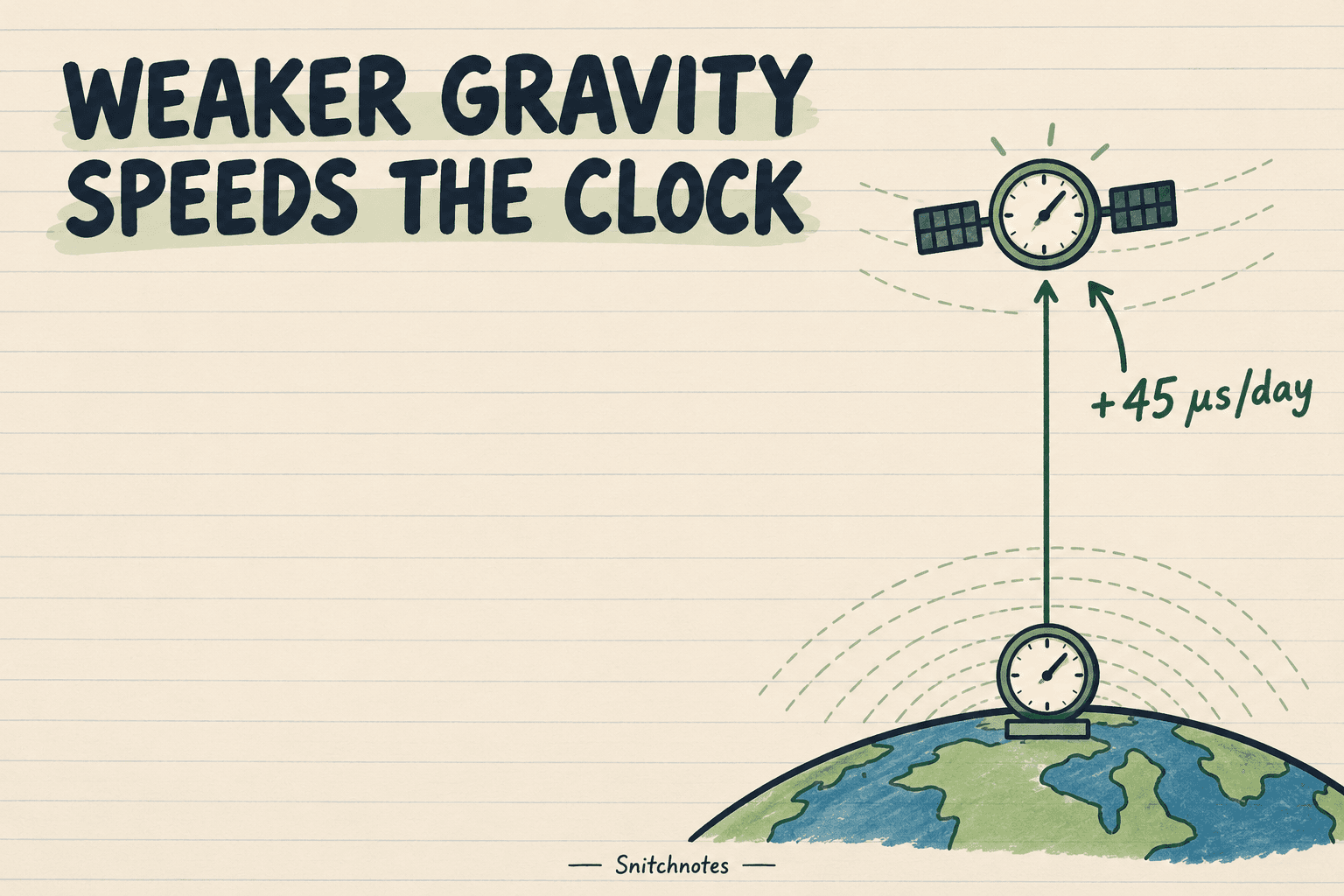
General relativity says gravity also changes the rate at which clocks tick. Clocks deeper in a gravitational field run more slowly. A GPS satellite is far above Earth’s surface, where Earth’s gravity is weaker, so its clock runs faster than an otherwise identical clock on the ground. For a GPS orbit, this gain is about 45 microseconds per day.
This gravitational effect is larger than the motion effect and points in the opposite direction. That is the crucial detail: the two effects partly cancel, but they do not cancel completely.
One day with two synchronized clocks
Imagine synchronizing two ideal clocks at midnight. One stays on Earth and the other operates aboard a GPS satellite. After 24 hours, motion has pushed the satellite clock about 7 microseconds behind, while weaker gravity has pulled it about 45 microseconds ahead. Combine the signs: plus 45 minus 7 equals a net gain of about 38 microseconds for the satellite clock.
Now translate time into distance. Using 299,792,458 meters per second for the speed of light, 38 microseconds corresponds to about 11,392 meters, or 11.4 kilometers, of one-way signal travel. After only one hour, the same uncorrected rate difference would already equal roughly 475 meters of signal travel. These are range equivalents; the exact position error would also depend on which satellites are visible and their geometry.
How GPS applies the correction
GPS engineers do not wait for clocks to drift and then hope to subtract a neat 38-microsecond total at the end of each day. The dominant offset is anticipated in the satellite clock frequency so that, once the clock is in its intended orbit, it keeps GPS time at the required rate. Ground monitoring also estimates satellite clock behavior and sends updated correction parameters for broadcast in the navigation message.
Receivers use those parameters and account for smaller orbit-dependent relativistic changes, including the periodic variation associated with a satellite’s not-perfectly-circular orbit. In other words, relativity is not an optional patch added to a finished navigation system. It is part of the definition, synchronization, broadcast data, and receiver calculations that make GPS work.
A common misconception: the two effects cancel
It is tempting to remember only that speed slows clocks and weaker gravity speeds them, then assume the result is zero. The numbers show otherwise: 45 microseconds ahead from gravity is larger than 7 microseconds behind from motion. The net rate is therefore about 38 microseconds ahead per day.
Another boundary matters too. Relativity is essential, but it is not the only source of GPS error. Satellite geometry, signal reflections, buildings, the ionosphere, the troposphere, receiver quality, and orbital prediction errors also affect a position fix. Correcting relativity makes accurate GPS possible; it does not make every phone location perfect.
Check your understanding
Which effect is larger for GPS clocks?
The general-relativity effect is larger. Weaker gravity speeds the satellite clock by about 45 microseconds per day, outweighing the roughly 7-microsecond daily slowdown from motion.
Why can a microsecond matter to navigation?
GPS turns signal travel time into distance. In one microsecond, light travels about 300 meters, so a tiny timing error can create a large ranging error.
Does your phone need an atomic clock?
No. Signals from at least four satellites let the receiver solve for its three-dimensional position and its own clock offset together.
If your physics notes turn time dilation into a blur of signs and reference frames, Snitchnotes can turn your lectures, slides, and PDFs into clearer notes, flashcards, quizzes, and audio for review.
Related concepts
- Time dilation: elapsed time depends on relative motion and gravitational potential, not on one universal clock shared everywhere.
- Trilateration: finding a position from measured distances rather than from measured angles.
- Why stars twinkle but planets do not: another everyday result of physics acting on signals that reach us.
- How QR codes work when damaged: how engineered redundancy keeps a real-world information system reliable.
Sources
National Institute of Standards and Technology: Putting Einstein to the Test
National Institute of Standards and Technology: Global Positioning System Receivers and Relativity
Convierte tus clases en material listo para el examen.
Apuntes, quizzes, podcasts, flashcards y chat — con una sola subida.
Prueba tu primer apunte gratis