
Snitchnotes Team
How to Find Evidence for a Literature Essay Without Rereading Everything
How to Find Evidence for a Literature Essay Without Rereading Everything
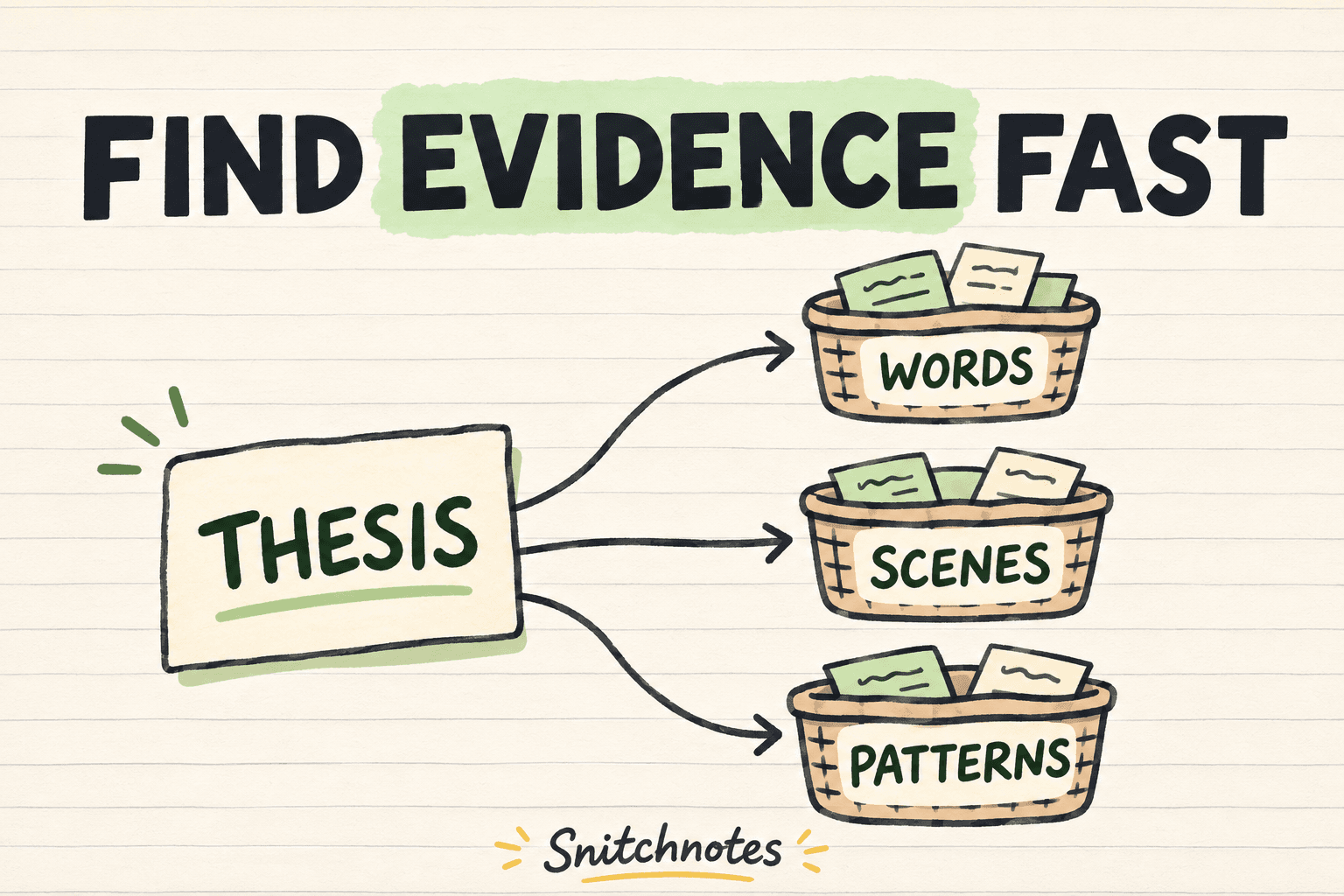
To find evidence for a literature essay without rereading the whole text, begin with the claim you need to prove. Break that claim into two or three evidence categories, turn each category into searchable words, images, actions, characters, and likely scenes, then reopen only the passages that match. Finally, test every candidate: does it prove this claim, and can you explain how? This claim-to-evidence index replaces random quote hunting with a short, directed search.
This matters because evidence is not simply a sentence that sounds important. The University of North Carolina Writing Center notes that a passage becomes evidence through its connection to a larger claim. Harvard’s College Writing Center similarly separates a strong paragraph into a topic sentence, evidence, and analysis. Finding the quotation is therefore only half the job; you need a passage that gives your analysis something precise to do.
Build a claim-to-evidence index
Write one provisional claim for each body paragraph. Under each claim, create three small columns: evidence category, search cues, and location. A category describes what kind of proof would count. Search cues are concrete features you might spot in the text. Location records a scene, chapter, page range, or moment from your notes.
- State the paragraph claim as one arguable sentence, not a broad topic.
- Name two or three things the reader would need to see for that claim to be believable.
- List search cues: repeated words, images, actions, relationships, settings, and turning points.
- Scan your annotations, chapter summaries, scene list, index, or a searchable edition for those cues.
- Record the best candidates with enough context and location information to return to them.
Search by meaning as well as by exact words. A character’s isolation may appear through secrecy, silence, sleeplessness, an empty stage, a broken conversation, or other characters leaving. If you search only for the word isolated, you may miss the strongest evidence because literary texts often show an idea instead of naming it.
Worked example: ambition isolates Macbeth
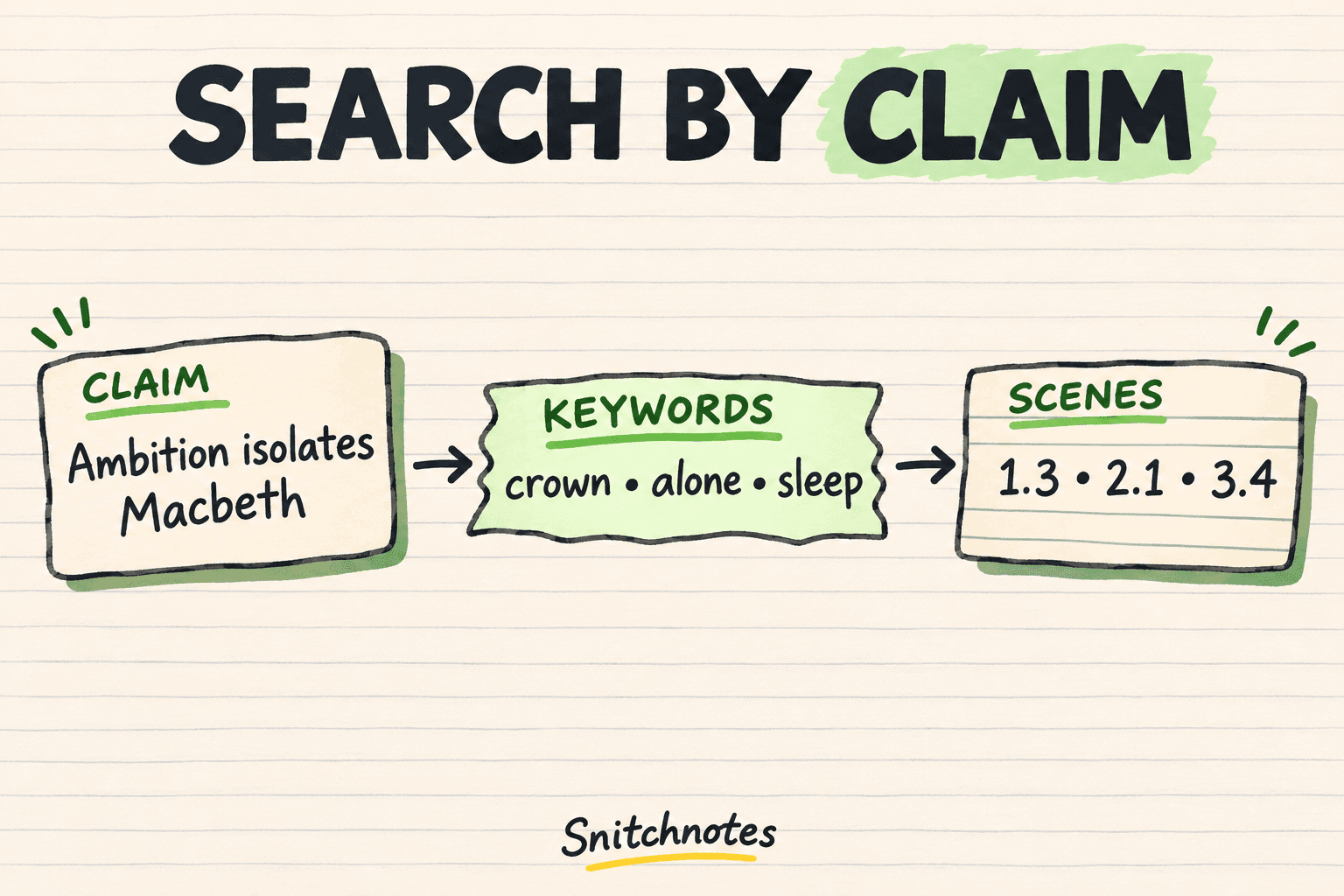
Suppose your thesis argues that ambition gradually isolates Macbeth. Turn that idea into three evidence categories: Macbeth divided from his earlier sense of self, Macbeth withholding plans from Lady Macbeth, and Macbeth separated from the nobles he rules. Now give each category search cues. For self-division, try deed, sleep, thoughts, fear, and blood. For relationships, scan moments of secrecy or commands to stay uninvolved. For public isolation, check the banquet, the ghost, desertion, and the final battle.
Next, use scene notes to shortlist places rather than reading from Act 1 onward. Act 1, Scene 3 introduces the prophecy that activates Macbeth’s ambition. Act 2, Scene 2 shows his response immediately after Duncan’s murder. Act 3, Scene 4 turns the banquet into a public breakdown. Later scenes show his shrinking circle of trust. Reopen those moments, read enough lines before and after each candidate to understand its speaker and situation, and note what changes across the sequence.
This sequence is more useful than collecting five quotations that all say roughly the same thing. It lets the paragraph or essay demonstrate development: temptation, private rupture, public rupture, and consequence. Purdue University’s Online Writing Lab recommends generating possible evidence and then limiting the final selection to the most illustrative examples, especially major scenes and turning points.
Choose evidence that proves the exact claim
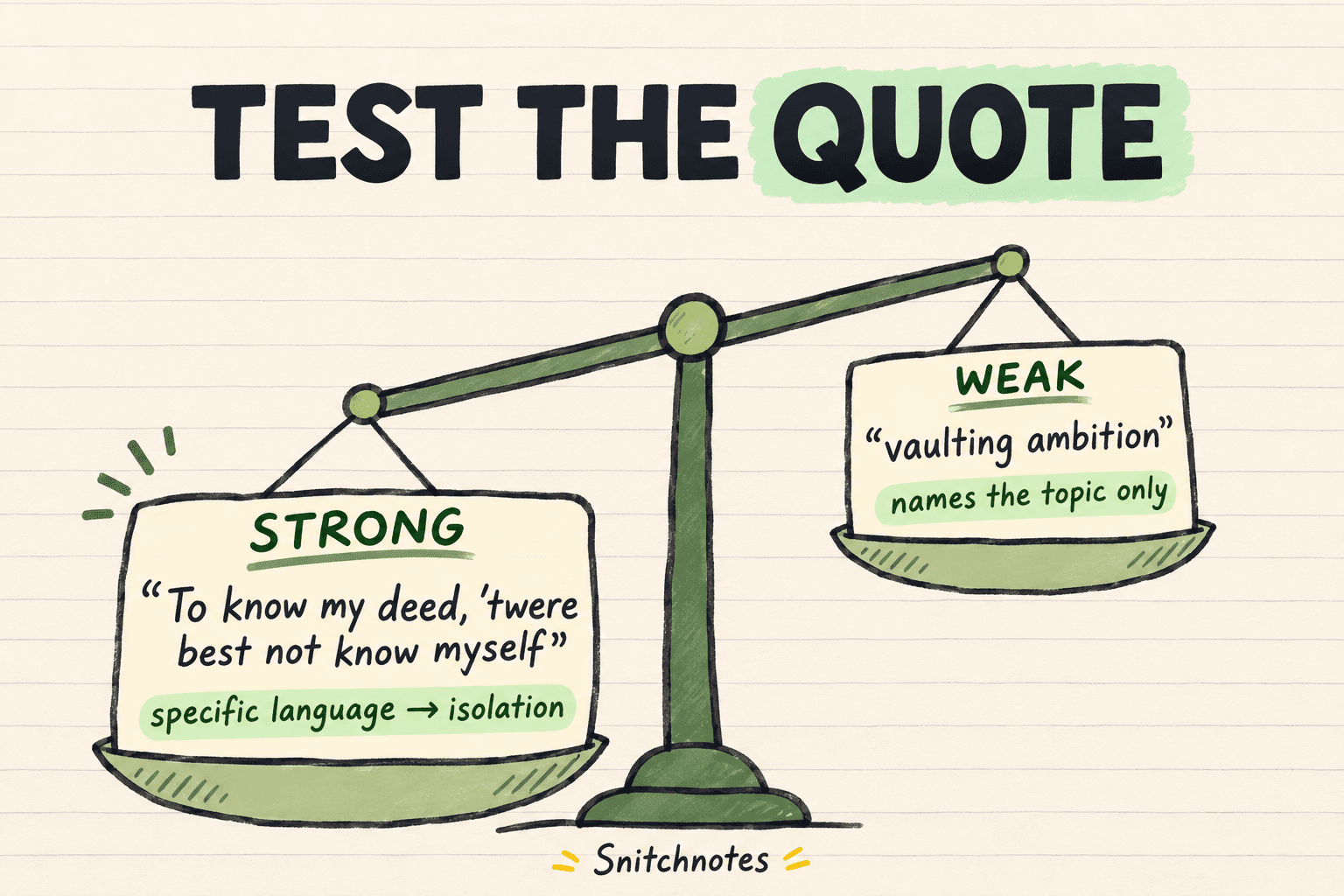
Compare two candidates. In Act 1, Scene 7, the phrase “vaulting ambition” directly names Macbeth’s motive. It is excellent evidence for a claim about how he understands ambition, but it does not by itself prove that ambition isolates him. In Act 2, Scene 2, after Duncan’s murder, Macbeth says, “To know my deed ’twere best not know myself.” For an isolation claim, this is stronger because the language splits Macbeth from his own identity.
Use a four-part test before keeping a passage. Relevance: does it prove this paragraph’s claim? Specificity: is there a word, image, contrast, or action you can analyze? Context: can you explain who speaks, when, and why? Distinctiveness: does it add something your other evidence does not? A short quotation with one revealing verb can be more useful than a dramatic speech that merely shares the topic.
Do not stop at the quotation. Introduce it, cite it using the system required by your course, and follow it with analysis. Ask what the wording implies, how the passage changes the reader’s view, and why it supports the claim. UNC warns against quotations that are dropped into a paper without introduction or follow-up; Harvard makes the same principle practical by treating analysis as a separate, necessary part of the paragraph.
What if the text is not searchable?
Use the structure around the text. Scan chapter titles, scene headings, an index, sticky notes, marginal marks, lecture slides, and any reading log you made. Skim the first and last lines of likely sections, then slow down near turning points. If the book is still unfamiliar, targeted rereading is necessary; the goal is to avoid starting blindly at page one, not to replace close reading with a keyword search.
Keep a small evidence bank as you read: location, short quotation or paraphrase, category, and one sentence explaining possible significance. If your course material is spread across notes, slides, and PDFs, Snitchnotes can turn those files into structured study notes, quizzes, and flashcards that make the next evidence search easier.
Common mistakes and boundaries
- Searching the topic instead of the claim: ambition is broad; ambition isolates Macbeth tells you what relationship to prove.
- Choosing the most famous line: familiarity does not guarantee relevance.
- Ignoring context: a line spoken sarcastically, hypothetically, or by another character may not mean what your clipped note suggests.
- Collecting without analyzing: quotations do not make the argumentative connection for the reader.
Assignment rules still come first. Some essays require only the primary text; others expect scholarly secondary sources. Confirm the permitted editions, citation style, and whether paraphrase counts as textual evidence. Efficient searching helps you locate passages, but it does not excuse inaccurate quotation, missing citations, or reading a scene out of context.
Check your understanding
Why should you begin with a claim rather than a keyword?
A claim defines the relationship you must prove. It produces several useful search cues and gives you a standard for rejecting passages that merely mention the general topic.
Why is “vaulting ambition” weak evidence for an isolation paragraph?
The phrase identifies Macbeth’s motive, but it does not itself show separation from another person, society, or his own identity. It may support a different claim very well.
When should you reread a full section?
Reread when the context is unclear, the passage marks a major turning point, or your interpretation depends on tone, sequence, or a pattern that extends beyond a few lines.
Related concepts
- How to review a marked essay before your next assignment
- Primary vs secondary sources: examples for students
- Close reading: explain how diction, imagery, syntax, and form create meaning in a short passage.
Sources
Harvard College Writing Center: Anatomy of a Body Paragraph
University of North Carolina Writing Center: Evidence
Purdue Online Writing Lab: Pre-writing Activities and Drafting Your Essay
Convierte tus clases en material listo para el examen.
Apuntes, quizzes, podcasts, flashcards y chat — con una sola subida.
Prueba tu primer apunte gratis