
Snitchnotes Team
Civil Law vs Criminal Law: Key Differences and Examples
Civil Law vs Criminal Law: Key Differences and Examples
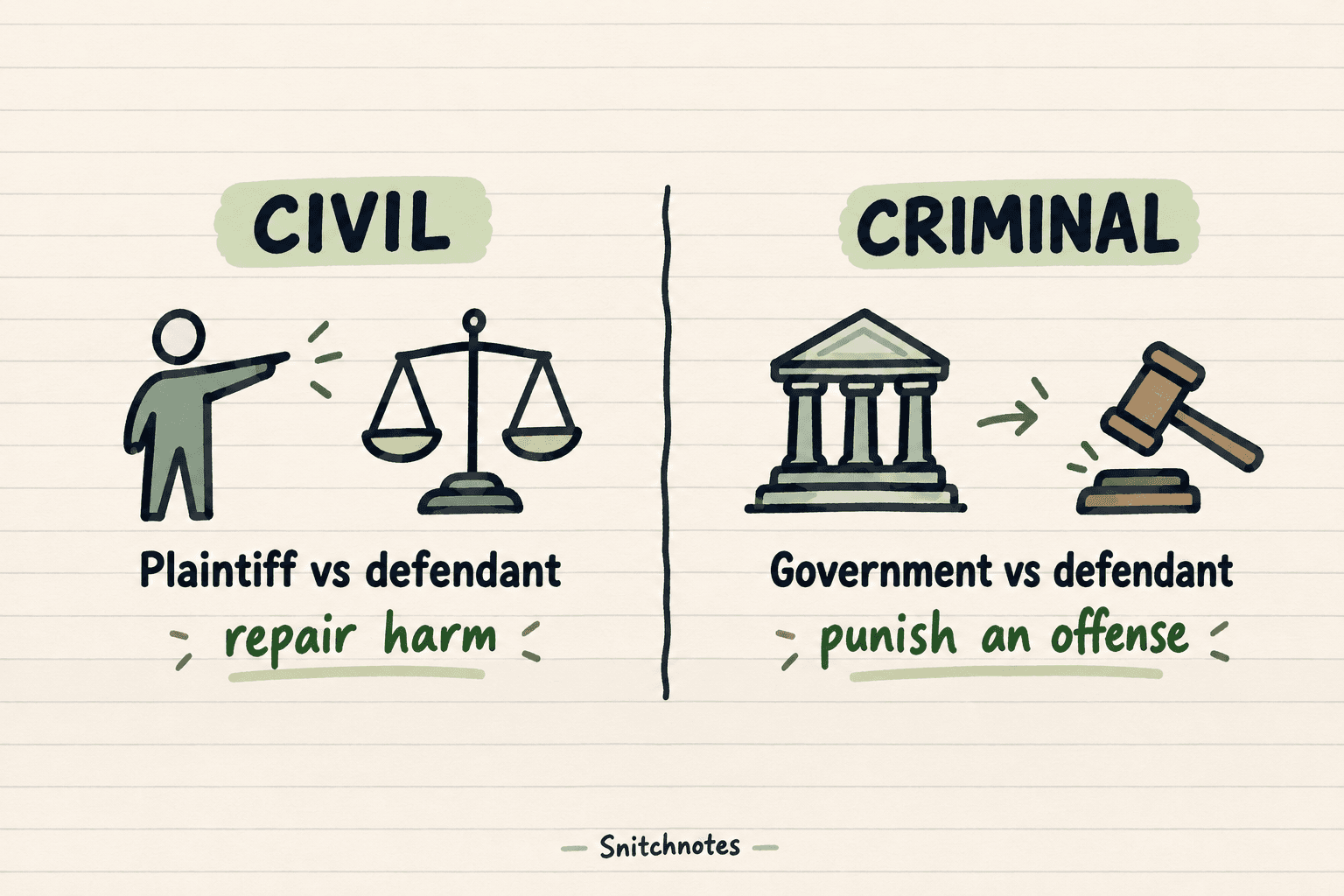
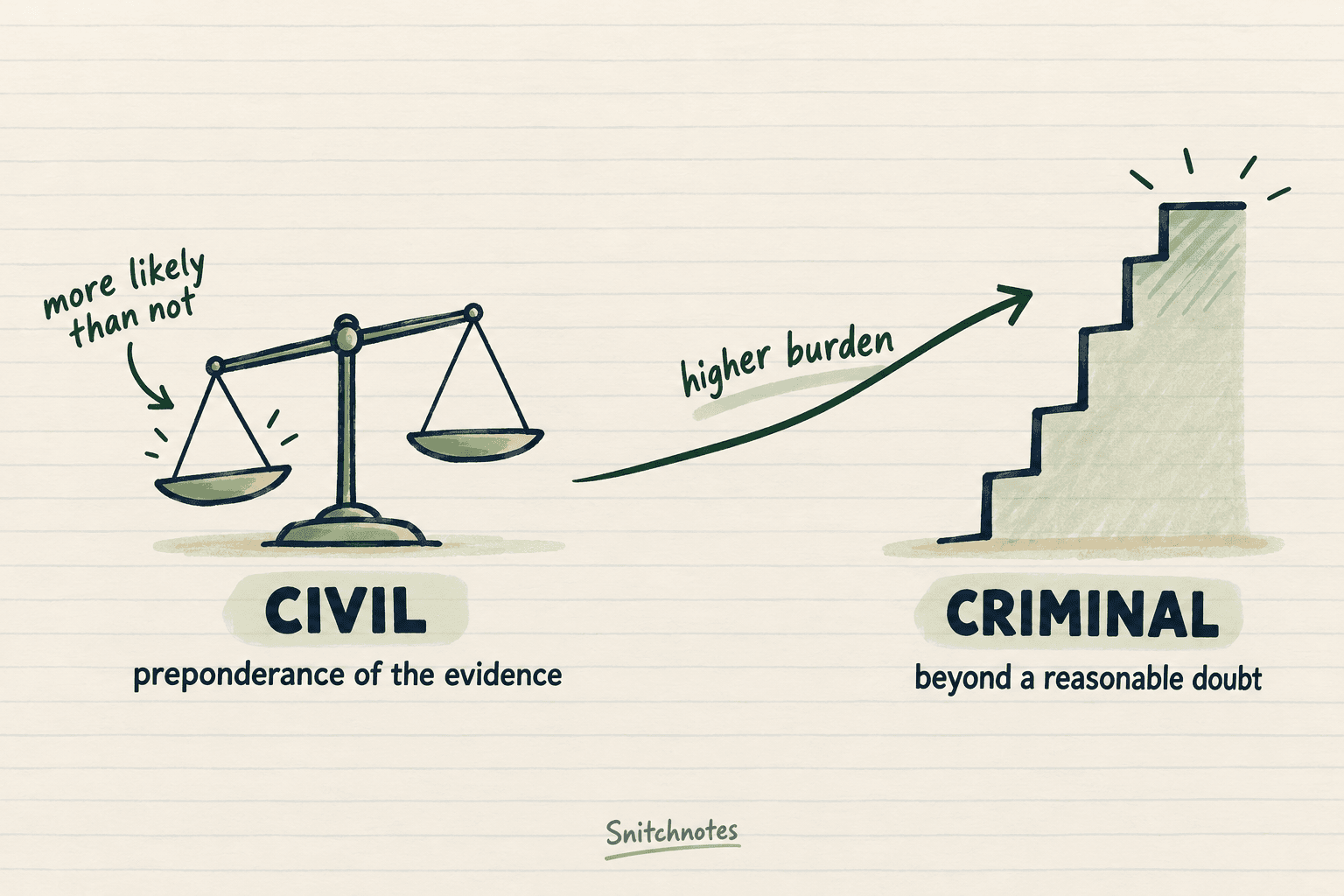
Civil law resolves disputes and provides remedies for legal wrongs, usually between private parties. Criminal law deals with conduct defined as an offense against the public, and the government prosecutes the accused. Civil plaintiffs usually must prove their claim by a preponderance of the evidence; criminal prosecutors must prove every element of the charged crime beyond a reasonable doubt.
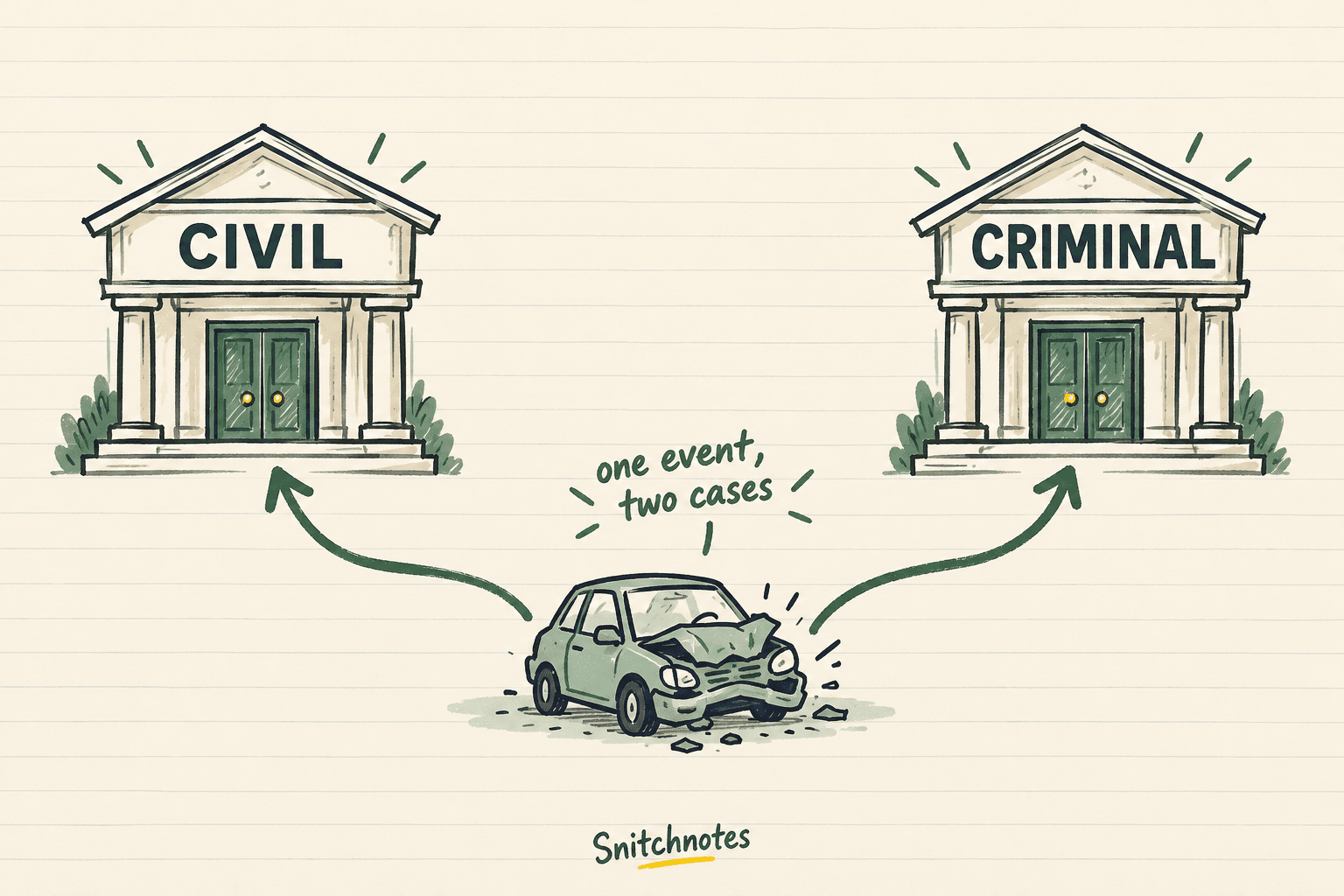
That difference affects who starts the case, why it exists, what the court can order, and how hard the facts must be proved. One action can also produce both kinds of case. A reckless-driving collision, for example, may lead to a government prosecution and a separate lawsuit by an injured person.
Civil law vs criminal law at a glance
In a civil case, the person or organization bringing the claim is the plaintiff, and the person or organization responding is the defendant. The plaintiff asks the court for a remedy. Money damages are common, but a court may also issue an injunction ordering someone to do or stop doing something, or make another civil order authorized by law.
In a criminal case, a public prosecutor brings charges on behalf of the government. The accused person is the defendant. The case asks whether the defendant committed a crime defined by statute. A conviction can lead to punishment such as a fine, probation, or imprisonment, depending on the offense and the jurisdiction.
- Who brings it: a civil plaintiff versus a government prosecutor.
- Main purpose: remedy a legal injury or enforce a right versus punish and deter criminal conduct.
- Typical trial result: liable or not liable versus guilty or not guilty.
- Usual proof standard: preponderance of the evidence versus beyond a reasonable doubt.
One reckless-driving collision, two legal paths
Imagine a driver races through a red light and hits another car. The injured driver has $18,000 in medical bills and repair costs in this hypothetical. Police investigate, and a prosecutor decides whether the evidence supports a criminal charge under the applicable traffic or criminal law. Separately, the injured driver may sue for compensation.
The criminal path
The case might be captioned State v. Driver because the state, not the injured motorist, prosecutes. The prosecutor must prove the charged offense beyond a reasonable doubt. If the defendant is convicted, the judge imposes a sentence permitted by law. The victim may provide evidence and have statutory rights, but does not personally control the prosecution in the way a civil plaintiff controls a lawsuit.
The civil path
The injured driver can file a negligence claim against the other driver. Here the central question is not whether the defendant committed a crime. It is whether the defendant breached a civil duty and caused compensable harm. If the plaintiff proves the required elements, the court may award damages for proven losses. The exact claims, defenses, and recoverable damages depend on local law.
The two cases can use evidence from the same event, such as witness testimony, photographs, or vehicle data, while asking different legal questions. They can also end differently. Because the criminal burden is higher, a failure to prove guilt beyond a reasonable doubt does not automatically mean a civil plaintiff cannot prove liability under the lower civil standard. Procedural details and the effect of earlier findings vary, so real cases require jurisdiction-specific legal advice.
The standards of proof are different
Most civil claims use the preponderance-of-the-evidence standard. In plain language, the factfinder must decide that the plaintiff's version of a disputed fact is more likely true than not true. People sometimes call this a 51 percent standard, but courts do not normally calculate evidence with a literal probability meter. The useful image is a scale tipping, even slightly, toward one side.
In a criminal trial, the government must prove each element of the offense beyond a reasonable doubt. The defendant is presumed innocent and does not have to prove innocence. This burden is deliberately much higher because criminal conviction can take away liberty and carries the moral judgment of guilt. Beyond a reasonable doubt does not mean proof beyond every imaginable doubt or absolute certainty.
Some civil matters use a different standard, such as clear and convincing evidence, for particular issues. That is why preponderance versus reasonable doubt is the core comparison, not a rule without exceptions. Always check the governing law and the particular claim.
Common misconceptions and boundaries
- A civil case is not simply a less serious criminal case. It has a different plaintiff, purpose, procedure, burden, and range of remedies.
- The same lawyer does not bring both cases. A prosecutor represents the government; a civil plaintiff usually hires or is represented by a civil lawyer.
- Not every harmful act is a crime, and not every crime produces a successful civil claim. Each case needs the elements required by its own law.
- In comparative law, civil law can also mean a legal system based primarily on codes, contrasted with common law. This article uses the common U.S. classroom meaning: noncriminal law versus criminal law.
Check your understanding
A shop owner sues a contractor for the cost of repairing a leaking roof. Civil or criminal?
Civil. The owner is a plaintiff seeking a remedy from a defendant for an alleged legal wrong. Unless the government separately alleges a crime, this is a private dispute.
A state charges someone with arson, while the building owner sues for the loss. Can both proceed?
Potentially yes. The prosecution asks whether the state can prove the crime beyond a reasonable doubt. The lawsuit asks whether the owner can prove civil liability and damages under the applicable civil standard.
If legal comparisons blur together in your class notes, Snitchnotes can turn your own lectures, readings, and PDFs into structured notes, flashcards, and practice questions for testing the distinction.
Related concepts
- Judicial review: how courts examine whether government action is consistent with a constitution or other controlling law.
- Primary versus secondary sources: how to distinguish original legal evidence and documents from later explanation or analysis.
- Burden of proof: which party must establish a fact and how persuasive the evidence must be.
- Remedies and sentences: civil courts repair or prevent legal harm; criminal courts impose punishment authorized by law.
Sources
United States Courts: Civil Cases
Convierte tus clases en material listo para el examen.
Apuntes, quizzes, podcasts, flashcards y chat — con una sola subida.
Prueba tu primer apunte gratis