
Snitchnotes Team
How to Study Metabolic Pathways With Input-Output Maps
How to Study Metabolic Pathways With Input-Output Maps
To study metabolic pathways, learn each pathway first as an input-output map: what it accomplishes, what enters, what leaves, where it happens, what regulates it, and what it connects to. Only then add individual enzymes and intermediates. This gives every detail an address instead of turning glycolysis, the citric acid cycle, or fatty-acid metabolism into a floating list of names.
This method is for biology, biochemistry, nursing, and medical students who can recognize a pathway diagram but struggle to reconstruct or explain it without looking. You will build one six-field map, use glycolysis as a concrete example, and then practice the map through retrieval rather than repeated rereading.
Why pathway maps work better than isolated enzyme lists
Metabolism is a connected system. Stanford Medicine's Pathways of Human Metabolism map was designed to show the relationships among metabolites, enzymes, cofactors, health, and disease. If you memorize ten enzymes without knowing the job of the pathway or its neighboring routes, you lose the structure that makes those ten names meaningful.
A useful map is not a substitute for detail. It is the scaffold that tells you where detail belongs. Think of it like learning a city's districts and main roads before trying to memorize every street address. Once the large route is stable, enzyme names, reversible steps, cofactors, and clinical exceptions have somewhere to attach.
Build a six-field pathway map
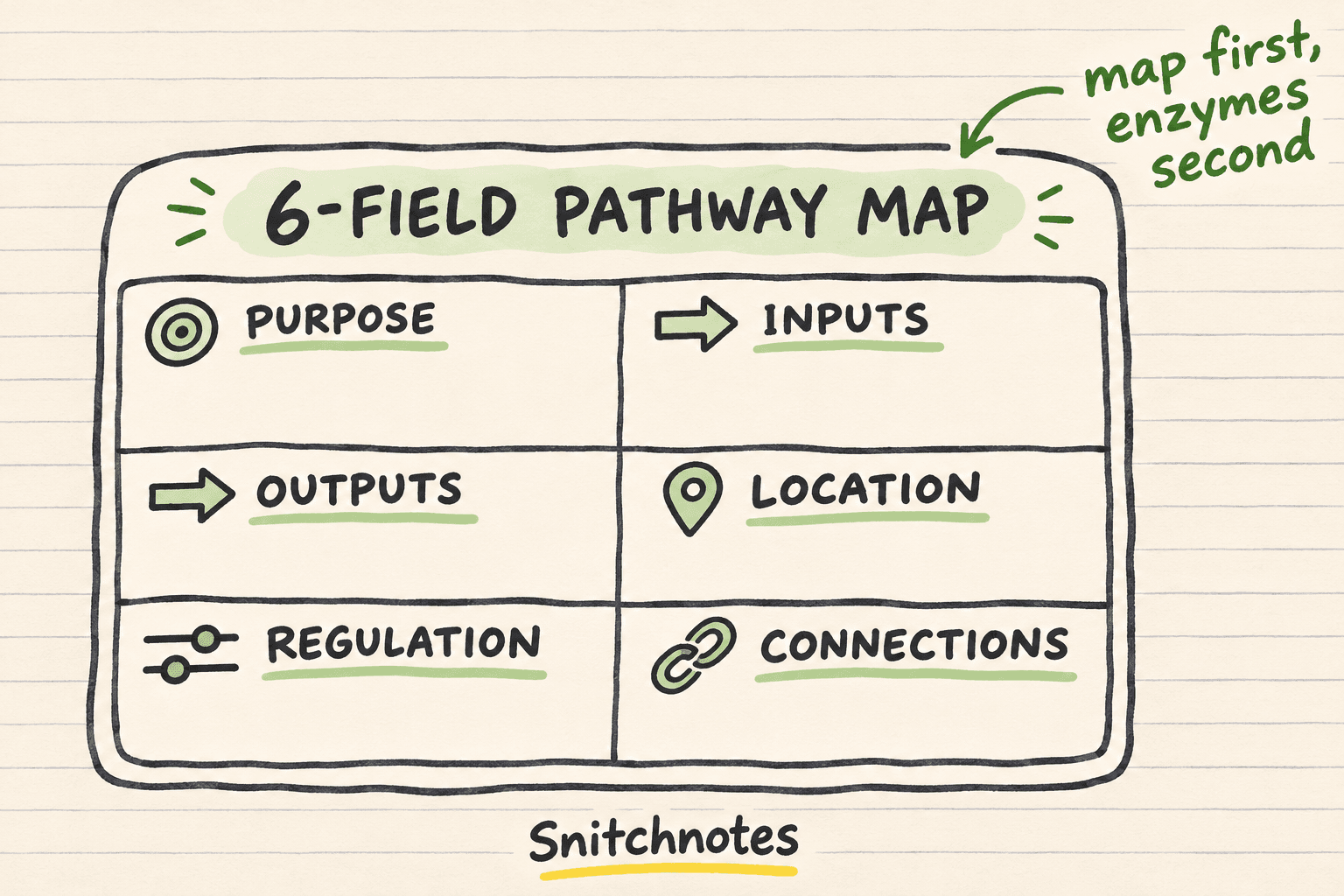
Give every pathway one card or one uncluttered page. Fill six fields in plain language before copying a textbook diagram. If you cannot complete a field, that is a useful signal: it shows exactly what to ask in class or verify in a trusted source.
- Purpose: write the pathway's main job in one sentence. Is it breaking down fuel, storing energy, producing a precursor, or disposing of a product?
- Inputs: list the starting carbon molecule plus important energy or electron carriers that are consumed.
- Outputs: separate gross production from net gain when the distinction matters. Include carbon products, ATP equivalents, and reduced carriers such as NADH.
- Location: name the cell compartment and, when relevant, the tissue or physiological condition.
- Regulation: identify the major control points and what signals speed the route up or slow it down.
- Connections: draw where the inputs came from and where the outputs can go next.
Worked example: map glycolysis before memorizing its enzymes
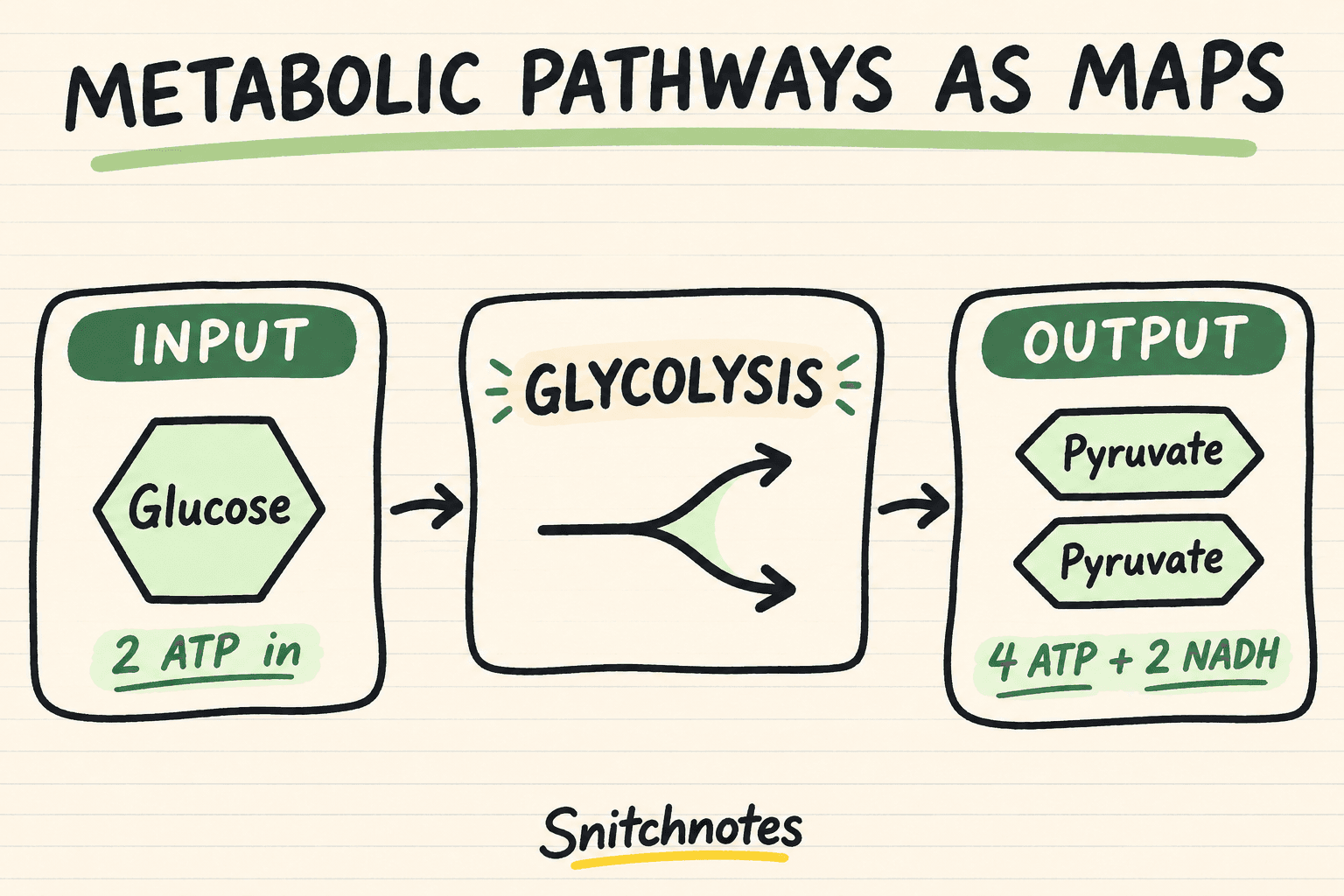
Start with purpose: glycolysis breaks one six-carbon glucose into two three-carbon pyruvate molecules while capturing some energy. OpenStax places glycolysis in the cytoplasm of both prokaryotic and eukaryotic cells and notes that the pathway does not use oxygen directly. That last point is precise: it does not mean every later fate of pyruvate or NADH is independent of oxygen.
Now fill the input-output box. Per glucose, the investment phase uses two ATP. The payoff phase produces four ATP and two NADH, while the carbon output is two pyruvate. Therefore, write both the gross ATP output, four, and the net ATP gain, two. Keeping gross and net on the same card prevents a very common exam error.
For regulation, begin with phosphofructokinase rather than trying to mark every enzyme as equally important. OpenStax describes phosphofructokinase as a main control point: abundant ATP or citrate decreases its activity, while the pathway responds to the cell's energy state. You can later add hexokinase and pyruvate kinase as other regulated steps, but first understand the logic: when energy is plentiful, the cell can slow glucose breakdown.
Finally, add connections. Glucose can arrive from blood glucose or stored carbohydrate; pyruvate can connect to acetyl-CoA and the citric acid cycle under aerobic conditions, or to routes that regenerate NAD+ when oxygen-dependent respiration cannot keep pace. The point is not to cram every branch onto one card. Draw only the two or three connections required by your course, then expand on a separate page.
Add enzymes in layers
Once you can explain the six fields without notes, add detail in three passes. Pass one is carbon shape: six carbons become two three-carbon molecules. Pass two is energy accounting: two ATP are invested, four are produced, and two NADH are produced. Pass three is enzyme order, with special emphasis on irreversible or regulated steps.
This layered approach also gives you smaller testable targets. Instead of asking, ‘Do I know glycolysis?’, ask, ‘Can I state its purpose and net products? Can I sketch the carbon split? Can I place phosphofructokinase at the committed control step?’ A vague feeling of familiarity becomes a set of observable answers.
Rebuild the map from memory
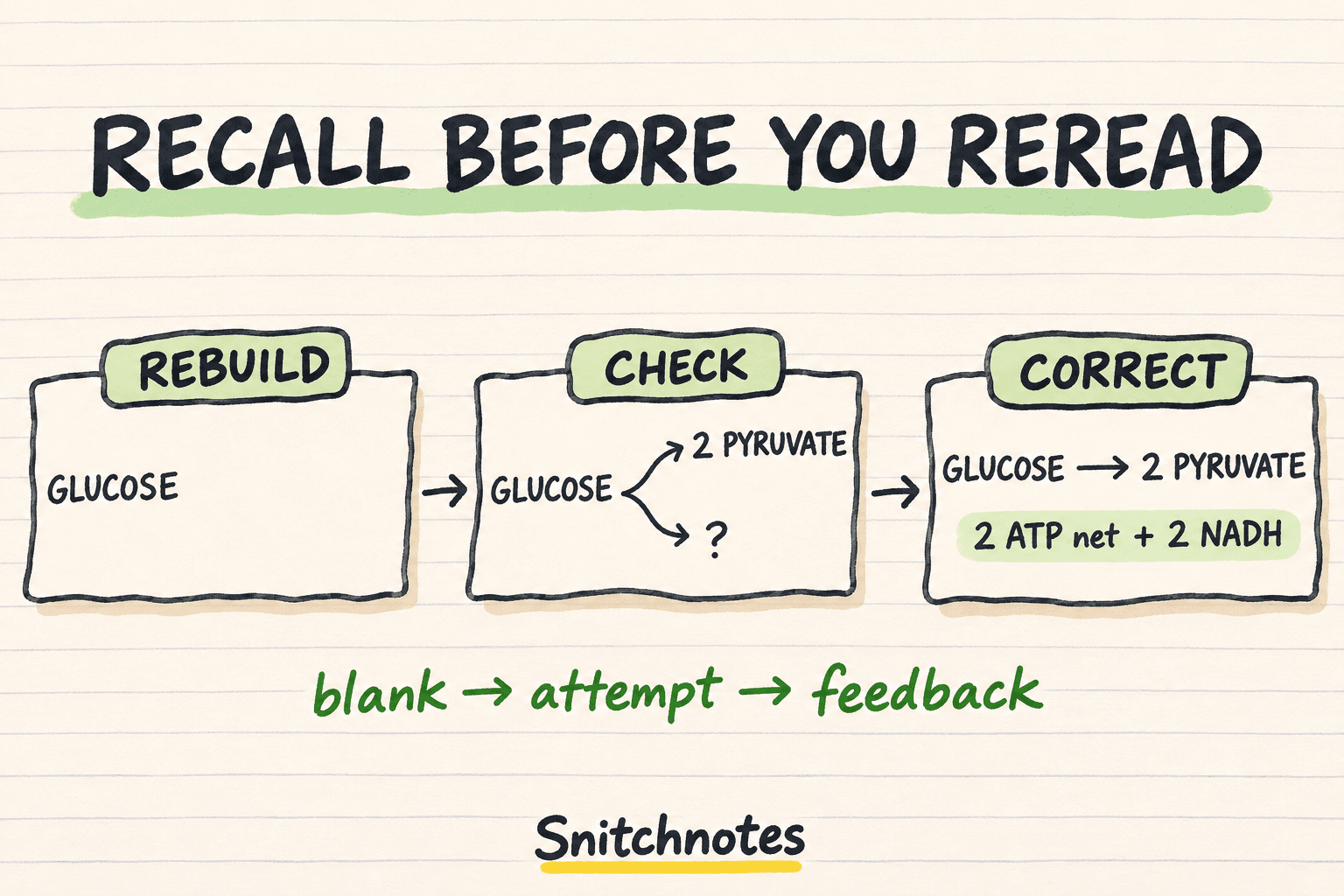
Close the book and rebuild the card from a blank page. First write the six field labels. Fill what you can, mark uncertain spots with a question mark, then compare your attempt with the source and correct it in another color. On the next round, redraw only the fields you missed plus one connecting arrow to a neighboring pathway.
The important move is attempting retrieval before rereading. In a controlled study published in Science, Jeffrey Karpicke and Janell Blunt found that retrieval practice produced stronger learning from science texts than elaborative studying with concept mapping. That does not make maps useless; it suggests that the high-value combination is a clear map plus repeated reconstruction from memory, not a beautiful map you only look at.
A practical session can be short: two minutes to rebuild the overview, two minutes to check it, and one minute to explain the pathway aloud. Repeat later with a blank page. If your notes are spread across lectures, slides, and PDFs, Snitchnotes can help turn that material into study notes, flashcards, quizzes, and audio that you can use for the same map-and-retrieve routine.
Common misconceptions and boundaries
First, an input-output summary is not the complete chemical equation. Water, protons, phosphate, and carrier balance may matter in a formal biochemical equation even when a first-pass study card emphasizes the main carbon and energy flows. Match the resolution of your map to the question your course asks.
Second, do not treat a pathway as an isolated pipe. Intermediates can feed biosynthesis, regulation depends on cellular conditions, and the same pathway may operate differently across tissues. Third, do not memorize regulation as ‘one enzyme turns the pathway on.’ Control is distributed, even when one step is especially useful as a teaching anchor.
Check your understanding
Why should you write both four ATP produced and two ATP net for glycolysis?
Because glycolysis produces four ATP in its payoff phase but spends two ATP earlier. Four is the gross production; two is the net gain per glucose.
What should you learn before the full enzyme order?
Learn the pathway's purpose, inputs, outputs, location, major regulation, and connections. Then add carbon changes, energy accounting, and enzyme order in layers.
How do you know whether you actually remember the pathway?
Rebuild the map on a blank page and explain each arrow without looking. Recognition while rereading is not the same as unaided recall.
Related concepts
- How to study the complement system without rote memorization: organize a branching biological cascade around purpose and convergence points.
- Sodium-potassium pump step by step: connect inputs, direction, energy use, and physiological purpose in one transport cycle.
- Metabolic regulation: explain how energy state, substrate availability, allosteric effectors, and hormones change pathway flow.
Sources
OpenStax, Biology 2e: 7.2 Glycolysis
OpenStax, Biology 2e: 7.7 Regulation of Cellular Respiration
Convierte tus clases en material listo para el examen.
Apuntes, quizzes, podcasts, flashcards y chat — con solo subir un archivo.
Prueba tu primer apunte gratis