
Snitchnotes Team
How to Study Historical Causation With Cause-and-Consequence Chains
How to Study Historical Causation With Cause-and-Consequence Chains
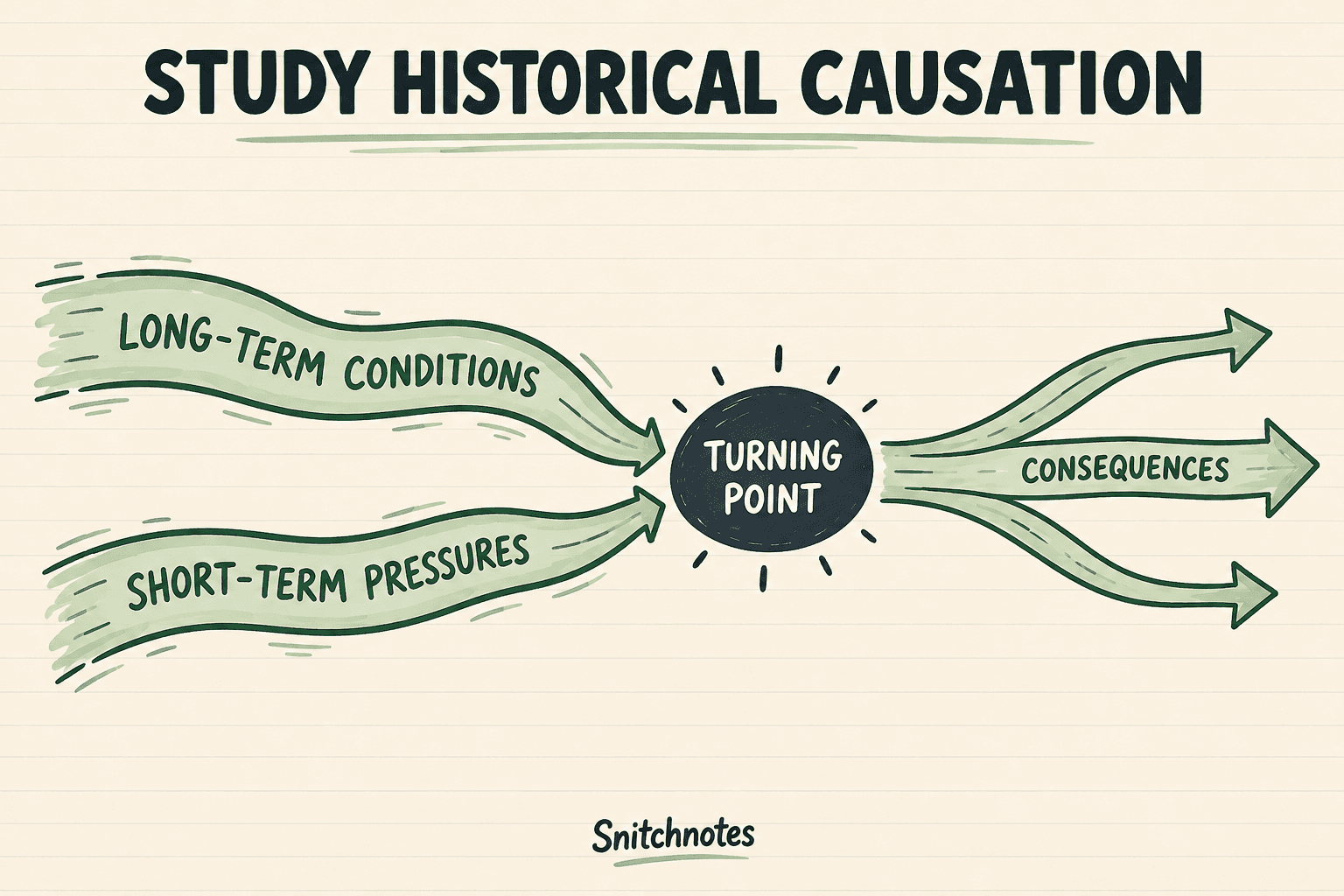
To study historical causation, sort evidence into long-term conditions, short-term pressures, triggers, and consequences; connect those factors with explanatory arrows; then rank each cause by how much it explains. A strong answer does not merely list what happened before an event. It shows how several factors interacted, which decisions changed the path, and why some causes mattered more than others.
This method is for students who know the dates but struggle to turn notes into an argument. A cause-and-consequence chain makes the reasoning visible, so you can test it before writing an essay or answering an exam question.
Why historical causation matters
Historical events rarely have one sufficient cause. The National Center for History in the Schools asks students to analyze multiple causation, including individuals, ideas, interests, beliefs, chance, and irrational action. That is different from memorizing a neat row of dominoes in which every step was inevitable.
Causal reasoning also improves essays. Instead of writing, ‘Militarism, alliances, imperialism, and nationalism caused World War I,’ you can explain what each factor changed. Did it create tension, narrow leaders’ choices, speed mobilization, widen the conflict, or trigger a particular decision? Those verbs turn labels into an explanation.
Build a cause-and-consequence chain in five steps
- Write one precise outcome. Replace a huge topic such as ‘World War I’ with a question such as ‘Why did a European war begin in July 1914?’
- Sort your notes by role. Use long-term condition, short-term pressure, trigger, escalation decision, and consequence. The same factor may play different roles in different questions.
- Draw arrows with verbs. Write ‘increased fear,’ ‘made mobilization faster,’ or ‘expanded a local conflict,’ not simply ‘led to.’
- Attach one supporting fact to every major arrow. If an arrow has no evidence, it is a guess or a reminder to research further.
- Rank the causes. Decide which had the broadest reach, the closest connection to the outcome, and the strongest evidence. Then state a qualified judgment.
Worked example: why World War I began
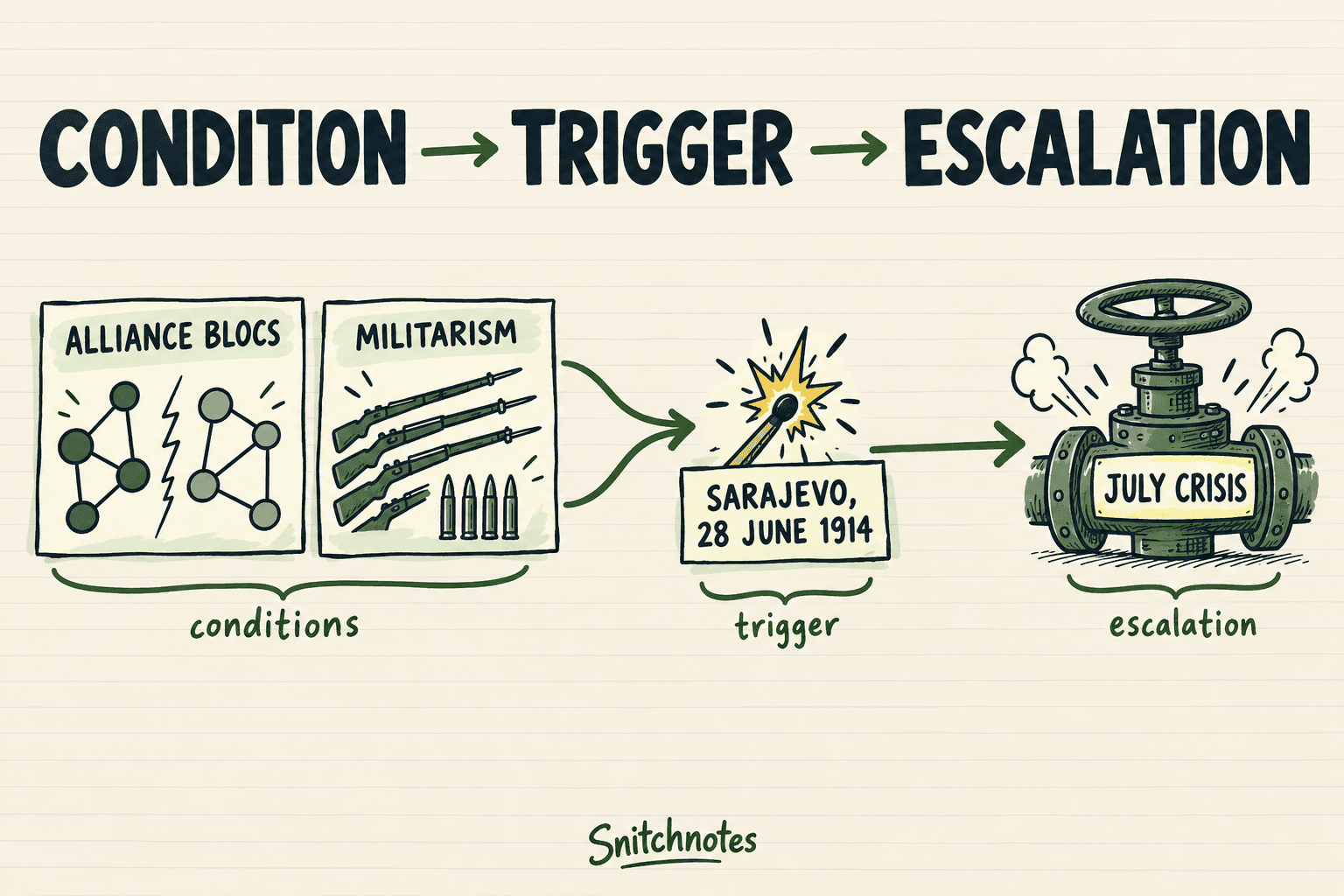
Start with conditions. By 1914, Europe had divided into rival power blocs, military forces had expanded, and imperial and nationalist competition had sharpened distrust. OpenStax notes an important boundary: these agreements were not all identical automatic war promises. Britain’s understandings with France and Russia differed from the Franco-Russian military alliance.
Next, add the trigger: on 28 June 1914, Gavrilo Princip assassinated Archduke Franz Ferdinand and his wife, Sophie, in Sarajevo. Do not jump straight from the shooting to world war. Insert the July Crisis: Austria-Hungary’s ultimatum to Serbia, declarations of war, mobilizations, and decisions by political and military leaders. The Imperial War Museums describes the war as the result of decisions made amid nationalism, militarism, imperial rivalry, and competition for power.
Your chain can therefore read: rival blocs and military planning increased fear and reduced room for delay; the assassination created an acute Austro-Serbian crisis; leaders chose escalation; alliance relationships and war plans helped widen the conflict. The Library of Congress timeline similarly distinguishes the strained prewar system from the assassination that ignited the crisis.
Rank causes instead of listing them
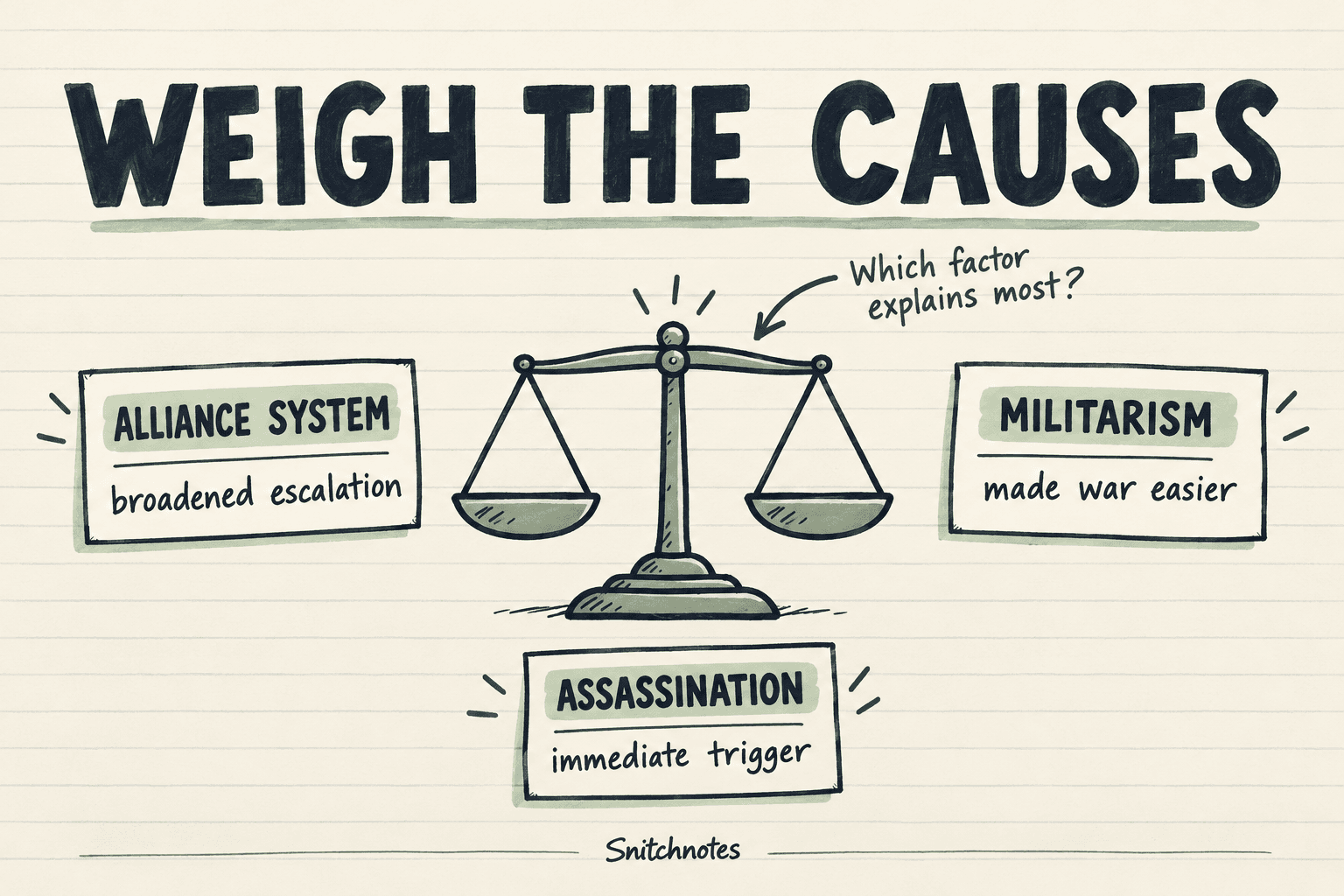
Give each candidate a short evidence card. For example: alliance system — connected crises across borders; militarism and military planning — made rapid mobilization influential; assassination — supplied the immediate trigger; July Crisis decisions — converted danger into actual war. Then ask four questions: How directly did it affect the outcome? How widely did it operate? What evidence supports the link? Would the outcome probably have happened at that time without it?
A defensible judgment might be: the assassination best explains why the crisis began when it did, while the alliance system, military planning, and leaders’ decisions better explain why the crisis spread. That answer is stronger than declaring one cause ‘most important’ without saying important for what.
Common misconceptions and boundaries
First, a trigger is not necessarily the deepest cause. A match starts a fire, but dry material and oxygen explain why it spreads. Second, sequence is not proof: because A happened before B, A did not automatically cause B. You still need a mechanism and evidence. Third, consequences can become later causes, so define the time window of your question.
Avoid inevitability language unless the evidence truly supports it. The 1914–1918 Online encyclopedia emphasizes that alliance uncertainty could encourage risky crisis management; alliances were not a machine that removed human choice. A causal chain should preserve alternatives and decisions, not erase them.
Turn the chain into an essay paragraph
Use one paragraph per causal job: claim, mechanism, evidence, and comparison. For example: ‘The assassination was the immediate trigger because it gave Austria-Hungary a reason to confront Serbia. However, it became a wider war only through the July Crisis decisions and the strategic relationships connecting the powers. The trigger explains timing; the broader conditions and choices explain scale.’
If your notes remain a pile of disconnected facts, Snitchnotes can turn lectures, slides, PDFs, and notes into clearer study notes, flashcards, quizzes, and audio that you can reorganize into causal chains.
Check your understanding
Why is ‘the assassination caused World War I’ incomplete?
It identifies the trigger but skips the mechanism of escalation. A complete answer must connect the assassination to the July Crisis decisions and explain how prewar conditions helped widen the conflict.
What should every arrow in your chain contain?
A causal verb and evidence. ‘Made leaders fear encirclement’ explains more than ‘led to war,’ while a dated treaty, mobilization order, speech, or diplomatic action gives you something testable.
How do you compare a condition with a trigger?
Ask different questions. The trigger may best explain timing; the condition may better explain vulnerability, reach, or scale. Rank factors against the exact outcome, not against a vague idea of importance.
Related concepts
- Primary vs secondary sources: choose evidence suited to the claim you are testing.
- How to analyze primary sources like a historian: test authorship, context, purpose, and corroboration.
- Counterfactual reasoning: change one plausible condition to test how necessary it was, without turning the exercise into unrestricted alternate history.
Sources
Library of Congress: Echoes of the Great War — Timeline
OpenStax: World History Volume 2 — Alliances, Expansion, and Conflict
Imperial War Museums: How the World Went to War in 1914
1914–1918 Online International Encyclopedia of the First World War: Alliance System 1914
Convierte tus clases en material listo para el examen.
Apuntes, quizzes, podcasts, flashcards y chat — con solo subir un archivo.
Prueba tu primer apunte gratis