
Snitchnotes Team
How to Study for Back-to-Back Exams Without Burning Out
How to Study for Back-to-Back Exams Without Burning Out
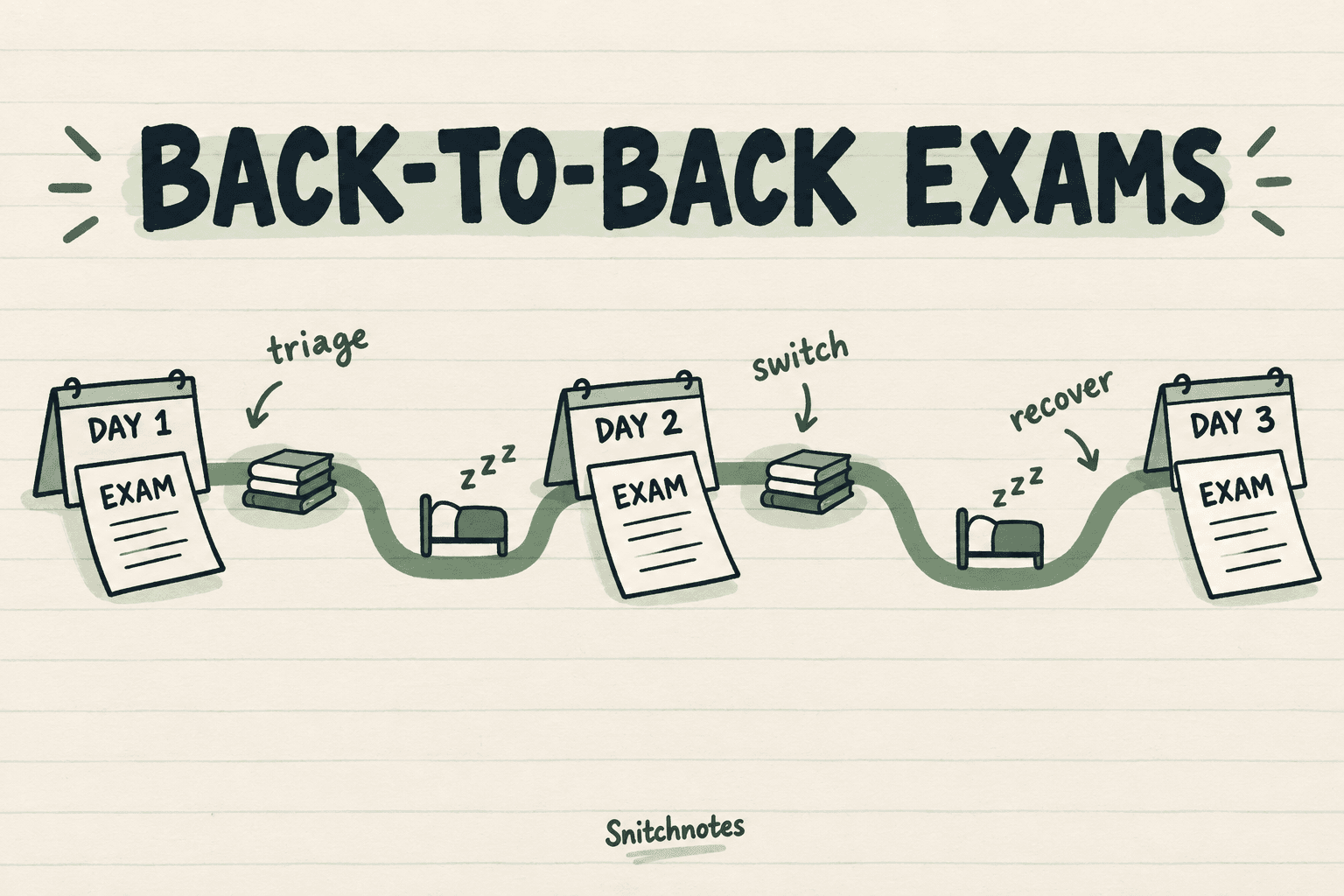
To study for back-to-back exams, rank every exam by date, grade weight, and your current readiness; give the first blocks to the earliest high-impact weak areas; then rotate through the other subjects so none disappears from your schedule. Use short, active sessions built around recall and practice, and treat meals, movement, and sleep as fixed parts of the plan—not rewards you earn after studying.
This approach matters because several exams close together create two problems at once: limited time and rapid context switching. Trying to study everything equally usually wastes the first; studying one subject until you are exhausted makes the second harder. A triage-and-recovery plan gives each hour a job while keeping enough energy for the final exam, not just the first one.
Step 1: Triage every exam
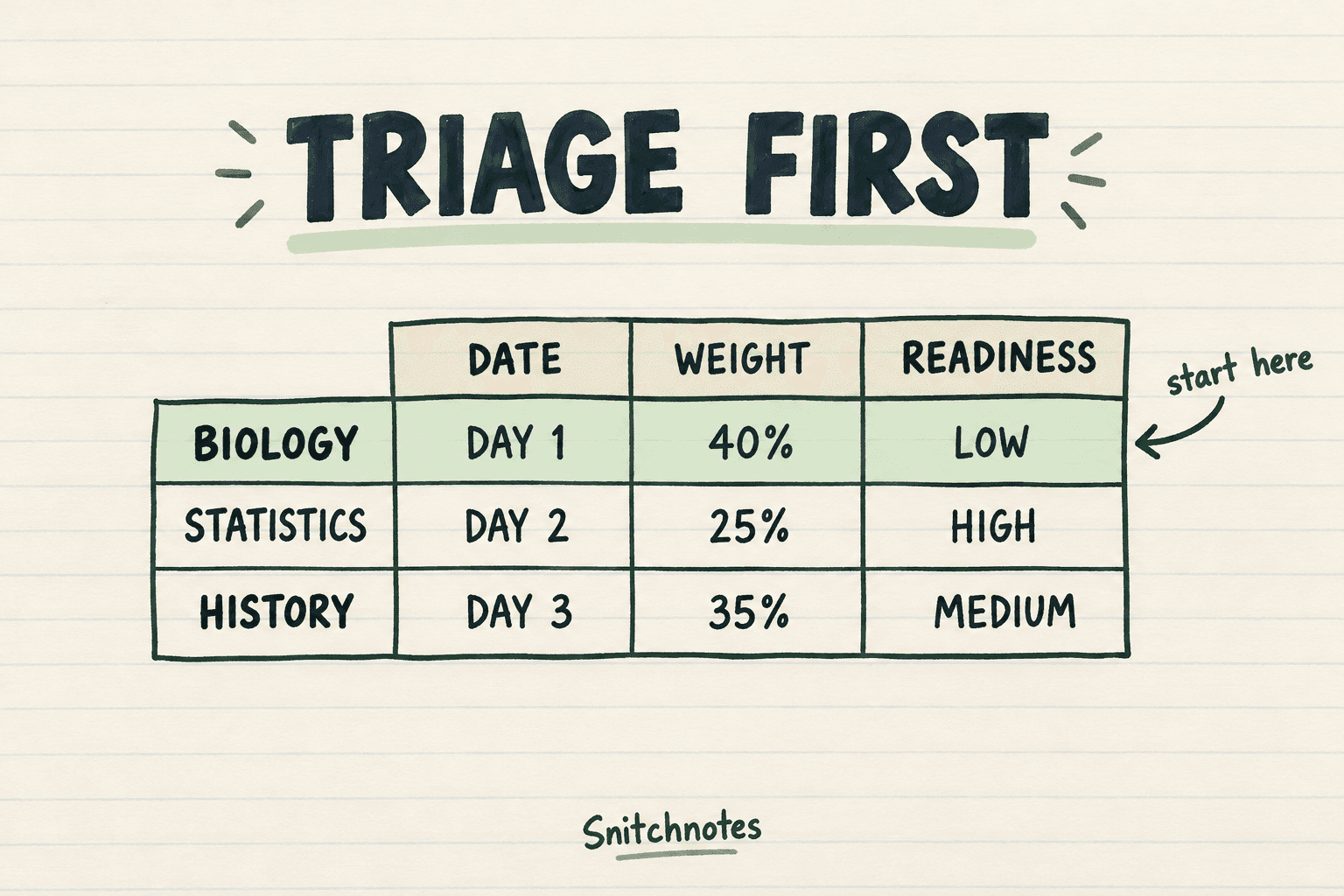
Make a one-page exam map before opening a textbook. For each exam, write its date and time, percentage of the course grade, tested topics, format, and your readiness on a simple low-medium-high scale. Readiness should come from evidence: a practice set, blank-page recall, or explaining the topic without notes—not from how familiar the chapter looks.
Prioritize the combination of urgency, impact, and weakness. An exam tomorrow deserves attention, but a high-weight topic you cannot yet retrieve deserves more than a low-weight topic you already answer reliably. This is not a perfect formula; it is a defense against spending three comfortable hours polishing the subject you like while the difficult one quietly catches fire.
- First: the earliest exam's weakest high-value topics.
- Second: a maintenance block for the next exam.
- Third: a brief preview or recall check for the last exam.
Step 2: Build an interleaved revision plan
Turn the priority list into study blocks, not a vague promise to “do biology.” The University of North Carolina Learning Center suggests intensive sessions of about 30 or 45 minutes using active study. A block might be “answer 20 cell-division questions and correct errors” or “solve six probability problems without notes.” The visible finish line makes it easier to start and tells you whether the block worked.
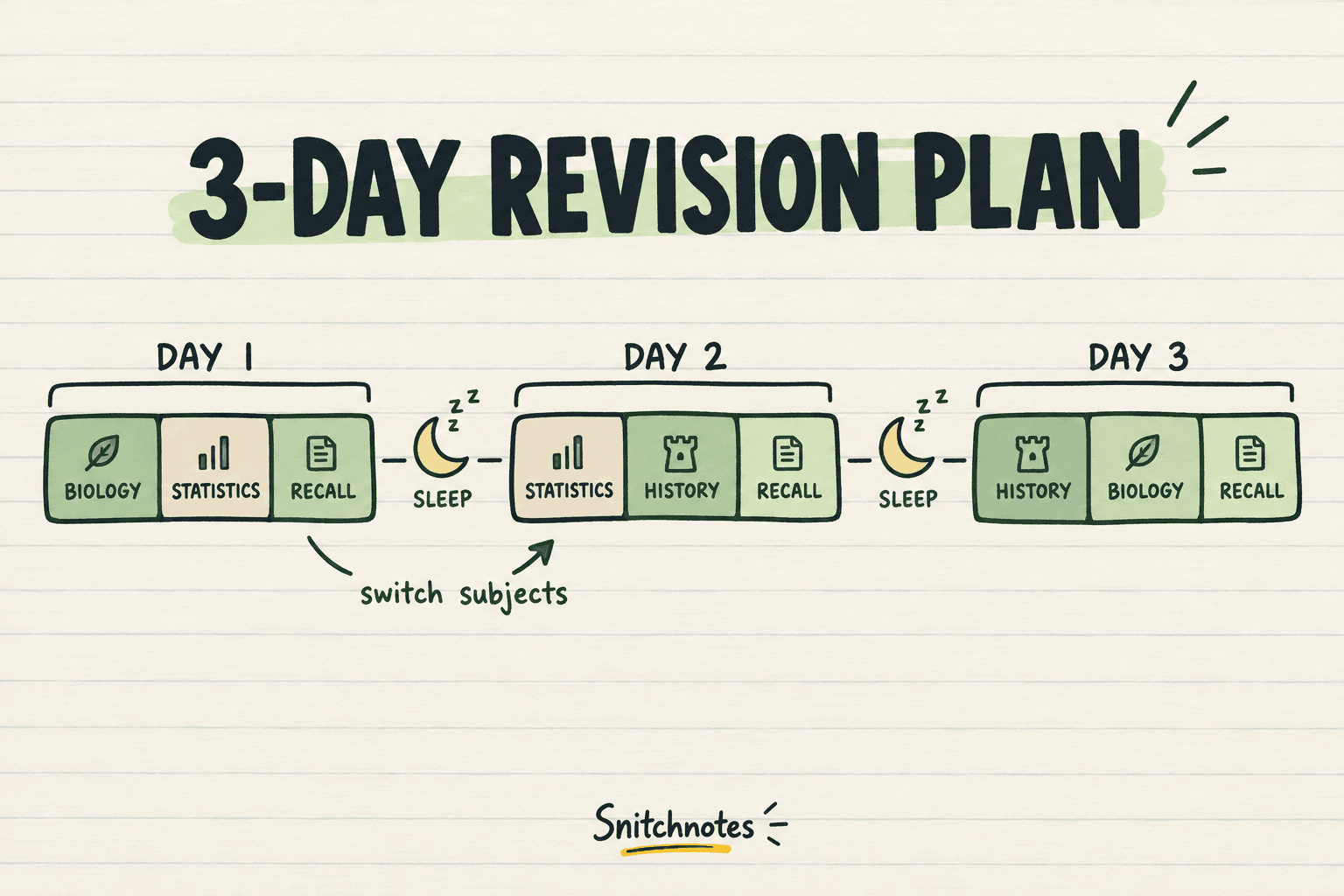
Suppose Biology is Tuesday, Statistics is Wednesday, and History is Thursday. On day one, use two Biology blocks around one Statistics block, then finish with a short History recall check. On day two, do a compact Biology warm-up before its exam, then shift the largest share to Statistics while keeping one History block. After each exam, remove that subject from the rotation and redistribute the time.
Cornell University's Learning Strategies Center recommends separating preparation from review: first organize or create useful material, then test whether you can retrieve it. Its five-day model also deliberately revisits chunks across days. When your window is only three days, keep the same logic but compress the number of chunks rather than deleting sleep.
Step 3: Use retrieval, not recognition
Rereading feels smooth because the answer is already on the page. Exams ask you to produce or apply an answer without that support. Close the notes and retrieve: write everything you remember, answer practice questions, solve problems, outline an essay, or teach the idea aloud. Then check the result and turn errors into the next block's target.
Match practice to the exam. For a problem-solving paper, mix problem types and explain why each method fits. For an essay exam, build claim-evidence outlines from memory. For definitions, use flashcards in both directions. The goal is not to make study feel difficult for its own sake; it is to expose missing knowledge while there is still time to fix it.
Step 4: Switch subjects cleanly
Context switching becomes expensive when one unfinished task follows you into the next. End each block with a two-line shutdown note: what you completed and the exact first action for your return. “Redo questions 4 and 7” is better than “study more.” Put away the first subject, take a brief screen-free break, and begin the written first action for the next one.
Do not switch every few minutes. Interleaving means planned blocks of different material, not juggling three tabs and replying to messages. If a subject needs sustained work, use two adjacent blocks with a short break, then switch.
What to do between exams
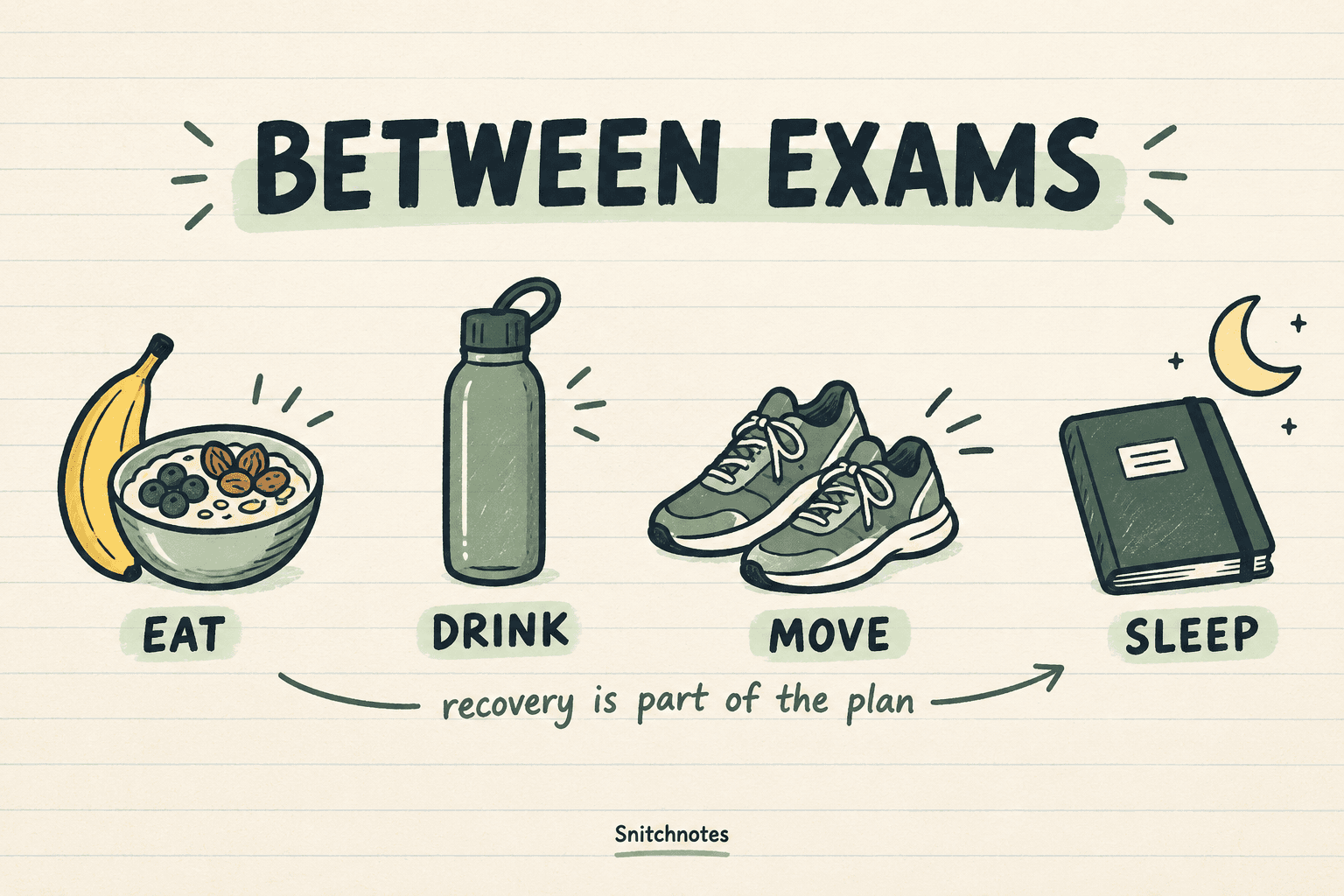
The hour after an exam is a transition, not an autopsy. Unless you need to report a technical problem, avoid comparing every answer with classmates; it spends attention on a result you can no longer change. Eat something substantial, drink water, walk or stretch, and use your shutdown note to begin the next subject without deciding the whole plan again.
Keep the next session narrow. Start with a short recall check to find what survived, then work on the largest gap. If you are too drained to think clearly, recovery may be the higher-value choice. The Centers for Disease Control and Prevention notes that sufficient sleep supports attention and memory, and recommends at least seven hours per day for adults.
Protect sleep and define a stopping point
Set a study cutoff before the evening begins. Sleep loss can weaken attention, working memory, and short-term memory—the exact tools you need to interpret questions and avoid careless errors. A review of sleep-deprivation research indexed by the National Library of Medicine reports effects across those cognitive tasks, although the size varies by task.
A good last block is light retrieval: key formulas, a one-page map, or the few errors you have already corrected. Starting an unfamiliar chapter at midnight is usually a planning failure disguised as dedication. Stop, prepare what you need for the morning, and let tomorrow's brain inherit a clear next step.
Common mistakes and important boundaries
- Equal time for every exam: allocate by date, impact, and readiness instead.
- Passive rereading: replace most of it with questions, problems, and recall.
- No recovery after the first exam: the next performance still needs food, hydration, movement, and sleep.
- Treating a timetable conflict as a study problem: if exams overlap, violate institutional spacing rules, or conflict with approved accommodations, contact the registrar or disability service promptly.
If stress is causing persistent panic, inability to sleep, or physical symptoms, a study schedule is not the whole solution. Contact a campus health or counseling service. Planning can reduce avoidable pressure, but it is not medical care.
Check your understanding
Your first exam is tomorrow, but you are already strong in it. What comes first?
Use a short verification block for the first exam, then give the larger block to the next high-impact weak area. Proximity matters, but it should not erase readiness.
What should the final study block of the night contain?
Use light retrieval of already studied material, correct a small set of known errors, and write tomorrow's first action. Avoid opening a large new topic just before your cutoff.
If your exam materials are scattered across lecture slides, PDFs, and notes, Snitchnotes can turn them into organized study notes, flashcards, and quizzes for each focused block.
Related concepts
- Timed-exam pacing: prepare a time budget for the paper itself.
- Practice-test error logs: turn mistakes into specific revision targets.
- Distributed practice: revisit material across separate sessions instead of one marathon.
- Retrieval practice: recall or apply knowledge before checking the answer.
Sources
Cornell University Learning Strategies Center: The Five-Day Study Plan
University of North Carolina Learning Center: Study Smarter, Not Harder
Centers for Disease Control and Prevention: About Sleep
National Library of Medicine: Sleep Deprivation and Memory—Meta-Analytic Reviews
Convierte tus clases en material listo para el examen.
Apuntes, quizzes, podcasts, flashcards y chat — con solo subir un archivo.
Prueba tu primer apunte gratis