
Snitchnotes Team
How to Practice Proof by Induction Step by Step
How to Practice Proof by Induction Step by Step
The proof by induction steps are: define the statement P(n), verify the first required value, assume P(k) for an arbitrary allowed integer k, use that assumption to prove P(k+1), and state the conclusion. The key practice rule is to keep those jobs separate. In particular, you may assume P(k) inside the inductive step, but you may not assume P(k+1), because P(k+1) is exactly what you must prove.
This article is for students who can follow a finished induction proof but freeze when the page is blank. A four-box rehearsal template turns the method into something you can diagnose: if the proof stalls, you can point to the missing base case, vague hypothesis, broken k-to-k+1 bridge, or absent conclusion instead of deciding that induction is mysterious.
Why proof by induction works
Ordinary mathematical induction proves a statement for a sequence of integers. First, the base case establishes a starting point such as P(1). Second, the inductive implication shows that whenever P(k) is true, P(k+1) must also be true. Together, those facts let the result propagate from the starting value to every later integer in the stated domain.
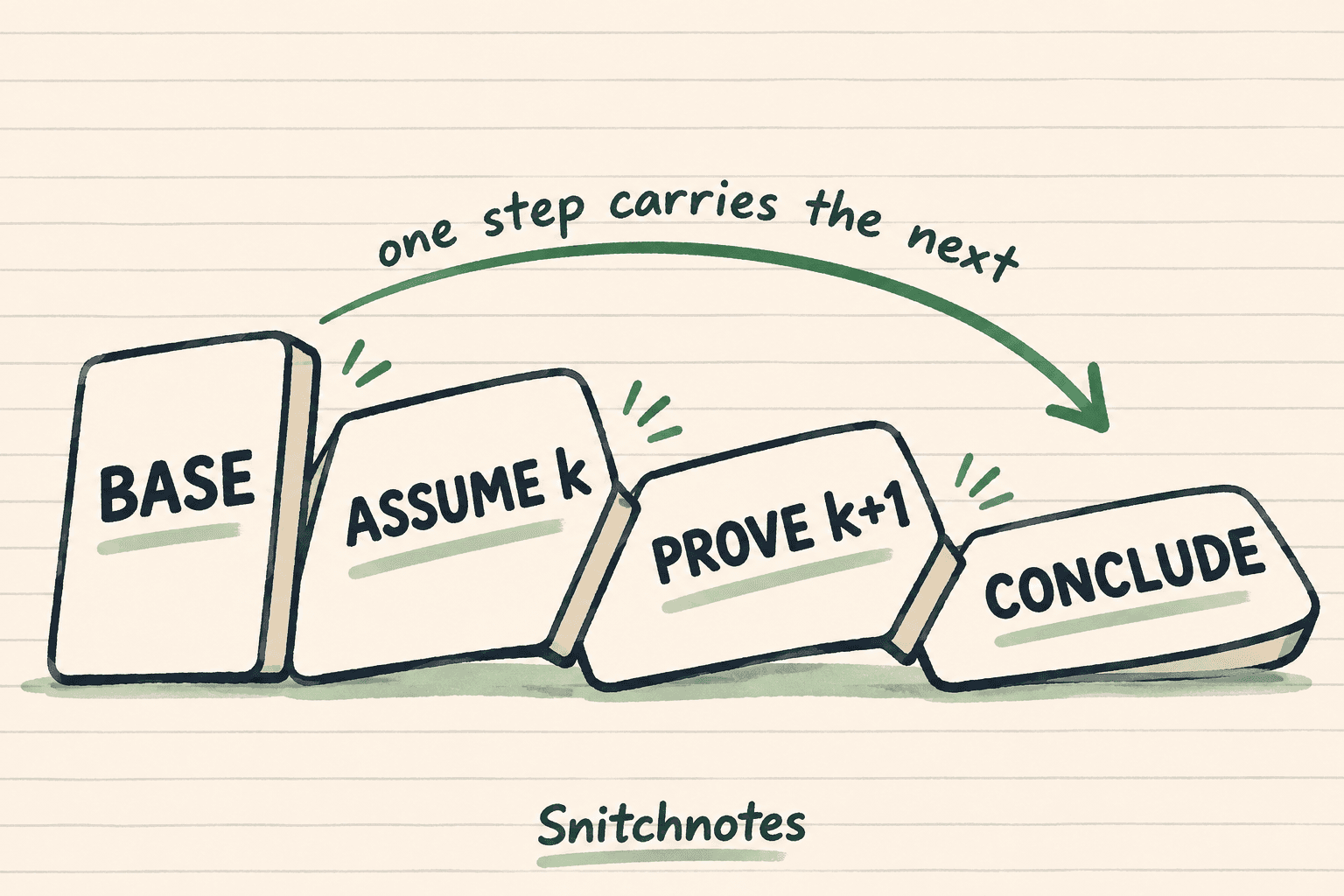
The domino metaphor is useful only if you remember both requirements. Showing that every domino would knock down the next one does not help if the first domino never falls. Checking the first domino does not prove anything about the rest unless you also establish the link from each arbitrary k to k+1.
The four-box practice method
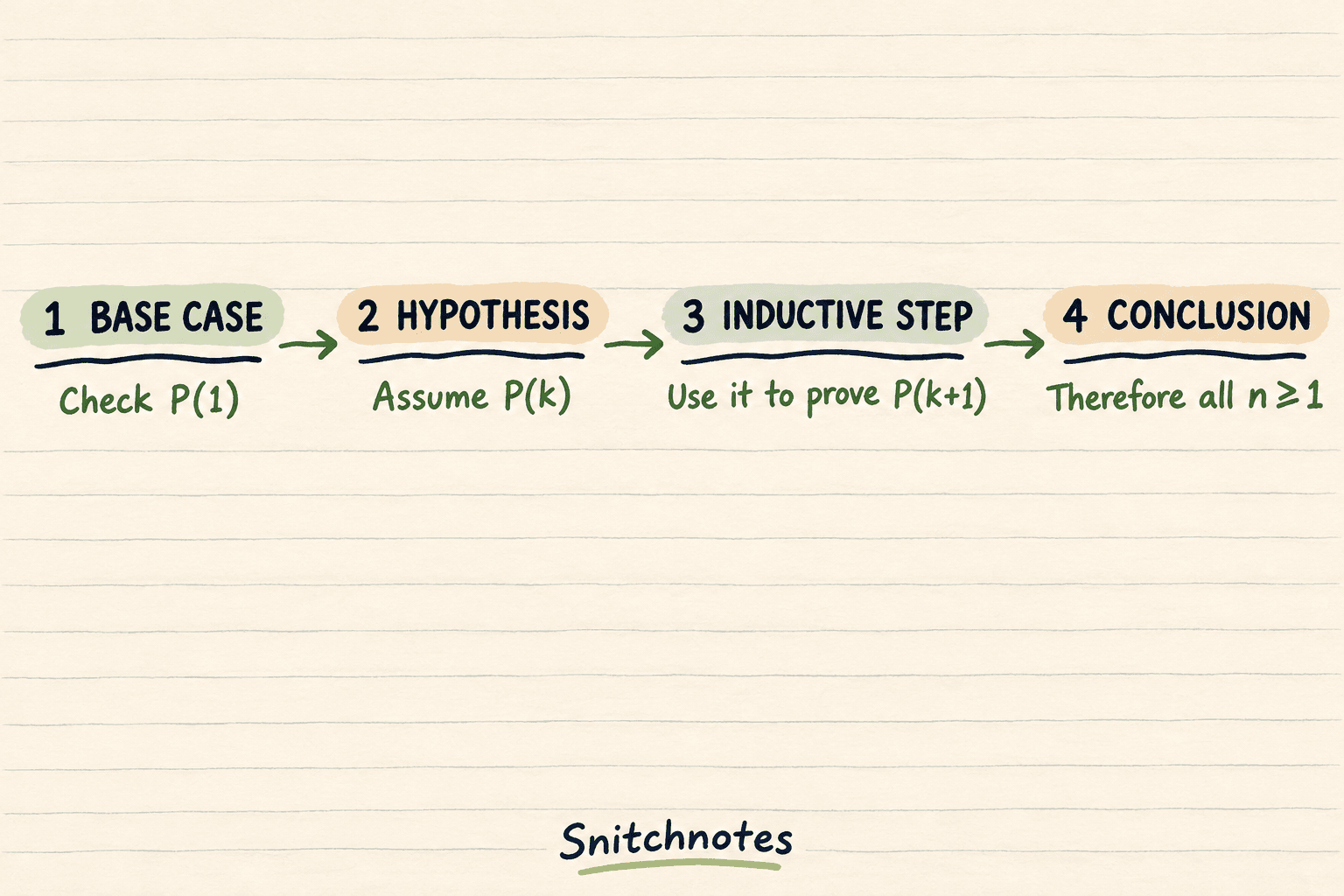
- Base case: identify the smallest integer in the claim and substitute it into both sides. Write the actual equality or inequality that verifies P(n₀); do not merely say that the case is obvious.
- Induction hypothesis: choose an arbitrary integer k in the allowed range and write the complete statement P(k). This line is a temporary assumption used to prove an implication, not a claim that every case is already true.
- Inductive step: write the exact target P(k+1), begin from one side of that target, and transform it using valid algebra. Mark the precise line where P(k) is used. Your work must end at the other side of P(k+1).
- Conclusion: state that the base case and the implication P(k) → P(k+1) have been proved. Therefore, by mathematical induction, P(n) holds for every integer n in the claimed range.
Practice with the boxes visible at first. After each problem, cover the worked solution and reproduce only the four structural lines. Then fill in the algebra. This separates remembering the proof architecture from solving the topic-specific manipulation, which makes errors easier to locate.
Worked example: the sum of the first n integers
Prove that 1 + 2 + ... + n = n(n + 1)/2 for every integer n ≥ 1. Let P(n) denote that equation. Keeping P(n) explicit prevents the symbols k and k+1 from quietly swapping jobs halfway through the proof.
Box 1: check the base case
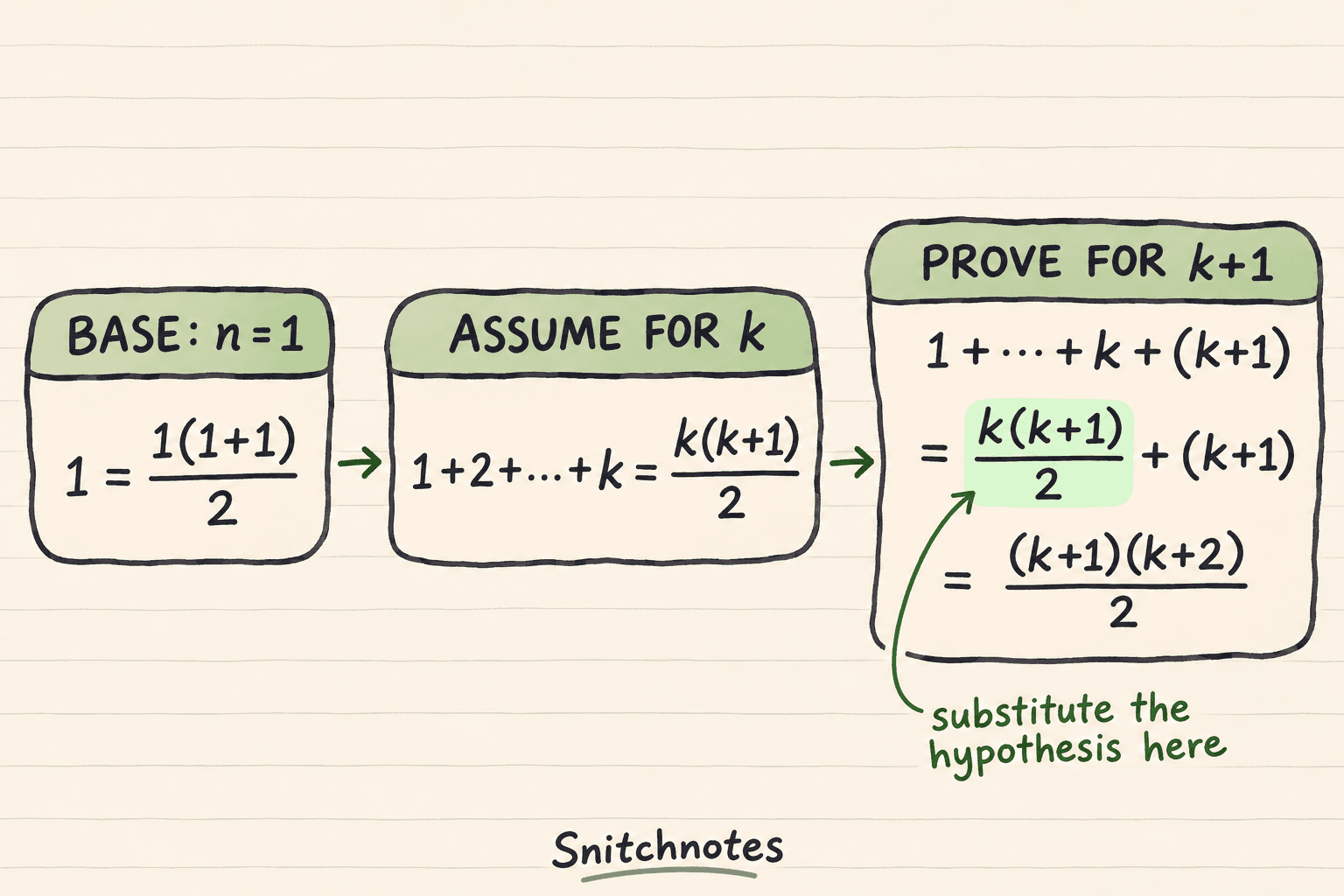
For n = 1, the left side is 1. The right side is 1(1 + 1)/2 = 1. Therefore P(1) is true. Checking n = 2 or n = 3 as well may build confidence, but extra examples do not replace the general inductive step.
Box 2: state the induction hypothesis
Assume that P(k) is true for some arbitrary integer k ≥ 1. In full, assume 1 + 2 + ... + k = k(k + 1)/2. Write the entire equation: the hypothesis is a tool you will substitute, not a decorative sentence.
Box 3: prove the next case
The P(k+1) target is 1 + 2 + ... + k + (k + 1) = (k + 1)(k + 2)/2. Start with its left side. The first k terms are exactly the left side of P(k), so replace only that chunk using the hypothesis: 1 + 2 + ... + k + (k + 1) = k(k + 1)/2 + (k + 1).
Now use algebra rather than another assumption. Factor out k + 1: k(k + 1)/2 + (k + 1) = (k + 1)(k/2 + 1) = (k + 1)(k + 2)/2. That is exactly the right side required by P(k+1), so the inductive implication is complete.
Box 4: conclude
The base case P(1) is true, and P(k) implies P(k+1) for every integer k ≥ 1. Therefore, by mathematical induction, 1 + 2 + ... + n = n(n + 1)/2 for every integer n ≥ 1. The conclusion repeats the domain because induction proves only the range connected to the base case.
Why the induction hypothesis is not circular reasoning
You are not assuming the final theorem. You are proving the conditional statement “if P(k), then P(k+1)” for an arbitrary k. A conditional proof may temporarily assume its premise. The reasoning becomes circular only if you assume P(k+1), use the desired conclusion without deriving it, or say P(k) is true for every k before induction has established that fact.
A reliable self-check is to underline the exact expression replaced by the hypothesis. In the sum example, the underlined chunk is 1 + 2 + ... + k. If you cannot point to a legitimate use of P(k), the proof may not have built the bridge. If you replace the entire P(k+1) target, you have assumed what you needed to prove.
Common mistakes and important boundaries
- Starting at the wrong value: if the claim begins at n = 4, test P(4), not P(1). The base case must match the stated domain.
- Changing the target: write P(k+1) before doing algebra so you know the expression your work must reach.
- Testing many examples: numerical checks can reveal a false conjecture, but no finite list proves a statement about every later integer.
- Using a hypothesis that is too weak: some recurrences require strong induction, where you assume all cases from the base through k, not just P(k).
Induction is designed for claims indexed by integers with a repeatable next-step relationship. It is not automatically the best method for every statement containing n. A direct proof, contradiction, or a counterexample may be shorter. Also, if the k-to-k+1 step needs two earlier cases, you may need multiple base cases or strong induction.
Check your understanding
What are you allowed to assume in the inductive step?
Assume P(k) for one arbitrary allowed integer k while proving the conditional P(k) → P(k+1). You are not allowed to assume P(k+1) or that P(n) already holds for all n.
Where is the hypothesis used in the sum proof?
It replaces the first k terms, 1 + 2 + ... + k, with k(k + 1)/2. The extra term k + 1 stays in place and is combined algebraically afterward.
Why is checking n = 1, 2, and 3 not enough?
Those checks cover only three cases. The inductive implication is what connects an arbitrary case to the next one and extends the result through the whole claimed range.
Related concepts
- Strong induction: assume all earlier cases in the required range when the next case depends on more than one predecessor.
- Recursive definitions: describe an object using initial values and a rule that builds later values from earlier ones.
- How to check a mathematical proof before submitting it: review logic, notation, and scope after the induction structure is complete.
- How to study when worked solutions skip steps: reconstruct hidden algebra between the hypothesis and the target.
Sources
Stanford University CS103, Mathematical Induction lecture notes
University of Sydney Mathematics Learning Centre, Mathematical Induction
Mathematics LibreTexts and Mount Royal University, Proof by Induction
Convierte tus clases en material listo para el examen.
Apuntes, quizzes, podcasts, flashcards y chat — con solo subir un archivo.
Prueba tu primer apunte gratis