
Snitchnotes Team
Innate vs Adaptive Immunity: Differences and Examples
Innate vs Adaptive Immunity: Differences and Examples
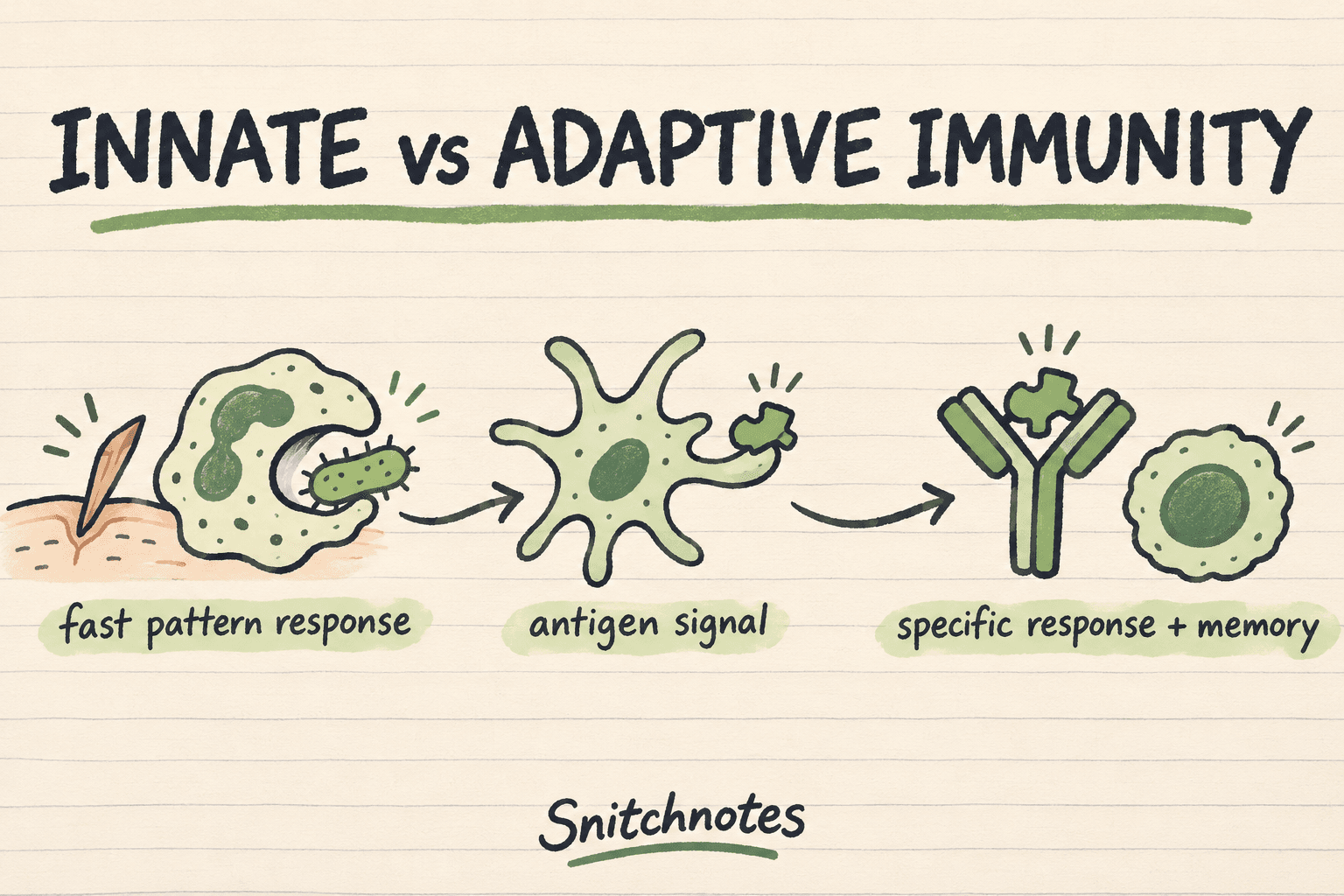
Innate immunity is the body's fast, built-in defense: barriers, inflammation, complement, and cells such as neutrophils and macrophages recognize shared signs of damage or infection and respond within minutes to hours. Adaptive immunity is slower during a first encounter, but B cells and T cells target particular antigens and can leave behind memory cells that produce a faster, stronger response when the same antigen appears again.
That is the core difference between innate and adaptive immunity. It matters because the two are not rival systems or consecutive shifts where one clocks out before the other arrives. Innate defenses contain the immediate problem and help instruct the adaptive response; adaptive antibodies and T cells then make pathogen removal more precise and can improve protection during later encounters.
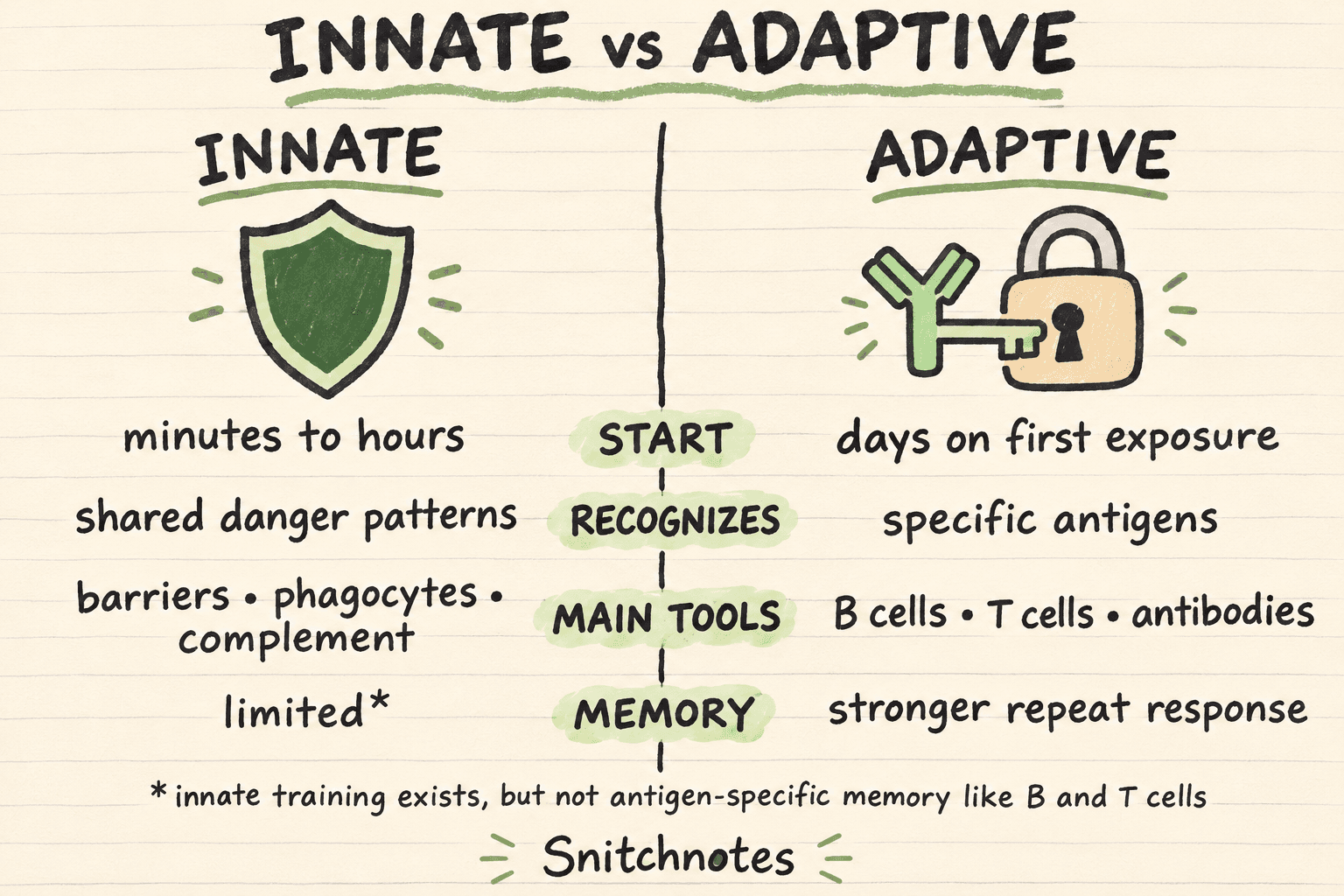
Innate vs adaptive immunity at a glance
Innate immunity begins quickly because its receptors are already present and recognize recurring molecular patterns associated with microbes or damaged cells. Its major components include skin and mucosal barriers, phagocytes, natural killer cells, complement proteins, and signaling molecules that drive inflammation. The response is broad, but not random: innate receptors distinguish categories of danger through specific pattern-recognition systems.
Adaptive immunity depends mainly on B lymphocytes and T lymphocytes. Each lymphocyte carries receptors with a particular binding specificity. When the matching antigen and the right activation signals appear, selected cells multiply into a larger clone. B cells can become antibody-secreting plasma cells, helper T cells coordinate other immune cells, and cytotoxic T cells can kill infected cells displaying a matching antigen fragment.
- Speed: innate responses begin within minutes to hours; a primary adaptive response usually builds over days.
- Recognition: innate receptors detect shared danger patterns; adaptive receptors distinguish particular antigens.
- Memory: adaptive memory B and T cells support a faster, stronger response after re-exposure to the same antigen.
How innate immunity responds first
The first innate defense is often a barrier rather than a white blood cell. Intact skin, mucus, cilia, enzymes, and antimicrobial substances make entry difficult. If a barrier is breached, local cells detect tissue damage and microbial patterns, release signals, widen nearby blood vessels, and recruit circulating defenders. Redness, warmth, swelling, and soreness are visible consequences of that inflammatory response.
Neutrophils can arrive rapidly and engulf microbes. Macrophages also phagocytose material and release signals, while complement proteins can mark targets, recruit inflammation, and damage some microbes directly. Dendritic cells create a crucial bridge: after taking up material, they can travel to lymphoid tissue and present antigen fragments to T cells. The fast response therefore does more than buy time; it helps determine what kind of adaptive response follows.
How adaptive immunity becomes specific
A tiny fraction of B or T cells will have receptors that fit a newly encountered antigen. Activation selects those cells and triggers clonal expansion, producing many descendants with the same specificity. This takes time during a first exposure, which is why adaptive immunity cannot replace the immediate innate response. It trades speed for a much larger recognition repertoire and targeted effector functions.
Antibodies can neutralize toxins or viruses, block attachment, and coat targets so phagocytes can remove them more efficiently. T cells recognize antigen fragments displayed on cell surfaces rather than free-floating whole microbes. Some activated B and T cells persist as memory cells after the immediate threat has passed. Vaccination uses this feature by exposing the immune system to an antigen in a controlled way, building active immunity without requiring the disease and its complications.
Worked example: a splinter, bacteria, and immune memory
Imagine a splinter pushes bacteria through the skin. The physical barrier has failed at one tiny point. Within minutes to hours, local innate sensors detect damage and microbial patterns. Inflammatory signals recruit neutrophils, which engulf bacteria, while complement and macrophages help contain the breach. This response does not wait to identify the exact bacterial strain before acting.
At the same time, dendritic cells can carry bacterial antigens toward a nearby lymph node. T cells whose receptors match presented antigen fragments can activate and multiply; matching B cells can receive help and develop into plasma cells that make antibodies. Over several days, the response becomes more antigen-specific. Antibodies then work with innate mechanisms, for example by coating bacteria so phagocytes can grab them more easily.
Months later, suppose the same antigen enters again. Innate defenses still respond; memory does not make skin, neutrophils, or complement unnecessary. But surviving memory B and T cells are more numerous and easier to activate than the rare matching cells present the first time. The adaptive response can therefore build sooner and more strongly, sometimes controlling the threat before noticeable illness develops.
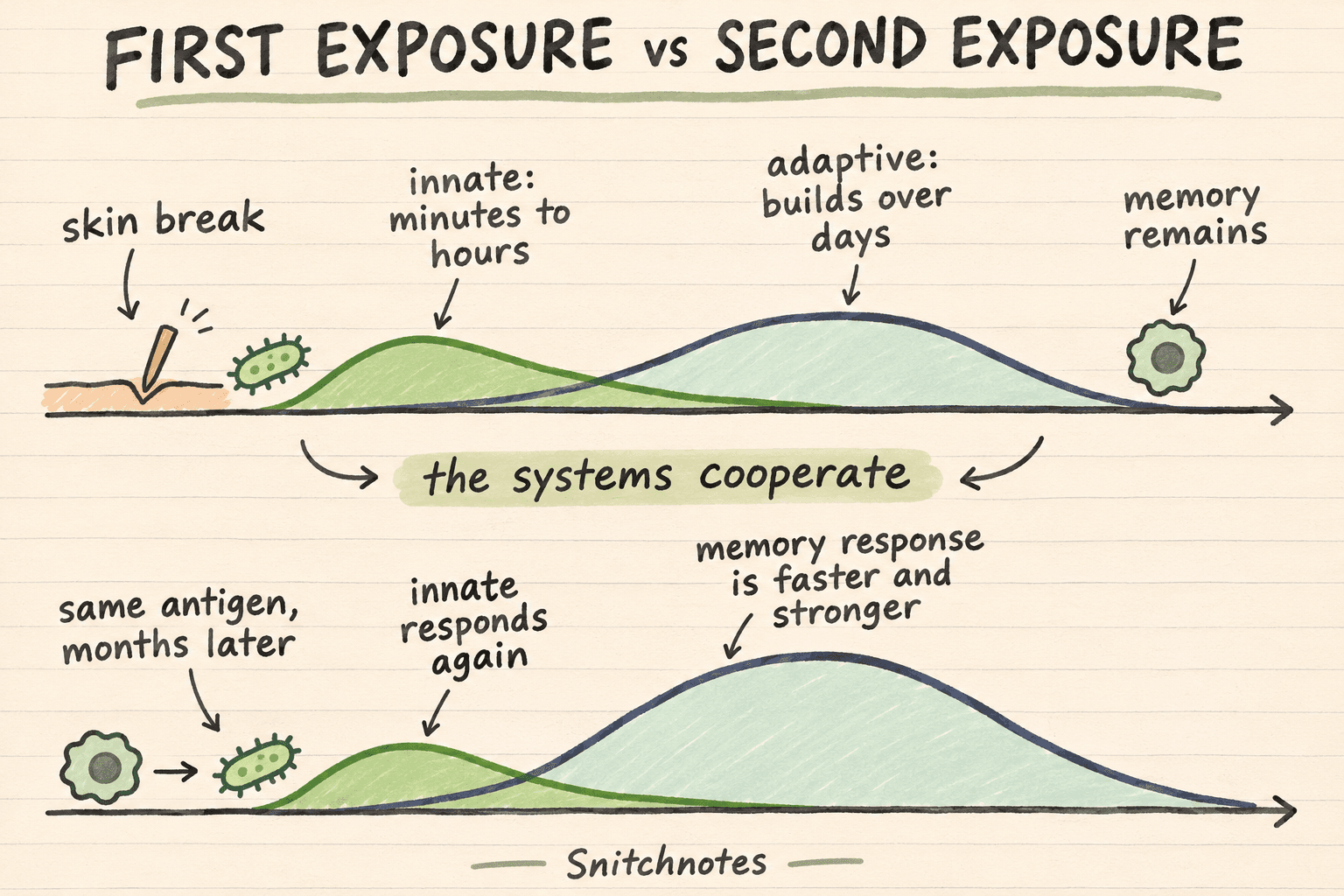
The important boundary: the systems cooperate
Calling innate immunity “nonspecific” is useful only as shorthand. Innate receptors recognize defined molecular patterns, and different signals produce different responses. It is more accurate to say that innate recognition uses inherited pattern-recognition receptors with a limited repertoire, whereas adaptive immunity generates an enormous repertoire of B-cell and T-cell receptors and selects clones that match particular antigens.
The memory contrast also has a boundary. Innate cells can undergo lasting functional changes sometimes called trained immunity. However, this is not the same as the highly antigen-specific clonal memory of B and T cells. For a standard innate-versus-adaptive comparison, remember four anchors: immediate pattern response, delayed antigen-specific response, constant cooperation, and stronger adaptive recall.
Check your understanding
Which system responds first after the splinter breaks the skin?
Innate immunity responds first through local sensing, inflammation, complement, and rapid recruitment of cells such as neutrophils. Adaptive activation begins alongside it but takes longer to expand during a first encounter.
Why is the second adaptive response faster?
Memory B and T cells specific to the antigen already exist in greater numbers and are primed to react. They can expand and produce effector functions more quickly than rare naive cells during the first exposure.
Do antibodies replace innate defenses?
No. Antibodies often cooperate with innate mechanisms, including complement and phagocytes. They make targeting more precise, but the two arms remain interdependent.
Related concepts
- How to study the complement system without rote memorization
- Aerobic vs anaerobic respiration: differences and examples
- How to memorize cranial nerves by function map
Sources
National Institute of Allergy and Infectious Diseases: Overview of the Immune System
National Institute of Allergy and Infectious Diseases: Features of an Immune Response
National Center for Biotechnology Information: Principles of Innate and Adaptive Immunity
Centers for Disease Control and Prevention: Pink Book, Chapter 1—Principles of Vaccination
Convierte tus clases en material listo para el examen.
Apuntes, quizzes, podcasts, flashcards y chat — con solo subir un archivo.
Prueba tu primer apunte gratis