
Snitchnotes Team
How to Fix Sign Errors in Physics Problems
How to Fix Sign Errors in Physics Problems
To avoid sign errors in physics, choose a positive direction before writing equations, draw the axis on the diagram, assign every vector a sign from that axis, and keep the convention unchanged through the calculation. Then interpret a negative result as a direction first—not as proof that the mathematics is wrong. Most sign mistakes are consistency mistakes, not arithmetic mistakes.
This workflow is for students who can select the right formula but still lose marks to flipped arrows, inconsistent components, or a minus sign added at the end. Signs carry physical meaning: they tell you whether motion, force, acceleration, current, or potential change points with or against your chosen direction.
Why sign errors happen
A plus or minus sign in a vector problem is not a permanent label attached to “right,” “up,” or “clockwise.” It depends on the coordinate system you choose. OpenStax notes that in one-dimensional motion you may choose either direction as positive. Once you choose, motion in the opposite direction is negative in that coordinate system. Both choices can produce a correct physical answer.
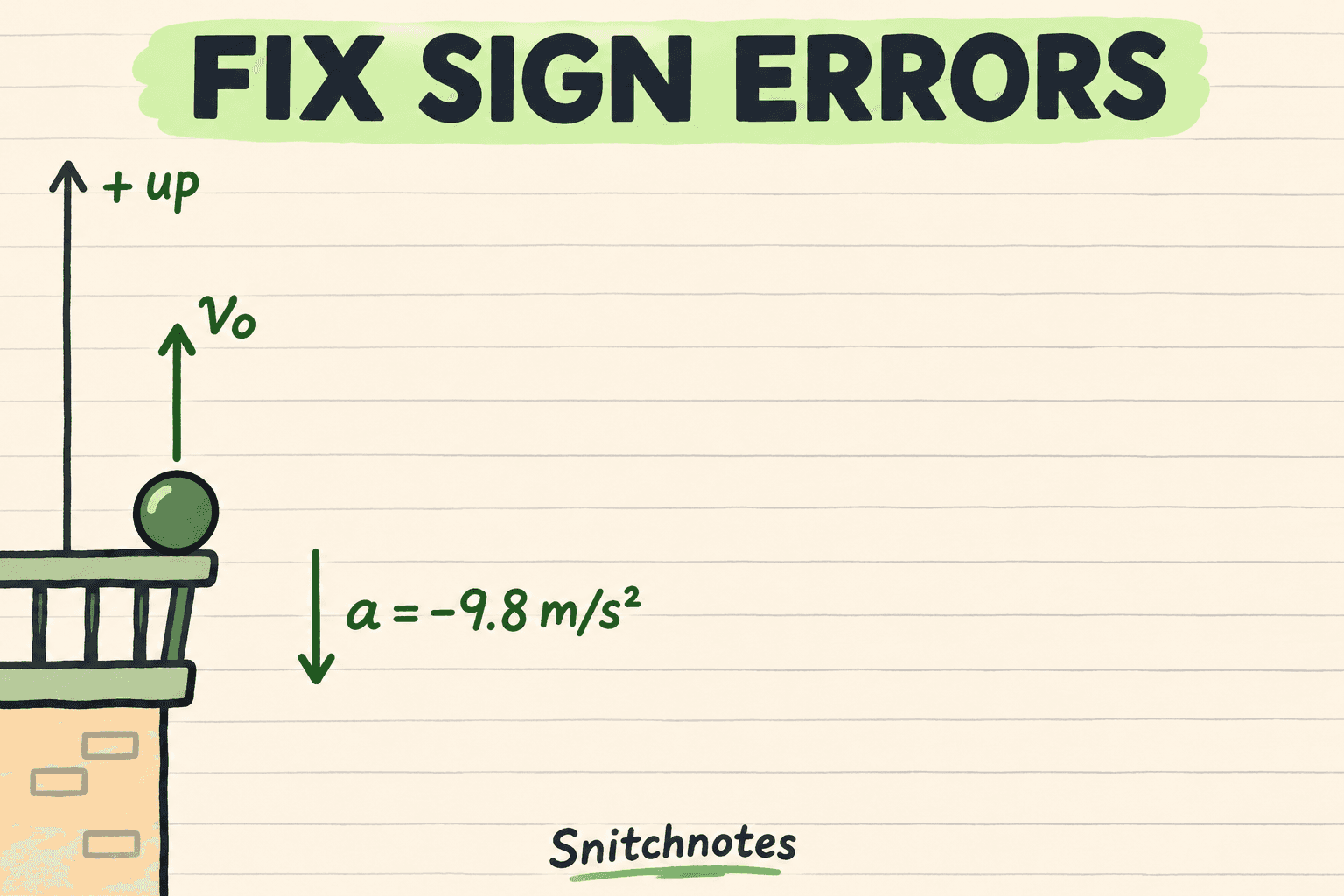
Trouble begins when the diagram uses one convention and the equation quietly uses another. A student may draw upward as positive, substitute gravitational acceleration as +9.8 m/s², and then add a minus sign later because “gravity goes down.” That counts gravity twice: the direction should already be encoded in the signed value.
Use the axis-vector-equation sign audit
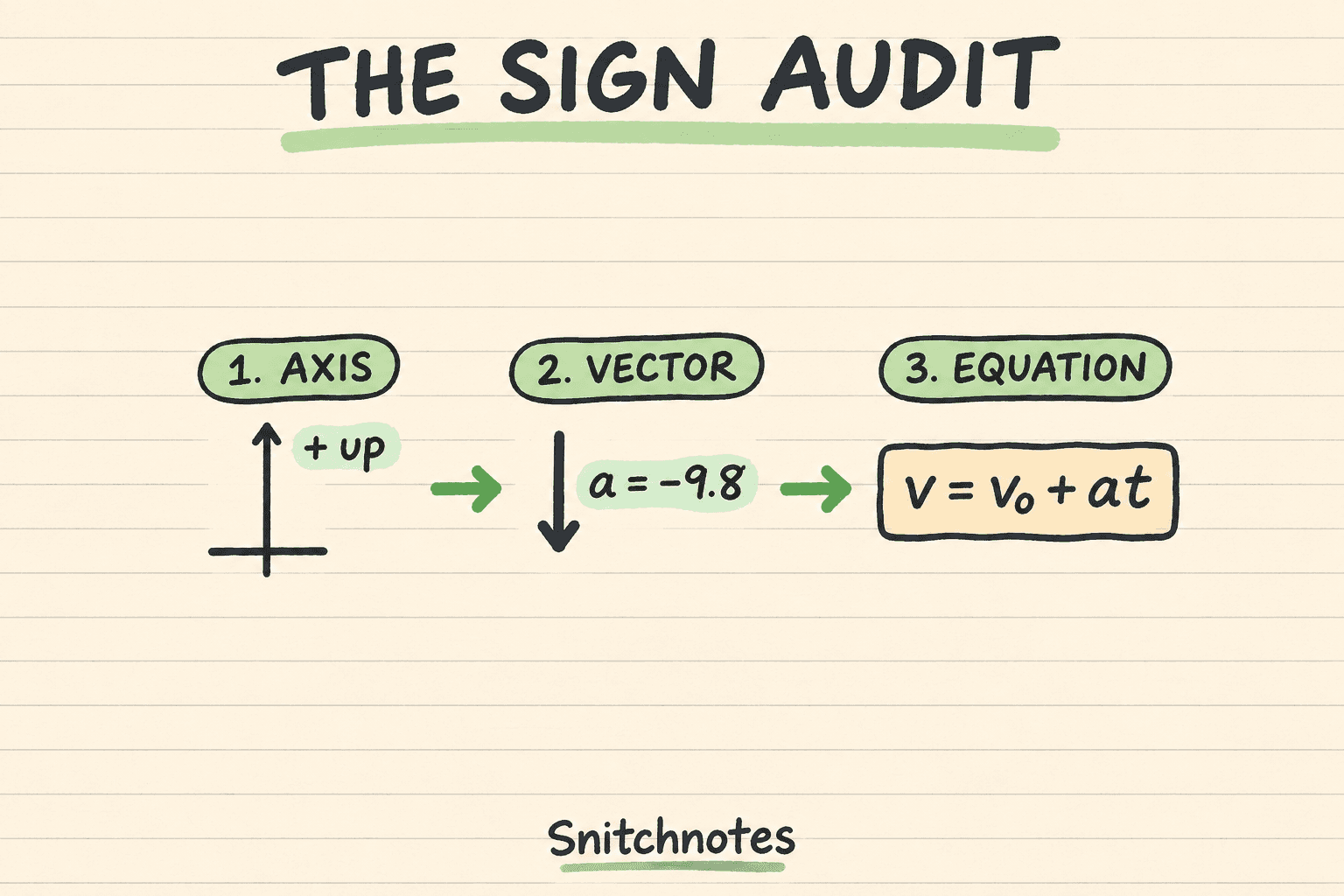
Run this three-step audit before calculating. First, draw the coordinate axis and mark the positive direction. Second, inspect each vector separately and give its component a plus or minus sign according to that axis. Third, copy those signed quantities into the equation without inventing an extra sign. For two-dimensional problems, repeat the process independently for the x- and y-components.
- Axis: write “+ right,” “+ up,” or the chosen positive rotational direction directly beside the diagram.
- Vectors: label velocity, acceleration, force, displacement, or current arrows before substituting numbers.
- Equation: use the signed components exactly as labeled, then check whether the result's sign matches the drawn axis.
Vector components deserve special care. In Cartesian coordinates, a component is positive when it points along the positive axis and negative when it points opposite it. A vector in the second quadrant, for example, has a negative x-component and a positive y-component. The vector's magnitude is still non-negative; the component signs carry direction.
Worked example: a ball thrown from a balcony
A ball is thrown straight upward from a balcony at 15.0 m/s. Find its velocity 2.43 s later, ignoring air resistance. Choose upward as positive. The initial velocity is therefore v₀ = +15.0 m/s. Gravity points downward, so a = −9.8 m/s². Time is a scalar interval, t = 2.43 s, so it is positive.
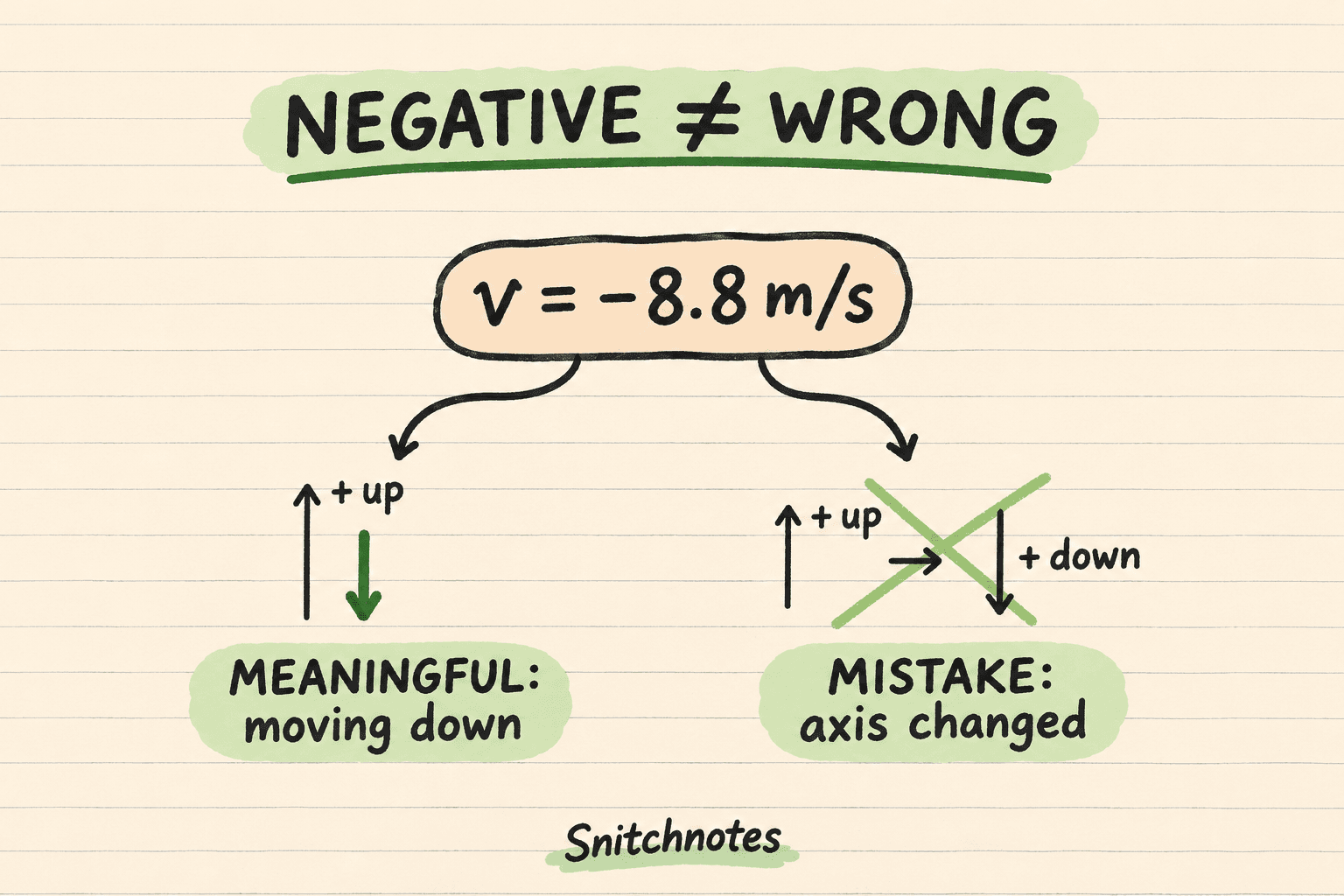
Use v = v₀ + at: v = 15.0 + (−9.8)(2.43) = −8.8 m/s, rounded to two significant figures. The negative sign is meaningful. It says the ball is moving downward at 8.8 m/s relative to the chosen upward-positive axis. It does not mean velocity has an impossible “negative speed,” and it does not tell you to erase the sign.
A quick physical check supports the answer. The ball reaches its highest point after about 15.0 ÷ 9.8 = 1.53 s, when its velocity is zero. At 2.43 s it should already be descending, so a negative velocity is exactly what the diagram predicts. The sign, equation, and physical story agree.
A negative answer is not automatically an error
Before correcting a negative result, ask what the quantity means. Negative velocity indicates motion opposite the positive axis. Negative displacement indicates a final position on the negative side relative to the reference point. Negative acceleration indicates that the acceleration vector points opposite the positive axis; it does not automatically mean the object is slowing down. An object moving in the negative direction with negative acceleration is speeding up.
A negative magnitude, elapsed time, mass, or ordinary distance is different. Those quantities are normally non-negative in introductory problems, so a negative value often signals an algebra or model error. Keep the distinction clear: vector components can be signed, while a vector's magnitude is not negative.
How to debug a suspicious sign
- Redraw the axis and compare every arrow with it. Do not inspect the equation first.
- Write symbols with signs before inserting numbers: for example, aᵧ = −g when +y is upward.
- Check component formulas by quadrant. The calculator's sine or cosine is not a substitute for deciding the vector's direction.
- Test the result against an easy moment or limiting case: before the highest point the ball moves up; afterward it moves down.
- Check units and scale. A correct-looking sign cannot rescue incompatible units or an implausible magnitude.
If you reverse the axis and solve again consistently, physical conclusions should remain the same even though component signs change. This is a powerful audit: the balcony example could use downward as positive, giving v₀ = −15.0 m/s, a = +9.8 m/s², and v = +8.8 m/s after 2.43 s. The plus sign now means downward because the axis changed before the solution began.
The same rule works in circuit problems
Circuit signs also follow choices made at the start. For Kirchhoff's loop rule, choose a direction to travel around the loop and apply one convention at every element. Northwestern University's mechatronics guide treats travel from a component's positive terminal to its negative terminal as a voltage drop and the reverse crossing as a rise. The algebraic sum of potential changes around a closed loop is zero.
You may also guess a current direction. If the solved current is negative, the circuit is not broken and the algebra is not automatically wrong; the actual conventional current flows opposite your guessed arrow. As in mechanics, choose once, label clearly, and let a negative result communicate direction.
Check your understanding
You choose right as positive and calculate a velocity of −6 m/s. What does it mean?
The object is moving left at a speed of 6 m/s. The negative sign describes direction relative to the chosen axis.
A car moves left and has acceleration to the left. Is it slowing down?
No. Velocity and acceleration point in the same direction, so the car's speed is increasing. If right is positive, both components are negative.
What is the fastest sign check before submitting a solution?
Point to the axis, then to each vector arrow, then to its signed term in the equation. If that chain is consistent, interpret the result before changing it.
If sign conventions keep getting lost across lecture slides and practice sets, Snitchnotes can turn your own course material into organized notes, flashcards, and quizzes built around the exact examples you need to revisit.
Related concepts
- Free-body diagrams and centripetal force: separate real force directions from motion direction.
- Dimensional analysis in chemistry: use units as a second error-detection system.
- Vector components: resolve a vector along fixed x- and y-axes before combining equations.
Sources
OpenStax, College Physics 2e: Displacement
Michigan State University Open Books: Vectors, Scalars, and Coordinate Systems
Northwestern University Mechatronics: Kirchhoff's Current and Voltage Laws
Convierte tus clases en material listo para el examen.
Apuntes, quizzes, podcasts, flashcards y chat — con solo subir un archivo.
Prueba tu primer apunte gratis