
Snitchnotes Team
How to Solve Conditional Probability Without Using the Wrong Denominator
How to Solve Conditional Probability Without Using the Wrong Denominator
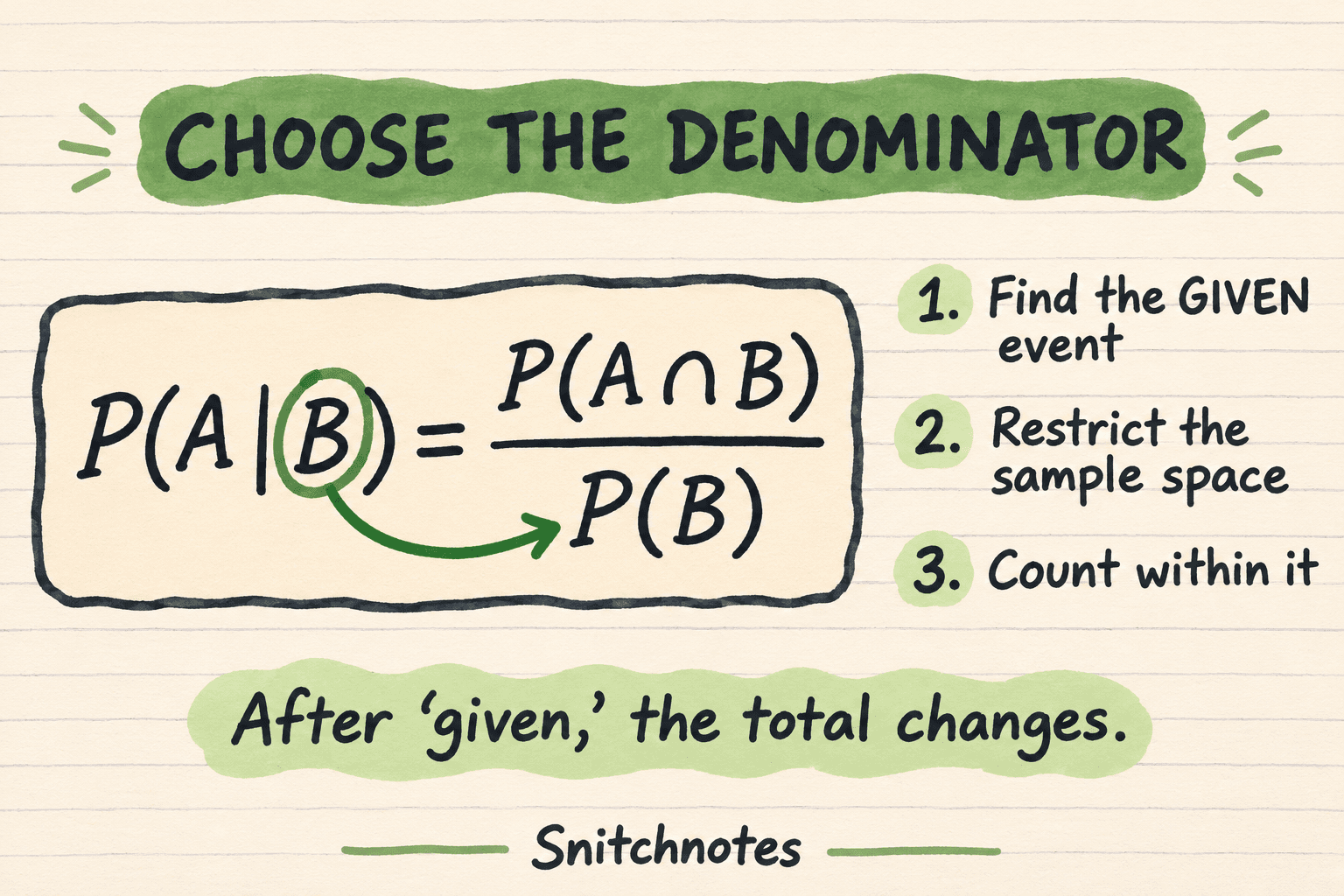
The denominator in conditional probability is the total number of outcomes that satisfy the given condition. For P(A | B), read the bar as “given B,” restrict the sample space to B, and then count how many of those B outcomes also satisfy A. In symbols, P(A | B) = P(A ∩ B) / P(B), provided P(B) is greater than zero.
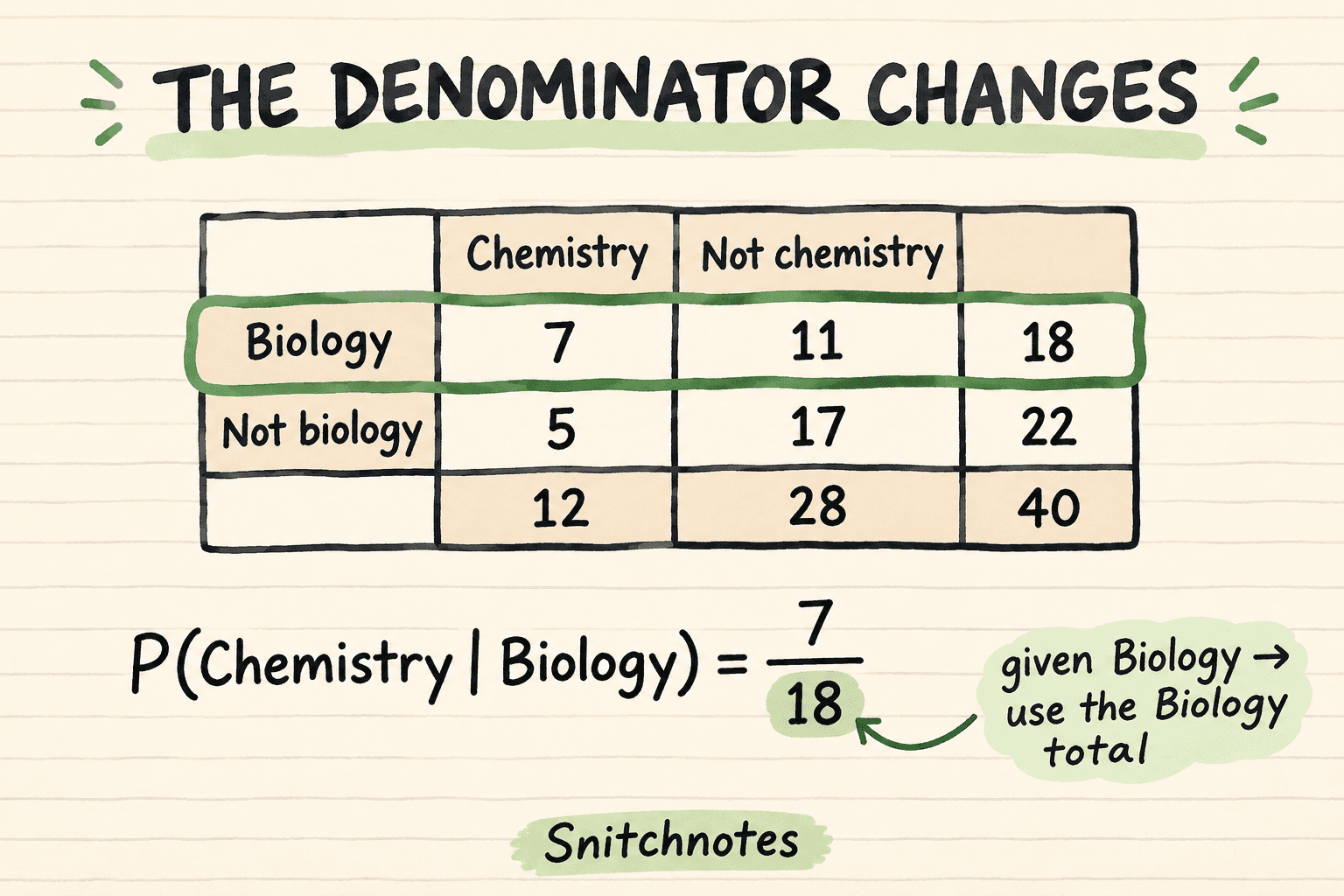
The most common mistake is keeping the original total after the question has narrowed the group. If 7 of 18 biology students also study chemistry, then P(chemistry | biology) is 7/18. Dividing by all 40 students would answer a different question: the joint probability that a randomly selected student studies both subjects.
Why the denominator changes after “given”
An ordinary probability compares favorable outcomes with every outcome in the sample space. Conditional probability begins after you learn extra information. The phrase “given B” tells you that only outcomes inside B remain possible for this calculation. B is no longer just another event; it is the temporary sample space.
That is why the formula divides by P(B). The numerator P(A ∩ B) measures outcomes where A and B both occur in the original sample space. Dividing by P(B) rescales that overlap relative to the smaller B group. The result answers, “Among the B outcomes, what fraction are also A outcomes?”
OpenStax describes a conditional probability as a probability calculated from a reduced sample space. Penn State’s STAT 200 course gives the same practical instruction for two-way tables: look only within the row or column named by the condition. This is the denominator idea in two forms—one conceptual and one visual.
A denominator decision rule that works
- Find the condition. In P(A | B), it is the event after the bar: B. In words, it follows “given.”
- Restrict the sample space. Ignore every outcome outside B. In a table, box the relevant B row or column before doing arithmetic.
- Use the restricted total as the denominator. For counts, this is the number of B outcomes. For probabilities, it is P(B).
- Count the overlap for the numerator. Within B, count the outcomes that also satisfy A. This is A ∩ B.
A quick language check helps: finish the sentence “Out of all the ___ outcomes, how many are also ___?” The first blank is the given event and therefore the denominator. For P(A | B), the sentence is “Out of all the B outcomes, how many are also A?”
Worked example: chemistry given biology
A class has 40 students. Eighteen study biology, 12 study chemistry, and 7 study both. Suppose you choose one student at random and ask for the probability that the student studies chemistry, given that the student studies biology.
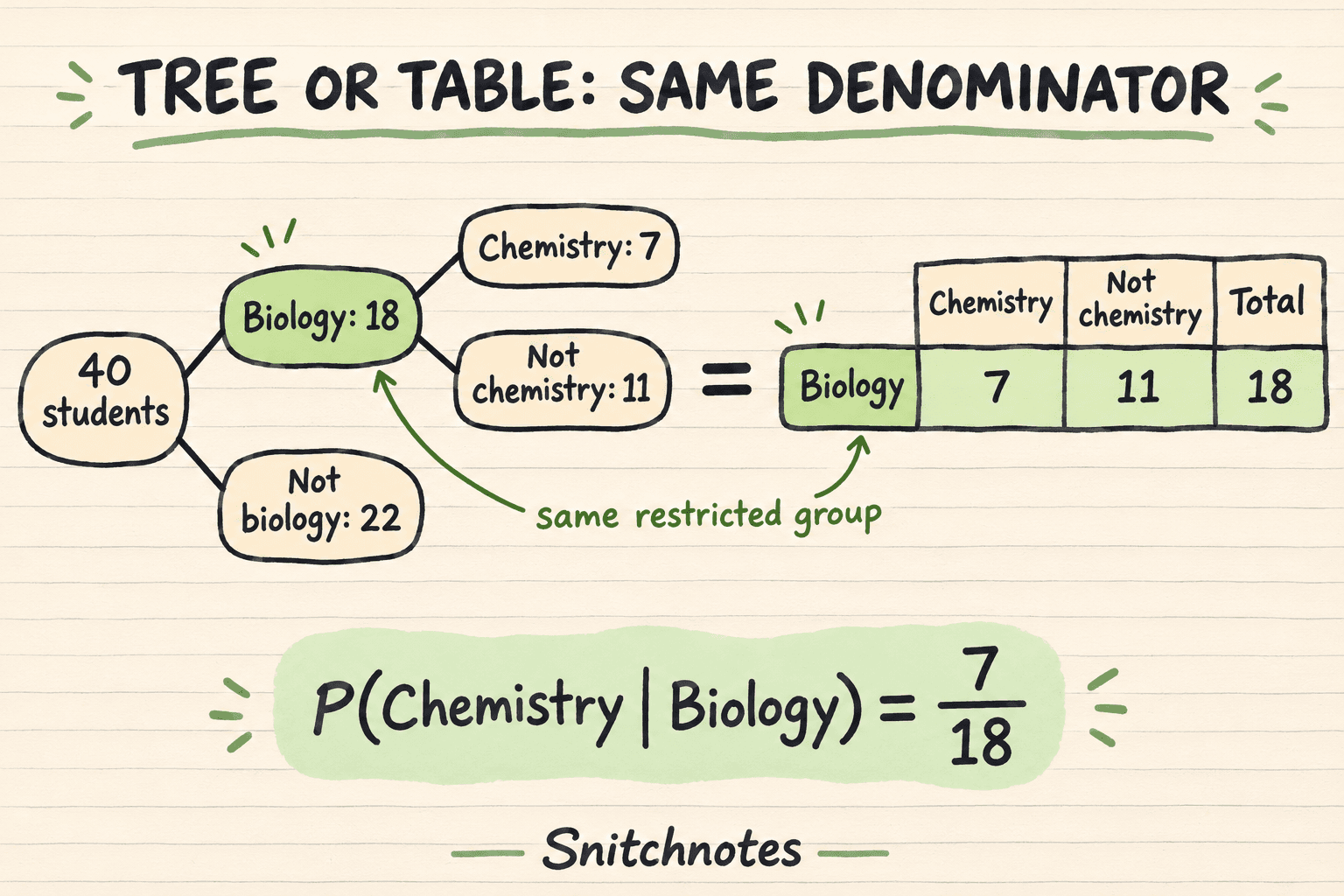
Start with the condition: biology. The words “given biology” reduce the sample space from 40 students to the 18 biology students. Among those 18, exactly 7 also study chemistry. Therefore P(chemistry | biology) = 7/18, which is about 0.389 or 38.9%.
Why not 7/40? Because 7/40 counts the students who study both subjects out of the whole class. It equals P(chemistry ∩ biology), the joint probability, and is 0.175 or 17.5%. The same numerator can appear in both calculations, but the question changes the denominator.
A two-way table makes this visible. The biology row contains 7 chemistry students and 11 non-chemistry students, for a total of 18. A probability tree tells the same story: follow the biology branch first, then measure the chemistry branch within it. The representation changes; the restricted group does not.
Do not reverse the condition
P(A | B) and P(B | A) usually have different denominators. In the class example, P(chemistry | biology) = 7/18 because there are 18 biology students. But P(biology | chemistry) = 7/12 because there are 12 chemistry students. The overlap is still 7; the group after “given” changes from biology to chemistry.
Stanford’s introductory statistics notes emphasize that conditional probability incorporates known information. Switching the order switches the information you are assumed to know. This reversal error also appears in medical-test questions, where the probability of a positive test given disease is not the same as the probability of disease given a positive test.
Boundary cases and useful checks
- The condition must be possible: P(B) must be greater than zero, because division by zero is undefined.
- Your numerator cannot exceed your denominator. A ∩ B is contained inside B, so P(A | B) must lie between 0 and 1.
- If A and B are independent, learning B does not change the probability of A, so P(A | B) = P(A). You still use the conditional formula; it simply reduces to the original probability.
- For equally likely outcomes, counts work directly. When outcomes have unequal probabilities, use P(A ∩ B) / P(B) rather than raw counts.
A reliable final check is to say the answer in words. For 7/18, say, “Of the biology students, 7 out of 18 also study chemistry.” If your denominator does not match the group named immediately after “of,” revisit the setup.
Check your understanding
What is P(biology | chemistry) in the class example?
The condition is chemistry, so restrict the class to the 12 chemistry students. Seven of them also study biology, giving P(biology | chemistry) = 7/12, or about 58.3%.
What does 7/40 represent?
It is the probability that a randomly selected student studies both biology and chemistry: P(biology ∩ chemistry). It is a joint probability, not a conditional probability.
Which event supplies the denominator in P(A | B)?
B supplies the denominator because B is the given event and defines the restricted sample space. The formula is P(A | B) = P(A ∩ B) / P(B).
If probability notation keeps blurring together in your lecture notes, Snitchnotes can turn your own slides and PDFs into organized notes, flashcards, and quizzes so you can practise choosing the condition before calculating.
Related concepts
- Type I vs Type II errors: separate two commonly reversed statistical ideas with concrete examples.
- How to calculate a 95% confidence interval: follow a worked statistics example from assumptions to interpretation.
- Bayes’ theorem: reverse a conditional probability by combining likelihoods with prior probabilities.
Sources
OpenStax, Introductory Business Statistics: 3.1 Terminology
Pennsylvania State University STAT 200: Conditional Probability
Stanford University STATS 60: Lecture 13, Conditional Probability
Yale University Department of Statistics: Conditional Probability
Convierte tus clases en material listo para el examen.
Apuntes, quizzes, podcasts, flashcards y chat — con solo subir un archivo.
Prueba tu primer apunte gratis