
Snitchnotes Team
How to Avoid Double Counting When Calculating GDP
How to Avoid Double Counting When Calculating GDP
To avoid double counting in GDP, count either the market value of final goods and services or the value added at each stage of production—never the full sale price at every stage. A final good is bought for final use. An intermediate good is used to make another product during the accounting period, so its value is already included in that later product's price.
The reliable exam rule is simple: follow the product to its use, not just its name. Flour sold to a bakery is an intermediate input; the same flour sold to a household for cooking is a final good. Classifying the transaction correctly prevents one chain of production from masquerading as several separate contributions to GDP.
Why double counting inflates GDP
GDP measures production, not the number of times products change hands. When an intermediate input is sold, its value becomes part of the next producer's costs and then part of the next product's sale price. Adding both full prices counts the embedded input twice. Continue doing that along a long supply chain and the error grows at every stage.
The U.S. Bureau of Economic Analysis distinguishes gross output from value added for exactly this reason. Gross output can include sales between industries, while value added removes intermediate inputs. Across all industries, those contributions add to GDP. The International Monetary Fund gives the same production approach: value added equals output less intermediate consumption.
So the mistake is not that the wheat or flour had no value. Their value matters; it is simply carried forward inside the bread price. GDP needs that value once, not once as wheat, again as flour, and a third time inside bread.
A quick final-good decision test
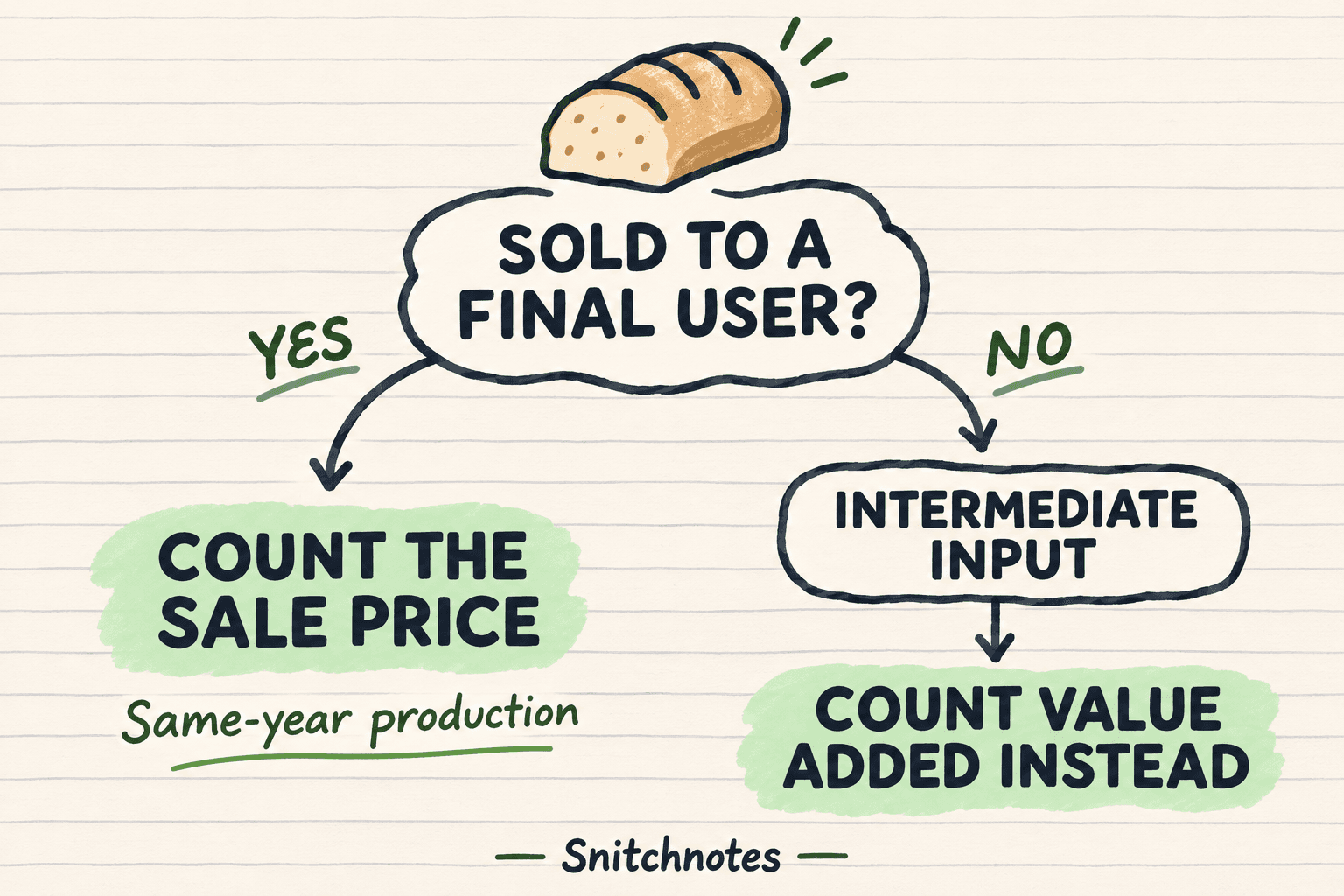
Ask who buys the item and what happens next. If a household, government, business investor, or foreign buyer acquires it for final use, count that final expenditure. If a producer buys it to transform or use up while making something else in the same period, treat it as an intermediate input. In a production question, use value added if the problem gives several stages and asks you to total their contributions.
- Final use: a family buys bread to eat, so the bread's sale price is counted.
- Intermediate use: a bakery buys flour to make bread, so do not add the flour's full price on top of the bread price.
- Value-added route: subtract each producer's purchased intermediate inputs from that producer's output.
Use one route consistently. Counting final expenditures and then adding value added would mix two equivalent measurement approaches and recreate the duplication you were trying to remove.
Worked example: wheat, flour, and bread
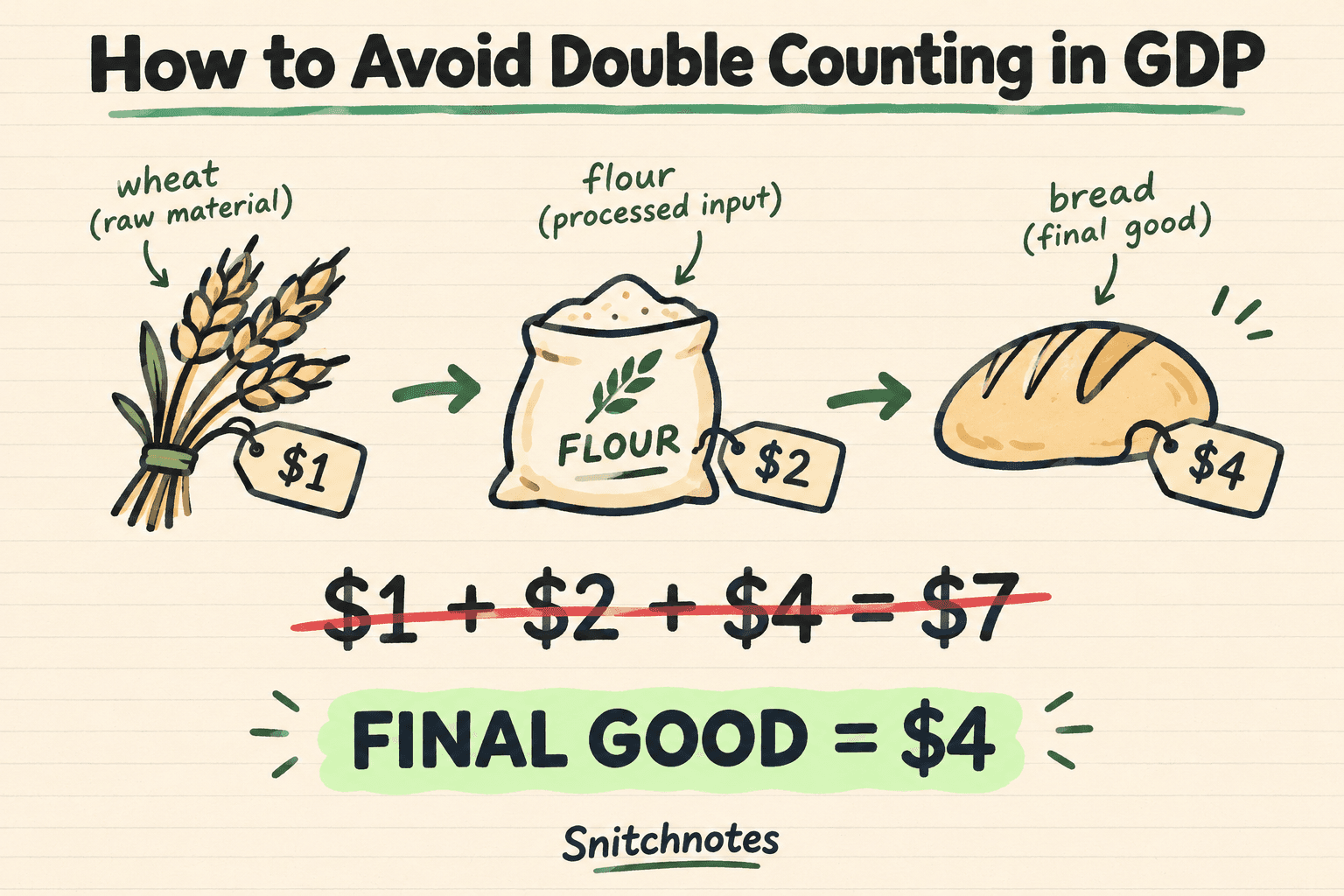
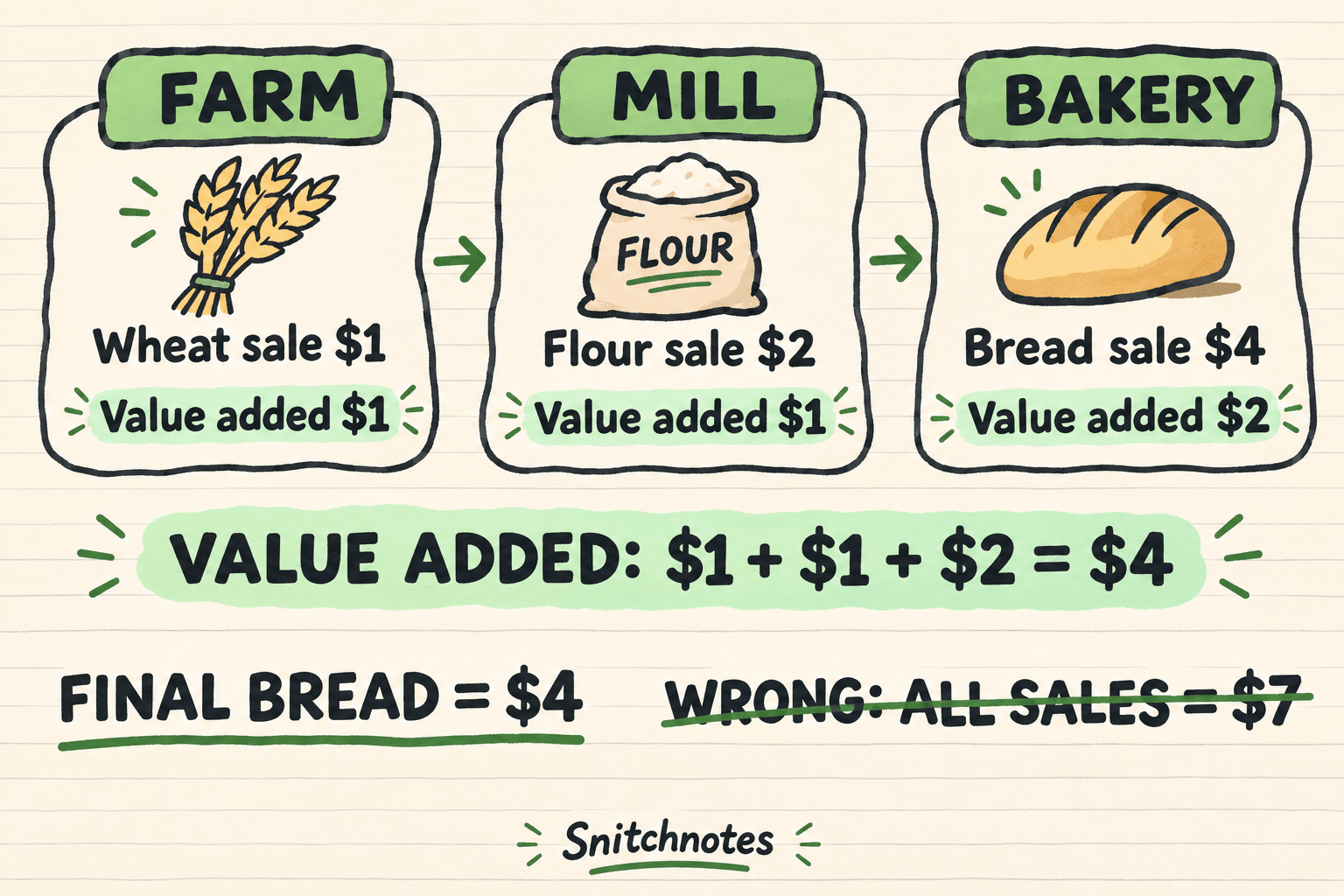
Suppose a farm sells wheat to a mill for $1. The mill turns it into flour and sells the flour to a bakery for $2. The bakery turns the flour into a loaf and sells the bread to a household for $4. If you add every sale—$1 + $2 + $4—you get $7. That answer is wrong because the $4 bread price already contains the economic value embodied in the wheat and flour.
The final-goods method counts only the $4 loaf bought by the household. The value-added method reaches the same answer stage by stage: the farm adds $1; the mill adds $1 because $2 minus its $1 wheat input equals $1; and the bakery adds $2 because $4 minus its $2 flour input equals $2. Total value added is $1 + $1 + $2 = $4.
This equality is your built-in error check. In a clean example, the sum of value added across the chain should match the value of the final product. If your value-added total exceeds the final price, you probably counted a full intermediate sale instead of only the extra value created at that stage.
Common boundaries that change the classification
An object is not permanently final or intermediate. Its use decides. A computer bought by a student is a final consumption good; a computer bought by a firm can be final investment because it is durable capital, not something used up inside another product this period. Flour bought by a bakery is intermediate, while flour bought by a household is final consumption.
Inventory is another boundary. If a firm produces a good this year but does not sell it, the increase in inventory is treated as investment, so current production is still counted. When that stored item is sold later, national accounts avoid counting its production a second time. Used goods are generally excluded because they were produced in an earlier period, although a current service fee for arranging the resale can be new production.
Also avoid confusing intermediate inputs with factors of production. Wages paid to workers are part of the income generated by current production, not a purchased intermediate good to subtract in a basic value-added calculation. Subtract goods and services bought from other producers, such as wheat, flour, electricity, or delivery services used in production.
Check your understanding
A café buys a cake for $18 and sells slices to customers for $30. What enters GDP?
Using the final-goods route, count the $30 paid by the customers, not $18 + $30. Using value added, the cake supplier contributes $18 and the café contributes $12, giving the same $30 total.
Why is a delivery van not automatically an intermediate good?
A firm uses a van over several periods rather than using it up inside one current product. The new van is generally final investment. Fuel consumed during deliveries, by contrast, is an intermediate input.
What is the fastest arithmetic check?
Add value added across every stage and compare it with the final-good price. The totals should match in the simplified production chain.
If national-accounts exercises keep blurring together, Snitchnotes can turn your own economics slides, notes, and practice material into organized explanations, flashcards, and quizzes for review.
Related concepts
- Nominal GDP vs real GDP: learn how prices and output affect GDP after you have classified what should be counted.
- How to read a balance of payments table: practice another accounting framework where signs and categories matter.
- Deadweight loss in supply and demand: connect national accounting with the difference between total output and economic welfare.
Sources
U.S. Bureau of Economic Analysis: Guide to the Interactive GDP-by-Industry Accounts Tables
International Monetary Fund: Gross Domestic Product—An Economy's All
OpenStax: Measuring the Size of the Economy—Gross Domestic Product
Convierte tus clases en material listo para el examen.
Apuntes, quizzes, podcasts, flashcards y chat — con solo subir un archivo.
Prueba tu primer apunte gratis