
Snitchnotes Team
How to Study Brain Lesions With Function-Deficit Maps
How to Study Brain Lesions With Function-Deficit Maps
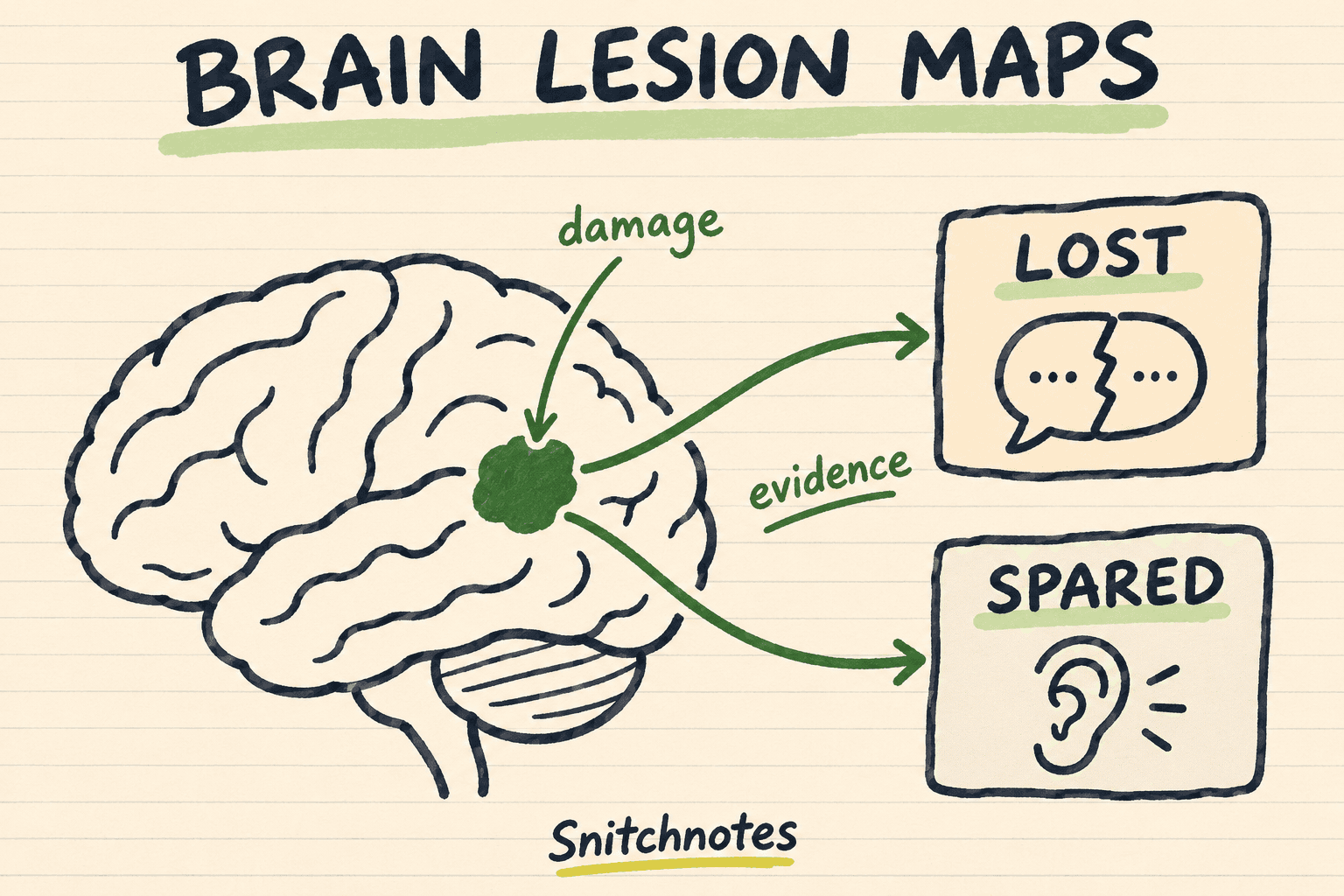
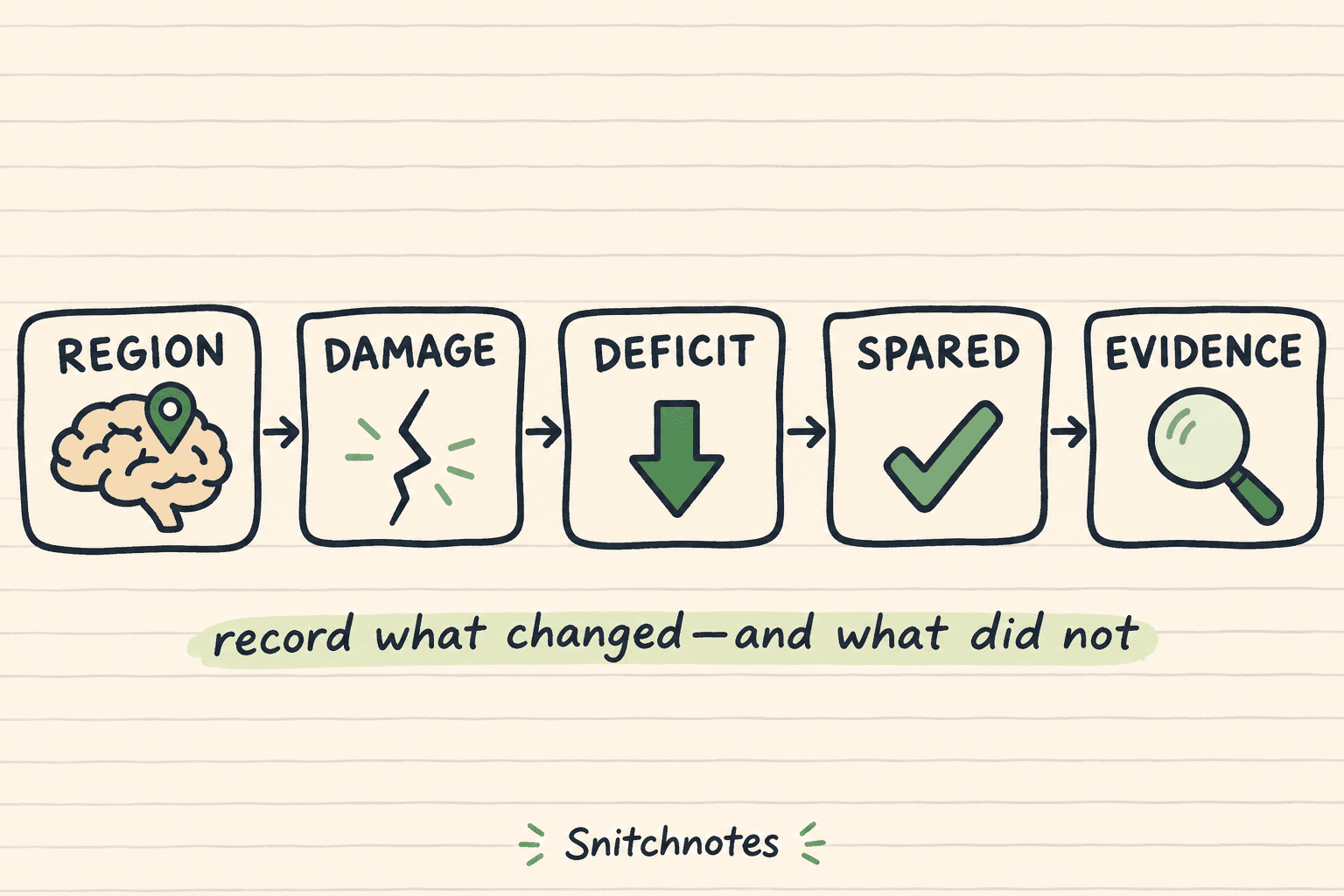
To study brain lesions, make a function-deficit map for each case: write the damaged region, the lost or weakened function, the functions that remain intact, the evidence, and the limit on what you can conclude. Then compare maps instead of memorizing region-name pairs. A lesion is informative because it creates a pattern of change, not because one damaged spot automatically equals one mental function.
This method is for psychology and neuroscience students who need to explain cases on an exam. It helps you turn cases such as a nonfluent language disorder or severe anterograde amnesia into predictions you can test, while remembering that most complex abilities depend on networks.
Why a function-deficit map works
A simple flashcard saying “Broca area equals speech” hides the useful reasoning. Which part of speech was affected: fluency, articulation, grammar, repetition, naming, or comprehension? Which abilities were relatively spared? Was the lesion confined to one cortical patch, or did it affect nearby tissue and connections? A map forces those questions onto the page.
Lesion evidence can support causal reasoning because damage occurs before a new deficit. But one case rarely proves that a function lives in one isolated location. Modern causal mapping research compares many lesions and also asks whether different lesion sites that produce the same symptom belong to a connected network.
Build a five-part function-deficit map
- Region: name the structure or network as precisely as the evidence allows, including side of the brain when known.
- Damage: record whether the case involves stroke, surgery, injury, degeneration, or another cause, plus the lesion's extent when available.
- Deficit: describe the observed behavior specifically. Write “effortful, nonfluent speech” rather than the vague word “language.”
- Spared function: list what the person can still do. Preserved comprehension, working memory, perception, or skill learning narrows the claim.
- Evidence and limit: state what supports the link, then add one caution such as lesion size, recovery, pre-existing illness, or network disruption.
Use one row per case and one column per category. After completing a row, cover the deficit and predict it from the lesion. Then cover the lesion and work backward from the pattern of lost and spared abilities. Two-way retrieval is much stronger than rereading a finished table.
Worked comparison: language versus memory
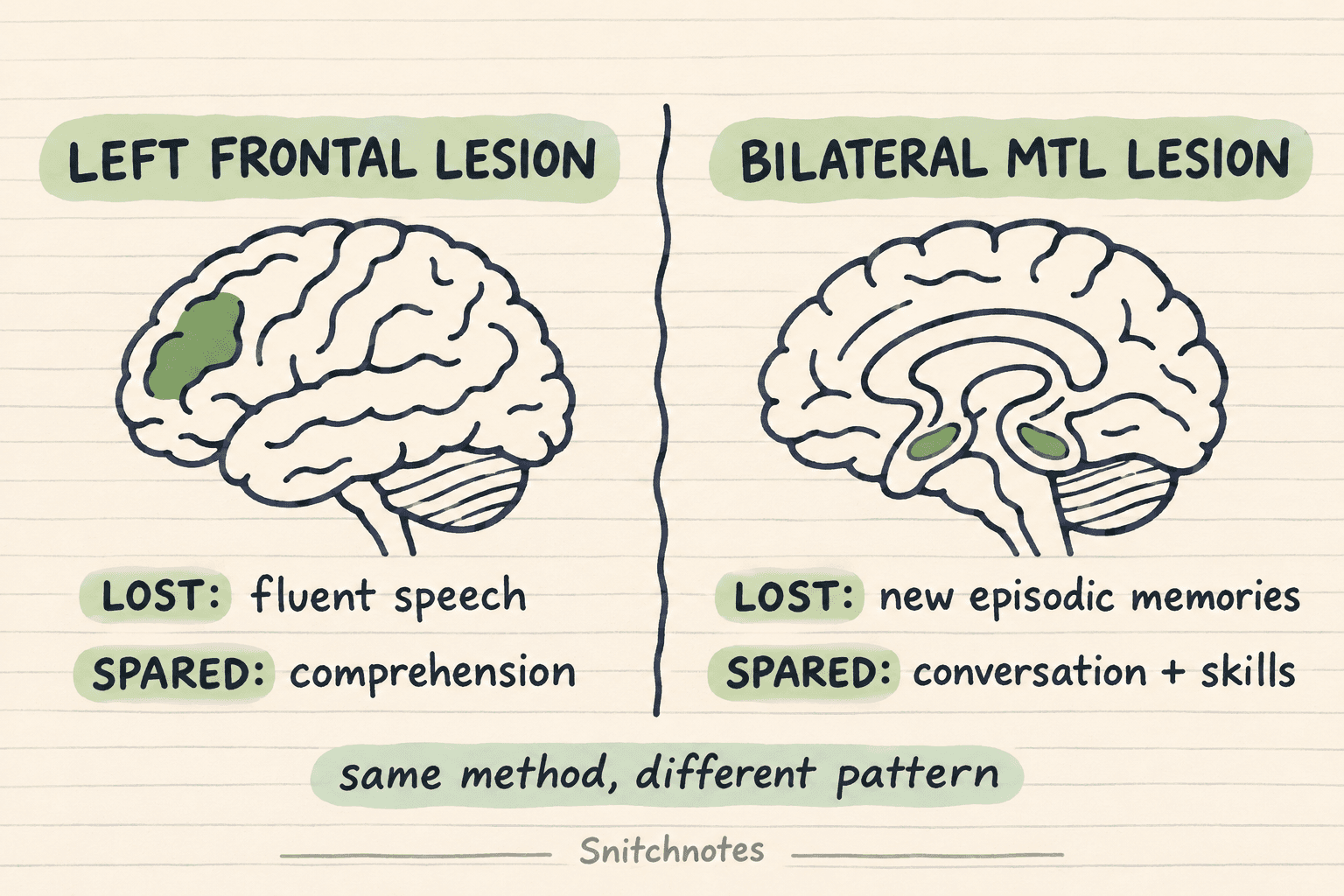
Start with a simplified language case. A patient has damage involving the left inferior frontal language region. Speech is halting and effortful, but comprehension is relatively good. Your map should not say merely “speech lost.” Record impaired fluent production, relatively spared comprehension, and the caution that real aphasia profiles vary with lesion extent and connected tissue.
Now compare a memory case modeled on Henry Molaison, known as H.M. After bilateral medial temporal surgery, he could converse and keep information active briefly, yet he was profoundly impaired at forming new declarative memories. Later research also showed preserved forms of learning, including motor-skill learning. The contrast matters: conversation and learning are not single, indivisible abilities.
Put the cases side by side. The first pattern predicts difficulty producing fluent speech despite useful understanding. The second predicts normal-looking conversation in the moment but poor memory for the episode later. On an exam, that comparison lets you explain both localization and functional dissociation rather than reciting two disconnected facts.
Turn maps into active study
Study in short rounds. First, reconstruct each map from memory. Second, compare two cases and name the most diagnostic spared function. Third, change one fact and predict the result: if comprehension were also severely impaired, would the same language label still fit? If working memory were absent, would the H.M.-style pattern still be the best match?
Finish by writing one cautious inference sentence: “This case supports the claim that the damaged region or network is necessary for this component under these conditions.” The wording is deliberately narrower than “this region controls the function.” That small habit protects you from the most common overstatement in lesion questions.
The boundary: lesions reveal networks, not tiny boxes
Textbook diagrams are cleaner than brains. A stroke may interrupt white-matter pathways as well as cortex, and two patients with apparently similar lesions may differ in anatomy, recovery, and testing. H.M.'s operation affected medial temporal structures beyond the hippocampus, and postmortem reconstruction found residual hippocampal tissue plus other pathology. His case is powerful, but it is not a perfectly isolated hippocampus experiment.
Treat named areas as useful entry points, then ask what larger circuit the task needs. A strong answer can say both “this deficit followed damage here” and “the behavior emerges from a distributed system.” Those statements are not contradictory; the second tells you how cautiously to interpret the first.
Check your understanding
Why record spared functions?
Spared functions constrain the explanation. If comprehension remains useful while fluent production is impaired, the case does not support a claim that all language was lost.
What does the H.M. comparison show?
It separates the ability to converse and hold information briefly from the ability to form lasting new declarative memories, while also showing that some nondeclarative learning can remain.
What is the safest causal conclusion from one lesion case?
Say the case supports a necessary role for the damaged region or network in a specific component, while noting lesion extent, connected tissue, and individual variation.
Related concepts
- Double dissociation: two cases show that function A can be impaired while B is spared, and function B can be impaired while A is spared.
- Lesion network mapping: linking symptoms to connected circuits when lesion locations differ.
- Why memories change during recall and reconsolidation
- Classical versus operant conditioning
- Cognitive dissonance explained with a real-life example
Sources
Scoville and Milner: Loss of Recent Memory After Bilateral Hippocampal Lesions
Annese and colleagues: Postmortem Examination of Patient H.M.'s Brain
National Center for Biotechnology Information: Neuroanatomy, Broca Area
Siddiqi and colleagues: Causal Mapping of Human Brain Function
Mach aus deinen Vorlesungen prüfungsfertiges Lernmaterial.
Notizen, Quizze, Podcasts, Karteikarten und Chat — aus einem Upload.
Erste Notiz kostenlos testen