
Snitchnotes Team
Primary vs Secondary Sources: Examples for Students
Primary vs Secondary Sources: Examples for Students
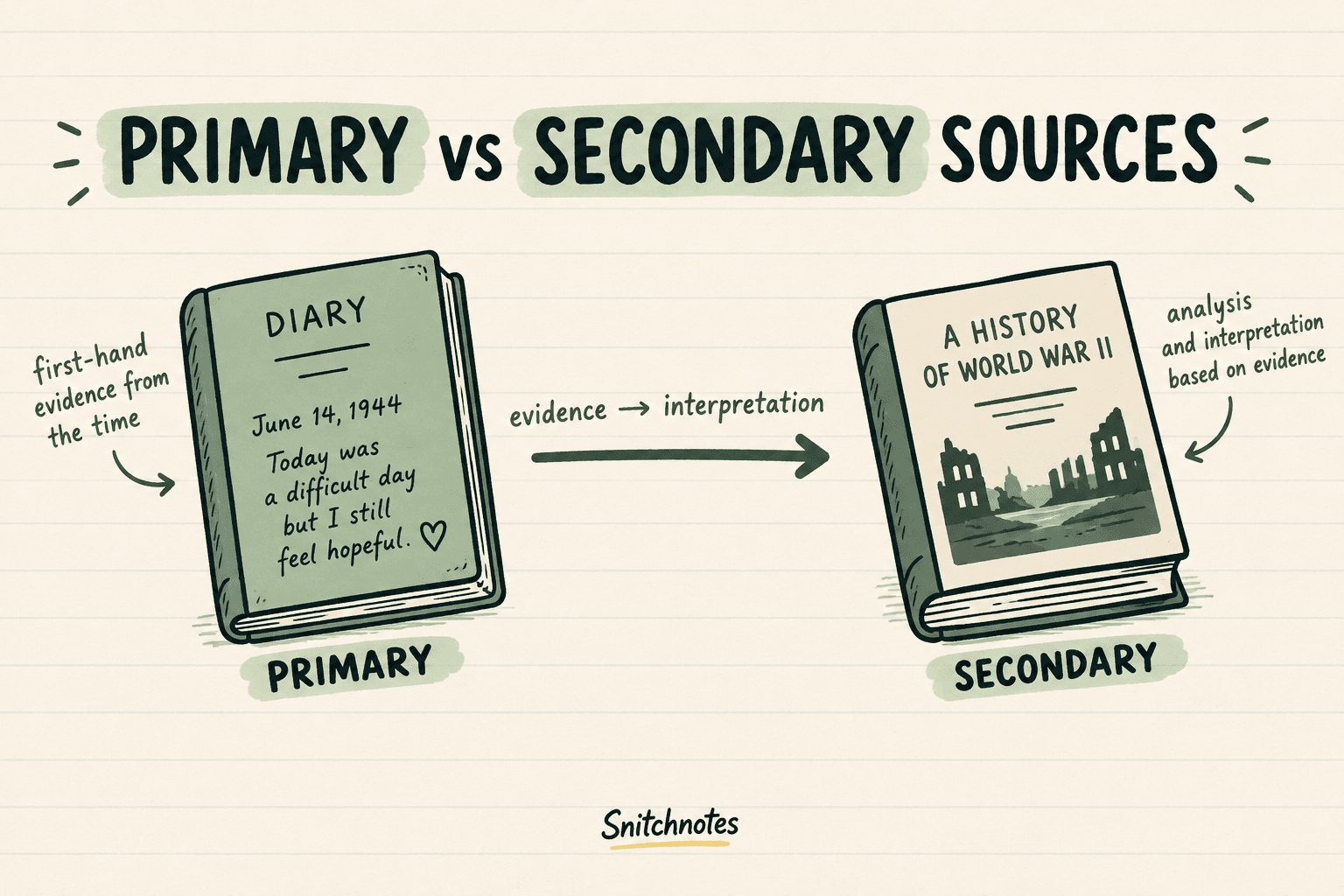
A primary source provides direct evidence, firsthand testimony, original data, or an original work connected to the subject you are studying. A secondary source stands one step back: it analyzes, interprets, summarizes, or evaluates primary sources. A diary from a historical event is usually primary; a historian's book explaining that event is secondary.
The distinction matters because assignments often ask you to do different jobs with each kind. Primary sources let you examine the evidence yourself. Secondary sources help you understand context, interpretations, and debates. Strong research usually uses both, but first you need to know which role each source plays.
Primary vs secondary sources at a glance
Primary does not mean “better,” and secondary does not mean “less trustworthy.” The labels describe a source's relationship to your research question, not its quality. A primary source gives you material to interpret; a secondary source gives you someone else's interpretation or synthesis of material.
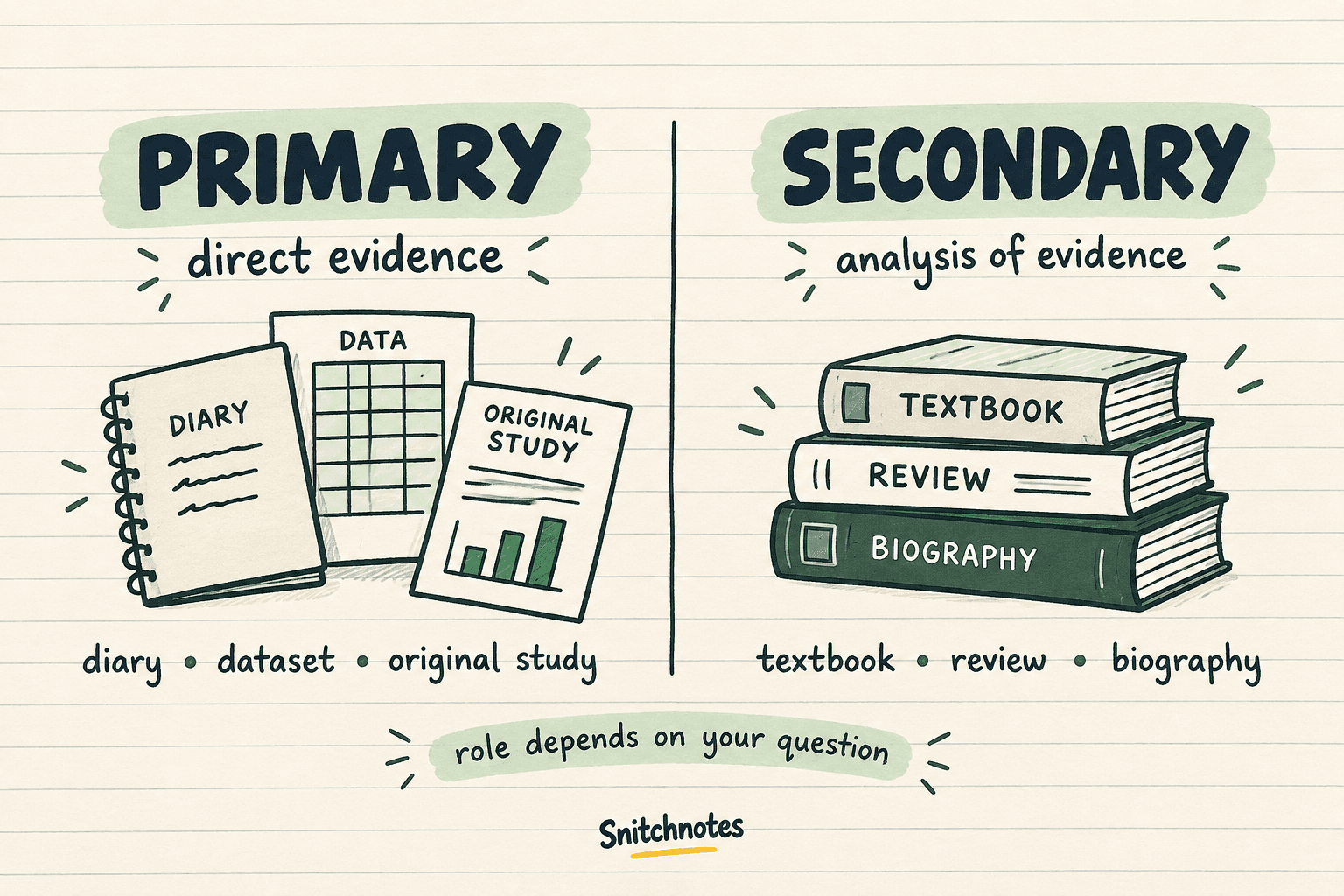
- Primary source: a letter, diary, photograph, speech, law, interview, dataset, experiment report, original research article, poem, novel, artwork, or other direct record relevant to the question.
- Secondary source: a textbook, biography, literature review, critical essay, documentary, or scholarly book that explains, compares, or evaluates primary material.
- Tertiary source: a reference work such as a general encyclopedia, index, or handbook that compiles established information and helps you get oriented.
Publication format alone cannot settle the question. A journal article reporting a new experiment can be primary, while a journal review that synthesizes dozens of experiments is secondary. A newspaper story written during an event may be primary evidence of contemporary reporting, yet an article summarizing research it did not conduct is secondary for a question about that research.
Primary and secondary source examples by subject
History
For a paper on a 1960s protest, photographs taken at the march, participants' letters, flyers distributed there, police records, and recorded interviews with witnesses can serve as primary sources. A recent book comparing the protest with other movements is secondary because the author selects and interprets evidence after the fact.
Science
In science, an article that reports the authors' methods, data, and results from a new study is generally primary research. A systematic review or textbook chapter that summarizes findings from many studies is secondary. Raw survey responses, laboratory measurements, patents, technical reports, and datasets may also be primary, depending on the question.
Literature and the arts
If you are analyzing a novel, the novel is your primary source. A critical essay about its narrator is secondary. For a painting, the artwork is primary and an art historian's interpretation is secondary. A review published when a play opened can be primary evidence for audience reception, even though it is secondary when used only as someone else's analysis of the play.
The same source can change categories
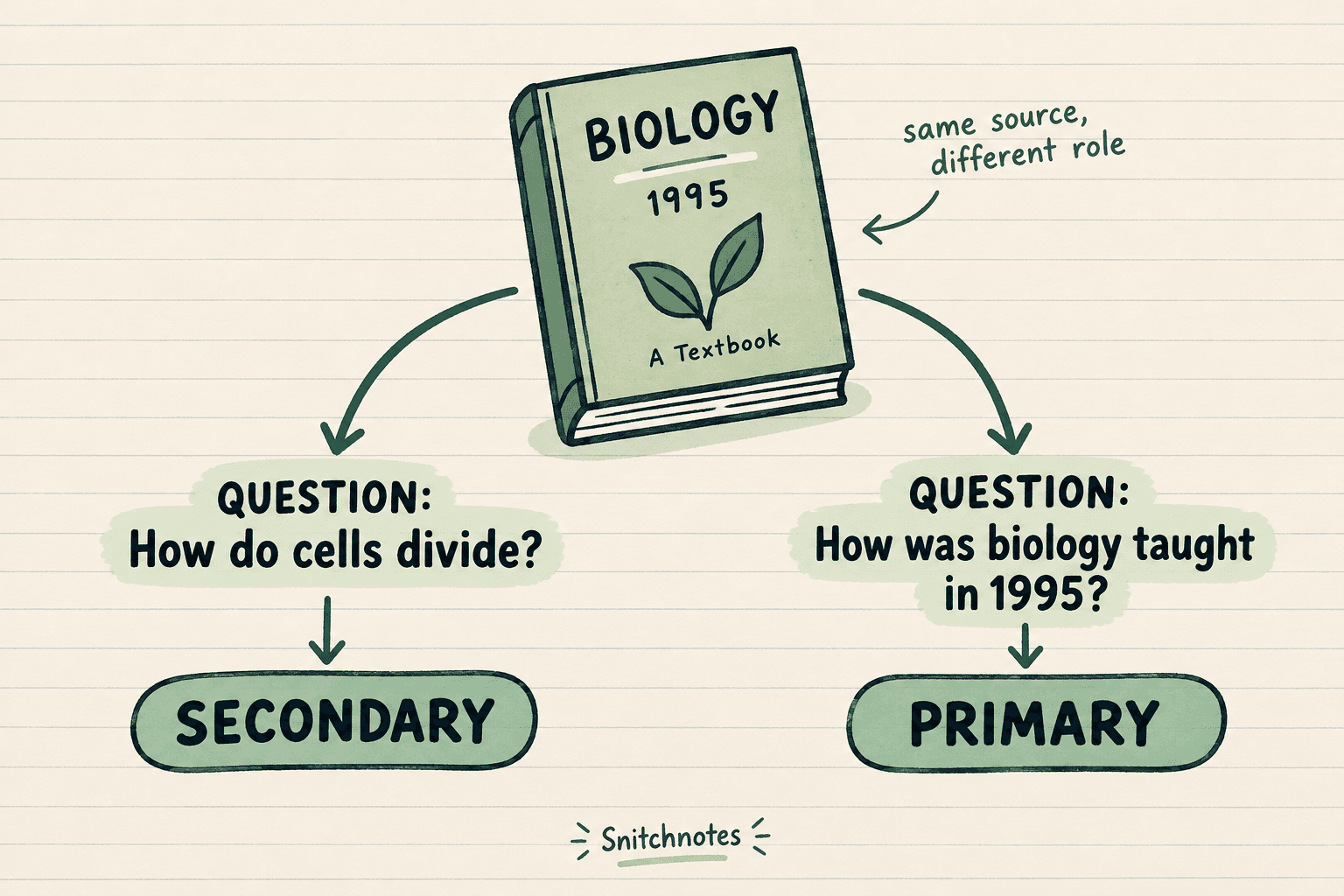
Here is the boundary students most often miss: sources are classified in relation to a question. Suppose you have a 1995 biology textbook. For a paper about how cells divide, it is a secondary explanation of scientific knowledge. For a paper about how schools taught cell division in the 1990s, the textbook itself is primary evidence.
The same logic applies elsewhere. A documentary is normally secondary when it edits interviews and archival footage into an argument about the past. But if your question asks how filmmakers in a particular decade represented that past, the documentary becomes the object you are directly studying and therefore functions as a primary source.
Time is useful, but it is not the whole rule. Memoirs and oral histories may be recorded long after an event and still provide firsthand testimony. Meanwhile, a newspaper report published the next morning can repeat rumors or analyze other accounts. Ask what evidence the item contains and how you plan to use it.
A quick decision tree for assignments
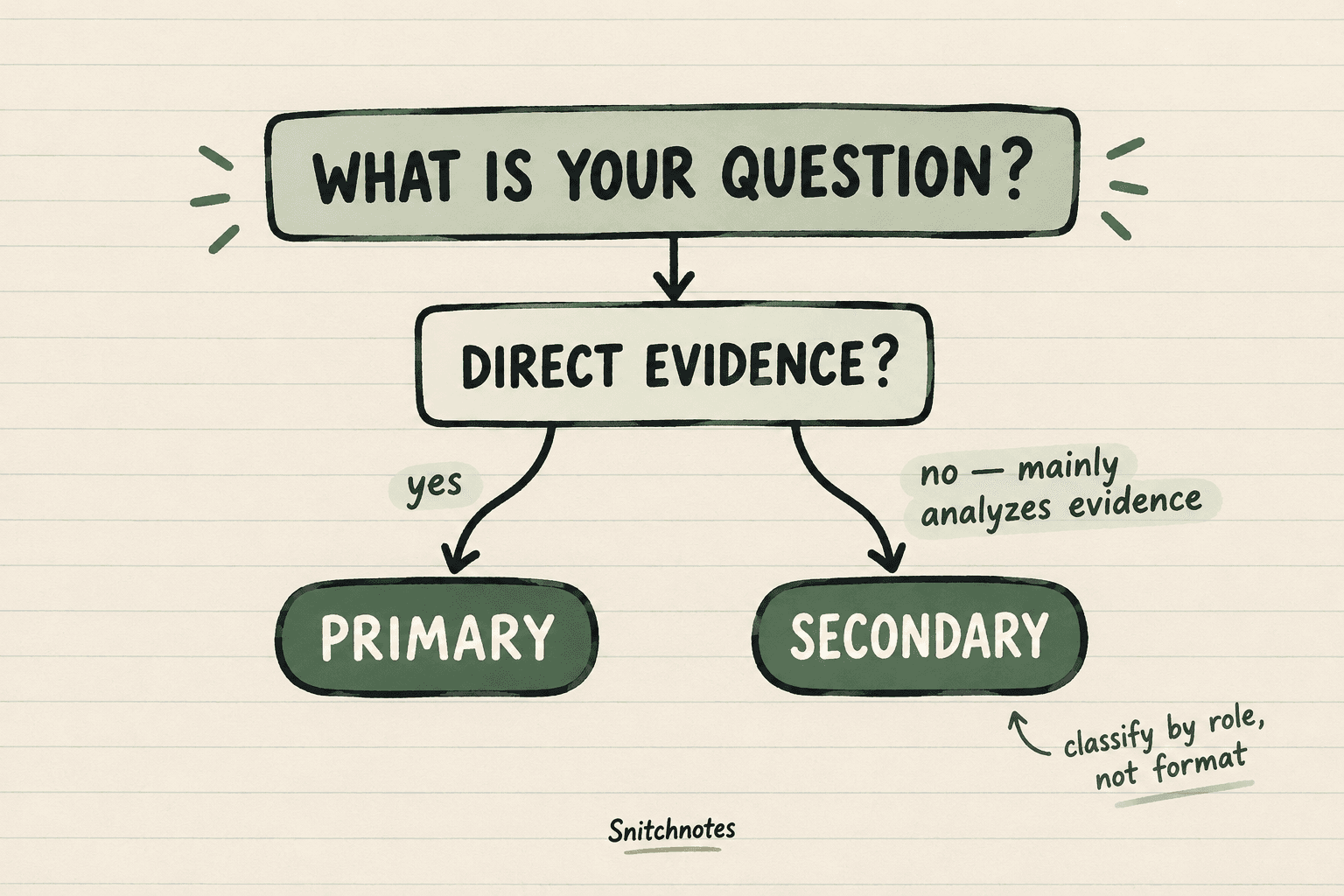
- Write your research question in one sentence. You cannot classify a borderline source reliably without knowing the question.
- Ask whether the source is the evidence or subject you will examine directly: an original document, observation, creative work, dataset, or firsthand account. If yes, it is functioning as primary.
- If the source mainly explains, evaluates, or combines evidence created by others, it is functioning as secondary.
- Check the assignment and discipline. Instructors sometimes use narrower definitions, and different fields classify research materials differently.
Try the test on a journal article. If it includes the authors' research question, methods, newly collected data, results, and discussion, it is probably a primary study. If it organizes and compares findings from previous studies without collecting new evidence, it is probably secondary. If you are still unsure, explain your reasoning to your instructor or a librarian rather than trusting the word “article” on its own.
Common misconceptions
- “Primary means unbiased.” No. Eyewitnesses, researchers, governments, and artists all have perspectives and limitations. Direct evidence still needs evaluation.
- “Primary means old.” No. Today's interview, election result, experiment, social media post, or photograph can be a primary source for a suitable question.
- “Secondary means unreliable.” No. A careful secondary source can compare many pieces of evidence, reveal context, and make its reasoning transparent.
- “A scanned copy is secondary.” No. A digital reproduction of a letter does not become a secondary source merely because you view it online, though you should verify its provenance and whether anything was omitted.
Classification is only the first quality check. For any source, ask who created it, for what audience and purpose, when and where it was created, what evidence it includes, and what might be missing. A primary source gets you closer to the evidence; it does not remove the need for skepticism.
Check your understanding
A researcher interviews ten commuters about a new transit policy. Is the interview transcript primary or secondary?
For a study of commuters' reported experiences, the transcript is primary evidence. An article that later compares and interprets those interviews is secondary for someone studying the policy, although the article may itself report primary research if its authors conducted the interviews.
Is a biography always a secondary source?
Usually it is secondary for a question about the person's life because the biographer interprets other evidence. But it could be primary for a question about how that person has been portrayed in biographies or how biography writing changed over time.
If your notes mix evidence, interpretations, and background reading, Snitchnotes can organize them into study notes, flashcards, and practice questions so you rehearse the distinction instead of only rereading definitions.
Related concepts
- How to analyze primary sources like a historian: evaluate context, purpose, audience, and limitations after identifying a source as primary.
- How to trace academic claims to their original sources: follow citations back from a summary or interpretation to the underlying evidence.
- Source evaluation: judging authority, evidence, context, relevance, and limitations rather than relying on a category label alone.
- Tertiary sources: tools that summarize established knowledge and point toward more detailed primary and secondary material.
Sources
Library of Congress: Types of Sources
National Archives: History in the Raw
Mach aus deinen Vorlesungen prüfungsfertiges Lernmaterial.
Notizen, Quizze, Podcasts, Karteikarten und Chat — aus einem Upload.
Erste Notiz kostenlos testen