
Snitchnotes Team
How to Learn Centripetal Force With Free-Body Diagrams
How to Learn Centripetal Force With Free-Body Diagrams
The simplest way to learn centripetal force is to draw a free-body diagram first, identify which real force or combination of forces points toward the center, and then set that inward net force equal to mv²/r. Do not add a separate arrow called centripetal force. The word centripetal describes the job done by the net inward force; friction, tension, gravity, a normal force, or a combination of forces can do that job.
This diagram-first habit matters because an object moving in a circle is constantly changing direction, even if its speed stays constant. That change in velocity requires acceleration toward the center. If your force diagram explains that inward acceleration, the equation becomes bookkeeping instead of guesswork. This guide is for students learning Newton's laws and uniform circular motion.
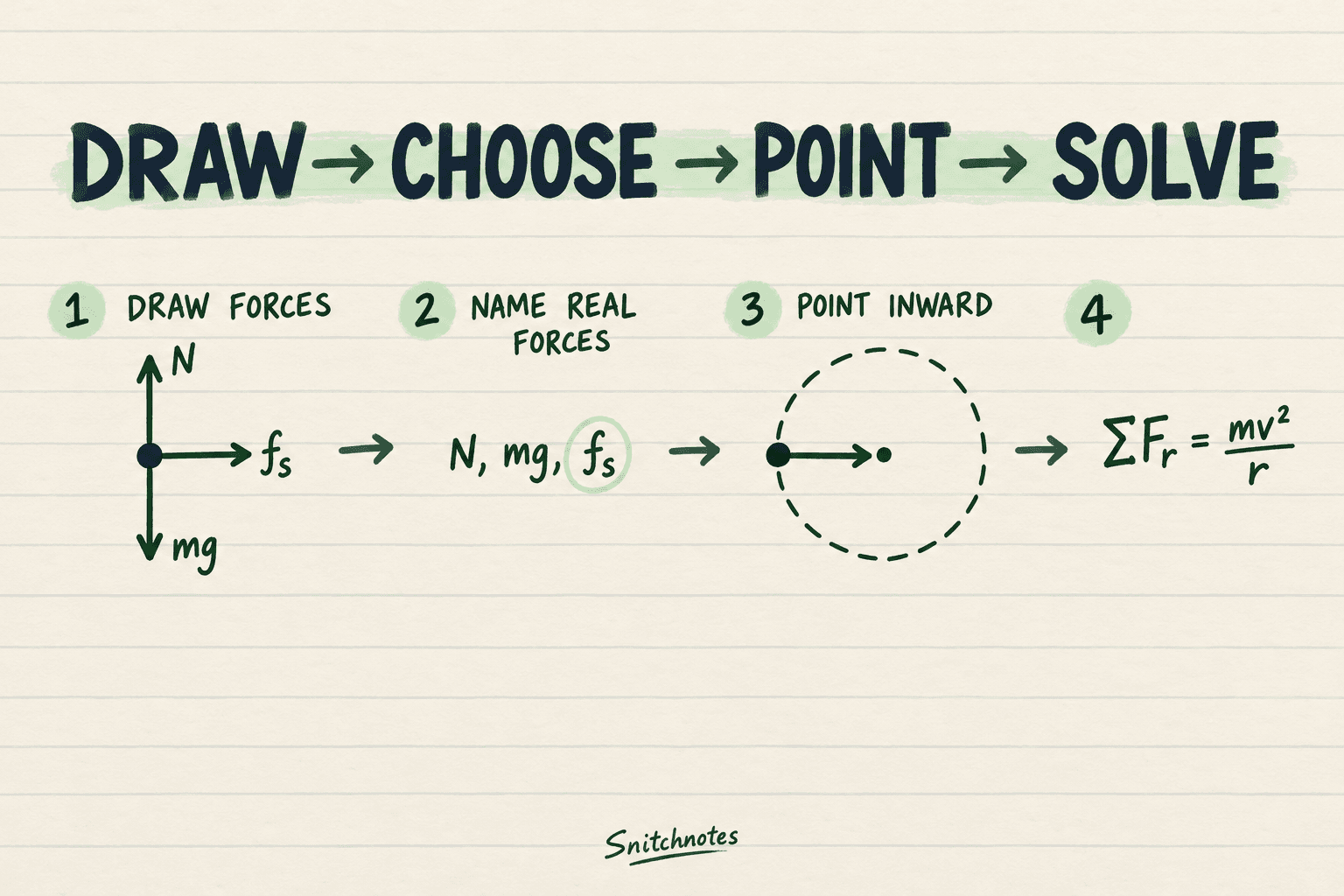
Use this four-step diagram-first routine
- Draw only real forces acting on the object. Typical labels are weight mg, normal force N, tension T, and friction f. Do not draw velocity as a force, and do not add an extra centripetal-force arrow.
- Choose a radial axis. Point its positive direction toward the center of the circular path. This turns the phrase inward into an unambiguous direction on the page.
- Project the real forces onto that radial axis. Add inward components and subtract outward components. Forces perpendicular to the radial direction do not contribute to the radial sum.
- Write ΣFᵣ = maᵣ = mv²/r and solve. The left side must contain the real force names from your diagram; mv²/r is the required net inward force, not a new physical interaction.
Keep units visible. Mass m is in kilograms, speed v in meters per second, radius r in meters, radial acceleration v²/r in meters per second squared, and the resulting force in newtons. The squared speed is easy to miss, so calculate v² before multiplying by mass.
Worked example: a car taking a level curve
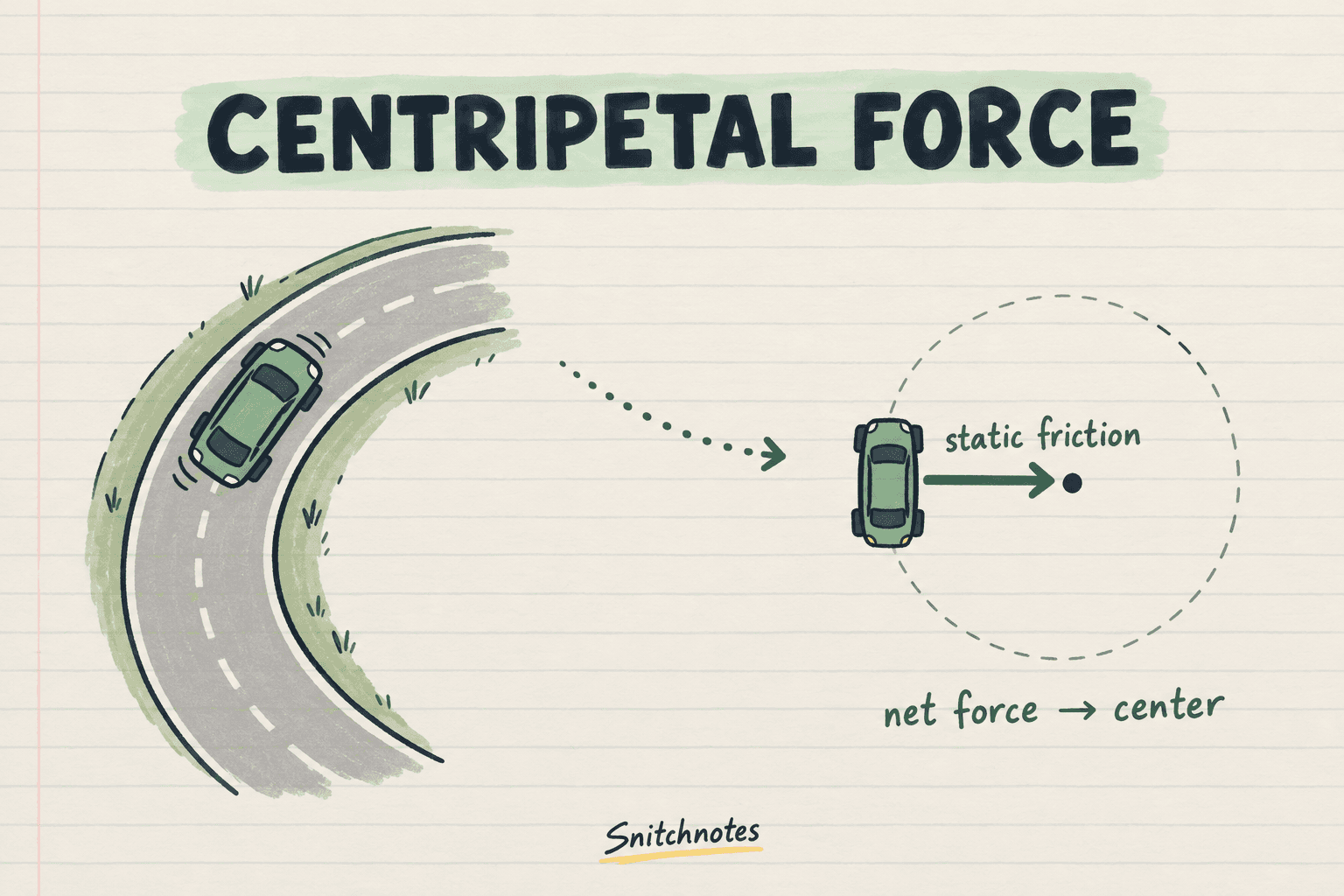
A 1,000-kilogram car travels at 10 meters per second around a level curve with radius 50 meters. Start with the free-body diagram. Weight mg points down, the road's normal force N points up, and static friction points horizontally toward the curve's center. There is no separate centripetal-force arrow.
The vertical acceleration is zero, so N and mg balance. Static friction is the only horizontal force and therefore supplies the entire inward net force. First find the radial acceleration: aᵣ = v²/r = (10 m/s)² ÷ 50 m = 2 m/s². Then apply Newton's second law radially: fₛ = maᵣ = 1,000 kg × 2 m/s² = 2,000 N.
That 2,000-newton result is the amount of inward static friction required at this speed and radius. It is not automatically the maximum friction the tires can provide. If the available tire-road friction is lower, the car cannot follow the requested circle. In the ground frame it continues more nearly along its tangent while the road curves away; an outward force does not suddenly appear.
Centripetal force is a role, not an extra force
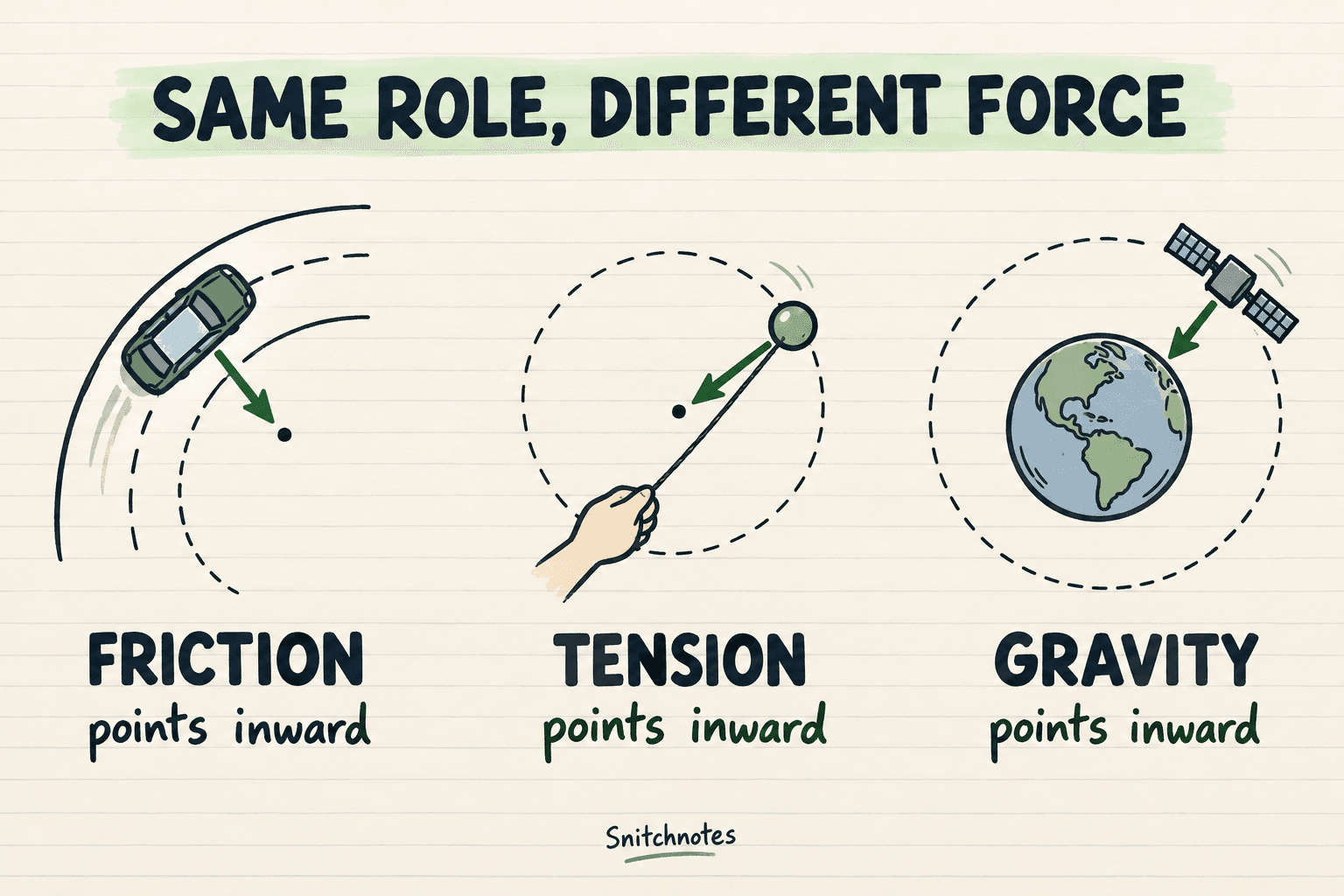
Ask, “What interaction points toward the center here?” For a car on a level road, the answer is usually static friction. For a ball moving in a horizontal circle on a string, tension has an inward component. For a satellite in an approximately circular orbit, gravity supplies the inward force. The mathematical role is the same even though the physical interactions differ.
Some problems use more than one radial force. At the bottom of a vertical loop, for example, the normal force can point toward the center while weight points away from it. The radial equation is then N − mg = mv²/r if inward is positive. At the top of the loop, both N and mg may point inward, so their radial contributions add. A free-body diagram decides the signs before algebra begins.
Separate velocity from force
For uniform circular motion, instantaneous velocity is tangent to the path while radial acceleration points toward the center. Those arrows are perpendicular. The inward force changes the direction of velocity from moment to moment; it does not need to increase the object's speed. Confusing the tangent velocity arrow with a force arrow is one of the fastest ways to produce a wrong diagram.
Also remember the boundary of the formula. The expression v²/r gives the radial acceleration at an instant along a path with local radius r. If speed is changing, there is also tangential acceleration, so the total acceleration is not purely inward. You can still use ΣFᵣ = mv²/r for the radial direction, but you may need a separate tangential force equation.
Common misconceptions to correct
- “Centripetal force” is not a fifth kind of force beside gravity, tension, friction, and the normal force. It names the net inward result of real forces.
- Constant speed does not mean zero acceleration. Velocity includes direction, and direction changes continuously around a circle.
- The velocity does not point toward the center. It is tangent to the path at that instant; the radial acceleration points inward.
- An object released from circular motion does not fly radially outward. Without enough inward force, it follows its instantaneous tangent, ignoring other forces.
Check your understanding
What supplies the centripetal force for the car in the example?
Static friction between the tires and road supplies the 2,000-newton inward net force. The normal force and weight cancel vertically, so neither contributes to the horizontal radial sum on a level road.
What happens to the required force if speed doubles?
It becomes four times as large because v is squared. At 20 meters per second with the same mass and radius, the required inward force would be 8,000 newtons.
Why should you draw the diagram before using mv²/r?
The diagram identifies the real forces and their directions. Without it, you may invent an extra force, use the wrong sign, or overlook that several force components combine to produce the inward net force.
Related concepts
- Dimensional analysis in chemistry: a step-by-step method
- Why stars twinkle but planets do not
- Newton's second law: connecting net force, mass, and acceleration in any coordinate direction.
Sources
OpenStax University Physics Volume 1: Centripetal Force
Mach aus deinen Vorlesungen prüfungsfertiges Lernmaterial.
Notizen, Quizze, Podcasts, Karteikarten und Chat — aus einem Upload.
Erste Notiz kostenlos testen