
Snitchnotes Team
How to Check a Mathematical Proof Before Submitting It
How to Check a Mathematical Proof Before Submitting It
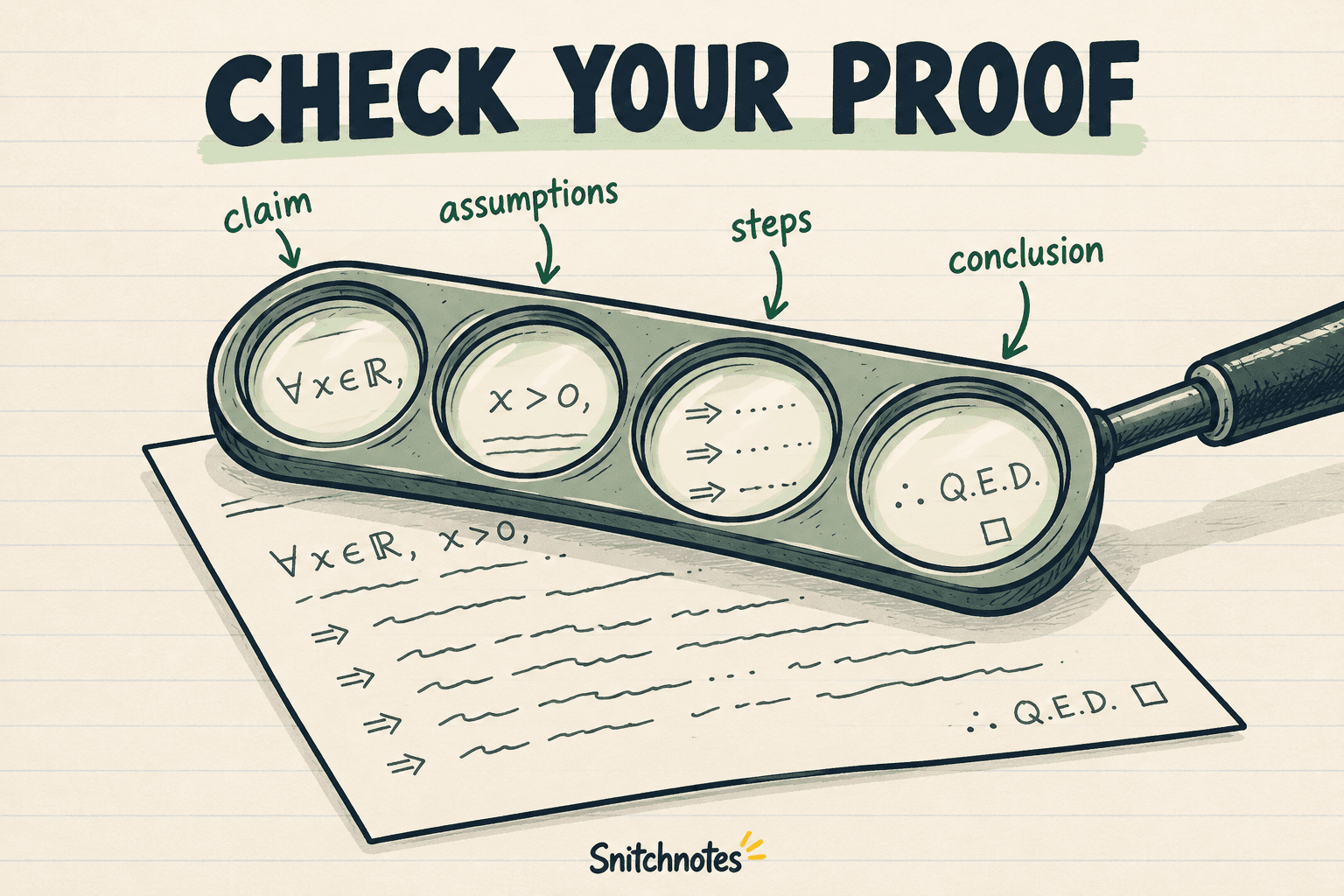
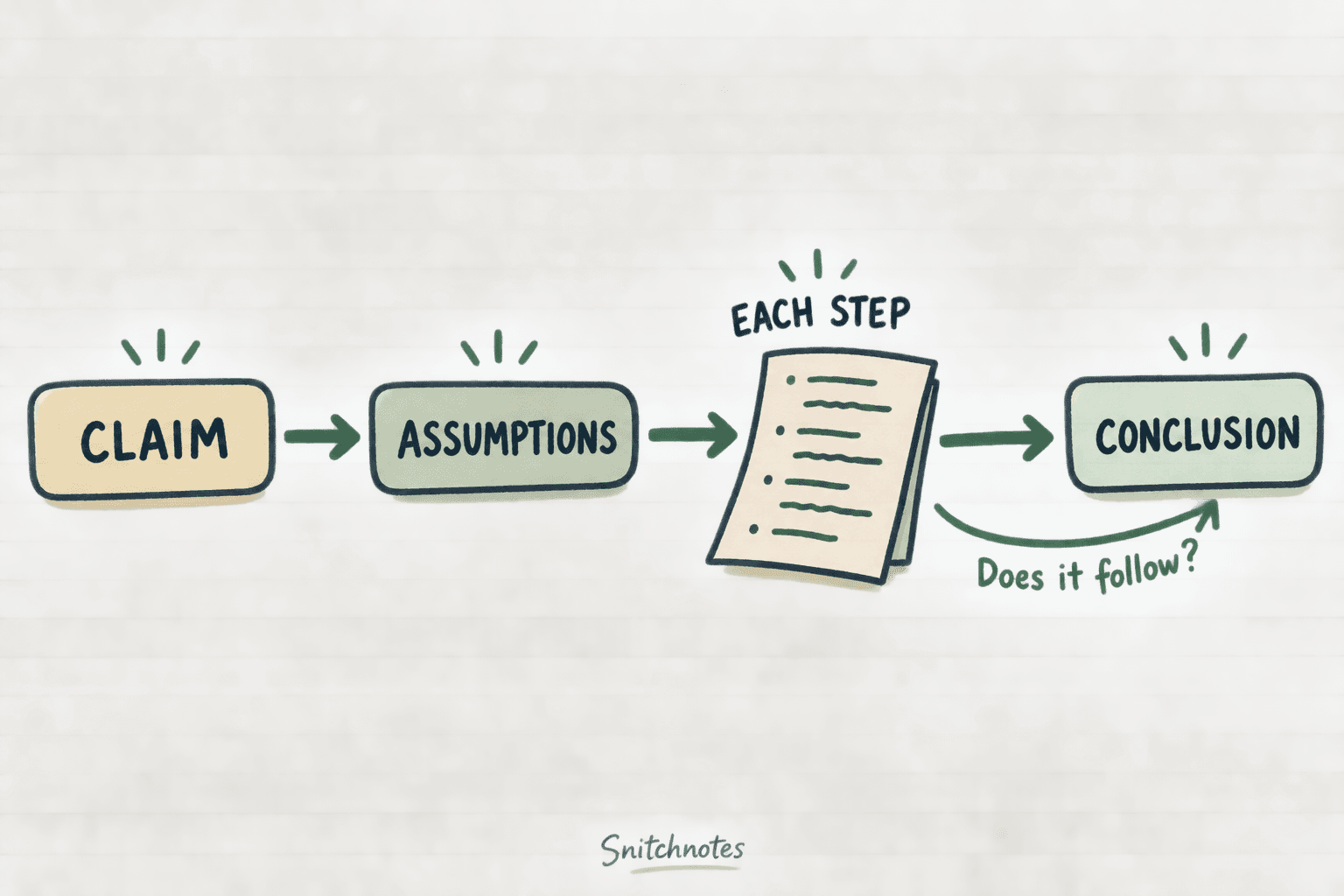
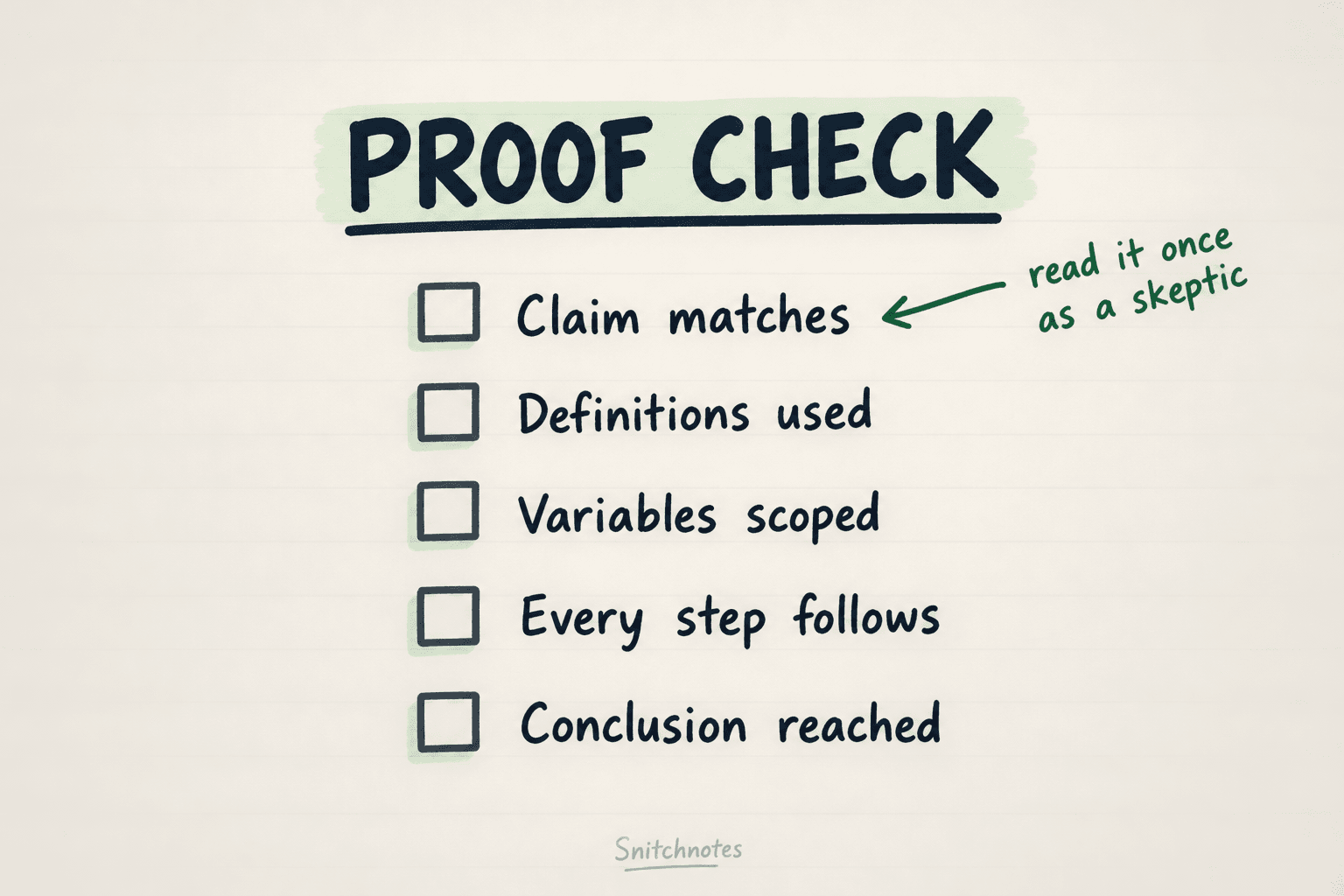
To check a mathematical proof, read it in five passes: compare the conclusion with the exact claim, list the assumptions, expand the definitions, justify every transition, and confirm that all variables are introduced with the right domain. Then read the proof once as a skeptical reader who is allowed to ask “why?” after every sentence.
This process does more than catch arithmetic slips. It finds the gaps that make an argument invalid even when the final statement happens to be true: a hidden assumption, an unscoped variable, a theorem used without its conditions, or a conclusion that is close to—but not quite—the one requested.
Why proof checking matters
A proof is not a record of what you tried; it is an argument showing why a conclusion must follow from stated assumptions. A correct answer at the bottom cannot repair a broken link above it. Stanford’s proofwriting checklist therefore emphasizes stating assumptions and the goal, properly introducing variables, using definitions, and making each sentence carry part of the argument.
Checking also improves readability. Mathematical notation compresses ideas, but compression can hide missing logic. The Carnegie Mellon University and University of California, Berkeley guides both stress that a proof should communicate a coherent argument, not present a pile of unexplained symbols. Your reader should be able to tell what is known, what is being shown, and why each move is permitted.
A five-pass proof check
Pass 1: Match the conclusion to the claim
Underline the exact statement to prove, including words such as every, some, if, only if, and unique. Now compare it with your last sentence. If the task asks for an equivalence, have you proved both directions? If it asks for existence, did you produce or justify an object? If it asks for uniqueness, did you show that no second object can work?
Pass 2: Inventory assumptions and definitions
Write the permitted assumptions in the margin. Separate them from facts you merely hope are true. Then expand the important definitions. “n is even” means there exists an integer k such that n = 2k; it does not simply mean that n looks divisible by two in a few examples. Definitions often supply the first valid step of the proof.
Pass 3: Audit variables and quantifiers
Circle every variable when it first appears. Ask where it came from, what set it belongs to, and whether it is arbitrary or specially chosen. “Let x” is incomplete when the domain matters. The Rutgers guide highlights how proof methods depend on the logical form of a statement; confusing “for every” with “there exists” changes the claim itself.
Pass 4: Challenge every arrow
Between consecutive sentences, ask: does this follow, and by what rule? Name the definition, algebraic operation, earlier result, or theorem. Check every theorem’s hypotheses before using its conclusion. Test suspicious algebra separately, but remember that numerical examples can reveal a false universal statement and still cannot prove a universal statement true.
Pass 5: Remove ambiguity
Replace vague words such as obviously, clearly, and it with the missing reason or noun. Read each displayed equation as part of a sentence. A proof can be concise without becoming cryptic: remove repetition, not justification. If a class has specific conventions for cited theorems, notation, or proof endings, check those too.
Maya’s even-integers proof
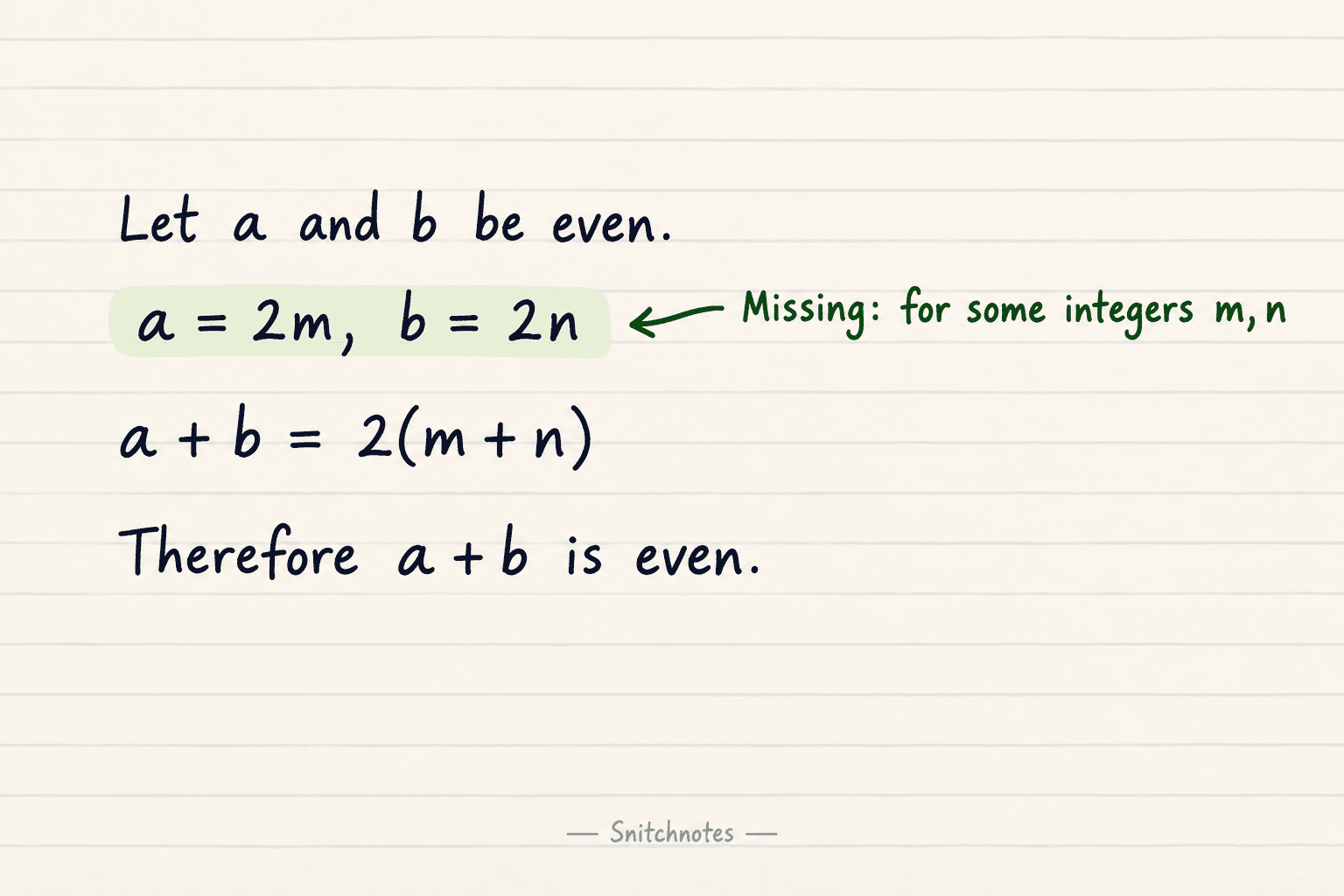
Maya must prove that the sum of two even integers is even. Her draft says: “Let a and b be even. Write a = 2m and b = 2n. Then a + b = 2(m + n). Therefore a + b is even.” The calculation looks familiar, but the five-pass check asks whether every definition and variable is doing legal work.
The claim and conclusion match, and the algebra is correct. The gap is that Maya never says m and n are integers. From the definition of even, she may write a = 2m and b = 2n for some integers m and n. Then m + n is an integer because integers are closed under addition, so a + b equals two times an integer and is therefore even.
That missing phrase is small, but it carries the final implication. If m + n were not known to be an integer, the expression 2(m + n) would not by itself establish evenness. This is exactly why variable domains and definitions deserve their own pass instead of being bundled into a quick algebra check.
Common traps and useful boundaries
Do not confuse checking a proof with proving it again by a different method. Your aim is to verify that the submitted argument is complete. Trying another method can be a useful diagnostic when you suspect the result, but two unfinished approaches do not combine into one valid proof.
Also, not every omitted algebra line is a logical gap. You may compress routine work when the intended reader can reconstruct it and no condition is hidden. By contrast, never compress a domain restriction, a division by a quantity that could be zero, a change in quantifier, or the hypothesis of a theorem. Those details control whether the step is valid.
The final submission pass
Set the proof aside briefly, then read it from the beginning without using the reasoning still in your head. Check the claim, definitions, variable scope, every implication, and the final sentence. Read it aloud if the prose feels tangled. Finally, inspect notation, references, and any diagrams against the assignment’s requirements.
Check your understanding
Why is testing five examples not a proof of a universal claim?
A universal claim covers every allowed case. Five successes leave all untested cases unresolved, although one genuine counterexample would be enough to disprove the claim.
What should you check when a theorem appears in a proof?
Identify the theorem, verify every hypothesis in the current situation, and confirm that its conclusion is exactly the statement used in the next step.
What was missing from Maya’s proof?
She needed to state that m and n are integers and use closure under addition, so m + n is an integer and 2(m + n) fits the definition of an even integer.
Related concepts
- Quantifier: a word or symbol, such as every or there exists, that states how widely a claim applies.
- Counterexample: one allowed case that makes a universal claim false.
- How to study discrete mathematics
- How to study for problem-solving exams without memorizing solutions
Sources
Stanford University CS103: Proofwriting Checklist
Carnegie Mellon University 15-251: Guidelines for Writing Proofs
University of California, Berkeley: How to Write Mathematical Proofs
Mach aus deinen Vorlesungen prüfungsfertiges Lernmaterial.
Notizen, Quizze, Podcasts, Karteikarten und Chat — aus einem Upload.
Erste Notiz kostenlos testen