
Snitchnotes Team
How to Study Electromagnetic Induction With Flux-Change Sketches
How to Study Electromagnetic Induction With Flux-Change Sketches
The most reliable way to study electromagnetic induction is to sketch the magnetic flux before, during, and after a change. First mark the original field through the loop. Next decide whether that flux is increasing or decreasing. Then draw the induced field that opposes the change, use a right-hand rule to find the current, and calculate the emf from the rate of flux change.
This order matters. It keeps three ideas that students often mix together—flux, direction, and magnitude—in separate boxes. The sketch handles the physical story; Lenz's law handles the direction; Faraday's law handles the size of the induced emf.
Why electromagnetic induction feels harder than it is
An induction problem can show a moving magnet, a rotating loop, a changing field, or a changing loop area. These look like different tricks, but they share one mechanism: the magnetic flux through a circuit changes. Magnetic flux measures how much magnetic field passes through a chosen surface; for a uniform field and a flat loop, its magnitude can be written as Φ = BA cos θ, where θ is the angle between the field and the surface's normal direction.
Flux can therefore change because B changes, the loop area A changes, the angle θ changes, or the loop moves into a region with a different field. OpenStax notes that relative motion matters in the familiar magnet-and-coil experiment: a stationary magnet relative to the coil produces no emf even if the magnet's field itself is strong. The trigger is change, not merely the presence of magnetism.
Use a before-during-after flux sketch
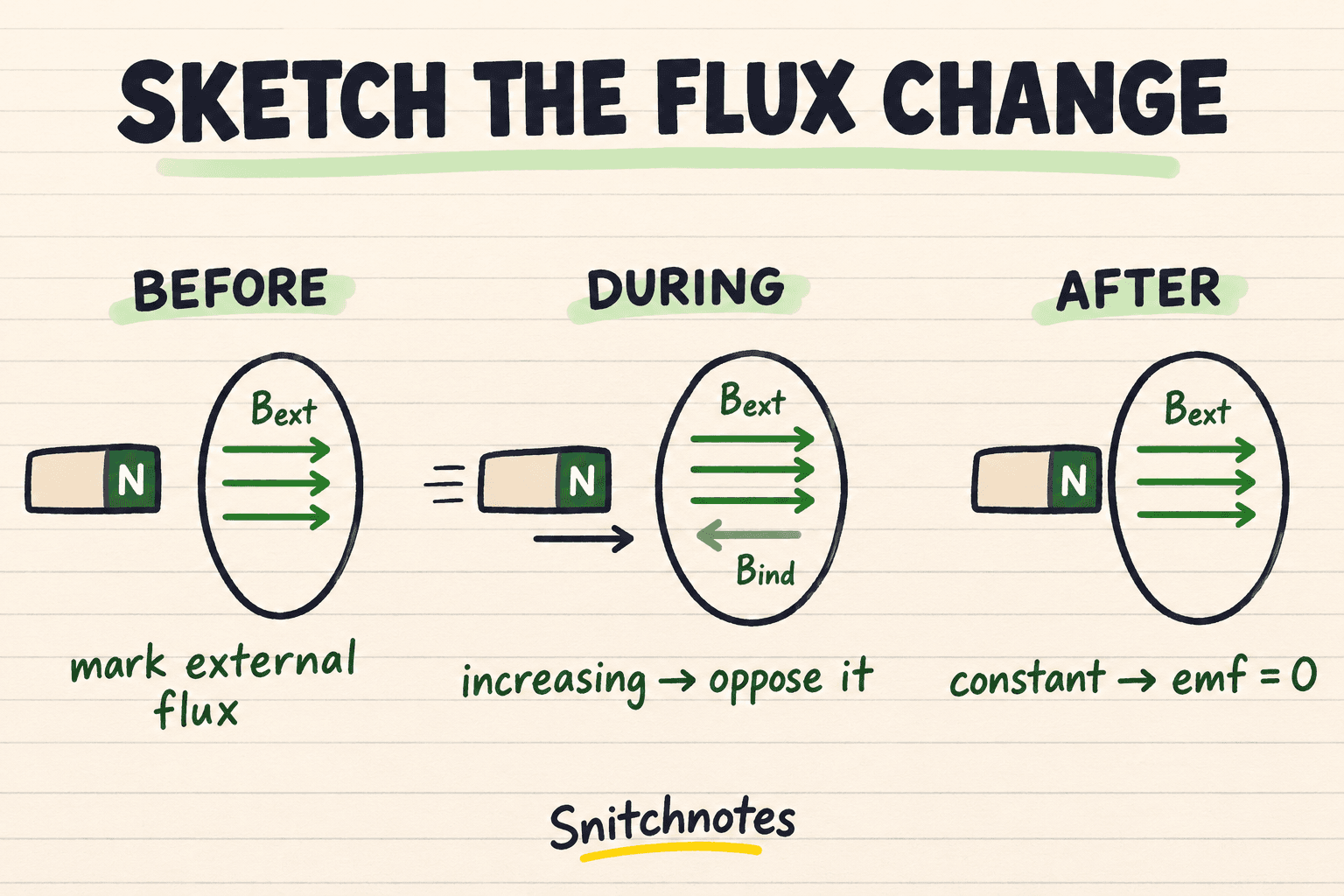
Draw the same loop three times, leaving room for arrows. In the before sketch, mark the external field through the loop and choose a clear viewing side. In the during sketch, add the motion or field-change arrow and write one sentence: “rightward flux increasing,” “into-page flux decreasing,” or another precise description. Do not choose clockwise or counterclockwise yet.
Now apply Lenz's law: the induced current produces a magnetic field that opposes the change in flux. If rightward flux is increasing, the induced field points left. If into-page flux is decreasing, the induced field points into the page to support what is being lost. Only after drawing that induced field should you curl the fingers of your right hand around the loop; your thumb points with the induced field, and your fingers give the conventional-current direction.
Finish with the after sketch. If the magnet has stopped and the flux is constant, the induced emf returns to zero. That last frame is a useful error detector: induction is not a permanent current supplied by a nearby magnet. It lasts while flux is changing, unless another source keeps the change going.
Worked example: a north pole approaches a 20-turn loop
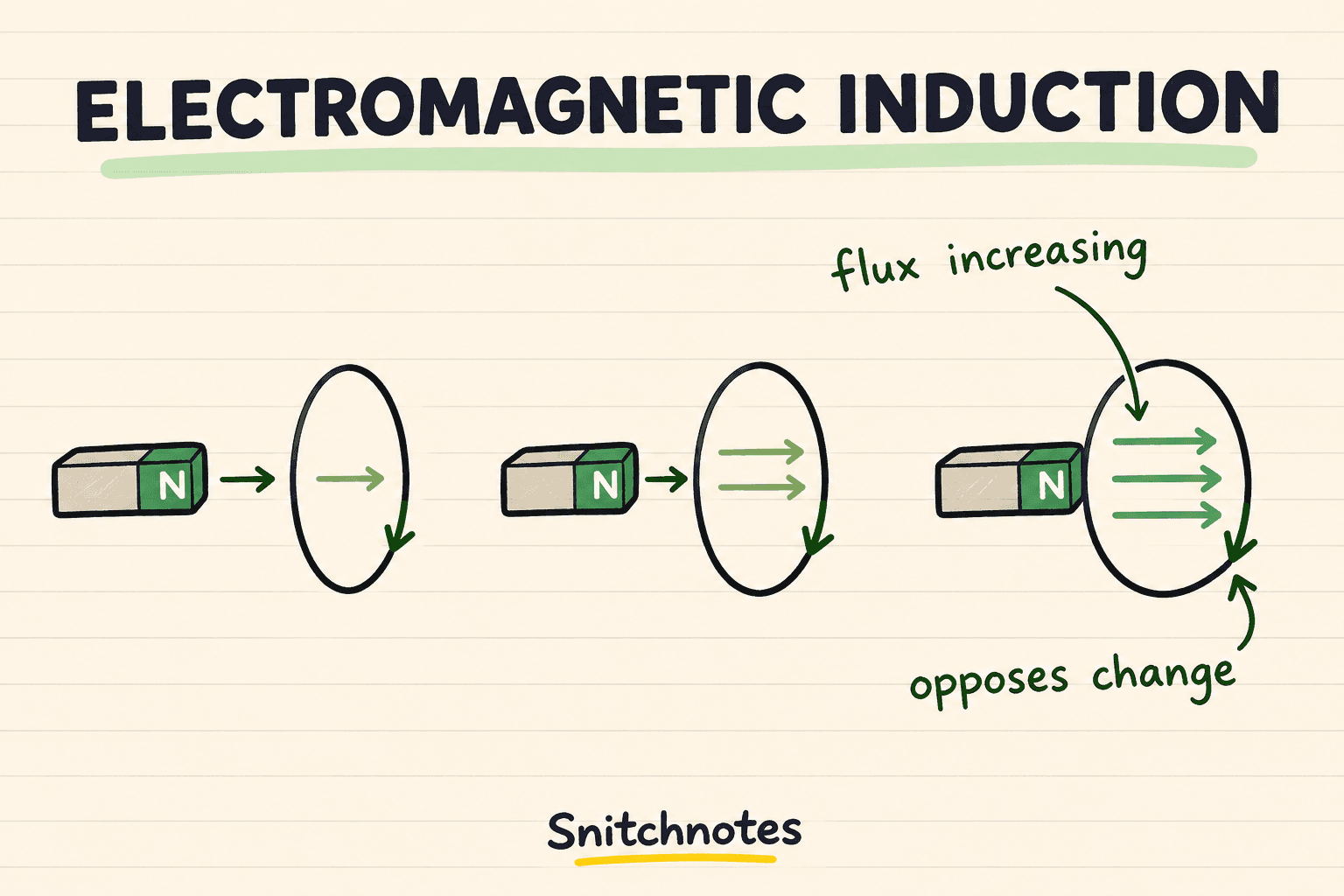
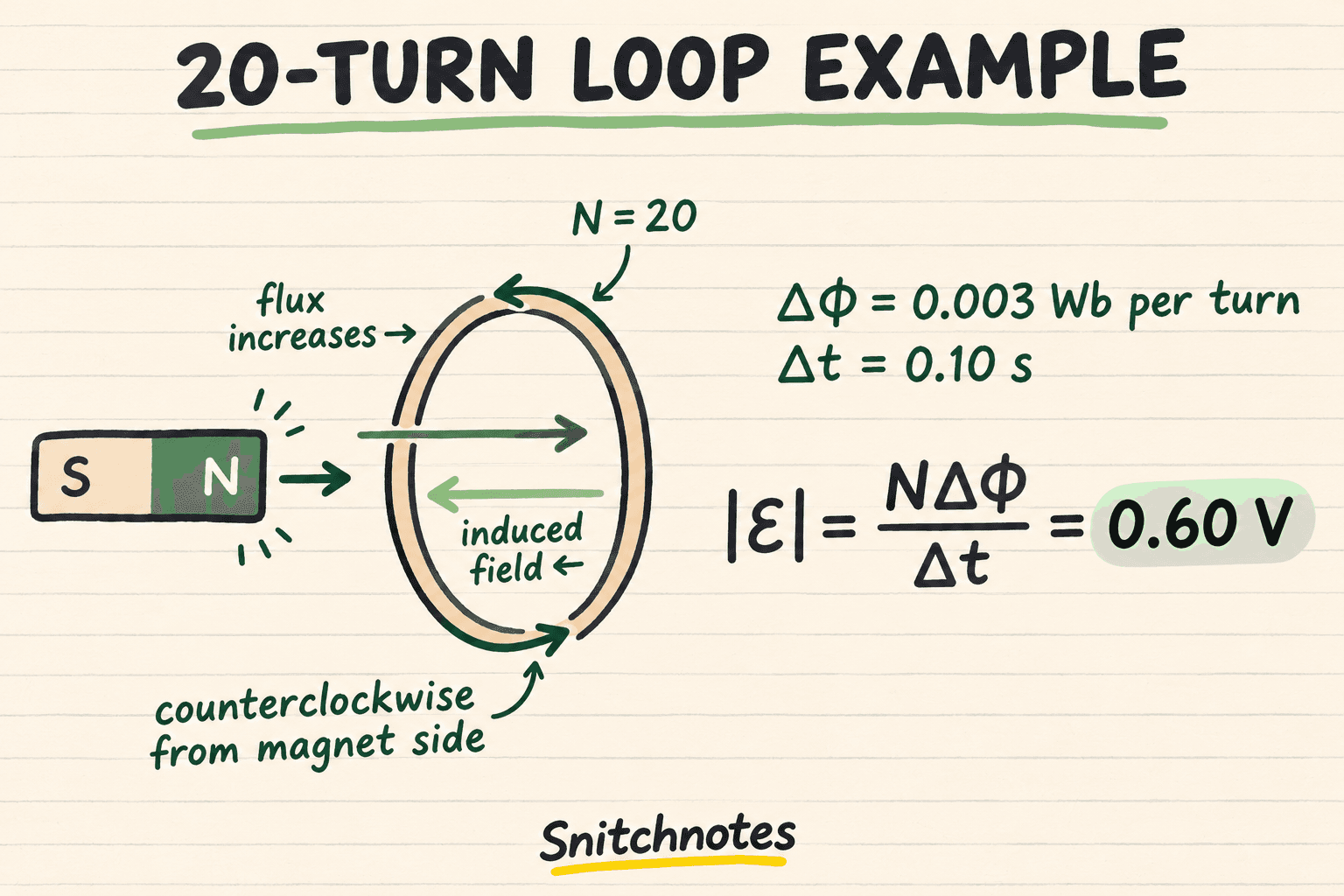
Place a bar magnet to the left of a loop, with its north pole facing the loop and moving right. Field lines leave the north pole, so the external magnetic flux through the loop points right. As the magnet approaches, the field at the loop grows stronger: rightward flux is increasing. The loop responds by producing a leftward magnetic field. Viewed from the magnet side, the induced conventional current is counterclockwise.
Now calculate the average emf. The loop has N = 20 turns, and the magnetic flux through each turn changes by ΔΦ = 0.003 Wb during Δt = 0.10 s. Faraday's law gives |ε| = N|ΔΦ/Δt|, so |ε| = 20 × 0.003 Wb ÷ 0.10 s = 0.60 V. The magnitude calculation says 0.60 volts; the sketch and Lenz's law supply the counterclockwise direction.
Notice that 0.003 Wb is the change per turn. Multiplying by 20 accounts for the coil's 20 identical turns. If a problem instead gives total flux linkage NΦ, do not multiply by N a second time. Writing the units beside each number makes this distinction much easier to spot.
A repeatable study routine for induction problems
- Choose a viewing side and keep it fixed; clockwise depends on where you stand.
- Draw the external magnetic field through the loop, not just the magnet or wire.
- State whether the flux is increasing, decreasing, or constant and name its direction.
- Draw the induced field that opposes that change, then use the right-hand rule for current.
- Calculate magnitude with Faraday's law, checking whether flux is per turn or already a flux linkage.
- Draw the after state and ask whether flux is still changing; if not, the induced emf is zero.
For practice, vary one feature at a time: reverse the magnet, pull it away, rotate the loop, or make the change happen twice as fast. Redrawing the three frames trains the causal chain instead of encouraging formula guessing.
The common misconception: Lenz's law opposes change
The induced field does not always point opposite to the external field. It opposes the change in flux. When an external rightward flux increases, the induced field points left. When that same rightward flux decreases, the induced field points right, trying to preserve it. “Oppose the field” works only in the increasing case and becomes a trap everywhere else.
A second boundary is that Faraday's law gives an emf, not automatically a current. Current also depends on whether the path is closed and on the circuit's resistance. An open loop can have an induced potential difference without a sustained circulating current.
Check your understanding
What happens if the north pole stops beside the loop?
Once the magnet and loop are stationary relative to each other, the flux is constant. The induced emf becomes zero, even though a magnetic field still passes through the loop.
What if the north pole moves away instead?
The rightward flux decreases, so the loop creates a rightward induced field to oppose that decrease. Viewed from the magnet side, the conventional current is clockwise—the reverse of the approaching case.
What doubles when the same flux change happens in half the time?
The average induced emf doubles because |ΔΦ/Δt| doubles. The direction stays the same as long as the direction of the flux change stays the same.
Related concepts
- Study Kirchhoff's laws with circuit loop maps to keep signs and loop directions consistent.
- Use the right-hand rule for magnetic fields after you have identified the field direction you need.
- Learn centripetal force with free-body diagrams for another sketch-first physics method.
Sources
MIT OpenCourseWare: Chapter 10, Faraday's Law of Induction
MIT OpenCourseWare: Problem Solving 7, Faraday's Law
OpenStax University Physics Volume 2: Faraday's Law
Convierte tus clases en material listo para el examen.
Apuntes, quizzes, podcasts, flashcards y chat — con solo subir un archivo.
Prueba tu primer apunte gratis