
Snitchnotes Team
Stack vs Queue: The Difference Between LIFO and FIFO
Stack vs Queue: The Difference Between LIFO and FIFO
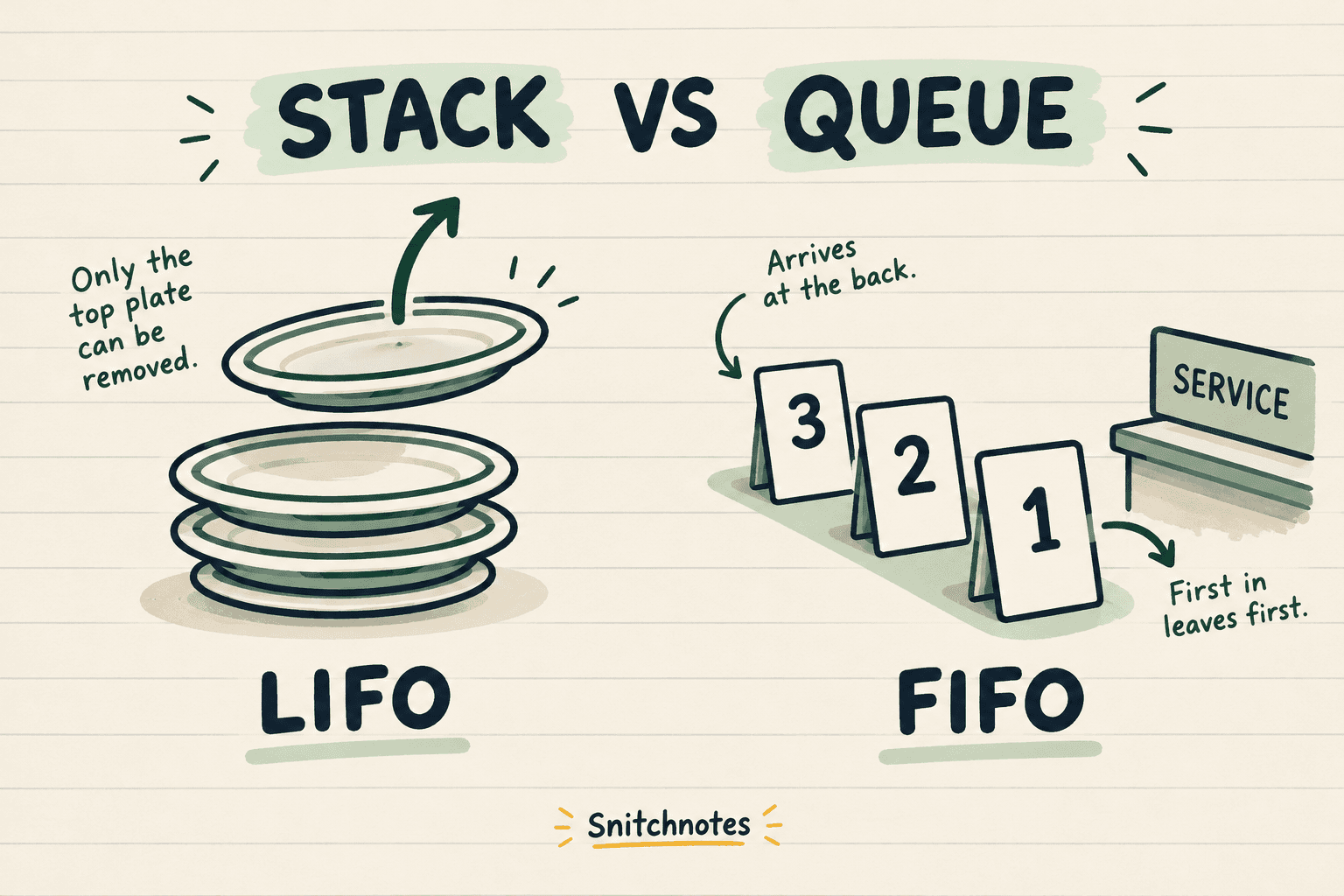
The difference between a stack and a queue is the order in which items come out. A stack follows LIFO: last in, first out, so the newest item leaves first. A queue follows FIFO: first in, first out, so the oldest item leaves first. Think of plates piled on a counter versus people waiting in a line.
That small change in removal order creates very different behavior. Stacks are useful when recent work must be revisited first, such as undo history or recursive calls. Queues are useful when work should be handled in arrival order, such as ordinary job scheduling or breadth-first search.
Stack vs queue at a glance
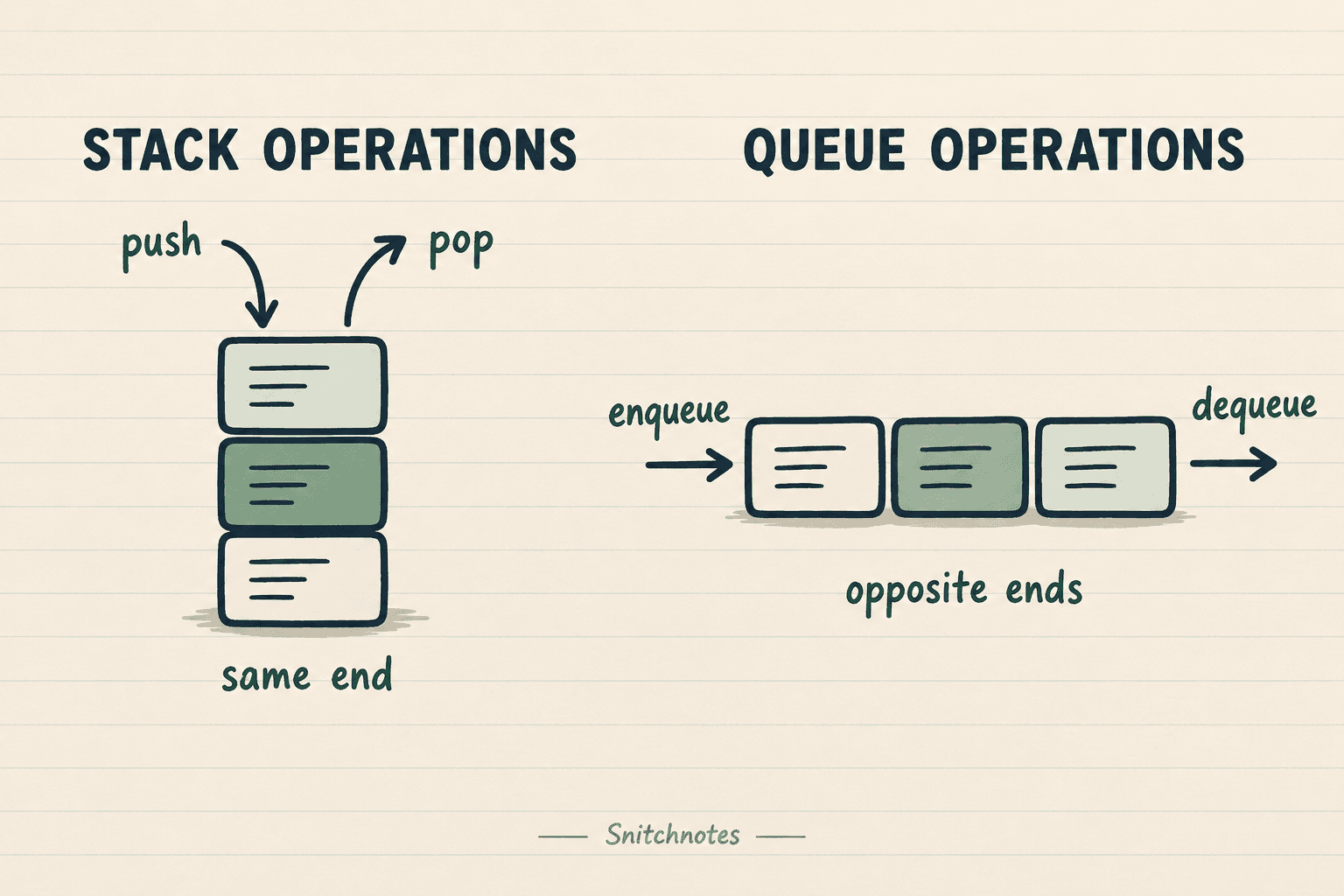
- Stack: LIFO ordering; add with push, remove with pop, and inspect the newest item with peek or top.
- Queue: FIFO ordering; add with enqueue, remove with dequeue, and inspect the oldest item at the front.
- Access pattern: a stack adds and removes at one end; a queue normally adds at the back and removes from the front.
- Typical uses: stacks support undo, parsing, recursion, backtracking, and depth-first search; queues support waiting work, buffering, and breadth-first search.
The core difference: removal order
A stack exposes one active end, usually called the top. Push places an item on top, and pop removes the item from that same position. If you push a textbook, a notebook, and then a calculator, the calculator is popped first because it arrived last.
A queue has two roles at opposite ends. Enqueue adds an item at the back, while dequeue removes the item at the front. If three print jobs arrive in the order one, two, and three, a plain FIFO queue offers job one for processing first.
Both are abstract data types. Their defining feature is the permitted behavior, not the material underneath. A programmer can implement either one with an array, a linked structure, or another suitable collection while preserving the same LIFO or FIFO contract.
Worked example with the same inputs
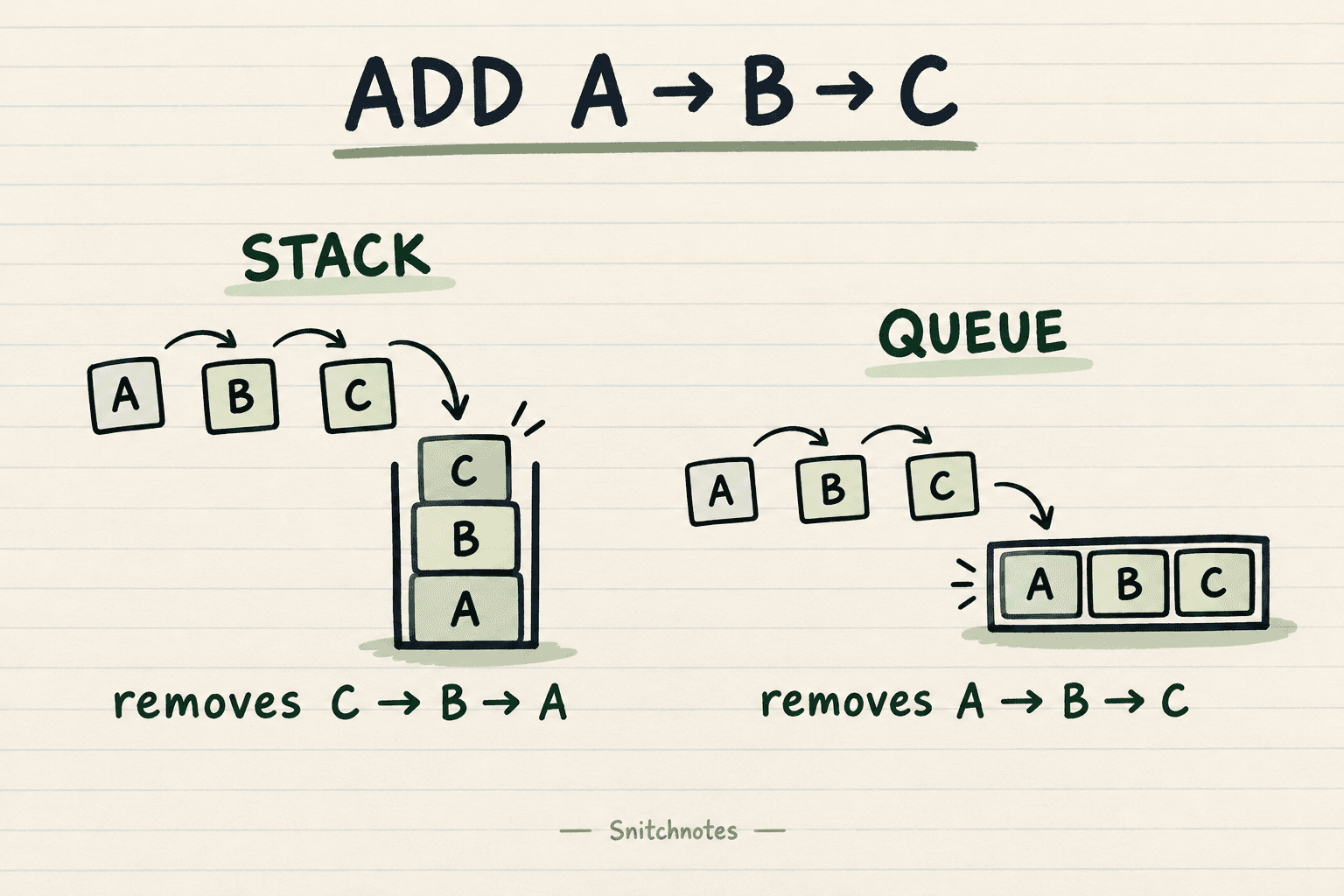
Suppose a small support tool receives three task cards in this order: T-17, fix the login error; T-18, compress the avatar image; T-19, export a receipt. Add all three before removing anything. This fixed input makes the effect of each rule easy to see.
In a stack, T-19 sits on top because it arrived last. Three pop operations return T-19, then T-18, then T-17. That is useful if each new task temporarily interrupts the previous one and the program must unwind the interruptions in reverse order.
In a queue, T-17 remains at the front because it arrived first. Three dequeue operations return T-17, then T-18, then T-19. That fits a simple first-come, first-served policy. The stored cards are identical in both cases; only the removal rule changes the result.
When to use a stack or queue
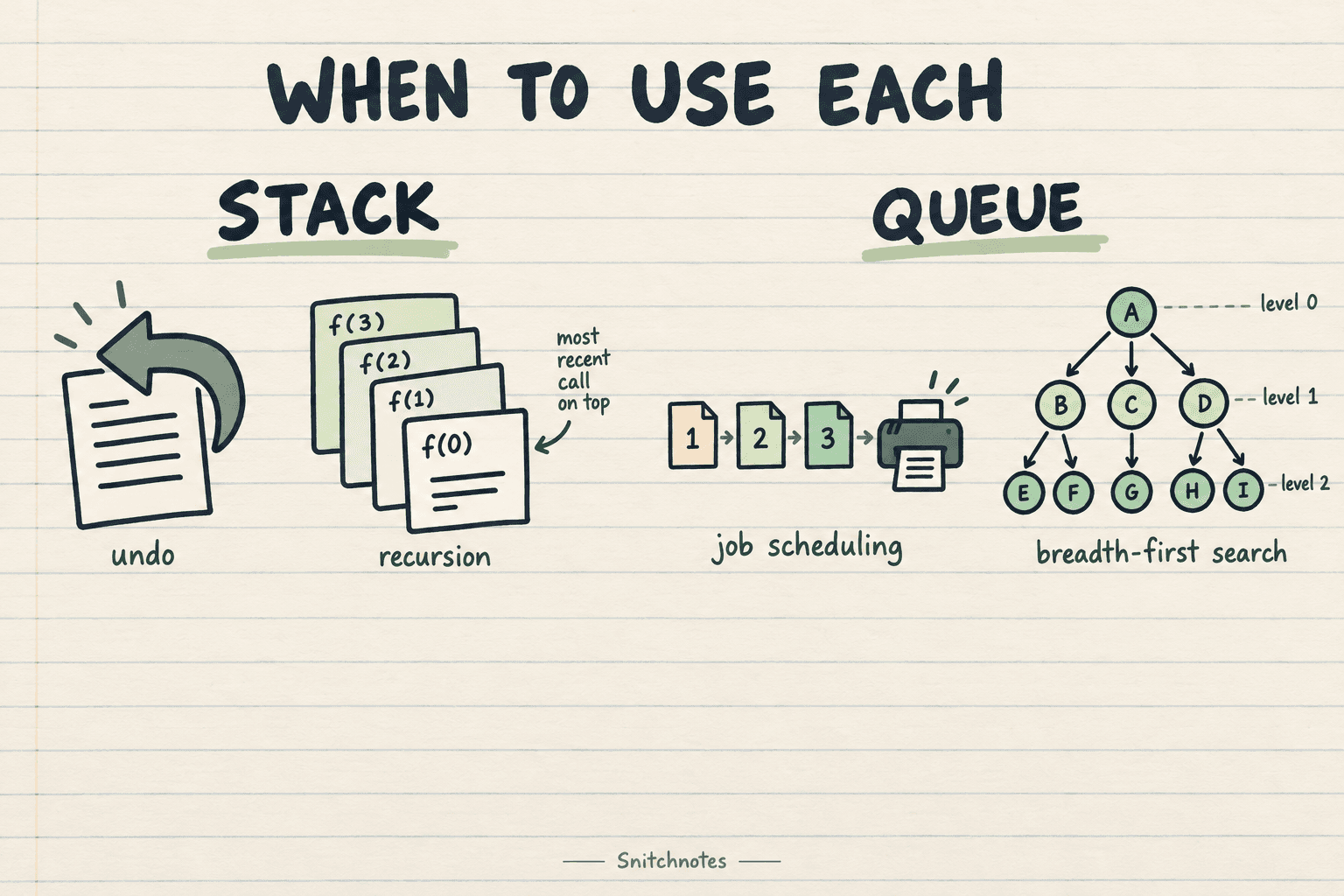
Choose a stack when the newest unfinished item should be handled next. An editor can push each change so undo reverses the latest action first. Parsers use stacks to match nested brackets and evaluate expressions. Recursive function calls also behave like a stack: the most recent call must finish before the earlier call can continue.
A stack also controls depth-first exploration. The search follows one path, stores alternatives, and returns to the most recent unfinished choice when it reaches a dead end. This is the same last-in, first-out logic in algorithmic clothing.
Choose a queue when older waiting work should be handled before newer work. Examples include basic printer jobs, incoming messages to be processed, and tasks awaiting a worker. In breadth-first search, a FIFO queue preserves layers: nodes at distance k are processed before newly discovered nodes at distance k plus one.
Implementation and performance
Well-designed stack push and pop operations are usually constant time. Queue enqueue and dequeue can also be constant time with a linked queue, circular buffer, or double-ended queue. A resizable array may occasionally copy elements when it grows, so its usual guarantee is amortized constant time rather than constant time for every single insertion.
The interface does not guarantee an efficient implementation. Python documentation, for example, notes that removing from the beginning of a list is slow because the remaining elements must shift. It recommends collections.deque for fast additions and removals at both ends. The lesson is to choose both the correct ordering rule and an implementation that supports it efficiently.
Common misconceptions and boundaries
- A queue is not automatically fair in every system. A priority queue deliberately removes the highest-priority item rather than strictly following arrival order.
- A stack and queue do not require different storage hardware. The abstract access rule matters more than whether the code uses an array or linked nodes.
- A deque is not simply another name for a FIFO queue. It permits insertion and removal at both ends, so it can support stack-like or queue-like behavior.
- LIFO does not mean items are sorted by value. It means they are removed according to recency of insertion.
How to choose quickly
Ask one question: which waiting item should leave next? If the answer is the newest one, use a stack. If the answer is the oldest one, use a queue. If the answer is the most urgent one, neither plain structure expresses the rule; consider a priority queue instead.
Check your understanding
You push 4, 7, and 9 onto a stack. What pops first?
The value 9 pops first because it was pushed last. The full pop order is 9, 7, 4.
You enqueue red, green, and blue. What dequeues first?
Red dequeues first because it entered the FIFO queue first. The full order is red, green, blue.
Why does breadth-first search use a queue?
A queue processes earlier-discovered nodes before later-discovered nodes, which keeps the traversal moving level by level from the starting node.
If data-structure diagrams still blur together, Snitchnotes can turn your own lecture slides or programming notes into clearer study notes, flashcards, quizzes, and audio review.
Related concepts
- Deque: a double-ended queue that permits additions and removals at both ends.
- Priority queue: removes items according to priority rather than pure arrival order.
- Depth-first and breadth-first search: traversal strategies whose behavior changes when the frontier uses a stack versus a queue.
- Binary search step by step: a related guide to how data order shapes an algorithm.
Sources
Carnegie Mellon University: Stacks and Queues
Princeton University: Bags, Queues, and Stacks
Turn your lectures into exam-ready materials.
Notes, quizzes, podcasts, flashcards, and chat — from one upload.
Try your first note free