
Snitchnotes Team
How to Set Up an ICE Table for a Difficult Equilibrium Problem
How to Set Up an ICE Table for a Difficult Equilibrium Problem
To set up an ICE table, first balance the reaction and write every starting concentration in the Initial row. Use one variable x for the reaction's progress, multiply x by each stoichiometric coefficient in the Change row, and choose the signs from the direction the system must shift. Add Initial and Change to build the Equilibrium row, then substitute that row into the equilibrium-constant expression.
The table is an organizer, not a separate chemistry law. Its three rows record Initial, Change, and Equilibrium quantities. Most difficult ICE problems are lost before the algebra begins: a product that starts above zero gets erased, every species receives the same x, or an impossible quadratic root survives unchecked.
Use this setup order every time
- Balance the chemical equation. The coefficients will control both the equilibrium expression and the relative changes in concentration.
- Write the correct equilibrium expression. For aA + bB reversible cC, the concentration form is Kc = [C]^c / ([A]^a[B]^b), omitting pure solids and pure liquids.
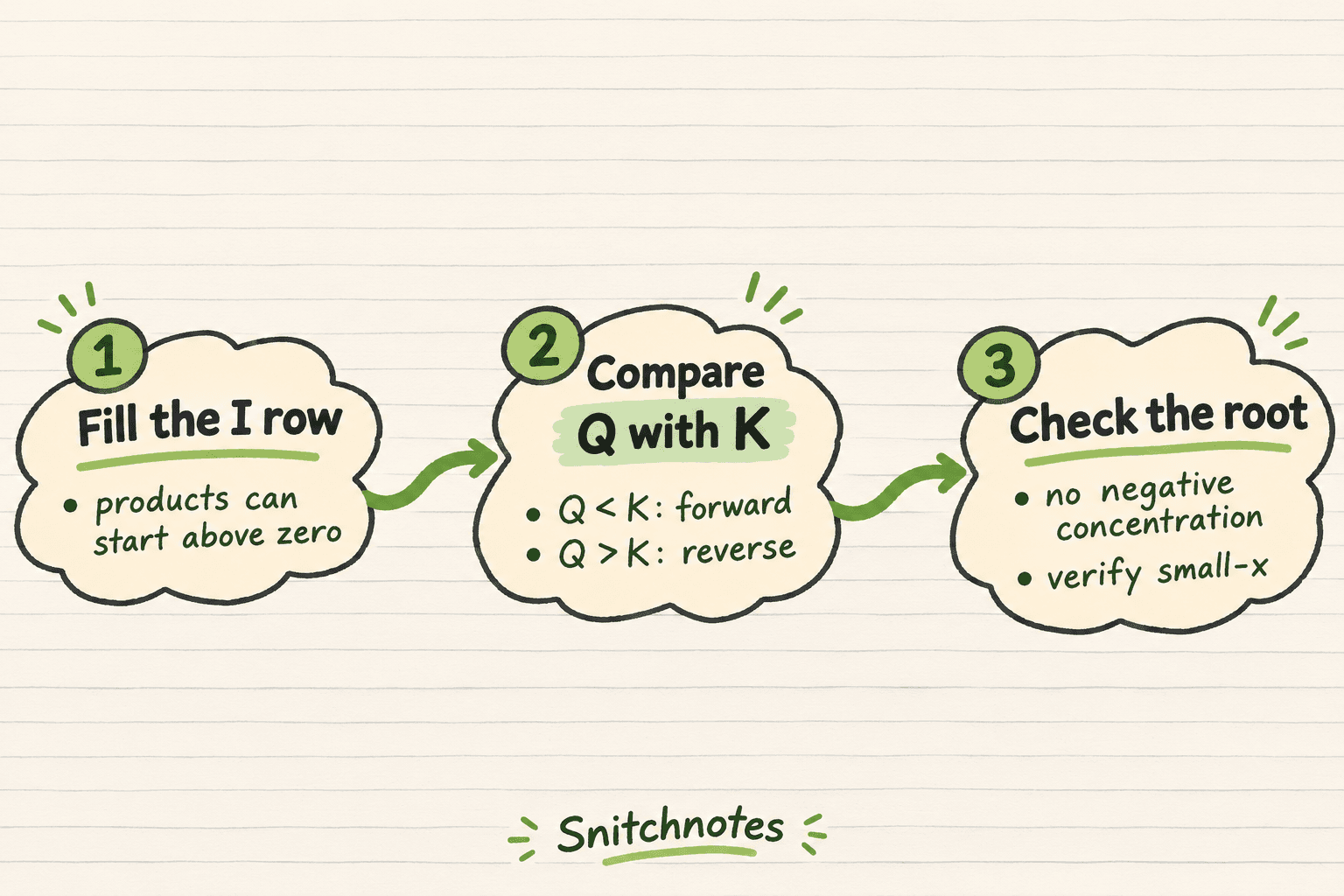
- Fill the Initial row with the values at the moment described in the problem. Do not automatically write zero under products. Keep units consistent with the form of K you are using.
- Decide the shift direction. If it is not obvious, calculate the reaction quotient Q from the initial values and compare it with K: Q < K means a forward shift, while Q > K means a reverse shift.
- Write one stoichiometric Change row and add it to the Initial row. Only then solve the resulting equation and test the answer against physical limits.
Let the coefficients control the change row
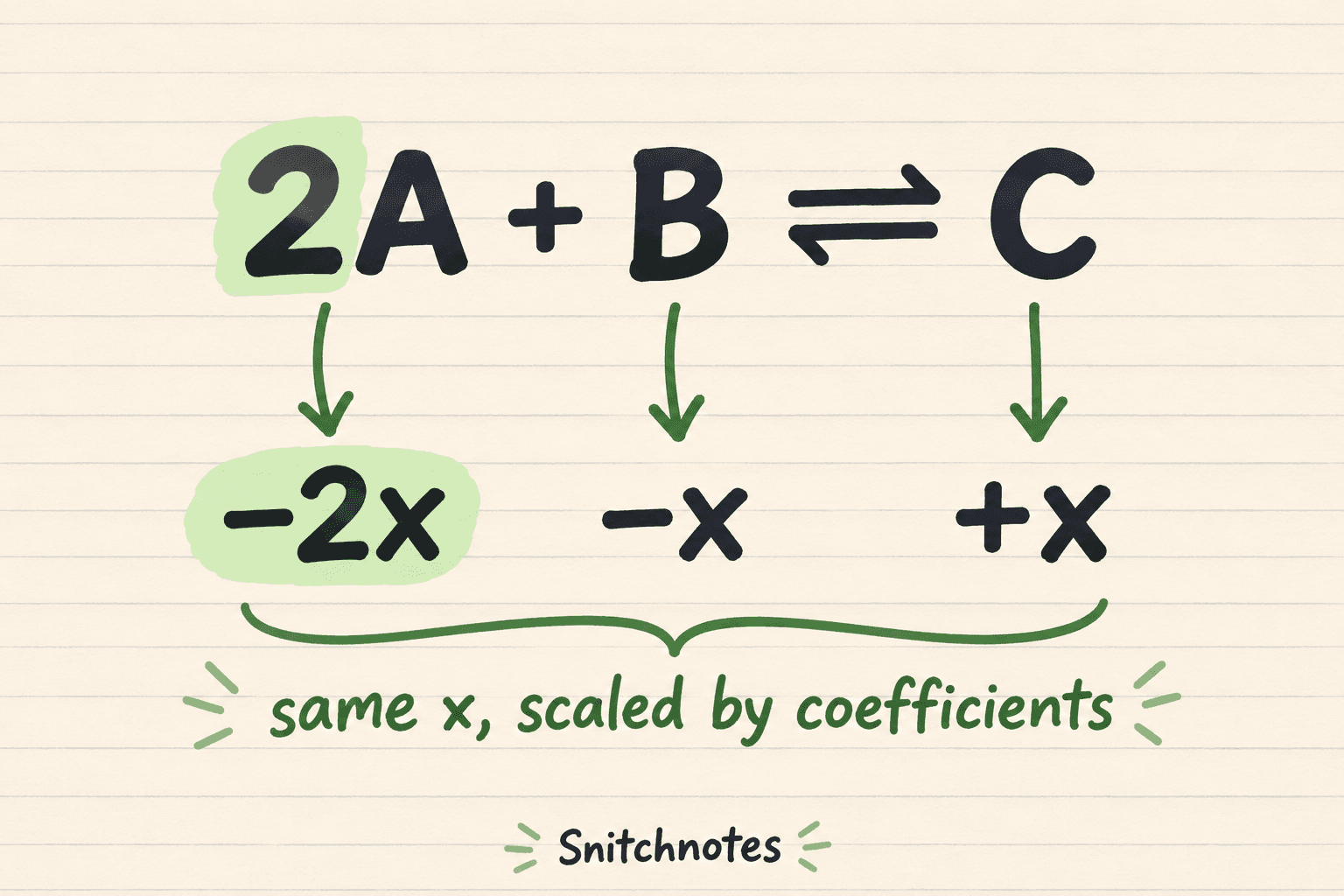
For 2A + B reversible C, suppose the system moves forward. If C increases by x, A cannot also decrease by x. The balanced reaction consumes two units of A for every one unit of B and produces one unit of C, so the changes are −2x, −x, and +x. It is the same reaction extent, scaled by the coefficients.
If the system shifts in reverse, all three signs flip: +2x for A, +x for B, and −x for C. Do not change the coefficient ratio. A useful quick check is that all reactants should share one sign and all products the opposite sign for a single reaction written in one direction.
Worked example: 2 NO2 reversible N2O4
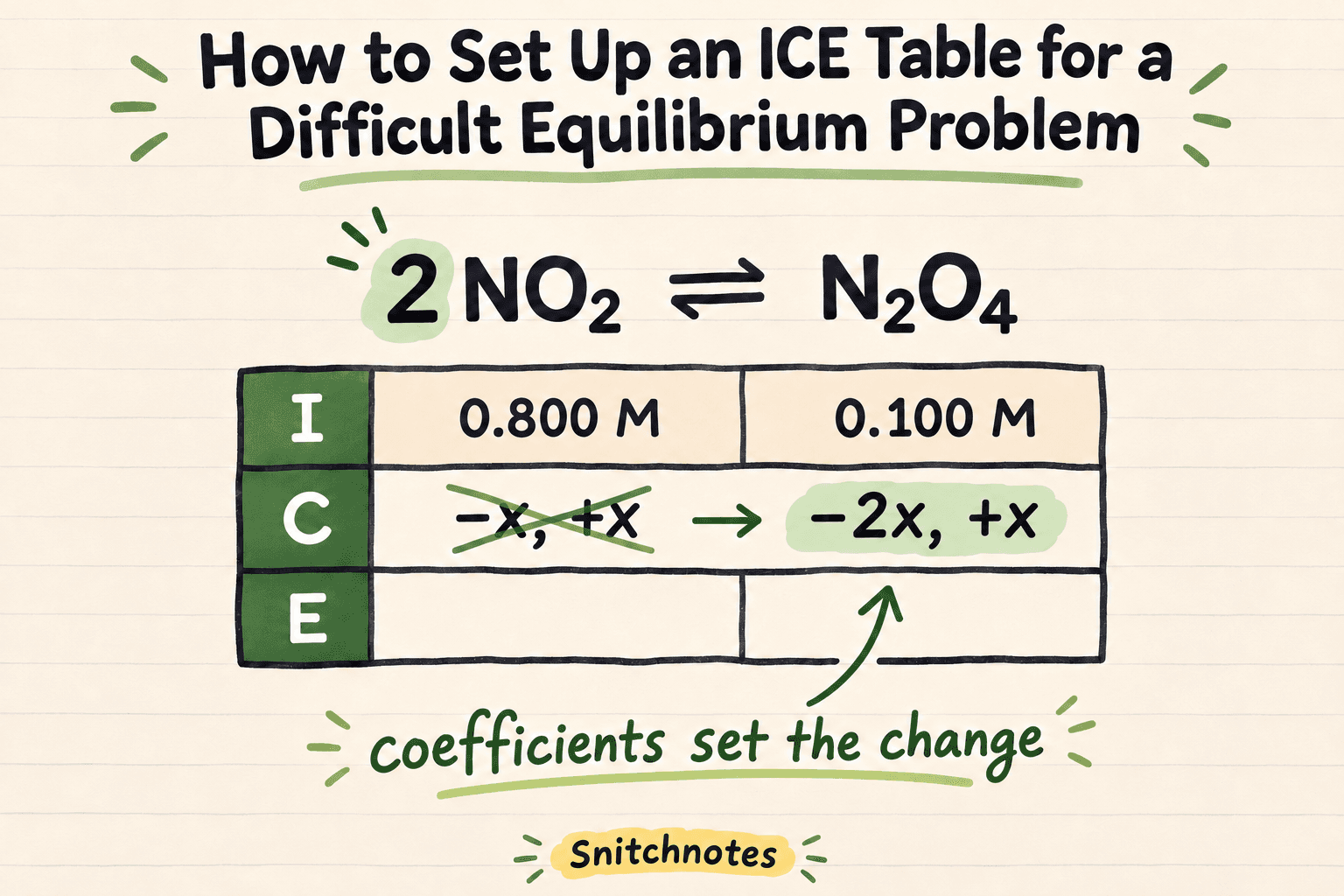
Consider a one-liter vessel that initially contains 0.80 M NO2 and 0.10 M N2O4. For this teaching exercise, suppose Kc = 4.00 at the stated temperature for 2 NO2(g) reversible N2O4(g). The initial product is not zero, which is exactly why this setup is easy to misread.
1. Choose the direction before assigning signs
The equilibrium expression is Kc = [N2O4] / [NO2]^2. Using the starting concentrations gives Qc = 0.10 / (0.80)^2 = 0.156. Because Qc is less than Kc, the mixture has too little product relative to equilibrium and shifts forward. NO2 therefore decreases while N2O4 increases.
2. Build all three rows
The Initial row is 0.80 M NO2 and 0.10 M N2O4. The Change row is −2x for NO2 and +x for N2O4, not −x and +x. Adding vertically gives the Equilibrium row: [NO2] = 0.80 − 2x and [N2O4] = 0.10 + x.
3. Solve and keep only the physical root
Substitution gives 4.00 = (0.10 + x) / (0.80 − 2x)^2, or 16x^2 − 13.8x + 2.46 = 0. The two mathematical roots are approximately 0.252 M and 0.611 M. The second would make [NO2] negative because x cannot exceed 0.400 M, so reject it.
Using x = 0.252 M gives [NO2]eq = 0.297 M and [N2O4]eq = 0.352 M after rounding. Substituting these values back gives about 4.00, so the equilibrium expression checks. The concentrations are nonnegative and the direction matches Qc < Kc. Those are three independent checks on the setup.
Troubleshoot nonzero products, direction, and roots
A nonzero starting product belongs in the Initial row exactly as given. Zero is appropriate only when the problem actually says no product is present or the stated preparation implies it. Erasing 0.10 M in the example would change Q, the equilibrium equation, and the final answer.
When both sides start above zero, use Q rather than guessing the direction from the size of K alone. K describes the equilibrium ratio at a specified temperature; Q describes the mixture now. Comparing them tells you whether the written forward reaction must proceed more or less before equilibrium is reached.
Finally, treat algebraic roots and approximations as candidates. A root is invalid if it makes any equilibrium concentration negative or violates the maximum possible change. If you assumed x was small, substitute the result and check the neglected change against the starting term; the common 5% test is a classroom heuristic, not permission to skip verification. In this example, the change is far too large for a small-x shortcut.
Know what the ICE table does not decide
An ICE table does not balance the reaction, choose the correct K expression, or decide which phases belong in that expression. Those decisions come first. It also does not prove that a real reaction reaches equilibrium quickly; equilibrium thermodynamics describes the final relation, while kinetics determines how fast the system approaches it.
For reactions with several coupled equilibria, mass-balance constraints, charge balance, or multiple significant reactions, one simple ICE table may not be enough. The same bookkeeping idea still helps, but the problem may require simultaneous equations or a numerical solver.
Check your understanding
For 3A reversible 2B, what is the forward Change row?
Write −3x for A and +2x for B. One x represents a single reaction extent; the coefficients scale the concentration changes.
What does Q > K tell you?
The current mixture has too much product relative to the equilibrium ratio for the reaction as written. The system shifts in reverse, so reactant changes are positive and product changes are negative.
Why can a correct quadratic root still be chemically wrong?
The algebra does not know that concentrations cannot be negative or that the reaction cannot consume more material than was initially present. Every root must be tested in the Equilibrium row.
If equilibrium setups are scattered across slides and problem sheets, Snitchnotes can turn your own course material into clearer notes, flashcards, and quizzes so you can practise the setup decisions before the algebra starts.
Related concepts
- Reaction quotient Q: the same form as the equilibrium expression, evaluated for the mixture before equilibrium.
- The Haber process: conditions and equilibrium explained
- How to balance redox equations using half-reactions
Sources
Purdue University Department of Chemistry: Making an ICE Chart
University of Wisconsin–Madison Department of Chemistry: ICE Tables Introduction
Turn your lectures into exam-ready materials.
Notes, quizzes, podcasts, flashcards, and chat — from one upload.
Try your first note free