
Snitchnotes Team
How Do Banks Create Money When They Make Loans?
How Do Banks Create Money When They Make Loans?
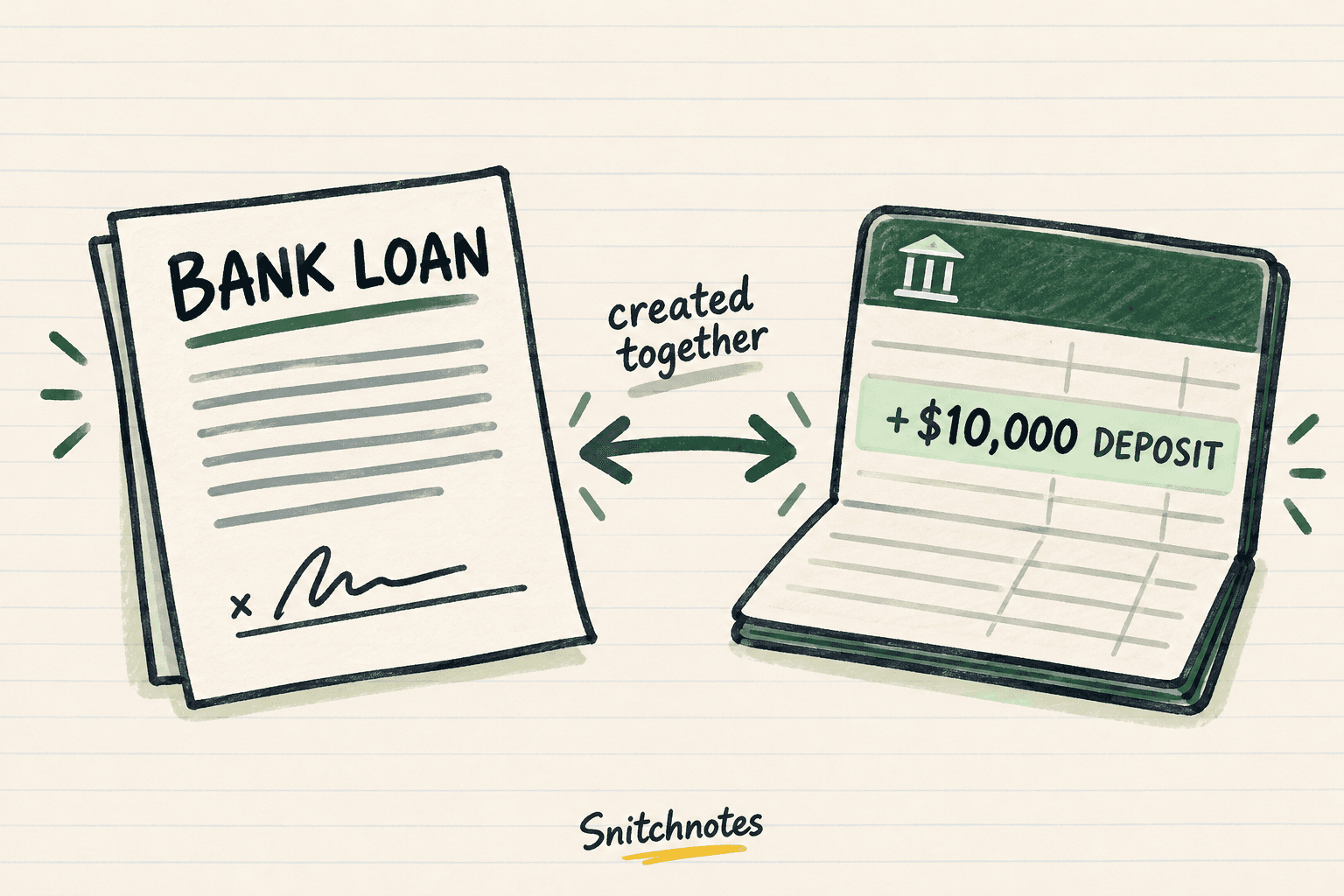
Banks create money when they lend by recording two entries at the same time: a new loan on the bank's asset side and a matching deposit in the borrower's account on the liability side. The deposit is new spendable bank money. The bank has not moved a pile of existing notes from a saver to the borrower, and it has not printed central-bank currency.
That does not mean banks can create unlimited money. Lending is constrained by credit risk, capital and liquidity rules, funding and settlement needs, borrower demand, interest rates, and the bank's expectation that a loan will be profitable. Understanding both halves of the story prevents one surprising fact from turning into a misleading slogan.
The two entries created at the same time
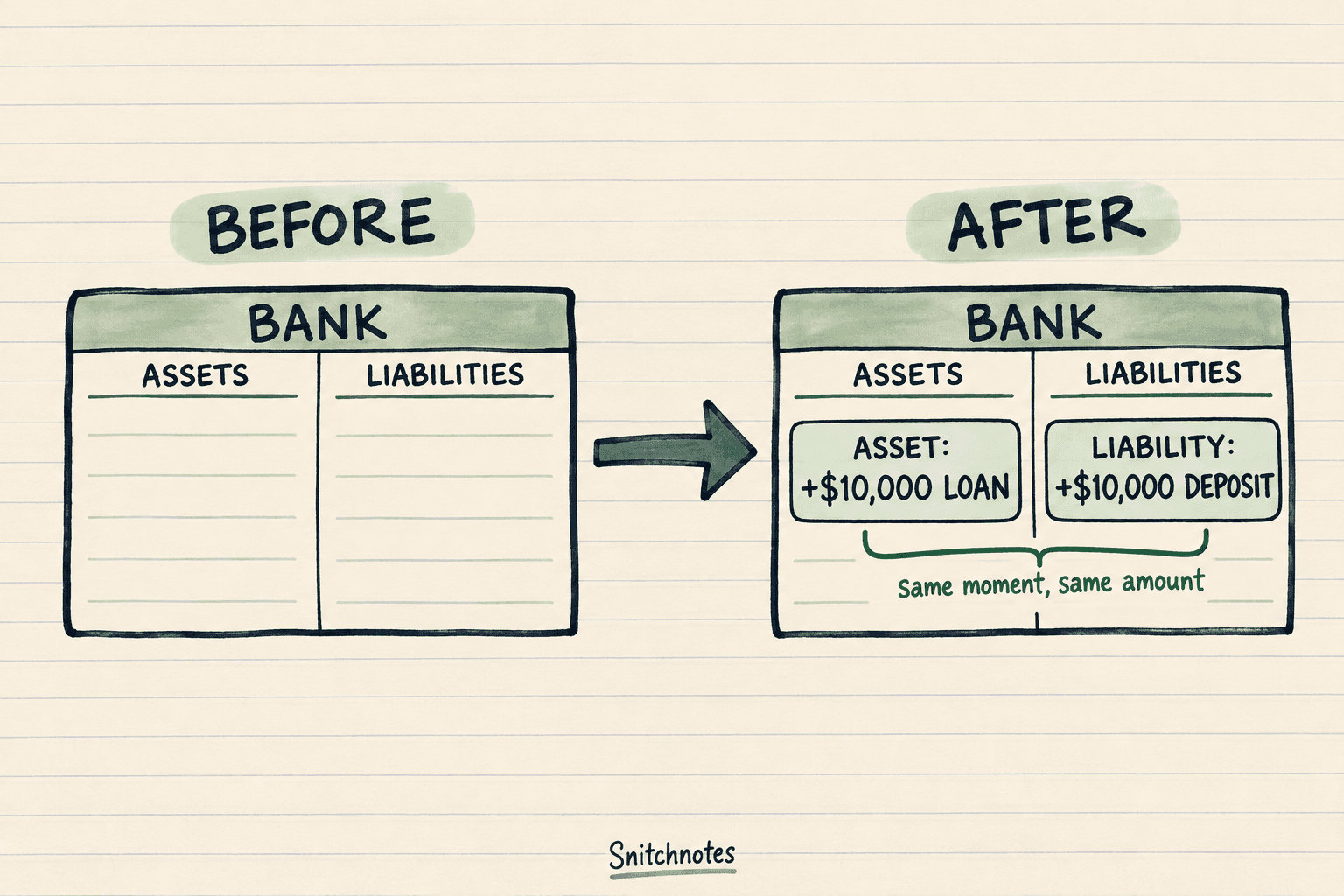
Suppose a bank approves a $10,000 personal loan. The signed promise to repay is worth something to the bank, so it records a $10,000 loan asset. At the same moment, it credits the borrower's checking account by $10,000. That deposit is a bank liability because the bank owes the customer access to those funds on demand.
The balance sheet expands by the same amount on both sides. Assets rise by $10,000 and liabilities rise by $10,000, so the accounting equation still balances. The borrower can now use the deposit to pay by card, transfer, or check. Because bank deposits function as a widely accepted means of payment, the transaction has increased broad money even though no extra banknotes appeared.
The Bank of England and Deutsche Bundesbank both describe this as the ordinary creation of deposit or book money through lending. Banks also create deposits when they buy assets from non-banks and credit the sellers' accounts, but a new loan is the clearest example.
Sophie’s $10,000 loan, step by step
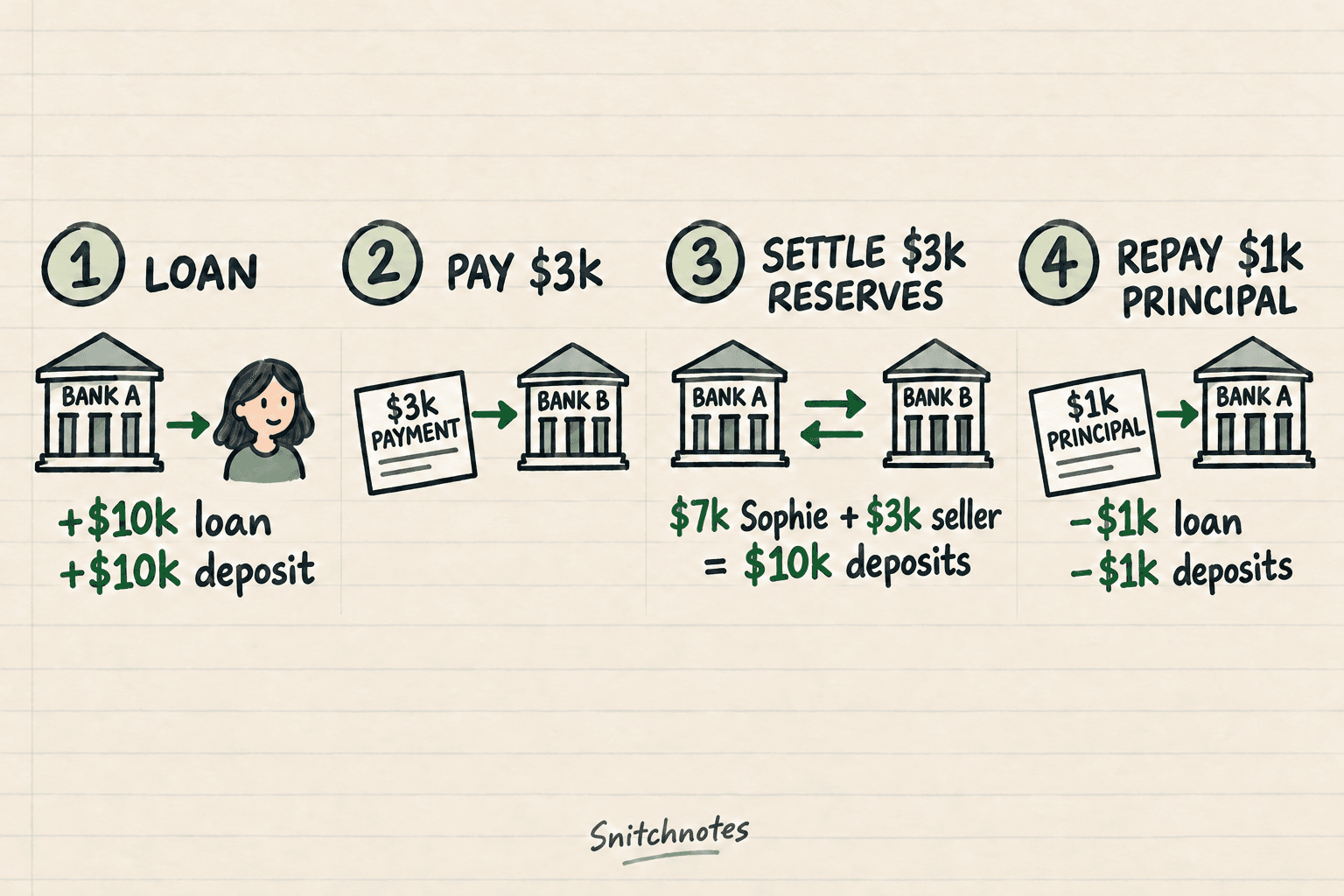
1. The loan creates Sophie's deposit
Sophie's bank approves a $10,000 loan. Its books now show a $10,000 loan asset and a $10,000 deposit owed to Sophie. The deposit did not need to exist before approval; the paired entries create it.
2. Sophie pays $3,000 to another bank
Sophie buys equipment from a seller who uses a different bank. Her deposit falls from $10,000 to $7,000, while the seller's deposit rises by $3,000. Across the banking system, deposits still total $10,000. The payment moved deposit money from one customer to another; it did not erase it.
3. The banks settle the payment
Behind the customer-facing transfer, Sophie's bank must settle with the seller's bank. Typically, $3,000 of central-bank reserves moves between their reserve accounts. This is why an individual bank cannot ignore liquidity and funding: deposits may leave it even though they remain inside the banking system.
4. Principal repayment reverses part of the creation
Later, Sophie repays $1,000 of principal from a bank deposit. The bank reduces the outstanding loan asset by $1,000 and reduces deposits by $1,000. In this simplified case, the money created with that portion of the loan is destroyed. Interest is different from principal: it is income to the bank rather than a reduction of the loan itself.
What limits how much money banks can create?
A keyboard entry is easy; making a safe, compliant, profitable loan is not. Several constraints work together rather than forming one fixed ceiling.
- Credit risk: the bank must judge whether borrowers can repay. Expected losses make weak loans unattractive and can consume capital.
- Capital: regulations and internal risk limits require banks to fund part of their risk with shareholder equity that can absorb losses.
- Liquidity and funding: when customers pay people at other banks or withdraw cash, a bank needs settlement assets and reliable funding.
- Profitability: lending rates must cover funding costs, operating costs, expected losses, and the return demanded on capital.
- Demand and monetary policy: households and firms must want to borrow, while central-bank policy rates influence loan demand and banks' funding costs.
These limits explain why saying banks create money 'out of nothing' is incomplete. No pre-existing deposit is mechanically handed to the borrower, but the bank acquires a risky claim and a payment obligation. A bad lending decision can create very real losses.
Why the simple money-multiplier story can mislead
A common classroom story says a bank receives reserves first, lends a fraction, and starts a mechanical chain of relending. That can illustrate how deposits and reserves differ, but it reverses the sequence of many real lending decisions. Banks usually decide whether a loan is worthwhile and then manage the reserves and funding needed for payments and regulation.
Reserves still matter. They are central-bank money used by banks for settlement and, where applicable, reserve requirements. The rules also differ by country and over time. In the United States, the Federal Reserve reduced reserve requirement ratios to 0 percent effective March 26, 2020, yet capital, liquidity, supervision, risk, and funding constraints remained. A zero reserve requirement is not a license for infinite lending.
Why this mechanism matters
Bank lending links credit creation with money creation. When banks extend more sound loans, households and firms gain purchasing power that can support spending and investment. When banks tighten credit or borrowers repay debt, deposit growth can slow or reverse. This is one reason interest-rate policy and bank regulation can affect the wider economy without anyone operating a literal money-printing machine.
The boundary is important: commercial-bank deposits are not the same thing as physical currency or central-bank reserves. A bank creates a promise denominated in the national currency, while the central bank supplies the settlement asset that lets different banks honor those promises across the payment system.
Check your understanding
What appears on a bank's balance sheet when it makes a $10,000 loan?
A $10,000 loan asset and a matching $10,000 deposit liability appear together. The balance sheet expands on both sides.
Does paying someone at another bank destroy the new deposit money?
Not by itself. The payment redistributes deposits between customers and causes reserves to move between banks. System-wide deposit money remains until an operation such as principal repayment reduces it.
What stops a bank from making unlimited loans?
Creditworthiness, capital, liquidity, funding costs, regulation, borrower demand, monetary policy, and expected profitability all constrain lending.
If economics mechanisms are buried across lectures, PDFs, and notes, Snitchnotes can turn your own materials into clearer study notes, flashcards, and quizzes for testing the balance-sheet logic yourself.
Related concepts
- Broad money: currency held by the public plus selected bank deposits that can readily be used for payments.
- Central-bank reserves: balances commercial banks hold at the central bank for settlement and other purposes.
- Stagflation and why it is hard to fix
- Comparative advantage and opportunity cost
Sources
Bank of England: Money creation in the modern economy
Deutsche Bundesbank: How money is created
Turn your lectures into exam-ready materials.
Notes, quizzes, podcasts, flashcards, and chat — from one upload.
Try your first note free