
Snitchnotes Team
Denotation vs Connotation: Differences and Examples
Denotation vs Connotation: Differences and Examples
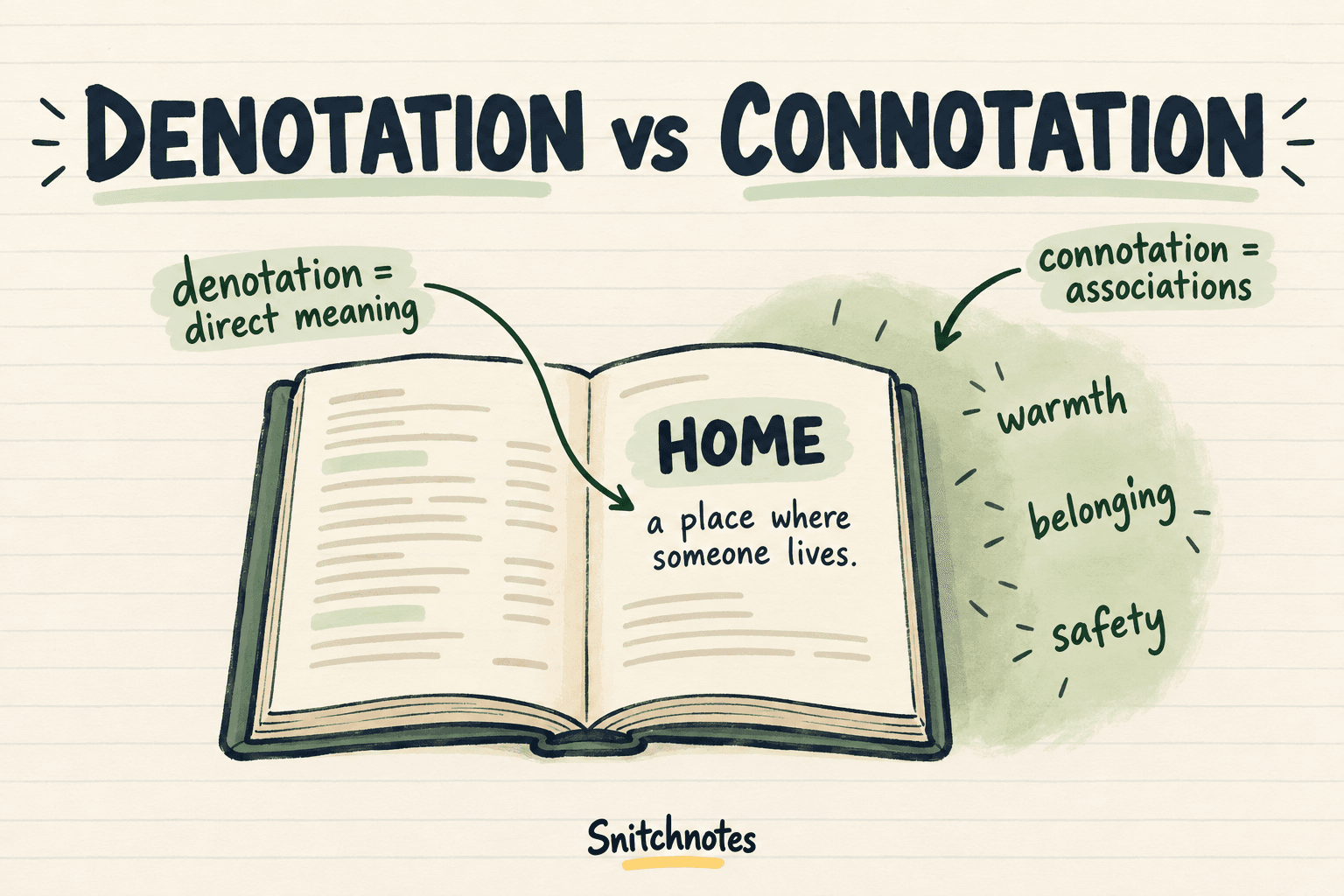
Denotation is a word's direct, literal meaning or reference. Connotation is the set of feelings, judgments, and cultural associations that the word suggests beyond that literal meaning. In short: denotation tells you what a word identifies; connotation helps explain how the word makes a reader view it.
For example, home and residence can both denote a place where someone lives. Home often suggests comfort or belonging, while residence sounds more formal and emotionally distant. That difference matters in close reading because a writer's word choice can shape tone without changing the basic subject.
Denotation vs connotation at a glance
- Denotation: the literal or dictionary meaning of a word, including the thing, action, or quality it directly refers to.
- Connotation: the additional feelings, ideas, values, or judgments associated with a word in a particular context.
- Key question for denotation: What does the word directly mean here?
- Key question for connotation: What attitude or association does this wording invite?
OpenStax defines denotation as a word's literal or dictionary definition and connotation as implied feelings or thoughts associated with it. Purdue University's Online Writing Lab makes the same practical distinction: choosing the right word requires attention to both its dictionary definition and the subtler meanings it has picked up in context.
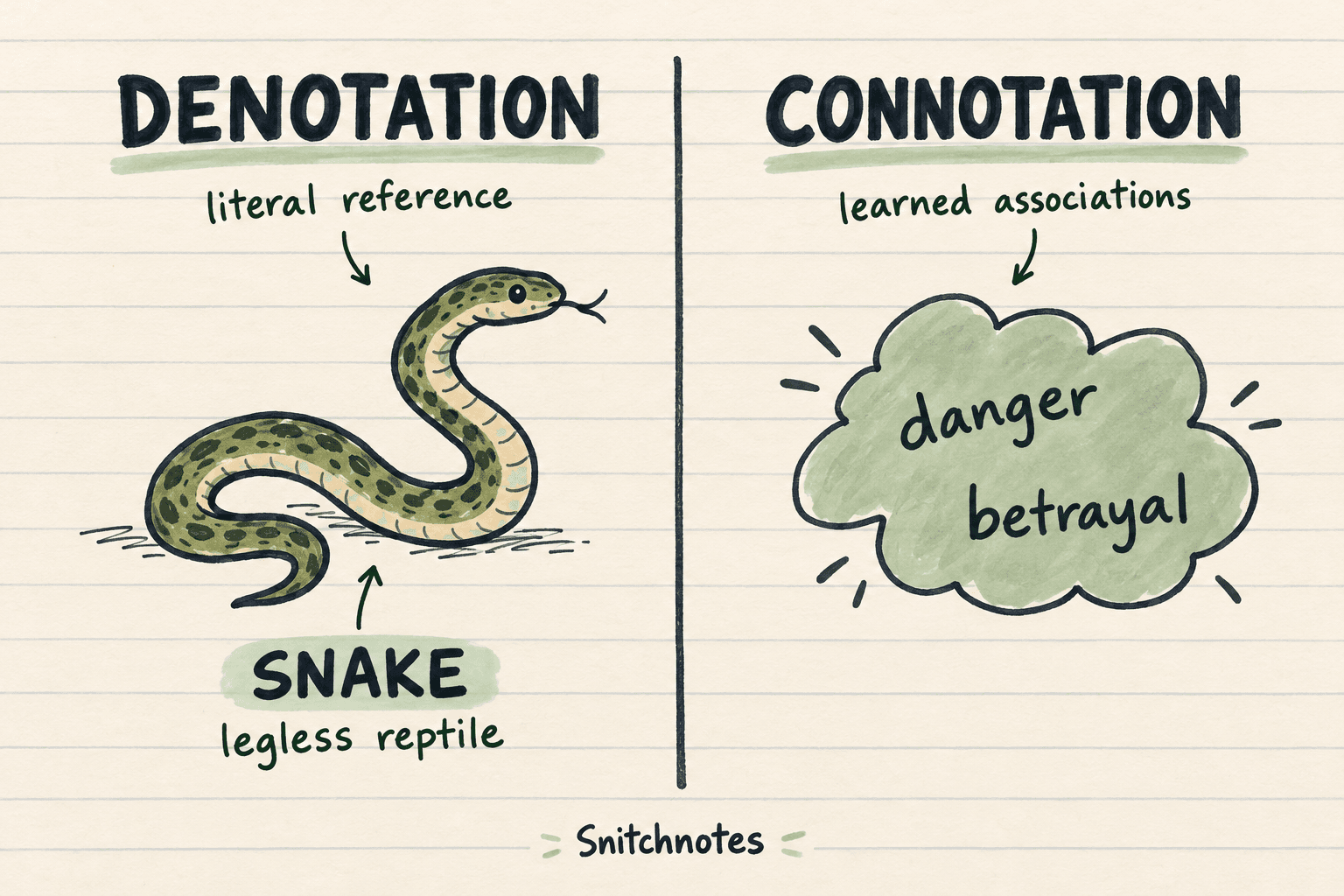
Consider snake. Its denotation is a kind of legless reptile. In a story about betrayal, however, calling a character a snake adds a negative connotation. The animal and the moral judgment are not the same kind of meaning: one is the direct reference, and the other is an association used figuratively.
Worked example: slim, thin, and skinny
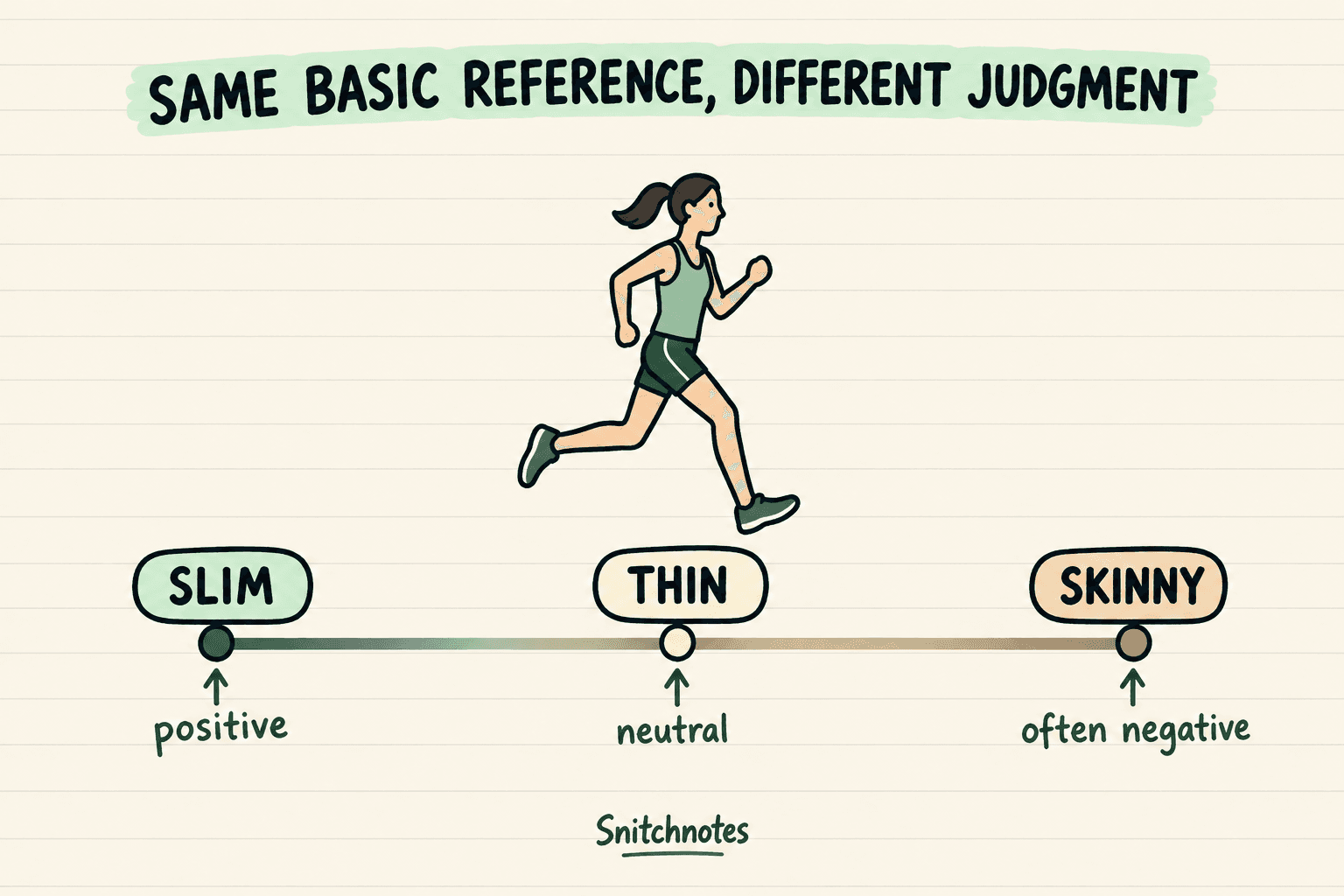
Imagine the same runner crossing a finish line. Three reporters describe her as slim, thin, or skinny. All three words can point to a relatively slight body shape, so their denotations overlap. Yet they do not position the reader in quite the same way.
Slim often sounds approving and may suggest an attractively lean build. Thin is more neutral in many contexts, although tone can still make it positive or negative. Skinny often sounds critical and may imply that the person is too thin. The physical person has not changed; the writer's framing has.
Compare the sentences: “The slim runner stepped onto the track,” “The thin runner stepped onto the track,” and “The skinny runner stepped onto the track.” A reader may picture roughly the same body in each sentence, but the first can sound admiring, the second observational, and the third unkind. This is why a thesaurus cannot choose the final word for you: near-synonyms may share a denotational core while carrying different connotations.
How connotation changes a sentence
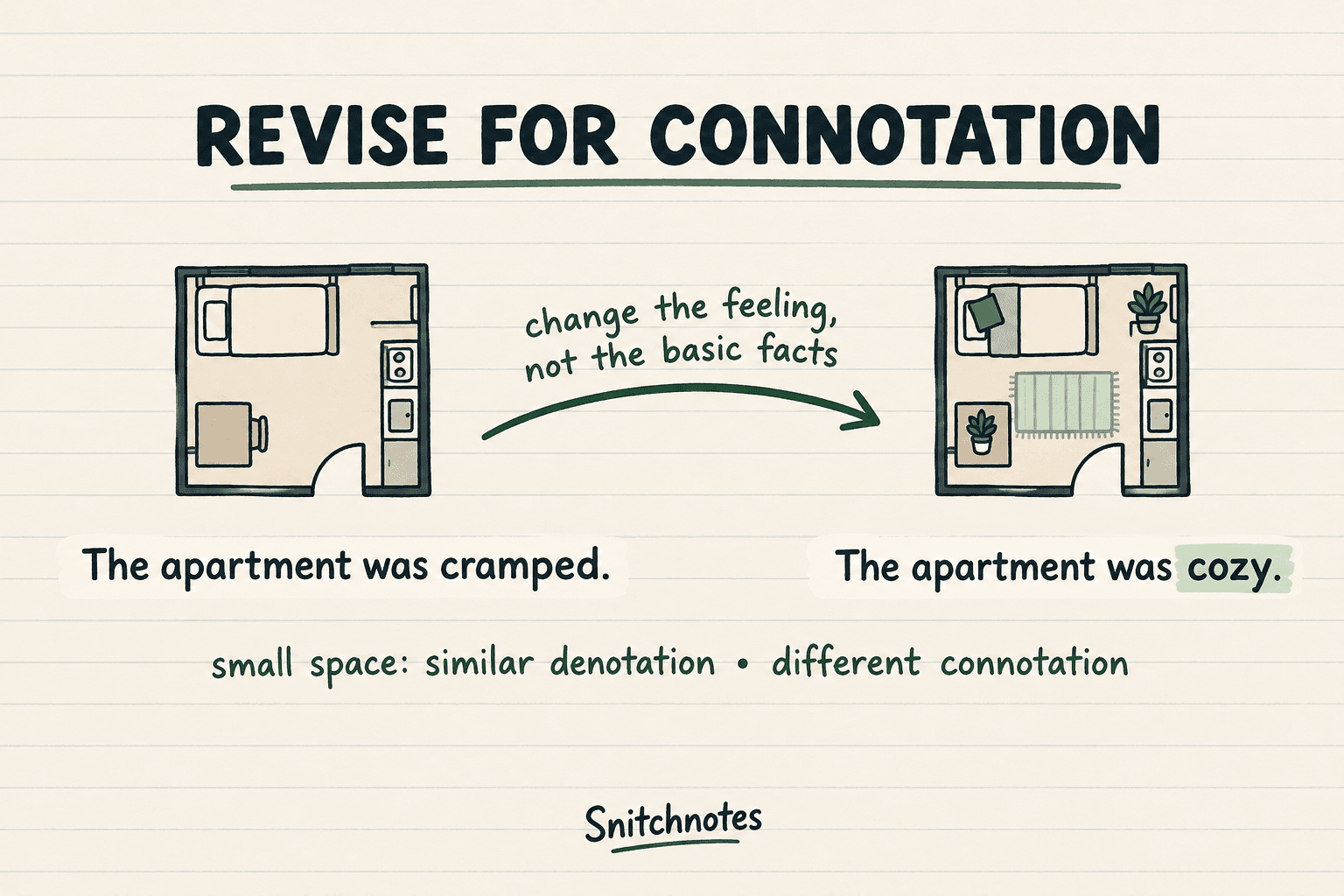
Writers use connotation to create tone and guide interpretation. Calling a room cozy emphasizes comfort; calling it cramped emphasizes discomfort. Calling a plan bold can express admiration, while calling the same plan reckless questions the decision-maker's judgment. The literal situation may be similar, but the evaluative angle changes.
When revising, underline the word that carries the judgment and test a near-synonym. Ask whether the replacement changes only precision, or also changes warmth, formality, intensity, or approval. For a neutral report, prefer wording whose associations do not quietly argue more than the evidence supports. For fiction or persuasion, select the association deliberately rather than accidentally.
How to identify denotation and connotation
- Read the whole sentence. Connotation depends on context, so do not judge the isolated word first.
- State the direct meaning. Replace the word with a plain definition that fits this use.
- Notice the emotional or cultural associations. Does the word sound approving, critical, affectionate, formal, frightening, or dismissive?
- Compare a near-synonym. If the facts stay similar but the tone changes, you have found a connotative difference.
- Explain the effect. Connect the word choice to the reader's likely view of the person, object, or event.
A strong literary-analysis sentence names both layers: “The word thrifty denotes careful spending, but its approving connotation presents the character as sensible rather than stingy.” That is more useful than writing only that the word has “good connotations,” because it identifies the exact judgment created.
Common misconceptions and boundaries
Connotation is not simply a hidden second dictionary definition. It is an association that develops through usage, experience, culture, genre, and context. Different readers may not share every association. A word can also change connotation over time or sound different in another community.
Denotation is not always one fixed meaning, either. Many words are polysemous: they have several established senses, and context selects the relevant one. The task is first to identify the direct sense used in the sentence, then examine the associations surrounding that use. Positive, neutral, and negative are helpful starting labels, but precise analysis should name the actual quality—such as affectionate, clinical, contemptuous, or nostalgic.
Check your understanding
What is the denotation of “cozy” in “a cozy room”?
It directly describes a small, comfortable, or warm-feeling room. Its common positive connotation adds a sense of welcome and comfort.
Which sounds more approving: determined or stubborn?
Determined usually sounds more approving because it suggests purposeful persistence. Stubborn often sounds critical because it suggests an unwillingness to change, even when change may be sensible. Context can still alter either effect.
Why can two synonyms create different tones?
Their denotations may overlap while their connotations differ. One word can carry warmer, harsher, more formal, or more culturally specific associations than another.
If subtle word choices disappear inside long reading notes, Snitchnotes can turn your own lectures, slides, and texts into organized notes, flashcards, and quizzes for closer review.
Related concepts
- Diction: a writer's choice of words and the effects those choices create.
- Tone: the attitude a text expresses toward its subject or audience.
- Semantic change: the way a word's meanings and associations shift over time.
- Why languages lose grammatical gender: a related guide to how language systems change.
- How to review a marked essay before your next assignment: apply word-choice feedback in revision.
Sources
OpenStax Writing Guide: Glance at Genre—Criteria, Evidence, Evaluation
Purdue University Online Writing Lab: Diction Introduction
Mt. San Antonio College Writing Center: Connotation vs. Denotation
Turn your lectures into exam-ready materials.
Notes, quizzes, podcasts, flashcards, and chat — from one upload.
Try your first note free