

Snitchnotes Team
What Is Asymmetric Information? A Simple Explanation
What Is Asymmetric Information? A Simple Explanation
Asymmetric information exists when one side of a transaction knows something important that the other side does not. A seller may know that a used car has an unreliable engine while the buyer can only judge its paint, mileage, and test drive. The information is not merely different; it is uneven in a way that can change the price, the deal, or whether trade happens at all.
This simple imbalance helps explain warranties, insurance deductibles, job qualifications, credit checks, product reviews, and many other familiar parts of economic life. Economists George Akerlof, Michael Spence, and Joseph Stiglitz received the 2001 economics prize for showing how markets behave when information is unevenly distributed.
The basic idea
Many textbook models begin by assuming that buyers and sellers know the relevant facts. Real markets are messier. A borrower knows more than a bank about how carefully they intend to repay a loan. A job applicant knows more than an employer about their actual ability. A patient knows more about their habits and symptoms than an insurer does. In each case, one party must make a decision with incomplete information about the other.
The problem is not simply that nobody knows everything. It matters that the missing information is held by someone whose interests may differ from yours. If both buyer and seller are equally uncertain about tomorrow's weather, that is uncertainty. If the seller already knows the roof leaks but the buyer does not, that is asymmetric information.
The used-car example
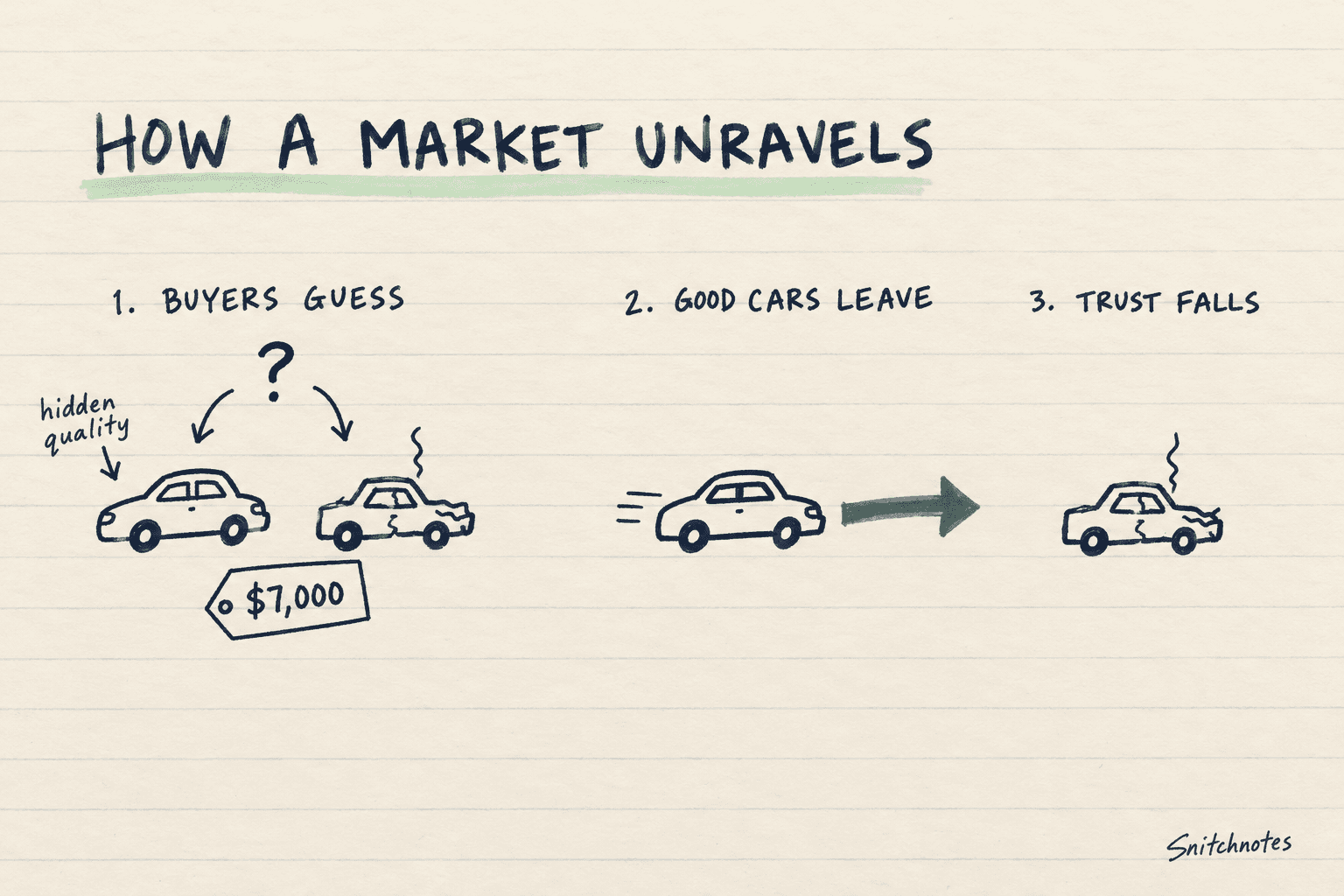
George Akerlof's famous “market for lemons” model begins with used cars of different quality. Owners know whether their own cars are dependable or defective. Buyers cannot easily tell the difference before purchase, so they are reluctant to pay the full value of a genuinely good car.
Imagine good cars are worth $10,000 to buyers, while defective cars are worth only $4,000. If buyers cannot distinguish them, they might offer an average price of $7,000. Owners of good cars will refuse because $7,000 is too low. Once those good cars leave the market, the average quality falls, so buyers lower their offers again. The market can shrink until mostly low-quality cars remain—or, in the extreme version of the model, trade can collapse.
That result feels strange at first. Nobody banned the good cars, and plenty of buyers would like them. The market performs badly because buyers cannot verify quality before agreeing on a price. Good products are punished by the suspicion created by bad ones.
Two problems caused by hidden information
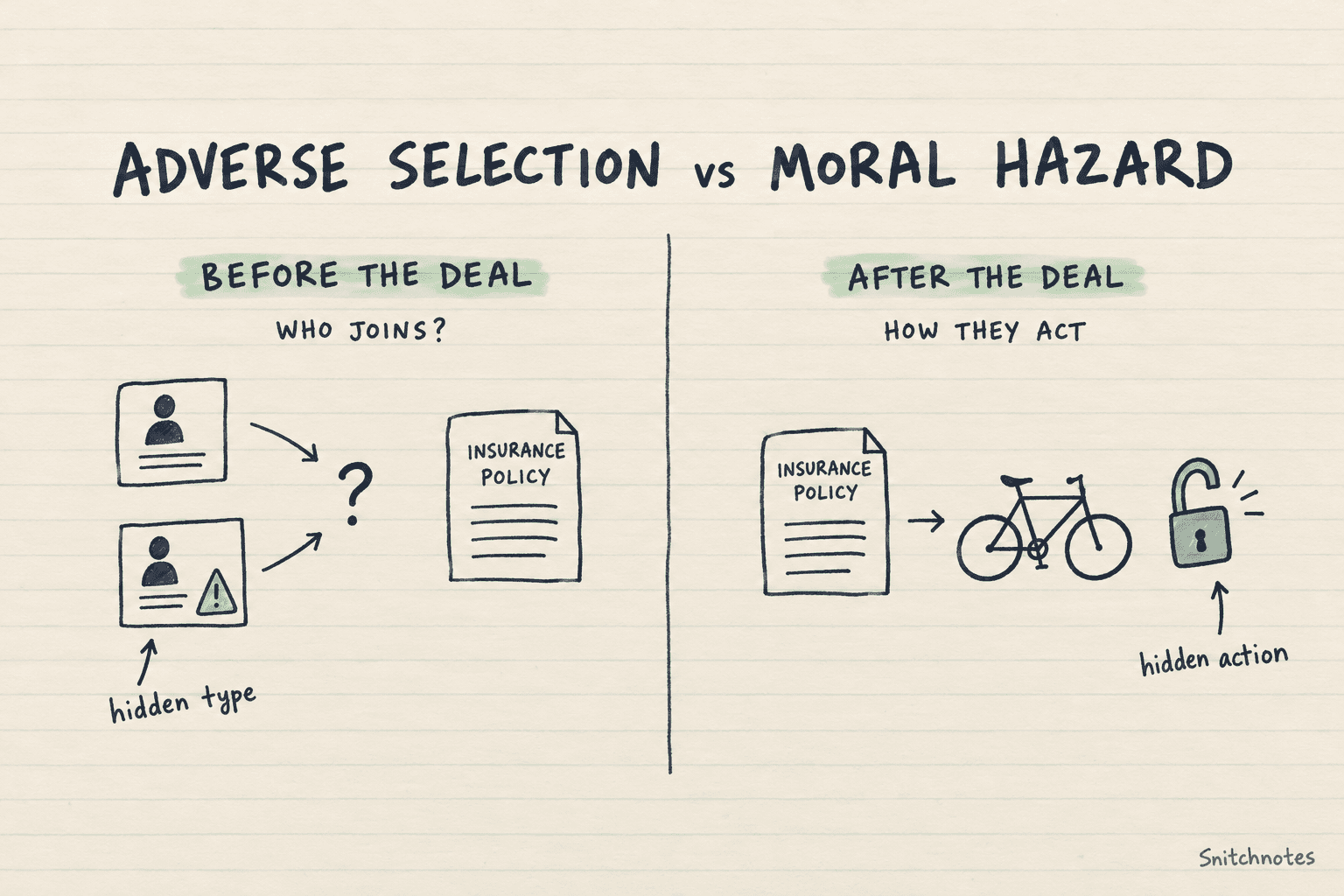
Adverse selection happens before the deal
Adverse selection means the people or products most likely to create a bad outcome are also more likely to accept the deal. If an insurer charges one price because it cannot observe each customer's risk, high-risk customers may find the policy especially attractive while low-risk customers leave. The pool then becomes riskier than the insurer expected. In the car example, low-quality cars remain while good cars disappear.
Moral hazard happens after the deal
Moral hazard appears when a contract changes someone's incentives after an agreement is made, while their actions are difficult for the other side to observe. A fully insured person may take less care to avoid a loss; a borrower may choose a riskier project because the lender bears much of the downside. The term does not mean the person is immoral. It describes how hidden action and shifted incentives can change behavior.
How markets respond
Markets do not simply surrender to the problem. They create institutions that make hidden information easier to reveal, verify, or manage.
- Warranties and return policies make it more costly for sellers to offer poor-quality products, so they can signal confidence in quality.
- Independent inspections, audits, reviews, and certifications give the less-informed side evidence it could not produce alone.
- Screening lets the less-informed side offer choices that reveal useful information. An insurer might offer a lower premium with a higher deductible, for example.
- Signals are observable actions that would be harder or more expensive for a low-quality seller, worker, or firm to imitate.
- Collateral and co-payments keep some risk with the informed party, reducing incentives to take hidden risks after the agreement.
These responses are imperfect and sometimes expensive. A warranty needs enforcement, a certification can be weak, and a signal may look impressive without proving real quality. The useful question is not “has the information gap vanished?” but “does this mechanism make the gap smaller or less damaging?”
A common misconception
Asymmetric information does not automatically mean fraud. The better-informed person may tell the truth, and the worse-informed person may understand that a gap exists. The economic problem remains because claims can be difficult to verify. A careful seller of a good car may be completely honest, yet a cautious buyer still cannot know whether that seller is different from someone hiding a defect.
Check your understanding
A restaurant knows its kitchen hygiene better than diners do. What reduces the information gap?
Visible inspection grades, credible reviews, and repeat-customer reputation all help. They turn information that was hidden inside the restaurant into evidence diners can use.
Why might raising a loan's interest rate attract riskier borrowers?
Safer borrowers may decide the loan is too expensive, while borrowers planning high-risk, high-return projects may still accept it. The lender can end up with a riskier applicant pool—the logic of adverse selection.
If you are learning this from a lecture or textbook, Snitchnotes can turn your own material into notes, flashcards, and practice questions—but the key idea to remember is simpler: when one side knows more, markets change their rules to compensate.
Related concepts
- Adverse selection: hidden information changes who or what enters a deal.
- Moral hazard: hidden actions and shifted incentives change behavior after a deal.
- Signaling: the informed side takes an observable action to communicate quality.
- Screening: the less-informed side designs choices or tests that reveal information.
- Principal–agent problem: one person acts for another, but their information and incentives do not fully align.
Sources
Nobel Prize: Markets with Asymmetric Information—popular information for the 2001 economics prize
George A. Akerlof: Writing “The Market for ‘Lemons’”
Federal Reserve Board: Financial Instability and Monetary Policy
Trasforma le tue lezioni in materiale pronto per l'esame.
Appunti, quiz, podcast, flashcard e chat — da un solo upload.
Prova il primo appunto gratis