
Snitchnotes Team
How to Analyze an Unreliable Narrator With a Claim-Evidence Table
How to Analyze an Unreliable Narrator With a Claim-Evidence Table
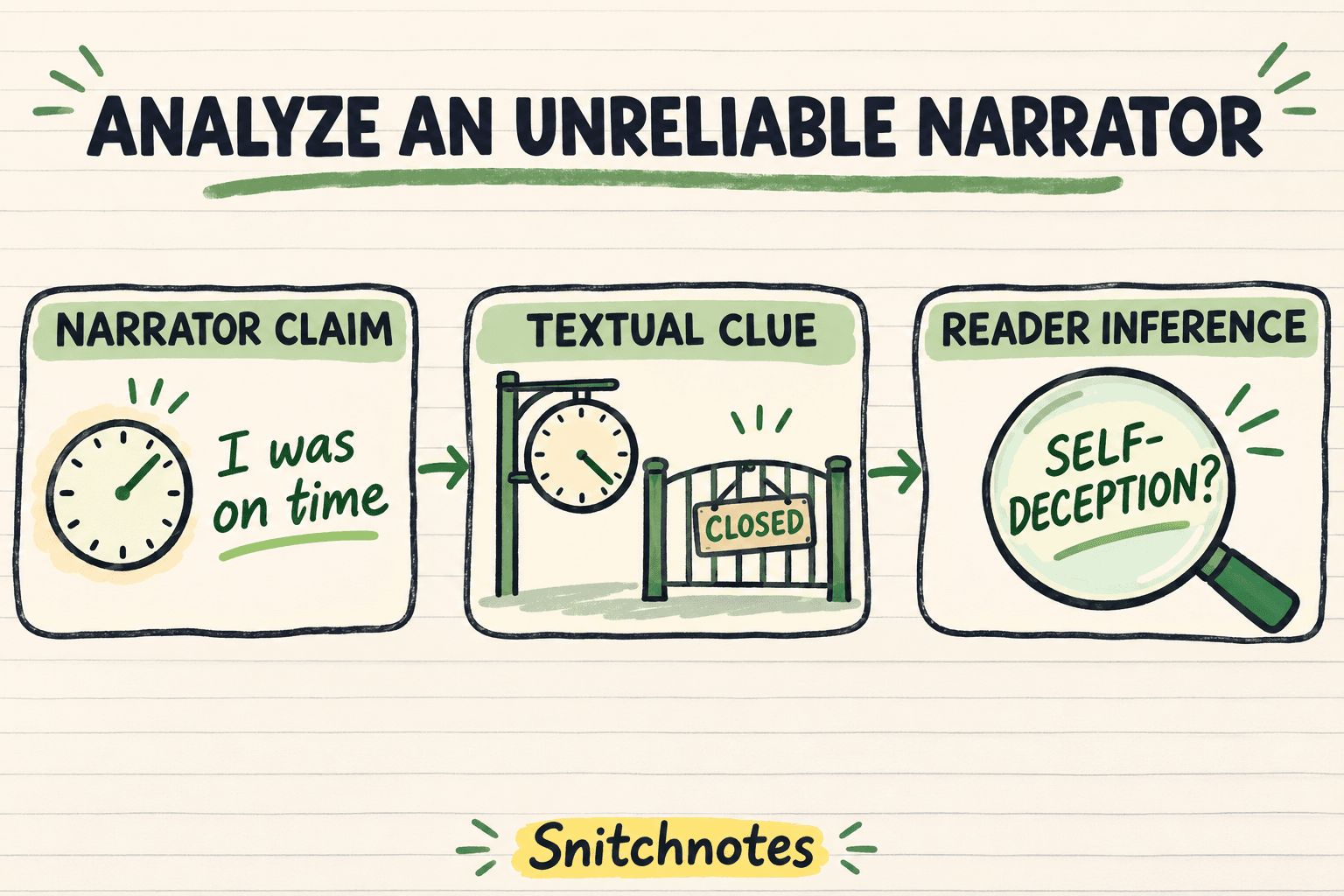
To analyze an unreliable narrator, separate what the narrator claims from what the text independently shows. Put each important claim beside contradictory details, omissions, other characters' accounts, or patterns in the narrator's language. Then write the narrowest inference those clues support. A claim-evidence-inference table makes that reasoning visible and gives you material for a literature paragraph.
An unreliable narrator is not simply a narrator you dislike. The voice becomes unreliable when its reporting, interpretation, or judgment cannot be accepted at face value. The interesting question is not only whether the account is wrong, but how the gap between account and evidence reveals limited knowledge, bias, self-deception, or deliberate concealment.
Why the evidence gap matters
Unreliable narration asks you to read on two levels at once. You follow the story the narrator tells, while also reconstructing a second version from details the narrator overlooks or explains badly. That distance can create irony, suspense, sympathy, or a psychological portrait that the narrator does not recognize.
This is why an essay should do more than label a voice unreliable. A stronger analysis identifies the exact mismatch, explains its likely cause, and connects the mismatch to the work's larger effect. Your evidence must carry the argument; the label alone proves very little.
Build a claim-evidence-inference table
- Copy the narrator's claim precisely. Record what the voice says happened, why it happened, or how another person should be judged. Keep this column descriptive rather than argumentative.
- Collect textual clues that test the claim. Look for factual contradictions, missing information, later outcomes, other characters' responses, repeated excuses, exaggerated certainty, and a gap between description and evaluation.
- Write a cautious reader inference. Explain what the evidence suggests about the narrator's knowledge, motives, values, or self-understanding. Use language such as suggests, implies, or makes it likely unless the text proves intent directly.
- Add a purpose note. Ask what the author achieves by making the reader work across the gap: dramatic irony, delayed revelation, moral discomfort, intimacy, or a more complicated view of memory.
One suspicious sentence is rarely enough. Build rows across a chapter or scene, then look for a pattern. Three related clues usually support a sturdier paragraph than ten quotations that you have not interpreted.
Name the kind of unreliability
A narrator can misreport facts, misinterpret what those facts mean, or misevaluate people and actions. These failures can overlap. Someone may accurately describe a friend's silence yet wrongly interpret it as admiration, then evaluate the friend as loyal on that mistaken basis.
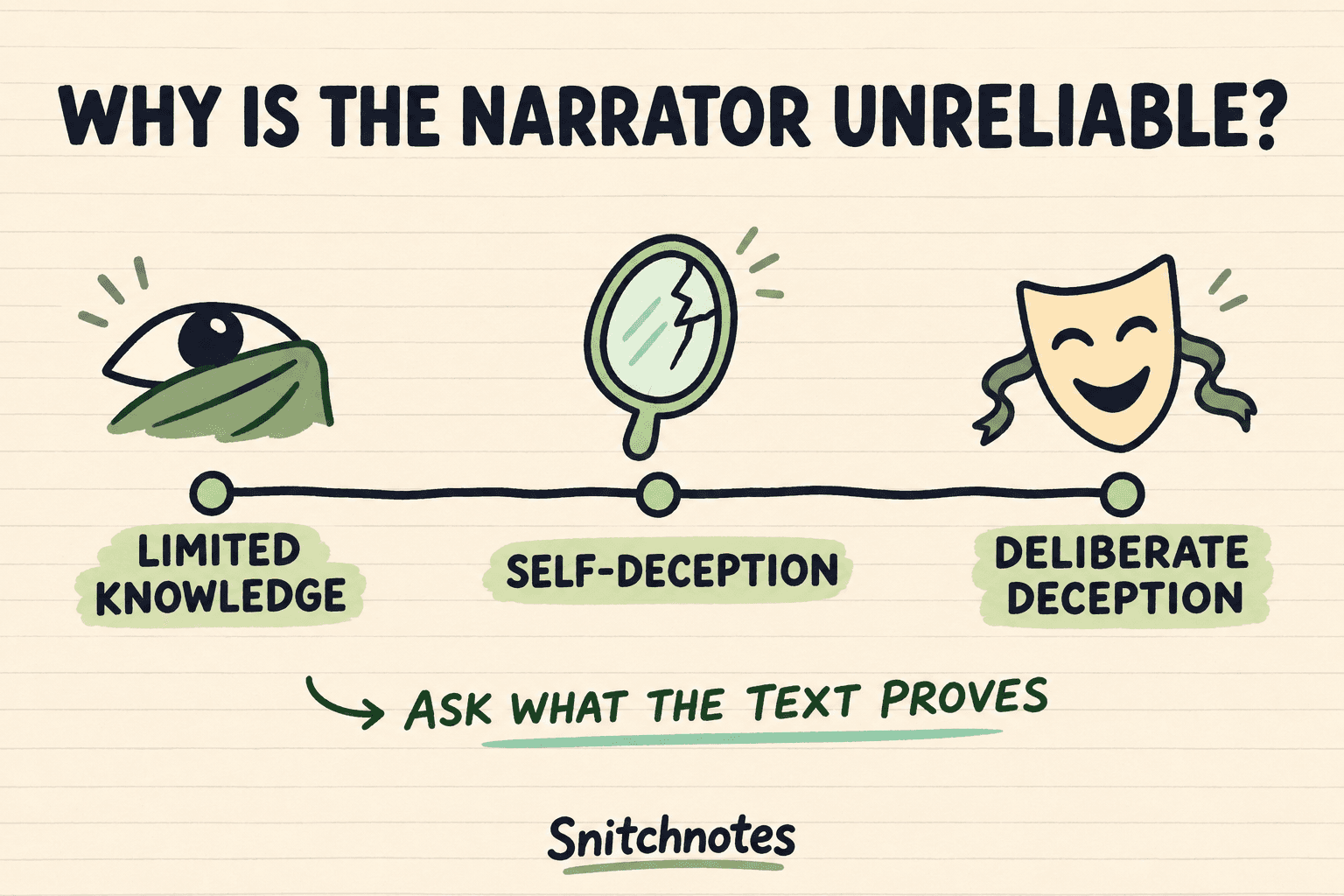
Cause also matters. Limited knowledge makes a narrator fallible without making them dishonest. Self-deception lets a character preserve a flattering identity by reshaping awkward evidence. Deliberate deception involves withholding or distorting information to mislead. Do not jump to the most dramatic explanation; ask which one best fits the textual pattern.
Worked example: Mara at the station
Mara told the story before anyone asked. She had arrived on time, she said, exactly as planned. The station clock was unreliable; everyone knew that. It showed 7:18, but her phone had just died, so there was no fair way to check. The iron gate to Platform 4 was already locked. Mara remembered a guard pulling it shut as she approached, though she could not describe his uniform. She waved the detail away and said the train must have left early. On the bench beside her, Leo's message still glowed on the tablet she had borrowed: You missed it. I waited until 7:15. Mara turned the screen facedown. She explained that Leo always exaggerated when he was annoyed. Then she described herself standing beneath the clock, calm and punctual, while everyone else created confusion around her. When her sister asked why her shoes were wet, Mara looked at the rain outside and said she had taken a shortcut. She did not mention the coffee receipt in her pocket, stamped 7:11 from a café six streets away.
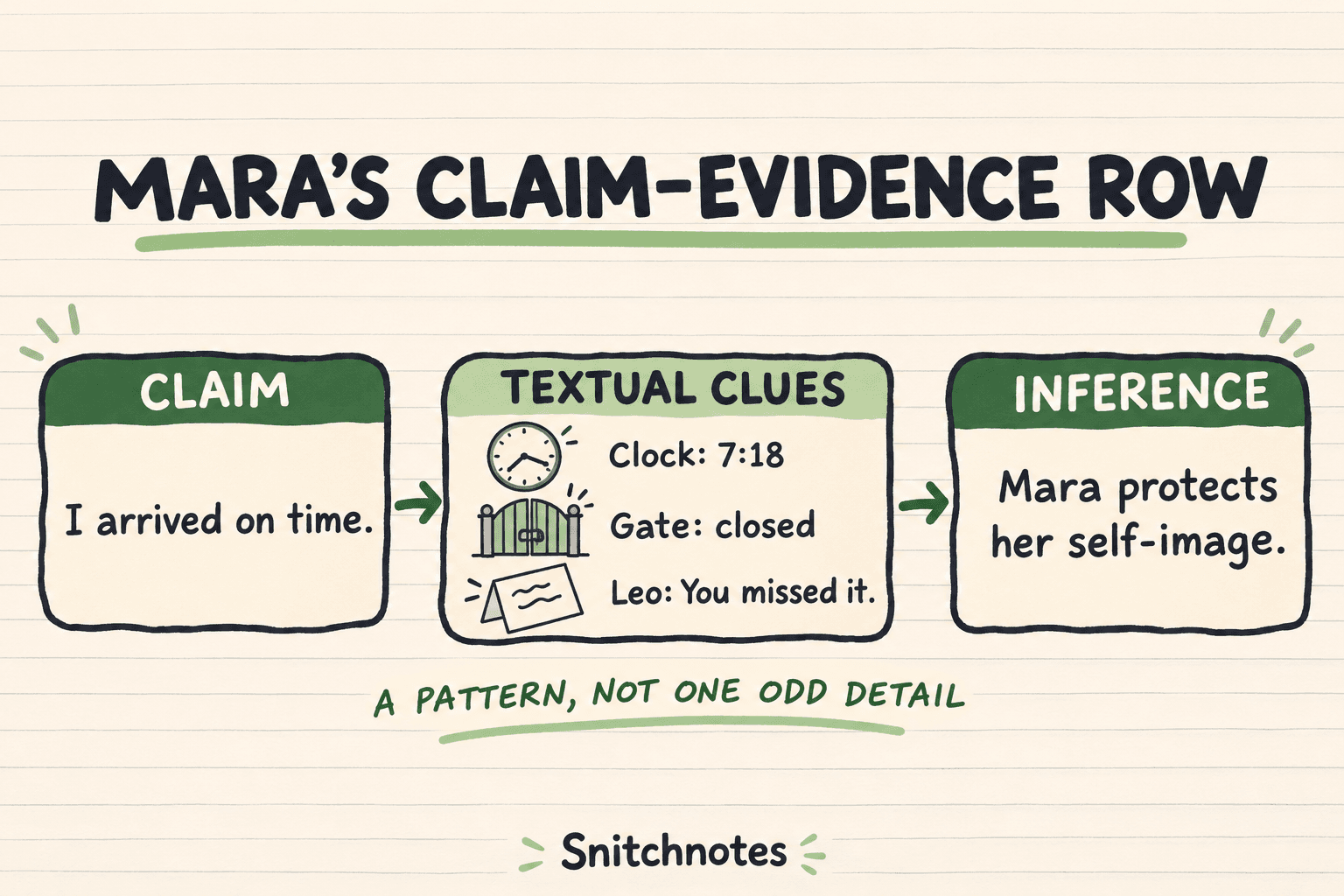
Start the row with Mara's claim: she arrived on time and the train left early. The evidence column holds the 7:18 station clock, the locked gate, Leo's 7:15 message, wet shoes from a shortcut, and the 7:11 café receipt. Any single clue might be explained away. Together they form a pattern that contradicts her version.
A defensible inference is that Mara reshapes the memory to protect her image as a punctual, composed person. The scene does not prove that every detail is a conscious lie, so calling her a calculating deceiver would outrun the evidence. Her immediate excuses and idealized self-description fit self-deception more closely.
Turn the row into an analytical paragraph
Mara's insistence that she arrived on time becomes unreliable because the scene repeatedly places checkable details against her account. The 7:18 clock, Leo's message, and the 7:11 receipt all make punctual arrival implausible, while Mara dismisses each clue without testing it. This pattern suggests self-deception rather than simple forgetfulness: she protects a preferred picture of herself as calm and responsible. By letting readers assemble the contradiction before Mara can admit it, the narration creates irony and exposes the emotional purpose of her story.
Avoid the common overreach
First-person narration is subjective, but subjectivity alone does not make a narrator unreliable. A narrator can have incomplete access and still report that limitation honestly. Conversely, a voice may report events accurately while interpreting motives or judging behavior in a way the wider text undermines.
Do not treat disagreement as automatic proof, and do not diagnose a narrator with a medical condition unless the work clearly supports that reading. Prefer a precise sentence such as the narrator's evaluation conflicts with the outcome over a sweeping claim such as nothing they say can be trusted. Reliability can change by topic and across the story.
Check your understanding
What belongs in the evidence column?
Use details the text gives you, not your guess about the narrator: contradictions, timestamps, objects, later outcomes, other voices, omissions, and repeated language patterns. Record enough context to explain why each clue tests the claim.
Why is one contradiction often insufficient?
A single inconsistency may be a memory slip, ambiguity, or authorial error. A recurring pattern across independent clues makes unreliability a stronger interpretation and helps you distinguish its likely cause.
How do you keep an inference defensible?
Make the claim no broader than the evidence. Name what is unreliable, cite the pattern, acknowledge plausible limits, and avoid asserting conscious intent when the text only shows error or self-protection.
If your close-reading notes are scattered across a novel, lecture slides, and seminar handouts, Snitchnotes can turn your own material into organized notes, flashcards, and quizzes for reviewing the evidence behind your interpretation.
Related concepts
- Dramatic irony: the reader understands a gap that a character or narrator does not.
- Denotation vs connotation: differences and examples
- How to study intertextuality with a connection map
Sources
Oregon State University, What Is an Unreliable Narrator?
The Living Handbook of Narratology, Unreliability
Purdue Online Writing Lab, Close Reading a Text and Avoiding Pitfalls
University of North Carolina Writing Center, Literature (Fiction)
Turn your lectures into exam-ready materials.
Notes, quizzes, podcasts, flashcards, and chat — from one upload.
Try your first note free